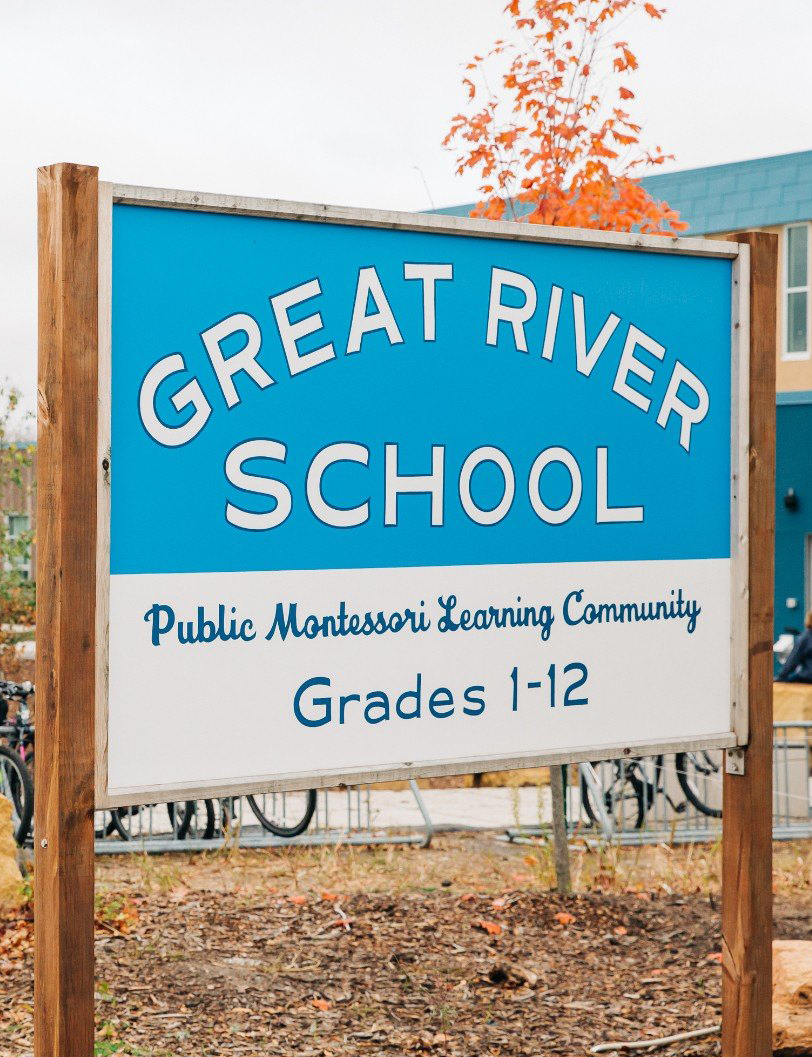
 Two years after voting to form a union with Education Minnesota, the teachers, support staff and other frontline workers of Great River School in St. Paul entered the 2023-24 school year with a first union contract in place.
Representatives of the Great River School Union and the charter school district drafted the agreement in bargaining over the course of about 18 months.
GRSU spokesperson Abby Mesnik, a high school math teacher, said the contract delivers on many objectives Great River employees had in mind when they sought a union election in May 2021, including pay transparency and greater stability in their benefits and work rules.
“People wanted some things in writing,” Mesnik said, noting that Great River was on the cusp of a leadership change during the union drive. “It wasn’t that they were necessarily unhappy with the current practices, but they wanted it preserved, and they wanted some consistency in what working in the school looked like. And I think the contract does that.”
Mesnik credited school administrators for taking a collaborative approach to negotiations. The district even brought in its own pro-union consultant to better understand the process and its staff members’ perspectives.
“We brought a draft of the contract that was very pro-union, and we just negotiated from that draft,” Mesnik said. “They never brought us their own version that we would try to reach a middle on; we would just make edits to ours.”
The contract covers about 120 employees at the Montessori charter school, which serves students in grades 1 through 12. GRSU is a “wall-to-wall” union, meaning teachers are in the same bargaining unit as support staff and even student workers, potentially.
That created a bargaining dynamic that’s unique in public education.
“We could not be separated in bargaining for funds,” Mesnik said. “We’re not just trying to move teachers up or just trying to move support staff up. We all rise together.”
The new contract puts every position covered by the unit into one of three pay scales, ensuring greater transparency and equity, Mesnik added.
“Now we can clearly track down what step and what lane people are on, what salary scale goes with which position,” she said. “Previously, there were not clear raises for folks. Some people were getting 5%, some were getting 2%, some knew to go talk to their boss and ask for a certain amount. Now there’s clarity.”
Other highlights of the contract include new incentives for advanced training in some positions, language around paid-time-off rollover, and a new independent retirement savings benefit, with an employer match after one year.
The contract also spells out for the first time what constitutes a working day and how many working days there are in Great River’s school year.
GRSU is one of five charter school unions in Minnesota. Teachers at the Twin Cities German Immersion School in St. Paul formed the state’s first charter school union in 2014.
Charter schools are publicly funded but exempt from some state laws in order to increase flexibility, autonomy and innovation. Minnesota is considered the birthplace of charter schools, having passed a first-in-the-nation law establishing their framework in 1991. Now, 180 charter schools serve about 76,000 pre-kindergarten through 12th-grade students statewide.
Mesnik said she and other GRSU activists often get asked by fellow union educators what it’s like to bargain a contract from scratch.
“I tell them it takes a lot of effort from a lot of people,” she said. “But it’s really exciting to join the labor movement and take power back as workers. We have a lot of power collectively, and it’s really cool to be on the other side with a contract and be able to say that these things are enforceable.”
– Michael Moore, Union Advocate editor
 Union Advocate