U of M workers launch organizing drive: ‘If ever there was a time, it is now’

Michael Wilson, who works on grants and contracts in the School of Public Health, speaks during the launch of SEIU Local 284’s organizing drive. (SEIU photo)

The surge in union organizing on college campuses in Minnesota shows no sign of waning, as Service Employees (SEIU) Local 284 announced last month that the union had launched a campaign to bring together nearly 3,000 workers across five University of Minnesota campuses.

The bargaining unit would cover workers in four departments: information technology, marketing and communications, student-services, and grants and contracts.

Union leaders and worker-organizers announced the organizing push Sept. 9 on the Northrup Auditorium steps in Minneapolis. A union contract, they said, would provide workers with greater certainty at an uncertain time for higher-ed institutions like the U.

“We’ve all seen what the last six months have been like for workers across all industries – higher-education workers specifically,” Local 284 Executive Director Kelly Gibbons said, adding that “the very existence of higher ed” has come under attack.

“If there was ever a time to come together in a union, it is now,” she added.

Since taking office, President Donald Trump’s administration has sought to bully colleges and universities with executive orders, legal threats and funding clawbacks.

U of M grants and contracts professional Michael Wilson, whose work supports research in the School of Public Health, said the federal funding landscape has experienced “a level of disruption unseen by any of my colleagues, young and old.”

Wilson and other U of M workers at the kickoff rally said they believe collective bargaining will put them in a stronger position to weather the radical changes in higher ed, as well as challenges unique to their departments.

“There are real people like me who are doing quality labor … and we are passionate about recreating the stability that (we) deserve and our entire society deserves,” Wilson said. “And we know that collectively bargaining a union contract will help provide clarity, transparency and stability long term.”

Workers said they will organize around four goals for their first contract: workplace democracy, career security, healthy workplaces and closing the salary gap with U of M’s administrators.

Those pay gaps persist, Labor Education staff member Amie Stager said, despite announcements of layoffs and budget cuts across the system.

“My job and the jobs of all my colleagues deserve to be good union jobs,” Stager added. “We all deserve dignity and respect in our workplace.”

More U of M jobs are becoming union jobs thanks, in part, to reforms passed by labor-endorsed state lawmakers in 2024 that extended bargaining rights to more university employees and allowed for smaller, more targeted bargaining units, making it easier to organize.

Some 1,000 resident physicians at the U’s flagship hospital formed a union earlier this year, and graduate student workers ratified their first union contract last winter. Other local schools, including Macalester College and Augsburg University, have seen successful union drives in recent years too.

Mitchel Kruchten recently gave up a union job at the U to take on more responsibility in the IT department – and explained why he regrets the move during the kickoff rally last month.

After clashing with a manager who made “comments about my character that I felt were deeply unprofessional,” Kruchten received a poor performance review. Later, the same boss mocked Kruchten’s request for time off as a “vacation” when he was, in fact, about to undergo surgery.

“I saw similar patterns with my colleagues, all talented people who came here with a desire to make the university a better place, but all left due to bullying and toxic behavior from a senior leader,” he said. “This is why a union is so important. If I had remained in AFSCME, I would have been entitled to a fair review and representation.”

Local 284 represents 10,000 support staff in K-12 schools across Minnesota, as well as adjunct faculty members at colleges and universities in the metro.

– Michael Moore, UA editor

Unions to stay vigilant at Capitol: ‘What we’ve got can go away in a vote’s notice’

Minnesota AFL-CIO President Bernie Burnham spoke at a rally outside a business lobby event on the opening day of the 2024 legislative session.

Minnesota’s unions will approach the 2024 state legislative session looking to expand on – and defend – the historic package of labor standards and public investments passed by DFL lawmakers last year.

Legislators returned to St. Paul on Feb. 12. Before their deadline to adjourn May 20, they are sure to hear from union members pressing for action on a range of issues, including infrastructure investments, pension adjustments, protections for health care and railroad workers and more.

Of course, union members and their allies won’t be the only voices lawmakers hear from at the Capitol this spring. On Day 1 of the new session, the Minnesota Chamber of Commerce hosted a reception with legislators at River Centre in downtown St. Paul. The event’s theme was “Restore the Balance.”

To union members like Jake Anderson, a special education teacher in the St. Paul Public Schools, that sounded like going backwards – “and we are not going backwards,” he said at a rally outside the event.

“We won a lot of things last time around,” Anderson, a member of the St. Paul Federation of Educators, said. “Our kids get free school lunch. We get unemployment for our paraeducators. But it’s not enough, it’s just the beginning.”

Kelly Gibbons, executive director of Service Employees (SEIU) Local 284, said 18,000 education support professionals accessed unemployment insurance last summer, after legislation passed to make hourly school employees eligible for the benefit. She said union members have told her that “unemployment insurance has changed their lives.”

“They’re going to talk about going back to the system that was rigged against us, the workers,” Gibbons said of the Chamber. “They want it to go back in their favor, and we’re here to say absolutely not.”

The state’s largest labor federation, the Minnesota AFL-CIO, last month identified its top priorities for the session, and defending the gains made in 2023 is at the top of the list.

Minnesota AFL-CIO President Bernie Burnham said the federation developed its priorities through conversations with affiliate unions and labor leaders.

“First and foremost, we’ve got to protect the things we’ve got,” Burnham said. “We’re going to be working to make sure that paid family and medical leave and union rights – all of that and more – stay in place. What we’ve got can go away in a vote’s notice.”

Burnham said it’s an indication of just how much work lawmakers did on labor issues last year that there are few holdovers from 2023 on the federation’s list of legislative priorities.

Along with paid family leave and unemployment for school employees, union-backed measures to expand earned sick and safe time benefits, ban captive audience meetings, raise safety standards in refineries and give public-sector unions more bargaining rights all became law, not to mention historic one-time investments in public schools and infrastructure jobs.

Still, there are policy measures the state AFL-CIO will work to advance in 2024, including a crackdown on employers who misclassify their workers as independent contractors. Unions have long said the practice is alarmingly common in the nonunion construction industry, but it also applies to the gig economy, advocates say.

Unions want to see legislators put teeth into the state’s existing misclassification laws this session. When workers are misclassified, Burnham said, “they lose out on minimum wage, they lose out on benefits like workers’ comp and overtime pay.”

The federation also plans to lobby for extending unemployment insurance to workers who are on strike. Such a law would level the playing field in collective bargaining, Burnham said, noting that employers can replace striking workers, cut off their health care and stall negotiations.

“There is so much action right now among people who are fighting to do better on the job,” she said. “If they have to go on strike, how are they going to make ends meet?

“If we are going to continue in Minnesota with all the good things we got last year, why wouldn’t we go that next step further?”

– Michael Moore, Union Advocate editor

Minnesota unions praise historic legislative session

Gov. Tim Walz spoke to supporters before signing 12 budget bills into law.

In a historically productive legislative session that ended on time Monday, labor-endorsed lawmakers delivered on nearly all their campaign promises, from investments in public infrastructure and schools to expansion of family-supporting benefits, union rights and workplace protections.

Union activists and leaders were among hundreds who celebrated the session’s accomplishments today on the Capitol grounds, as Gov. Tim Walz held a signing ceremony for 12 budget bills that will fund state government for the next two years.

Walz likened the newly approved budget to the “Minnesota Miracle” of 1971, when the state drew nationwide acclaim for investing in public education.

“If this is ‘Minnesota Miracle 2.0,’ the difference between then and now is … we’re leaving no one behind,” Walz said.

Labor leaders praised Walz and DFL legislators for rising to the occasion created by a projected budget surplus that swelled to $17.5 billion – thanks, in part, to one-time federal stimulus dollars that Republicans blocked the state from allocating one year ago.

After winning all three levers of power – with support from union volunteers – during the 2022 election, DFLers invested the surplus in infrastructure projects and jobs, schools, nursing homes and targeted tax relief for working families, including an expanded child tax credit that will return up to $1,750 per child to lower-income families.

Lt. Gov. Peggy Flanagan, former director of the Minnesota Children’s Defense Fund, said the budget is “deeply rooted in equity and decades in the making.” She credited organizers and activists who have devoted years to fighting for policies that will soon become law, like earned sick and safe time and paid family leave.

“We have played the long game,” Flanagan said. “And we won.”

Children and families will also benefit from $2.26 billion in new funding for Minnesota’s public schools over the next biennium. The 10.5% increase will help school districts cover rising costs – and recruit and retain educators and other employees. And the budget allocates $600 million to hire and retain child care teachers.

Walz and DFL lawmakers focused on issues that matter to workers and families, Minnesota AFL-CIO President Bernie Burnham said, noting that their work stands in contrast to Republican-controlled chambers in other states that have sought to ban abortion, weaken child-labor laws and meddle in school curriculum.

“While other states are putting 14- and 15-year-olds to work on assembly lines, Minnesota is making sure parents have the time and resources to care for and sustain their families; while other states ban books in our schools and libraries, Minnesota is making sure no student goes hungry at school; and while other states make it harder to vote, Minnesota is expanding our Democracy to make sure every eligible voter has the freedom to make their voice heard,” Burnham said.

Walz is also expected to sign a $2.3 billion infrastructure deal that contains a mix of borrowing – a so-called “bonding” bill – and cash investments. It would be the first bonding bill the state has passed since 2020.

Sen. Sandy Pappas, the lead author, said the measure “will create thousands of well-paying union jobs and ensure businesses have the infrastructure they need to build in Minnesota for years to come.”

On the Capitol grounds today, Walz gave a shout to people in hard hats throughout the crowd. “All of these good union jobs have built the middle class and built Minnesota,” he said. “It is going to continue that way.”

In addition to historic investments approved this session, Minnesota lawmakers took up several policy changes long sought by union members, including an extension of unemployment benefits to hourly school employees, a ban on private prisons and a new Nursing Home Workforce Standards Board with the authority to set standards like pay and benefits.

Lawmakers expanded and strengthened union rights, enshrining public-sector workers’ ability to bargain on non-economic issues like safe staffing and class sizes, giving workers in the newly legalized recreational cannabis industry a path to collective bargaining and banning “captive audience meetings,” in which workers are forced to listen to their bosses’ religious, political or anti-union views.

Funds allocated this session will also bolster the state’s film industry tax credit, raise pay for home care and nursing home workers and strengthen public pensions.

A measure to address hospital staffing shortfalls, however, fell short of the Minnesota Nurses Association’s expectations. The bill established new safety protections and recruitment bonuses for health care workers, but it left out language that would have would have required hospitals to create labor-management committees to determine appropriate staffing in their wards.

Support for a safe staffing law dwindled after Mayo Clinic threatened to withhold investments in its Rochester campus if it passed.

“I hope Minnesotans know how hard nurses fought for your care and safety,” MNA President Mary Turner said. “And I hope corporate executives and our public officials know that our fight is not over to put patients before profits in our health care system.”

Union-backed coalition rallies to get paid leave across finish line

Supporters cheered Gov. Tim Walz, who spoke during a Capitol rally for paid family leave.

Union members, retirees, small business owners and faith-based organizations rallied with Gov. Tim Walz and other lawmakers at the Capitol March 21 in a bid to get paid family and medical leave legislation across the finish line this session.

“Paid family and medical leave is one of the best policies we can pursue to support Minnesota’s families and workers,” Walz said during the rally. “Let’s make it easier for Minnesota families to raise a child or care for a sick or aging relative without putting a paycheck at risk.”

Walz has pledged to sign legislation, advancing through committees in both the House and Senate, that would create a state-administered leave program. Minnesotans would be able to access the program and receive up to 12 weeks of partial wage replacement while recovering from a medical issue, caring for a family member or welcoming a new child.

The paid-leave fund would operate similar to the state’s unemployment insurance system. Employers and employees would share equally in the cost, each contributing 35 cents per $100 of earnings.

UNITE HERE member Leah Riley traveled from Rochester for the paid leave rally with her 8-year-old son, Riley Altom.

Sarah Piepenburg, co-owner of Vinaigrette in Minneapolis, was among small business owners who showed support for the bill, calling it an investment in small businesses.

“I have looked into plans available on the private market, and the best option would cost 50% more than this proposal, offer only 6 weeks off, exclude coverage for cancer and require a health screening,” she said. “In other words, the private market provides unaffordable, substandard options.”

Several labor organizations, including the Minnesota AFL-CIO, are part of a broad coalition of groups that has been fighting for statewide paid leave for nearly a decade, and union colors could be spotted throughout the rotunda during the rally.

Steve Miltich, a retired school custodian and member of the Service Employees (SEIU) Local 284 Executive Board, said many union members are among the 83% of American workers who do not receive paid family leave as a benefit of employment.

“I saw the importance of this firsthand as a union steward,” Miltich said. “Custodians I worked with, for one reason or another, had medical issues with themselves or their families – or with newborn children – and could not afford to take the time they needed.”

Even some workers with access to paid family leave said the state should do better by all workers. Ashlie Kennedy, a state employee from St. Paul, shared a wrenching story of giving birth to a child with a fatal health condition, who died within hours.

Steve Miltich (R), a retired custodian in the Orono school district, said many unionized workers would benefit from the proposed paid family and medical leave law.

“Even though I was expressly told that I met all of the eligibility requirements for paid parental leave, the Judicial Branch denied my request for paid leave stating that the unwritten intent of the policy is for parents to bond with their baby,” she said. “HR confirmed that because my child died, I no longer qualified for paid parental leave.

“Minnesotans should not have to sacrifice their livelihood and financial security in order to care for themselves and the people they love. Minnesota can do better. Minnesotans deserve better.”

After the rally, advocates fanned out across the Capitol campus, meeting with lawmakers and delivering postcards signed by supporters from their districts.

Learn more about the Minnesotans for Paid Family Leave Coalition at paidleavemn.org.

‘Bill of Rights’ would fund $25 minimum wage, health benefits for hourly school staff

Sara Rapp, a school cook on strike in Hastings, testified at the Capitol in support of the ESP Bill of Rights.

As striking food service workers in Hastings put a spotlight on hardships faced by some of the lowest-paid school employees, state lawmakers this week debated bold, new legislation to lift standards for all hourly school workers.

The “Education Support Professionals’ Bill of Rights,” introduced by DFLers in both the House and Senate, would establish a minimum wage of $25 for paraprofessionals, bus drivers, clerical workers and other hourly employees.

It would also require schools to offer affordable, year-round health coverage and to sustain hourly workers’ pay during e-learning days, among other provisions.

To cover schools’ increased costs, the measure would provide new state funding – beyond increases to the per-pupil formula – determined by a district’s ESP staffing needs.

Rep. Brad Tabke of Shakopee, lead author in the House, touted the bill as a matter of fairness for the trusted adults who work in their communities’ school systems.

“All throughout the summer (while) talking to folks, I ran into dozens and dozens of paras, janitors, bus drivers, lunch workers that are really struggling,” he told members of the House Education Finance Committee on Tuesday. “As a state we should be valuing that work.”

Senate author Alice Mann (D-Edina) said school districts need new, dedicated funding to make their hourly positions competitive with other employers.

“You can walk down the street to McDonald’s and get paid more to work there than in our schools taking care of our children, feeding our children, transporting our children and helping to educate them,” Mann said during a Senate committee hearing Tuesday.

Labor market data shows the job vacancy rate at school districts across the nation has been rising for a decade. In Minnesota, where overall workforce participation is higher than the national average, employment in school districts has dropped by 6.4% since October 2019, according to data compiled by the Economic Policy Institute’s Economic Analysis and Research Network (EARN).

“There’s a lot of reasons why this could be, but the most simple and obvious one is compensation,” EARN policy coordinator Dave Kamper said. “Workers are leaving ESP jobs for higher-paying gigs elsewhere.”

Rep. Brad Tabke holds a press conference with school employees after committee hearings on the ESP Bill of Rights.

Hourly school workers who want to continue serving students have found it increasingly difficult to make ends meet, as several ESPs – including one food service worker on strike for higher wages – testified at the Capitol.

Sara Rapp, a cook at Hastings High School, earns just $15.05 per hour in her fourth year with the district. A $10-per-hour raise, she said, “would mean we could take care of ourselves and our families with the same care and compassion we take care of our students.”

Staffing shortfalls in her district have gotten so bad, Rapp told lawmakers, that three employees recently were tasked with doing the work of eight.

“And we know it’s not just us,” said Rapp, a member of Service Employees Local 284. “Our strike shows the crisis facing school workers because of the low wages and disrespect we are facing. We need to fix this before the staffing crisis gets worse, so we can do what we do best – caring for our students.”

Carloline Long, a special-ed teacher in the Minneapolis Public Schools and member of Education Minnesota, said most hourly school employees work multiple jobs to cover rising costs. Health care costs, in particular, have risen faster than ESPs’ wages, she said.

“I believe everyone who works with children should have access to affordable health care,” Long said. “Due to the low wages, some ESPs will work all their hours in one pay period and not have anything to show for it because every dime they made went to pay for health insurance offered by their employer.”

In addition to a $25 minimum wage and affordable health care, the ESP Bill of Rights would require schools to dedicate two days of paid training to all school staff members who work with students, and to build time into special education teachers’ schedule for managing their students’ individualized education program (IEP).

Annie Gibson, a paraprofessional in the South Washington County Schools, said steps to recruit, retain and treat ESPs like the professionals they are will ultimately benefit students.

“Our children with IEPs are so much more successful when they have consistency in staffing,” Gibson said. “I take pride in building my relationships with each child, and I love being a part of a child’s growth, education, and social and emotional wellbeing.

“We need to make this a profession people seek out and stay in for a long time. This legislation would be a great start.”

School board ducks meeting after striking workers plan to show

Laurie Potthoff, a food service worker at Hastings High School, speaks during an impromptu union rally after school board members canceled their scheduled meeting.

Striking food service workers in Hastings have a lot of questions for members of the local school board, who were scheduled to have a public meeting this afternoon.

Why won’t the district come back to the bargaining table?

Why does the superintendent deserve a 6% raise when 2% is the best he can offer food service workers?

What’s changed since the height of the pandemic, when frontline staff were praised as heroes for helping deliver thousands of meals to the community?

Unfortunately for workers, the board abruptly canceled its noon meeting, avoiding a face-to-face encounter with workers like Laurie Potthoff, a high school cook who spoke during a rally outside Kennedy Elementary instead of before the board.

“We are ready to settle this strike, and we are ready to go back and feed the kids. But the board won’t meet with us,” said Potthoff, who has six years of experience with the district. “Come on, school board. Bring us back to the table.”

In bargaining, the district’s negotiators have held firm that most food service workers should accept 35- to 40-cent raises. If the district’s elected leaders share that position, they should look workers in the eye and say as much, Service Employees (SEIU) Local 284 Executive Director Kelly Gibbons said.

“I have a message for the Hastings School Board,” Gibbons said. “Shame on you. Shame on you for not coming to the table and not coming to this meeting and talking to these workers.”

Local 284 represents the 35 food service workers who have been on strike since Feb. 7.

Workers have refused to accept the district’s offer to raise their wages by 2%, with a one-time bonus. Union members want the wage scale increased by $3 per hour, and they say one-time bonuses won’t do enough to keep Hastings’ pay competitive with other districts in the area.

Starting pay for food service workers in the nearby South Washington County School District is $16.50, compared to $3.85 per hour in Hastings, where some workers with three years of experience are making just $15.05 per hour.

Hastings workers also accuse the district of inequitable treatment when it comes to ensuring a minimum number of work hours, and they are fighting to maintain affordable dental and family insurance premiums.

Striking food service workers picket outside Kennedy Elementary in Hastings.

The two sides, who had been working with a state mediator, haven’t met since Feb. 2, despite requests from the union to resume talks.

Instead of sitting down with workers, school administrators attempted last week to bully SEIU members back to work, sending out letters that warned they would lose their health care benefits and citing “End of Employment” as the reason.

It is illegal to fire striking workers under Minnesota public sector labor law. Members who have paid into their health insurance should have access to their benefits through the end of the month, Local 284 Executive Director Kelly Gibbons said.

“The district should be coming to the table to find a fair deal to get these incredible workers back on the job feeding Hastings students,” Gibbons added. “Instead they are sending letters that are misleading and possibly even illegal, hoping to scare our members into accepting a contract.”

Gibbons, a former school food service worker herself, said she hasn’t seen “such solidarity and commitment from a group of workers in a long time.”

The Hastings community, meanwhile, has shown striking workers overwhelming support, with multiple deliveries of food and drinks to the picket line. The feeling is mutual, according to Potthoff, who said she and her co-workers are ready to “get the warm meals back into our students’ bellies so they have the nourishment they need.”

“A frozen sandwich does not cut it,” she added.

The school board’s next scheduled public meeting is Wednesday, Feb. 22.

Hastings food service workers strike for higher wages

Striking food service workers line the sidewalk outside the entrance to Hastings Middle School on Day 1 of their strike.

About 35 school food service workers in Hastings went on strike for higher wages today, demanding more from a school district that recently increased its superintendent’s pay to over $200,000 per year.

“We feed their kids,” school cook Julie Clark said. “They should do more to help us feed ours.”

But in last-ditch talks with a state mediator Thursday, Independent School District 200 refused to put more money on the table, union leaders said on the picket line outside Hastings Middle School today.

The workers, members of Service Employees (SEIU) Local 284, are seeking wage increases of $3 per hour, but the district has refused to budge from an offer of roughly 2% per year, plus one-time bonuses.

Most workers in the bargaining unit earn between $15 and just over $18 per hour, with head cooks’ pay scale running about $7 per hour higher. Union members say one-time bonuses will do nothing to recruit and retain kitchen staff.

“I have kids ranging from 27 down to 11 years old, and my older kids make more money than I do with less required training,” said Clark, who earns $15.05 per hour after three years working in the district. “To be a cook, we’re required to take trainings and pass tests. My senior in high school is making $20 to $25 per hour.”

Hastings food service workers also accuse the district of inequitable treatment when it comes to ensuring a minimum number of work hours, and say they are fighting to maintain affordable dental and family insurance premiums.

But wages have been the biggest sticking point since negotiations began last June. Local 284’s previous, two-year contract expired June 30.

“I would prefer not to go on strike, but we haven’t seen much movement,” high school cook Sara Rapp said.

On Day 1 of the strike, union members picketed in two shifts, at the beginning and end of the school day. During the morning shift, several supporters honked their horns and waved as they drove by, and the picket line was overflowing with donated coffee and donuts.

Rapp said students at the high school were particularly supportive after workers, who voted to authorize a strike in December, publicly announced their strike date last month.

“The students have been really, really kind,” Rapp said. “I would hate to not serve them food, but at the same time they would hate to see us continue to make (the wages) we make.”

Union members said they plan to move their picket line to other school sites as the strike continues. They are asking supporters to join them on the picket line (follow the union’s Facebook page for locations) and sign onto a letter to the superintendent and school board members.

Food service workers in Hastings schools set Feb. 7 strike date

Hastings food service workers plan to strike Feb. 7. (SEIU Local 284 photo)

Food service workers today put the Hastings public school district on notice of their intent to strike Feb. 7 unless the two sides reach agreement on a new union contract before then.

“We’re united, and we’re ready to strike if the district won’t pay us what we’re worth and stop nickel-and-diming us about our working hours and snow days,” said Sara Rapp, a cook at Hastings High School and member of the union’s bargaining team.

Contract negotiations between Independent School District 200 and the 35-person bargaining unit, represented by Service Employees (SEIU) Local 284, began last June and later entered mediation. The previous, two-year contract expired June 30.

No bargaining dates are currently on the calendar between now and Feb. 7, according to Local 284.

The two sides remain far apart when it comes to wages, Local 284 contract organizer Hal Goetz said, with workers holding out for an increase roughly double what the district is offering.

Most workers in the bargaining unit earn between $15 and just over $18 per hour. A few are paid less, and head cooks’ pay scale runs about $7 per hour higher, Goetz said.

Union members also are fighting to maintain affordable dental and family insurance premiums, and for language ensuring a minimum number of work hours. A union statement said workers “have been clear that any settlement needs to include a fair wage increase to combat the impact of historic inflation and maintain stability through regular hours and health insurance benefits.”

Workers voted in December to authorize a strike, and they are asking supporters to sign onto a letter to the superintendent and school board members at seiu.mn/hastings.

Staffing crisis prompts school employees to ask for support, patience

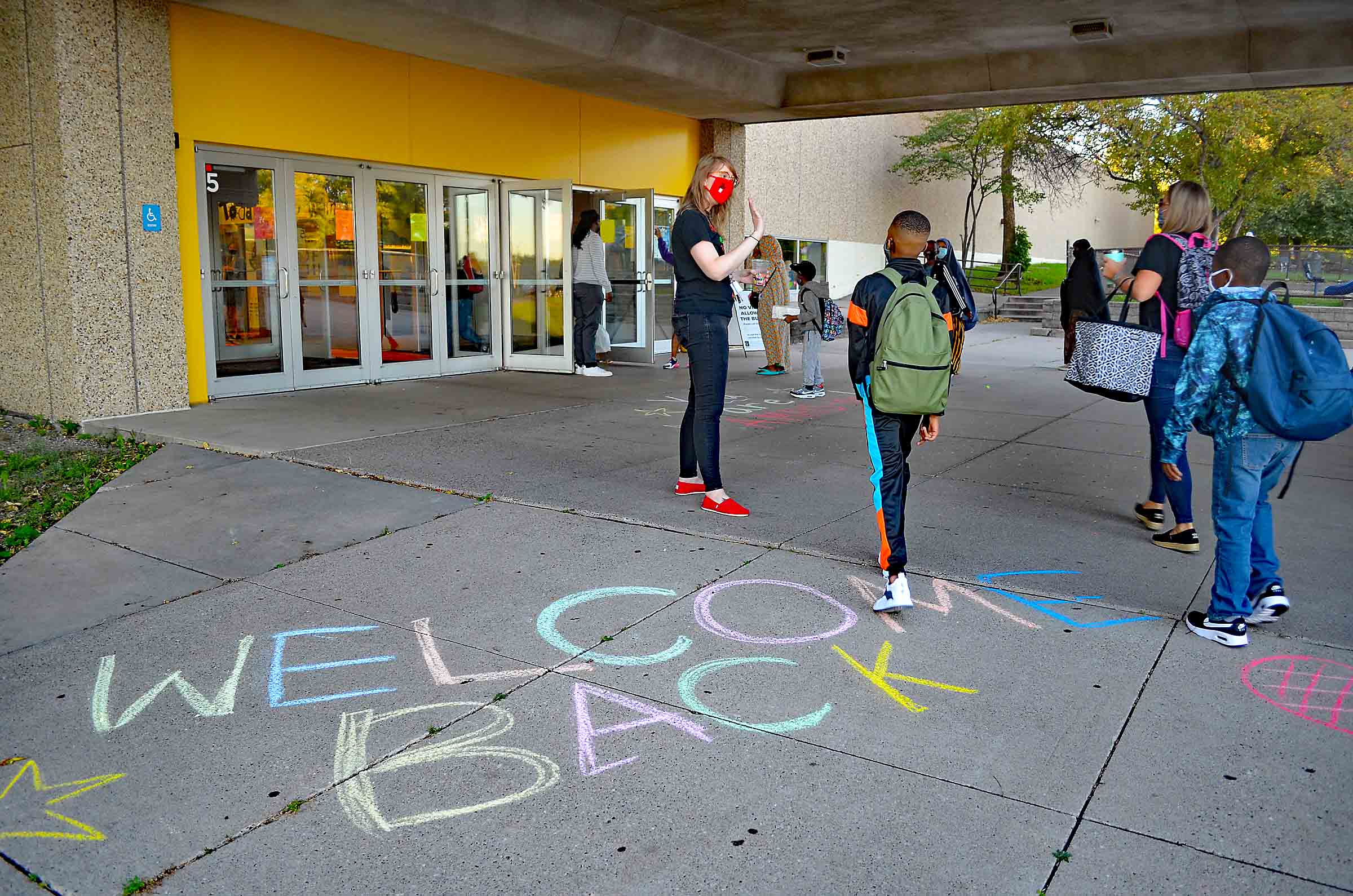
On the first day of school Benjamin E. Mays elementary school in St. Paul last year, teachers greeted returning students at with sidewalk chalk and confetti.

As public schools across Minnesota scramble to fill open positions before classes resume, union members coming back to work this fall asked families for patience, and called on school leaders to offer more incentives – financial and professional – to ease the staffing shortage.

“The working conditions in our schools have suffocated many teachers’ passion for teaching,” said Dr. Mara Borges-Gatewood, who teaches English-language learners in the White Bear Lake district. “There are just so many things being asked from us, and we can’t do them anymore.”

U.S. schools are looking to fill 300,000 positions nationwide, according to an estimate from the nation’s largest teachers’ union, the National Education Association (NEA).

It’s likely to be a rocky start to the school year for many, and Education Minnesota President Denise Specht asked for patience from parents and students.

“Take a breath and remember that the educators and staff who chose to come back this fall did so because they really care about the students and want them to succeed,” she said.

Staffing challenges hit school districts hard after the COVID-19 outbreak, but Borges-Gatewood and other school employees, speaking during a press conference today, said the issues driving workers to leave began well before the pandemic. They include unsustainable workloads, uncompetitive pay and, for hourly workers, lack of access to unemployment-insurance benefits.

Brooke Malek, a licensed school nurse in the Morris Area School District, said nurses are stretched thin across multiple school buildings, with many “leaving for better paying jobs.” Jeanne Fox, an education support professional from Osseo, said her district nickeled and dimed support staff in contract negotiations, despite piling on responsibilities – like covering for absent classroom teachers – over the last two years.

“This extra workload burnt out a lot of school support staff,” Fox said. “They’re expected to step up to the plate, but their extra effort didn’t result in more pay.”

The State of Minnesota’s projected $9.4 billion budget surplus offered lawmakers an opportunity to give school districts more funds to recruit and retain workers. But Republicans who control the Senate never took up a spending package, backed by Gov. Tim Walz and the DFL-controlled House, that would have delivered $1 billion to schools.

Lawmakers also failed to pass legislation that would extend unemployment benefits to hourly school employees in Minnesota, one of just a handful of states that bar school bus drivers, custodians, nutritional workers and others from access.

Without help from the Capitol, union members said, school districts should look for ways to collaborate with their employees to address to the staffing crisis.

Cat Briggs, a bus driver in the Rosemount-Apple Valley-Eagan district, said her union, SEIU Local 284, bargained for higher wages and a retention bonus. It also helped identify opportunities to merge part-time jobs – like crossing guard and bus monitor – into more attractive, full-time positions with benefits.

“We’re calling on every district in the state to make these jobs a career,” Briggs said. “Get all the jobs, including the starting wages, above poverty level.”

Education Minnesota’s think tank, the Educator Policy Innovation Center, released a report earlier this month analyzing firsthand accounts from educators about the challenges of working through the pandemic – and what changes are needed to keep more from leaving the profession.

Authors recommended giving educators more time to build relationships and collaborate within the school community, a greater say in school policies and more authentic opportunities for professional development.

“We can lighten loads; we can take stress off of people’s plate,” said Specht, president of the statewide educators’ union. “We can reach out to licensed staff who have chosen to walk away from teaching and ask them why, ask them what they need to come back.”

Newly unionized Chisago Lakes custodians tap community support in first contract campaign

Custodians and supporters rally in advance of a first mediation session with the Chisago Lakes schools.

If administrators in the Chisago Lakes School District thought they could push their school custodians around without anyone noticing, then the semi-truck blaring its horn outside their offices at 8 a.m. Monday was a wakeup call in more ways than one.

The custodians, who formed a union earlier this year, rallied with dozens of supporters on the day of their first scheduled mediation session with the district, which has shown little interest, workers said, in addressing their concerns about wages, workloads and turnover.

The rally drew support from educators and other school staff. The local labor community turned out too, most notably with the Teamsters Local 120 big rig making a few passes through the district’s parking lot.

Scott Carlson, a custodian with three years of experience in Chisago Lakes, said he and fellow union members have appreciated the outpouring of encouragement in recent weeks.

“In my years with the district, I’ve always been treated with respect and as an equal by the teachers, parents and staff,” Carlson said. “Unfortunately, that does not seem to resonate within the walls of our district office.”

The bargaining unit of about 20 custodians, represented by Service Employees (SEIU) Local 284, came together quickly after organizing began in January.

Carlson said conditions had reached a tipping point, with custodians in some buildings tasked with 40 percent more area-cleaning responsibilities than industry standards recommend, according to the school district’s own evaluation. And that’s without taking into account extra tasks required for pandemic safety.

Custodians’ wages start at just over $14 per hour – too low to attract and retain the workers needed to do the job right, union steward Chris Marks said. About one-third of the bargaining unit already has turned over, Carlson added, since custodians organized their union last school year.

“You can go to Kwik Trip and make more money working the second shift, just cashiering,” said Marks, the lead custodian at Chisago Lakes High School. “We want longevity. We need it to keep our students healthy, our buildings healthy.”

But in negotiations, the district has shown more interest in keeping the newly unionized custodians under management’s thumb.

In recent years, Chisago Lakes custodians’ terms and conditions of employment were governed by an agreement – but not a union contract – with the district. School administrators hand-picked two negotiators to represent custodians in drawing up the agreement.

“The human resource person representing the district told our reps what the board would or wouldn’t accept, and they abided by that,” Carlson said.

Now that custodians have a real seat at the table in collective bargaining, the district has responded by bringing in a high-priced, anti-union attorney, who did most of the talking in two sessions before the sides entered mediation, according to workers.

Custodians, Marks said, drafted a proposal for their first contract and presented it to the district at the first session.

“The attorney redlined the whole thing and put all the verbiage back from our previous agreement, including the pay scale,” Marks said. “He handed it back and said, ‘There you go, that’s our offer.’

“But they did change one thing: they took a 90-day probationary period and changed it to nine months.”

That district administrators would rather pay a lawyer to run out the clock than offer community members who maintain school facilities a living wage didn’t sit well with supporters at the rally Monday morning.

“They’re willing to pay him $250 an hour to do nothing,” Local 284 President Kelly Gibbons said. “He’s here to make his money and take it home to his family, but these folks can’t pay their bills.”

Kera Peterson, president of the St. Paul Regional Labor Federation, which represents over 50,000 union members in Chisago, Dakota, Ramsey and Washington counties, urged custodians to keep up their fight – and reminded them that union members never fight alone.

“Our labor community will be here, standing in solidarity with the custodians in Chisago Lakes Schools, for as long as it takes,” she said.