Lawmakers take up educators’ call for new insurance pool

Rep. Liz Reyer of Eagan joins members of Education Minnesota at a Capitol press conference about the Educator Group Insurance Program.

House and Senate authors of a statewide health insurance pool for school employees, one of Education Minnesota’s top priorities this session, outlined their legislation’s path forward last week.

The statewide educators’ union held a day of action at the Capitol March 18 to drum up support for the idea among lawmakers. During a press conference, Rep. Liz Reyer (D-Eagan) and Sen. Mary Kunesh (D-New Brighton) said they hoped to pass bills this session that would survey school districts about the insurance coverage they provide.

The data is necessary, Kunesh said, to calculate costs of the full proposal, known as the Educator Group Insurance Program (EGIP). Kunesh and Reyer said they are aiming for EGIP’s passage in 2027.

“This session, the goal is to vet concepts through committees,” Kunesh said during a press conference with educators at the Capitol on March 18.

Modeled after an existing program that covers State of Minnesota employees and after programs in other states, EGIP is Education Minnesota’s preferred approach to stabilizing school districts’ skyrocketing health insurance costs.

The issue has increasingly become a stumbling block for local unions in contract negotiations, as educators and other school employees are repeatedly forced to choose between absorbing big premium hikes or accepting lower wage increases.

Over 150 union members joined the day of action at the Capitol, and many carried signs bearing the exact amount by which their district’s health insurance costs have increased in recent years – 30% in Mankato, 34% in Lyle, 54% in New Ulm.

By consolidating the purchasing power of every school district into a statewide risk pool, EGIP would cut down on brokerage fees and level the playing field in negotiations with large insurers like UnitedHealthcare and Blue Cross MN, advocates say.

“Minnesota’s school districts are small buyers in a market that rewards large ones,” Education Minnesota President Monica Byron said. “Every year, hundreds of school districts negotiate alone against a multi-billion-dollar insurance industry that knows exactly how much leverage it has. Educators pay for that power imbalance in higher premiums, worse coverage and impossible choices.”

Because the risk pool in most school districts is relatively small, they often see a dramatic spike in coverage costs after an employee experiences a health crisis, Byron added. “Every school district in Minnesota is just one sick employee away from a crisis that it cannot manage.”

A high-deductible insurance plan left Glencoe-Silver Lake science teacher Amanda Kottke’s family with steep medical bills after her son’s hospitalization.

That’s what happened to Amanda Kottke, a science teacher in the Glencoe-Silver Lake district. Her son spent 10 “long, terrifying days” at Children’s Hospital last year receiving treatment for complications from a ruptured appendix.

Kottke, who has a high-deductible plan through her employer, acknowledged that concerns about out-of-pocket costs factored into her family’s initial decision to hold off on a $250 trip to the urgent care. But the hospital stay left Kottke with a much larger bill – and feelings of “guilt and trauma” that she now can’t afford to address in therapy.

“We were asked to pay our $10,000 deductible up front, and we couldn’t,” Kottke said. “They then suggested $900 a month until the bill was paid off, and we couldn’t do that either.”

Now her district, which already has seen insurance costs increase 165% over the last six years, is seeing bids for insurance plans next year come in 30% to 50% higher, she said.

The rising cost of their health insurance comes with public costs beyond the strain it creates on districts’ budgets. (The proposal would include a “hold harmless” provision to ensure districts’ costs don’t increase with EGIP.)

Education Minnesota reports that high insurance costs are a leading factor in driving licensed educators away from the profession. Lower-paid school employees, meanwhile, often forego the district’s insurance and look to public programs for coverage.

Kunesh and Reyer, EGIP’s authors in the legislature, said most lawmakers agree that public schools’ rising insurance costs are an urgent problem. Reyer had a message for those who are still skeptical EGIP is the solution.

“They have not offered a systemic solution, and that’s what we need,” she said. “Every day without a solution is another educator choosing between a paycheck and a family’s health care. Minnesota can do better than that.”

– Michael Moore, UA editor

Families, educators, food shelves brace for SNAP cutoff: ‘This is a policy choice’

Matteo Halbesleben speaks at a press conference outside a St. Paul food shelf.

Matteo Halbesleben of Minneapolis is among 42 million people nationwide, including 440,000 in Minnesota, who will see food assistance from the federal government, known as SNAP, disappear tomorrow.

Benny Roberts is executive director of the Hallie Q. Brown Food Shelf in St. Paul, where demand already has doubled this week, prompting staff to put out a call for donations – money, food, clothes, toiletries and volunteer help.

Devina Moore teaches at nearby Benjamin E. Mays elementary school, where over half of students qualify for free or reduced school lunch. She and other educators are trying to keep things “as consistent as possible” for children – 150,000 of whom rely on SNAP in Minnesota – while scrambling to connect families with other resources.

As they brace for the impacts on their families and their community, Halbesleben, Roberts, Moore and others are also calling out the driving force behind the SNAP cutoff and ongoing federal government shutdown.

“Greed,” Roberts said during a press conference outside his food shelf in the city’s Rondo neighborhood, arranged by unions, faith groups and progressive organizations.

“This isn’t a charity issue,” St. Paul school board member Erica Valliant added. “This is a policy choice.”

Sitting on $5 billion

The motive behind that choice, union leaders say, is especially callous – an attempt by President Donald Trump and Republicans to use hunger as political leverage. Why else would the administration refuse to release more than $5 billion in SNAP contingency funds?

The AFL-CIO and 26 labor unions today sent a letter demanding Agriculture Secretary Brooke Rollins release the contingency funding. AFL-CIO President Liz Shuler said Trump is “deliberately inflicting pain on workers by cutting jobs, slashing food assistance and ripping away livelihoods.”

“The administration could continue SNAP without a hitch,” she added. “Instead, it’s inflicting cruelty on people and treating this crisis as some sick political game.”

SNAP cuts will only add to the pain inflicted on workers during the shutdown.

The administration has forced 730,000 federal workers to do their jobs without pay, locked 670,000 federal workers out of their jobs, threatened to destroy 130,000 health care jobs and sidelined hundreds of thousands of workers in construction, transportation and energy by canceling infrastructure projects.

Pain spreads

As the shutdown enters a second month, more Minnesotans, like Halbesleben, will feel the pain.

He began accessing SNAP benefits several years ago, after a string of health crises – skin cancer, reconstructive surgery and a car accident – left him unable to work. Halbesleben is now able to work part time, but still cannot stand for more than four hours without needing to lie down for a physical-therapy exercise that resets his rib cage.

“My story is my own, but there are other stories out there – people who have families who are trying to keep their kids fed, elderly (people) who can’t work anymore and whose retirement doesn’t pay enough for them to (buy) food.”

He said SNAP benefits allow him to put money he does earn toward keeping his home. He already lost the home where lived at the beginning of his health troubles.

Valliant and Moore said they worry that losing SNAP benefits will create a similar snowball effect for SPPS families, making it even harder to afford housing, transportation, energy and other costs.

“It’s overwhelming to see what our families are already going through, the needs that they already have,” Moore said. “Our youngest citizens are being affected the most, and they can’t do for themselves.”

‘We need community’

Valliant noted that Minnesota students will continue to have access to free breakfast and lunch on school days, and Gov. Tim Walz and some counties have tapped emergency funds to help prepare local food shelves like Hallie Q. Brown for a surge in demand.

But it won’t replace SNAP.

“For every meal a food shelf provides, SNAP provides nine,” Valliant said. “We’d be hard pressed to replace that with donations and good will alone, and we should not have to.”

Roberts agreed, calling the shutdown a continuation of “overt and covert practices that pick on the vulnerable for the profit of the comfortable” – a nod to the political fight behind the government shutdown, which pits tax cuts for the wealthy against funding that keeps clinics open and health insurance affordable.

“We’re going to brace for harm – in community,” Roberts said. “We’re going to support each other – in community. We’re going to do our best, but we need community.”

Looking to access food, donate or volunteer with a local food shelf? Click here for a map of locations across Minnesota.

– Michael Moore, Union Advocate editor

St. Paul educators reach tentative deal, shift focus to levy campaign

SPFE members and community supporters rallied in 2020 to support the union’s contract campaign. (UA file photo)

The St. Paul Federation of Educators last week reached a tentative agreement on new union contracts covering about 4,000 teachers, education assistants and school professionals working in the state’s second-largest school district.

If union members and the Board of Education vote to ratify the two-year contracts, they could take effect before the district’s first day of school.

That’s a big departure from recent bargaining cycles, which take place every two years. Talks between the St. Paul Public Schools and SPFE typically extend deep into the school year and have often required assistance from a state mediator.

Educators had voted to authorize a strike in each round of talks since 2018. They went on strike for a week in 2020.

This time around, SPFE and the district committed to a robust summer bargaining schedule, meeting for full days instead of evenings. Union negotiators credited the early settlement to engagement both from rank-and-file members, who spoke to the union’s proposals during open bargaining, and from district leaders.

Erica Schatzlein, SPFE’s lead negotiator, said newly hired Superintendent Stacie Stanley and school board members – at least one of whom attended every session – set a new tone for the collective bargaining process.

Stanley’s predecessor, Joe Gothard, would “show up on the first night in a suit, stand up, give a speech and then we would not see him again typically until very close to a strike date,” Schatzlein, who has been part of the union’s negotiations team since 2012, said.

“Dr. Stanley wasn’t there all the time – we expect that she can’t be – but she was there often. In crunch time she was there pretty much the whole time, for a lot of hard discussions, and she participated. She offered some solutions. It was a very different vibe.”

Focused on dignity

Educators and the district make bargaining sessions open to the public, and SPFE took steps to turn out its members in support of their negotiators. The union provided child care, held cookouts and brought in an ice-cream truck.

SPFE also took a new approach to presenting its contract proposals, organizing members with similar interests into “bargaining action teams,” which joined the union’s elected negotiators whenever those issues were on the agenda.

Schatzlein, an English-learner teacher at Nokomis North Middle School, declined to discuss economic gains until they had been presented to union members, but she said the strategy built on the SPFE’s work over the last two decades to expand the scope of bargaining and push for the “schools St. Paul students deserve.”

“We went into this round talking about dignity,” she said. “We’re in a political climate right now where things that would have shocked us eight years ago are happening all the time. So what do we need to do to shore up our contract language to provide dignity for our members and our students and families across the district?”

The district agreed to language that protects students’ right to be addressed by their preferred name and pronouns – and protects educators from discipline for using them. SPPS also agreed language that recommits the district to educating every student in the district, regardless of immigration status.

The new contract delivers new standards on staffing, training and beyond for educators at RiverEast, which provides therapeutic services to students in the district with acute special-education needs.

Another contract gain will give school nurses more time to complete legal paperwork and track down the authorizations they need to administer medications or other health services to students. Schatzlein said the bargaining action team of SPFE nurses was especially effective at the negotiations table.

“They came and presented the proposal and said, ‘This is what we need,’” she said. “And at the next meeting, the district’s head of Health and Wellness came to the table and actually said that’s not what nurses need.

“That’s really shocking if you think about it, to say, ‘I know better what the workers need than the workers who are doing the work.’ That’s what happens in open negotiations; those voices have been heard by all of our members in attendance. It’s really powerful.”

Rallying behind ‘Vote Yes’

By wrapping up negotiations early, SPFE and school leaders can shift more of their focus to advocating – in harmony – for the levy referendum before voters in the district this fall.

SPPS is seeking an increase to the current annual operating levy of $1,073 per student. If approved by voters, it would generate about $37.2 million per year – and stave off the same amount in cuts to staffing and programs beginning next school year, the district says.

Superintendent Stanley, in announcing the tentative agreement with SPFE, said the district is “focused on coming together as one community,” noting that includes “informing St. Paul residents about the upcoming referendum this November.”

SPFE already has endorsed the “Vote Yes” campaign.

“We did have an eye to whether, if we are all in the throes of negotiations, we were going to be able to devote the energy necessary to campaign,” Schatzlein said. “Our feeling was if the district can get its house in order to settle this sooner, then we’re going to do that as well. And I feel confident that we’re taking our members a good settlement.”

– Michael Moore, UA editor

Union educators tracking effects of federal funding loss

NEA President Becky Pringle spoke to media members alongside SPFE member Nicki Nolen before the “walk-in” at Adams Spanish Immersion school.

During the previous three school years, Nicki Nolen worked as Adams Spanish Immersion Elementary School’s reading support teacher. She spent school days dropping into kindergarten, first- and second-grade classrooms, where she led small, guided reading groups tailored to meet students’ individual needs.

Every elementary school in the St. Paul Public Schools had a reading support teacher like Nolen – until this year, when the federal pandemic-relief program that funded the position, known as ESSER, expired.

“This year I’ve had families coming to me in the hallway and saying, ‘Oh, you’re not a reading teacher anymore, what happened?’” Nolen, now a first-grade teacher at Adams, said. “And I have to say that the funding was cut.”

In a show of unity on Sept. 30 – the ESSER program’s official expiration date – St. Paul educators, school administrators, union leaders and lawmakers held two events to raise awareness of the impact the loss of funding will have on students and families.

“What will end are after-school programs,” National Education Association President Becky Pringle said. “What will end are successful literacy programs. What will end is that one-to-one attention that our students need. What will end is making sure we have counselors and mental health services.”

Pringle, who leads the nation’s largest labor union, joined a “walk-in” event at Adams before the start of the school day, one of several staged by members of the St. Paul Federation of Educators at their school buildings Sept. 30. Similar events took place in 17 other states, Pringle said.

SPPS received approximately $207 million in ESSER funds as part of the 2021 American Rescue Plan (ARP). Among other things, the district used the money to expand arts and after-school programming.

It also went toward the literacy program that brought Nolen and other reading teachers into the classroom, known as What I Need Now (WINN). Due to its success, the district allocated $7 million this year to keep some WINN programming in place, but it came at the expense of other district offerings.

And WINN didn’t survive at many elementary schools, including Adams.

“COVID funds gave SPPS the opportunity to focus on what students actually need to be successful learners,” Nolen said. “Students, parents and educators all saw our students improve. The loss of these funds will be devastating for our community.”

Pringle said the NEA has been working in partnership with the Alliance to Reclaim Our Schools to track and evaluate the effectiveness of local initiatives funded by ESSER, like St. Paul’s literacy program.

“This is actually working,” Pringle said. “We have evidence that we are closing those reading gaps, we have the evidence that students are doing better, that their social, emotional and academic learning is increasing… We need to make sure that we have this funding permanent.”

Later in the afternoon, Pringle joined a press conference with school board members, educators and U.S. Rep. Betty McCollum, who said the COVID aid provided a glimpse of the gains schools could make with fully funded Title I and IDEA programs, federal supports for low-income students and students with disabilities, respectively.

The 4th District representative has co-sponsored the Keep Our PACT Act to put the federal government on a 10-year path to full funding for both programs.

“As a former teacher, I understand the importance – as well as the challenges – of ensuring that every child receives a great education,” McCollum said. “We must fulfill our commitment to our nation’s youth, no matter their abilities, skin color, zip code or background.”

– Michael Moore, Union Advocate editor

St. Paul educators’ new contracts deliver pay increases, preserve classroom gains

Educators held an “art build” for a potential strike at the Carpenters union’s training center in St. Paul.

St. Paul educators voted this week to ratify new union contracts that will improve their pay and benefits while upholding the in-classroom supports they won in previous bargaining cycles.

“Educators often bargain for things that are outside of those bread-and-butter issues,” St. Paul Federation of Educators President Leah VanDassor said. “This time around, we’re really struggling to keep our educators in St. Paul, so we did push a lot harder on pay and benefits than in the past. And we did get some classroom wins as well.”

The union said its members voted “overwhelmingly” to ratify contracts covering 3,689 employees in the St. Paul Public Schools. Three bargaining units – licensed teachers, educational assistants, and school and community professionals – negotiated jointly with the district, and each agreed to two-year contracts that will expire after the 2024-25 school year.

Educational assistants, the lowest-paid SPFE members, will see the steepest wage increases under the new contracts, with an hourly hike of $2.25 retroactive to Jan. 1 and an across-the-board increase of 4% in 2024-25. That amounts to a 16% pay increase for newly hired workers.

Other union members will see salary increases of $3,084 or $3,500 this school year retroactive to Jan. 1, and a 4% pay increase next year. The contracts also provide longevity bonuses and increased holiday pay to some educators, and the district will increase its contribution to union members’ health plans.

“With historic funding from the state, now was the time to be bold for our members and our students – and we were,” VanDassor said. “I’m proud of the improvements we won for our schools with this contract and the past progress we were able to expand upon.”

Prior to reaching a tentative agreement with SPFE on March 5, school administrators had claimed that the student-centered commitments won by the union in previous bargaining cycles – like language capping class sizes and establishing mental health teams in each school – prevented the district from offering competitive pay increases this cycle.

Not only will existing student supports remain in place under the new contracts, but SPFE won language that will reduce caseloads for some special-ed teachers, as well as new supports for dual language immersion educators.

The agreement also restores site councils at schools across the district, giving local educators, parents, students and district administrators a voice in decisions on budget priorities, events and other issues.

New contract language also will establish an easy process for educators who wish to change their names or pronouns used by the district, extending a policy to staff members that has been in place for SPPS students for about a decade.

“No one contract campaign can fix all of the things we need for our students and for our educators,” Erica Schatzlein, a member of the SPFE Executive Board, said during a press conference announcing the agreement. “But I do feel strongly that this is one big step.”

Throughout negotiations, which began last May, the SPFE bargaining team maintained that the district was painting an overly dire financial picture, pointing to a record $56 million increase in state funding delivered by lawmakers last year.

When union leaders asked for strike authorization in February, members responded with an overwhelming “yes” vote. Two weeks later, the SPFE filed notice of its intent to begin striking March 11 barring an agreement with the district.

A mediation session between two sides scheduled for Friday, March 1, stretched deep into the weekend without an agreement, and VanDassor said administrators’ economic offer did not meaningfully improve until educators held a raucous round of informational picketing outside district headquarters Monday, March 3.

When the two sides returned to the table, the district brought more money, doubling its proposed wage increase for educational assistants, VanDassor said.

SPFE members have voted to authorize a strike in every bargaining cycle since 2018, but union leaders found reason to believe a more collaborative bargaining relationship with the district could be possible. VanDassor credited school board members – six of whom her union endorsed – for taking more active role in negotiations.

“Elections matter, they really do,” she said. “We’ve turned over the board over with people who support educators and families. And it’s clear at the table, where we had four of six board members who could participate in negotiations actually show up and do that. It turned the tide.

“This is a step forward in our work with the board so we don’t get to this point again. It’s very encouraging.”

St. Paul educators set March 11 strike deadline, seek community support

SPFE members rallied for a contract before a school board meeting in January.

Union educators in the St. Paul Public Schools are giving the district two weeks to settle their contracts. Otherwise, the St. Paul Federation of Educators’ 3,689 members – teachers, education assistants and school professionals – will go on strike March 11.

Outside the state Bureau of Mediation Services, where union representatives on Monday filed an official notice of their intent to strike, SPFE President Leah VanDassor said the district would need to significantly improve its contract proposals on wages, health insurance and student supports to prevent a strike.

“This is about retention,” VanDassor said. “This is about stability. This is about valuing what goes on in those classrooms in our schools.”

Representatives of SPFE and the district will meet with a state mediator Friday – their last scheduled session before the union’s strike deadline, although other dates could be added.

Last Friday, the two sides held their first mediation session since SPFE members voted overwhelmingly to authorize a strike Feb. 15. The vote, VanDassor said, should have sent a powerful message that educators are “enthusiastically ready” to stand together “to show, as a working group, that we need to be respected,” she said.

But district leaders continue to claim educators’ demands – even a scaled-back economic proposal passed across the table last Friday – exceeded the amount SPPS has budgeted for the contract, despite a record $56 million funding increase delivered by state lawmakers last session.

“While we agree that our staff deserve more for their hard work on behalf of our students, we also have to live with the resources available to us without compromising the services and programs that our students need and deserve,” Halla Henderson, school board chair, said during a press conference yesterday.

The board met in closed session Monday to discuss negotiations.

SPFE, meanwhile, has set up an online form for supporters to email board members. VanDassor said District negotiators “claim the Board of Education sets the parameters” for how much of the SPPS budget can go toward the educators’ contract.

“If that’s what happening here, then the board needs to change those parameters,” she said. “We have an educator shortage that’s only getting worse, not better. We’re asking for a budget that reflects that reality.”

VanDassor also asked supporters, especially parents of SPPS students, to offer their solidarity to educators and staff as the strike deadline nears, whether in person at a school or online via the union’s social media channels.

She emphasized that educators do not take the decision to set a strike deadline lightly.

“Our bargaining team is doing everything in its power to reach a settlement before that time and will continue to do so,” she said.

– Michael Moore, Union Advocate editor

‘Bill of Rights’ would fund $25 minimum wage, health benefits for hourly school staff

Sara Rapp, a school cook on strike in Hastings, testified at the Capitol in support of the ESP Bill of Rights.

As striking food service workers in Hastings put a spotlight on hardships faced by some of the lowest-paid school employees, state lawmakers this week debated bold, new legislation to lift standards for all hourly school workers.

The “Education Support Professionals’ Bill of Rights,” introduced by DFLers in both the House and Senate, would establish a minimum wage of $25 for paraprofessionals, bus drivers, clerical workers and other hourly employees.

It would also require schools to offer affordable, year-round health coverage and to sustain hourly workers’ pay during e-learning days, among other provisions.

To cover schools’ increased costs, the measure would provide new state funding – beyond increases to the per-pupil formula – determined by a district’s ESP staffing needs.

Rep. Brad Tabke of Shakopee, lead author in the House, touted the bill as a matter of fairness for the trusted adults who work in their communities’ school systems.

“All throughout the summer (while) talking to folks, I ran into dozens and dozens of paras, janitors, bus drivers, lunch workers that are really struggling,” he told members of the House Education Finance Committee on Tuesday. “As a state we should be valuing that work.”

Senate author Alice Mann (D-Edina) said school districts need new, dedicated funding to make their hourly positions competitive with other employers.

“You can walk down the street to McDonald’s and get paid more to work there than in our schools taking care of our children, feeding our children, transporting our children and helping to educate them,” Mann said during a Senate committee hearing Tuesday.

Labor market data shows the job vacancy rate at school districts across the nation has been rising for a decade. In Minnesota, where overall workforce participation is higher than the national average, employment in school districts has dropped by 6.4% since October 2019, according to data compiled by the Economic Policy Institute’s Economic Analysis and Research Network (EARN).

“There’s a lot of reasons why this could be, but the most simple and obvious one is compensation,” EARN policy coordinator Dave Kamper said. “Workers are leaving ESP jobs for higher-paying gigs elsewhere.”

Rep. Brad Tabke holds a press conference with school employees after committee hearings on the ESP Bill of Rights.

Hourly school workers who want to continue serving students have found it increasingly difficult to make ends meet, as several ESPs – including one food service worker on strike for higher wages – testified at the Capitol.

Sara Rapp, a cook at Hastings High School, earns just $15.05 per hour in her fourth year with the district. A $10-per-hour raise, she said, “would mean we could take care of ourselves and our families with the same care and compassion we take care of our students.”

Staffing shortfalls in her district have gotten so bad, Rapp told lawmakers, that three employees recently were tasked with doing the work of eight.

“And we know it’s not just us,” said Rapp, a member of Service Employees Local 284. “Our strike shows the crisis facing school workers because of the low wages and disrespect we are facing. We need to fix this before the staffing crisis gets worse, so we can do what we do best – caring for our students.”

Carloline Long, a special-ed teacher in the Minneapolis Public Schools and member of Education Minnesota, said most hourly school employees work multiple jobs to cover rising costs. Health care costs, in particular, have risen faster than ESPs’ wages, she said.

“I believe everyone who works with children should have access to affordable health care,” Long said. “Due to the low wages, some ESPs will work all their hours in one pay period and not have anything to show for it because every dime they made went to pay for health insurance offered by their employer.”

In addition to a $25 minimum wage and affordable health care, the ESP Bill of Rights would require schools to dedicate two days of paid training to all school staff members who work with students, and to build time into special education teachers’ schedule for managing their students’ individualized education program (IEP).

Annie Gibson, a paraprofessional in the South Washington County Schools, said steps to recruit, retain and treat ESPs like the professionals they are will ultimately benefit students.

“Our children with IEPs are so much more successful when they have consistency in staffing,” Gibson said. “I take pride in building my relationships with each child, and I love being a part of a child’s growth, education, and social and emotional wellbeing.

“We need to make this a profession people seek out and stay in for a long time. This legislation would be a great start.”

Staffing crisis prompts school employees to ask for support, patience

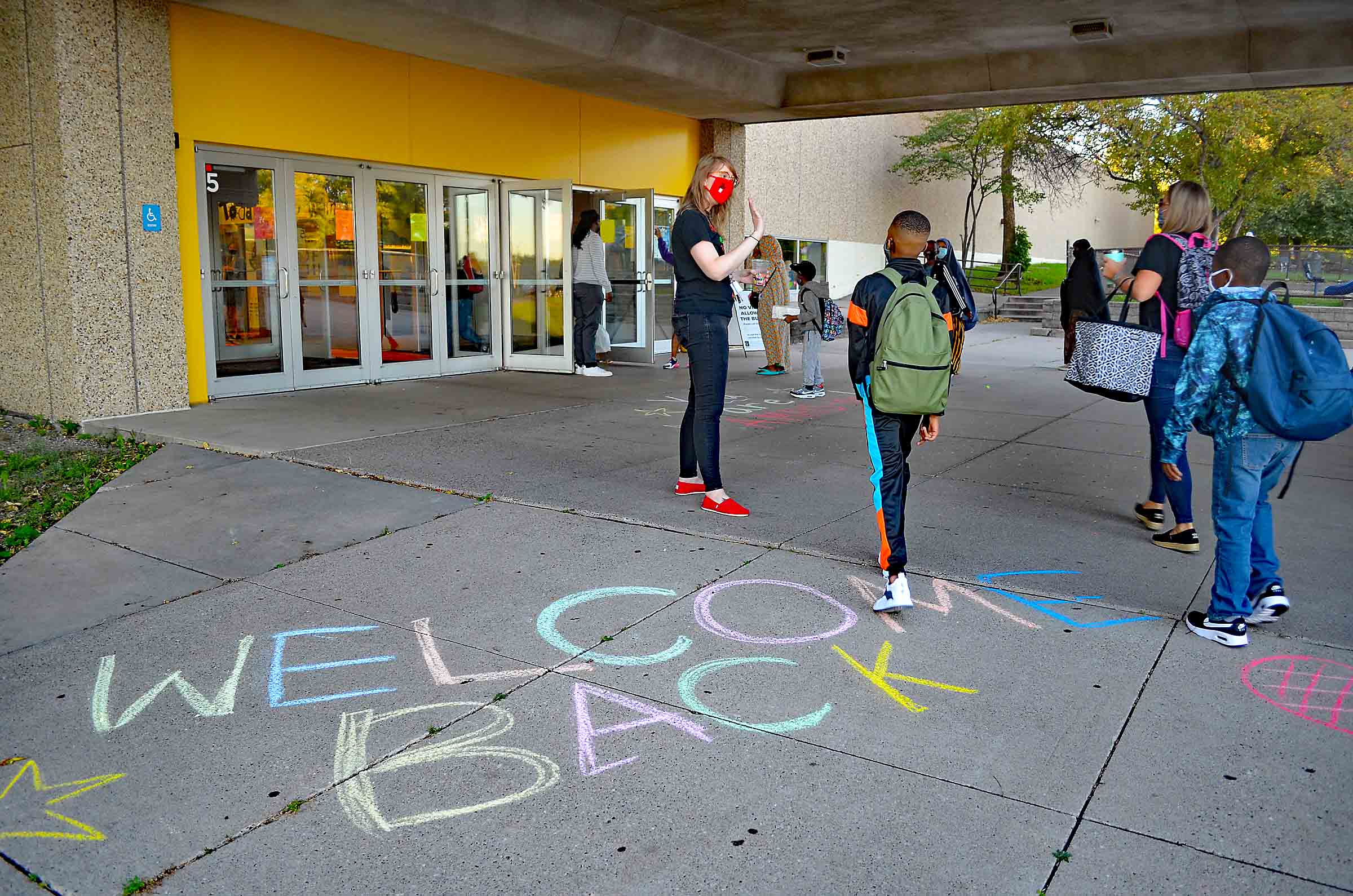
On the first day of school Benjamin E. Mays elementary school in St. Paul last year, teachers greeted returning students at with sidewalk chalk and confetti.

As public schools across Minnesota scramble to fill open positions before classes resume, union members coming back to work this fall asked families for patience, and called on school leaders to offer more incentives – financial and professional – to ease the staffing shortage.

“The working conditions in our schools have suffocated many teachers’ passion for teaching,” said Dr. Mara Borges-Gatewood, who teaches English-language learners in the White Bear Lake district. “There are just so many things being asked from us, and we can’t do them anymore.”

U.S. schools are looking to fill 300,000 positions nationwide, according to an estimate from the nation’s largest teachers’ union, the National Education Association (NEA).

It’s likely to be a rocky start to the school year for many, and Education Minnesota President Denise Specht asked for patience from parents and students.

“Take a breath and remember that the educators and staff who chose to come back this fall did so because they really care about the students and want them to succeed,” she said.

Staffing challenges hit school districts hard after the COVID-19 outbreak, but Borges-Gatewood and other school employees, speaking during a press conference today, said the issues driving workers to leave began well before the pandemic. They include unsustainable workloads, uncompetitive pay and, for hourly workers, lack of access to unemployment-insurance benefits.

Brooke Malek, a licensed school nurse in the Morris Area School District, said nurses are stretched thin across multiple school buildings, with many “leaving for better paying jobs.” Jeanne Fox, an education support professional from Osseo, said her district nickeled and dimed support staff in contract negotiations, despite piling on responsibilities – like covering for absent classroom teachers – over the last two years.

“This extra workload burnt out a lot of school support staff,” Fox said. “They’re expected to step up to the plate, but their extra effort didn’t result in more pay.”

The State of Minnesota’s projected $9.4 billion budget surplus offered lawmakers an opportunity to give school districts more funds to recruit and retain workers. But Republicans who control the Senate never took up a spending package, backed by Gov. Tim Walz and the DFL-controlled House, that would have delivered $1 billion to schools.

Lawmakers also failed to pass legislation that would extend unemployment benefits to hourly school employees in Minnesota, one of just a handful of states that bar school bus drivers, custodians, nutritional workers and others from access.

Without help from the Capitol, union members said, school districts should look for ways to collaborate with their employees to address to the staffing crisis.

Cat Briggs, a bus driver in the Rosemount-Apple Valley-Eagan district, said her union, SEIU Local 284, bargained for higher wages and a retention bonus. It also helped identify opportunities to merge part-time jobs – like crossing guard and bus monitor – into more attractive, full-time positions with benefits.

“We’re calling on every district in the state to make these jobs a career,” Briggs said. “Get all the jobs, including the starting wages, above poverty level.”

Education Minnesota’s think tank, the Educator Policy Innovation Center, released a report earlier this month analyzing firsthand accounts from educators about the challenges of working through the pandemic – and what changes are needed to keep more from leaving the profession.

Authors recommended giving educators more time to build relationships and collaborate within the school community, a greater say in school policies and more authentic opportunities for professional development.

“We can lighten loads; we can take stress off of people’s plate,” said Specht, president of the statewide educators’ union. “We can reach out to licensed staff who have chosen to walk away from teaching and ask them why, ask them what they need to come back.”

St. Paul educators balk at district’s demand for concessions

Educators line the sidewalk outside St. Anthony Park Elementary during a walk-in event highlighting their union’s student-centered contract priorities.

Less than two years after their historic strike drew thousands of supporters into the streets, St. Paul educators are back at the bargaining table, looking to defend and build on gains made in their last contract.

This morning educators were back outside their school buildings, too, showing unity and support for the student-centered priorities guiding their union in talks with the district.

“The students should always come first – always,” second-grade teacher Ruth Krider said before a “walk-in” event at St. Anthony Park Elementary.

That means keeping class sizes small, staffing mental health teams at every school, hiring and retaining more bilingual educators and educators of color, and providing more support and resources to special education teachers.

The St. Paul Federation of Educators calls it building the “schools St. Paul students deserve,” and educators have fought hard in recent rounds of bargaining to write benchmarks for student services into their union contract. An agreement to expand students’ access to mental-health supports was key to settling the strike in March 2020.

But union members say the district set out this year to take back many of those gains, including limits on class sizes and the hard-fought language around mental health. One proposal to eliminate a guarantee that students have access to recess time sparked a new chant outside St. Anthony Park this morning: “What do we want? Recess! When do we want it? Now!”

The district is demanding concessions from educators despite receiving over $200 million in American Rescue Plan funds.

Krider called it “disheartening” to see that kind of posturing from the district, particularly during a school year that many educators have described as their most difficult. In St. Paul, looming school closures have only added to the stress of teaching during the COVID-19 pandemic.

“It feels like things are coming at us from all sides,” Krider said. “With negotiations on top of all that, it would be nice to feel like we could be trusted by the district, but staff are not being listened to.

“We feel like we’re moving backwards, almost. We fought hard, we had some gains, and now we’re feeling like we have to redo the whole thing.”

But SPFE members aren’t shying away from another fight with the district.

Yesterday, a delegation of educators presented Superintendent Joe Gothard with a petition signed by 75% of members supporting the union’s contract proposals. And today’s “walk-in” events, in which educators enter school alongside the students at the center of their bargaining priorities, took place across the city.

Supporters can sign onto the petition backing educators’ bargaining proposals, and sign up for updates from the union about future public actions.

SPFE and district leaders met Tuesday in their first mediation session since the district petitioned to move talks behind closed doors.

Staff announce union drives at two Twin Cities charter schools

Teachers from Great River and Hiawatha announce their union campaigns during a video conference with Education Minnesota.

Staff at two Twin Cities charter schools kicked off Teacher Appreciation Week earlier this month by filing for recognition of their unions.

Teachers, paraprofessionals and support staff from Great River School in St. Paul and Hiawatha Academies in Minneapolis went public with their campaigns after filing signed authorization cards with the National Labor Relations Board (NLRB), triggering the union-election process.

“We are all incredibly proud and honored to be working with the amazing staff, families and students who really make our school run,” said Janiru Herath, a teacher at Hiawatha College Prep – Kingfield. “Through unionizing, we can have a seat at the table in which the decision-making process includes all voices.”

About 70% of workers eligible for the bargaining units signed authorization cards, according to Education Minnesota, the union of 89,000 education workers statewide, which is supporting both organizing drives.

The bargaining units would bring together as many as 122 school employees at Great River and 202 at Hiawatha.

Employees at both schools pushed administrators and board members to recognize their unions voluntarily, hoping to bypass the NLRB and get to work on first collective bargaining agreements that will strengthen their learning communities – but to no avail.

Instead, Great River staff members are scheduled to vote June 3 in person. Voting at Hiawatha will take place by mail, with ballots set to be counted June 8.

A bridge to support students

In a discussion streamed live on Education Minnesota’s Facebook page during Teacher Appreciation Week, Herath and other union supporters laid out their reasons for pursuing a collective voice at their schools. Each of the speakers said a union would increase staff members’ power to advocate for themselves and their students.

Great River’s Sarah Garton likened forming a union to building a bridge between staff and the school’s administration, so the two groups work together better. That would only benefit students, Hiawatha’s Tory Waggoner agreed.

“Students are the center of every- thing we do,” Waggoner said. “By prioritizing the voice of the people who work most closely with them, we can improve student outcomes and increase the satisfaction of workers as well.”

Growth at the schools has factored into workers’ decision to organize, too. Since the school’s founding in 2007, Hiawatha has expanded from a

single elementary campus into a net- work of one elementary school, two middle schools and one high school. Great River, a first- through 12th-grade Montessori school on Energy Park Drive, also has grown in recent years.

Great River teacher Nadine McNiff said growth is an opportunity “to expand what is working and improve what isn’t,” and a having a union will ensure staff members are part of that process.

“One thing that’s really important is continuity and foundation,” McNiff said. “Especially through a time of growth and changes at Great River, a union offers support for those things.”

Staff members at Great River, McNiff added, strive to create “space and structures that give students agency and voice.” And what better way to model that work than by forming a union?

“Our hopes are that unionizing and having that consistency in place, having that stability in place, can really help with maintaining working conditions that can feel supportive to workers, so they can focus and really invest their energies and thoughts on connections with students,” McNiff said.

Unions gaining favor

Charter schools are publicly funded but exempt from some state laws in order to increase flexibility, autonomy and innovation.

Minnesota is considered the birth- place of charter schools, having passed a first-in-the-nation law establishing their framework in 1991. Now, 168 charter schools serve about 68,000 pre-kindergarten through 12th-grade students statewide.

Teachers at the Twin Cities German Immersion School in St. Paul formed the state’s first charter-school union in 2014. Currently, Education Minnesota represents four bargaining units at three charter schools.

– Updated May 5, 2021, with reporting on NLRB election dates.