Local lawmakers, unions scramble to support federal workers harmed by Trump cuts

Members of the Minnesota Association of Professional Employees (MAPE) held informational picketing in support of about 170 employees at the Department of Health who have been laid off as a result of federal funding cuts.

Unions, local lawmakers and community volunteers are acting to support Minnesotans ensnared by the Trump administration’s reckless attempt to gut the federal workforce.

“If the Trump administration turned you away, Minnesota wants you,” Gov. Tim Walz said, announcing a new one-stop website with referrals to state employment openings, resources for veterans and tips for accessing state unemployment insurance benefits.

DFL legislators, meanwhile, have introduced bills that would bolster the safety net for workers navigating the federal chaos.

One measure would guarantee unemployment benefits for workers who accepted the so-called “fork-in-the-road offer” from Trump megadonor Elon Musk, head of the administration’s “DOGE” team.

Jacob Romans, president of American Federation of Government Employees (AFGE) Local 3699, which represents 2,300 VA hospital workers, praised the proposal. He called it “legitimate” to question whether DOGE and the Trump administration would honor terms of the buyout through Sept. 30, as originally promised.

Another bill would establish a relocation bonus program for veterans who have been fired by the Trump administration, incentivizing public employees to continue their public service in Minnesota. Veterans make up roughly 30% of the federal government’s workforce.

Some House DFLers are also pushing a measure to tack on a 13-week extension of unemployment benefits for government workers whose federal benefits expire.

“We want to make sure that these dedicated public servants stay here in Minnesota and are not forced to leave their communities and find work elsewhere,” Rep. Pete Johnson of Duluth said. “But the goal is clear – make the job unbearable for workers so that they leave.”

“What we are trying to do is absorb some of the shock and the impact of the Trump-Musk actions, and protect Minnesota’s economy,” Rep. Greenman of Minneapolis said. “Right now our job is to protect Minnesota with the power that we have.”

Unions, too, have stepped up their advocacy on behalf of federal workers. As their attorneys continue fighting Trump’s war on the federal workforce in court, unions announced a new partnership that aims to connect individuals impacted by the cuts with free legal support.

The Rise Up Federal Workers Legal Defense Network, backed by the AFL-CIO and several federal government unions, put out the call for attorneys to volunteer their services to advocate for workers who have seen their rights violated – and careers upended – by the Trump administration’s recklessness.

“Attacks on federal workers are attacks on all workers and on the essential services that our communities rely on daily,” AFL-CIO President Liz Shuler said. “Getting these workers the justice they deserve in the face of this onslaught will take all of us.”

Anna Chu, executive director of We The Action, an organization that connects volunteer attorneys with community initiatives, said lawyers are “uniquely positioned” to assist federal employees in this moment.

“This is a moment for lawyers to support the federal workers who serve us all,” Chu added.

Tens of thousands of federal workers have been laid off, put on administrative leave or left their jobs since Trump took office. Over 18,000 federal employees reside in Minnesota.

– Michael Moore, Union Advocate editor

Union members push bill to give striking workers unemployment benefits

Autoworkers in Hudson, Wis., picketed during their union’s “Stand Up Strike” in 2023.

After a wave of collective action saw American workers improve their pay and working conditions by going on strike, Minnesota lawmakers are weighing a change to the state’s unemployment insurance system that would lighten the economic hardship union members here face during a labor dispute.

Legislation introduced earlier this month by DFLers in the House and Senate would make some workers in Minnesota eligible for unemployment benefits when they are on strike.

Advocates, including several union members who testified in support of the bill last month, said giving workers more leverage at the bargaining table is good for working families, local communities and the economy as a whole.

The cost to the state’s unemployment insurance fund, meanwhile, would be “negligible,” according to Jake Schwitzer, director of the North Star Policy Action, a research group that issued a report on the idea earlier this year. That report estimated the proposed expansion would amount to 0.3% or less of existing unemployment claims.

The benefits, union members said, would far outweigh those costs.

More equal footing

More often than not, employers enter a work stoppage from a position of strength, with deep pockets to cover any losses in productivity. Workers, particularly those in low-wage jobs, begin feeling the impact of lost wages almost immediately.

That dynamic, workers told lawmakers, gives employers an incentive to wait things out and force workers to capitulate to their demands. It’s what Dean Benson, a retired St. Paul Park refinery worker, said Marathon tried to do to members of Teamsters Local 120 when they went on strike for safety and job security three years ago.

“We won that strike, but only because we had the support we needed to keep that fight on,” Benson said during a Senate committee hearing on the bill March 13. “That isn’t always the case because Marathon did what many large corporations try to do when their workers are seeking a fair contract. They tried to starve us out.”

Minnesota’s unemployment benefit covers about 50% of a worker’s average weekly wage, up to a maximum of $890. That’s the right amount, AFSCME Council 5 Interim Executive Director Bart Anderson said, to give workers more bargaining power while keeping the strike a last resort.

“Going on strike will still be financially challenging, but at least workers won’t be starved back to work,” Anderson said.

Community gains

Other supporters argued that the legislation could reduce the number of work stoppages in Minnesota. Employers would know that union members have access to a partial wage replacement if they strike, giving them reason to bargain a timely, equitable contract.

With record profits in the bank, the Big 3 automakers could have reached a deal before members of the United Auto Workers went on strike last September, UAW member John Kontzelmann told lawmakers.

“The strike didn’t have to take five weeks because these employers knew what their top offer was,” said Kontzelmann, who was on strike at the Twin Cities Stellantis parts facility. “Managers didn’t sacrifice a penny while they tried to starve us out, and despite pleading poverty for weeks they ended up agreeing to a record four-year contract.”

The autoworkers’ contracts, with wage increases of 25% or more, also show the ripple effects of union power at the bargaining table. After the UAW settled, non-union automakers across the U.S. moved quickly to increase their wages by double-digit percentages – the so-called “UAW bump.”

“This bill benefits not just workers, but the entire economy,” Rep. Kaela Berg (D-Burnsville), lead House author of the bill, said. “When workers are earning a living wage, they are contributing to the local economy.”

– Michael Moore, Union Advocate editor

Unions to stay vigilant at Capitol: ‘What we’ve got can go away in a vote’s notice’

Minnesota AFL-CIO President Bernie Burnham spoke at a rally outside a business lobby event on the opening day of the 2024 legislative session.

Minnesota’s unions will approach the 2024 state legislative session looking to expand on – and defend – the historic package of labor standards and public investments passed by DFL lawmakers last year.

Legislators returned to St. Paul on Feb. 12. Before their deadline to adjourn May 20, they are sure to hear from union members pressing for action on a range of issues, including infrastructure investments, pension adjustments, protections for health care and railroad workers and more.

Of course, union members and their allies won’t be the only voices lawmakers hear from at the Capitol this spring. On Day 1 of the new session, the Minnesota Chamber of Commerce hosted a reception with legislators at River Centre in downtown St. Paul. The event’s theme was “Restore the Balance.”

To union members like Jake Anderson, a special education teacher in the St. Paul Public Schools, that sounded like going backwards – “and we are not going backwards,” he said at a rally outside the event.

“We won a lot of things last time around,” Anderson, a member of the St. Paul Federation of Educators, said. “Our kids get free school lunch. We get unemployment for our paraeducators. But it’s not enough, it’s just the beginning.”

Kelly Gibbons, executive director of Service Employees (SEIU) Local 284, said 18,000 education support professionals accessed unemployment insurance last summer, after legislation passed to make hourly school employees eligible for the benefit. She said union members have told her that “unemployment insurance has changed their lives.”

“They’re going to talk about going back to the system that was rigged against us, the workers,” Gibbons said of the Chamber. “They want it to go back in their favor, and we’re here to say absolutely not.”

The state’s largest labor federation, the Minnesota AFL-CIO, last month identified its top priorities for the session, and defending the gains made in 2023 is at the top of the list.

Minnesota AFL-CIO President Bernie Burnham said the federation developed its priorities through conversations with affiliate unions and labor leaders.

“First and foremost, we’ve got to protect the things we’ve got,” Burnham said. “We’re going to be working to make sure that paid family and medical leave and union rights – all of that and more – stay in place. What we’ve got can go away in a vote’s notice.”

Burnham said it’s an indication of just how much work lawmakers did on labor issues last year that there are few holdovers from 2023 on the federation’s list of legislative priorities.

Along with paid family leave and unemployment for school employees, union-backed measures to expand earned sick and safe time benefits, ban captive audience meetings, raise safety standards in refineries and give public-sector unions more bargaining rights all became law, not to mention historic one-time investments in public schools and infrastructure jobs.

Still, there are policy measures the state AFL-CIO will work to advance in 2024, including a crackdown on employers who misclassify their workers as independent contractors. Unions have long said the practice is alarmingly common in the nonunion construction industry, but it also applies to the gig economy, advocates say.

Unions want to see legislators put teeth into the state’s existing misclassification laws this session. When workers are misclassified, Burnham said, “they lose out on minimum wage, they lose out on benefits like workers’ comp and overtime pay.”

The federation also plans to lobby for extending unemployment insurance to workers who are on strike. Such a law would level the playing field in collective bargaining, Burnham said, noting that employers can replace striking workers, cut off their health care and stall negotiations.

“There is so much action right now among people who are fighting to do better on the job,” she said. “If they have to go on strike, how are they going to make ends meet?

“If we are going to continue in Minnesota with all the good things we got last year, why wouldn’t we go that next step further?”

– Michael Moore, Union Advocate editor

Minnesota unions praise historic legislative session

Gov. Tim Walz spoke to supporters before signing 12 budget bills into law.

In a historically productive legislative session that ended on time Monday, labor-endorsed lawmakers delivered on nearly all their campaign promises, from investments in public infrastructure and schools to expansion of family-supporting benefits, union rights and workplace protections.

Union activists and leaders were among hundreds who celebrated the session’s accomplishments today on the Capitol grounds, as Gov. Tim Walz held a signing ceremony for 12 budget bills that will fund state government for the next two years.

Walz likened the newly approved budget to the “Minnesota Miracle” of 1971, when the state drew nationwide acclaim for investing in public education.

“If this is ‘Minnesota Miracle 2.0,’ the difference between then and now is … we’re leaving no one behind,” Walz said.

Labor leaders praised Walz and DFL legislators for rising to the occasion created by a projected budget surplus that swelled to $17.5 billion – thanks, in part, to one-time federal stimulus dollars that Republicans blocked the state from allocating one year ago.

After winning all three levers of power – with support from union volunteers – during the 2022 election, DFLers invested the surplus in infrastructure projects and jobs, schools, nursing homes and targeted tax relief for working families, including an expanded child tax credit that will return up to $1,750 per child to lower-income families.

Lt. Gov. Peggy Flanagan, former director of the Minnesota Children’s Defense Fund, said the budget is “deeply rooted in equity and decades in the making.” She credited organizers and activists who have devoted years to fighting for policies that will soon become law, like earned sick and safe time and paid family leave.

“We have played the long game,” Flanagan said. “And we won.”

Children and families will also benefit from $2.26 billion in new funding for Minnesota’s public schools over the next biennium. The 10.5% increase will help school districts cover rising costs – and recruit and retain educators and other employees. And the budget allocates $600 million to hire and retain child care teachers.

Walz and DFL lawmakers focused on issues that matter to workers and families, Minnesota AFL-CIO President Bernie Burnham said, noting that their work stands in contrast to Republican-controlled chambers in other states that have sought to ban abortion, weaken child-labor laws and meddle in school curriculum.

“While other states are putting 14- and 15-year-olds to work on assembly lines, Minnesota is making sure parents have the time and resources to care for and sustain their families; while other states ban books in our schools and libraries, Minnesota is making sure no student goes hungry at school; and while other states make it harder to vote, Minnesota is expanding our Democracy to make sure every eligible voter has the freedom to make their voice heard,” Burnham said.

Walz is also expected to sign a $2.3 billion infrastructure deal that contains a mix of borrowing – a so-called “bonding” bill – and cash investments. It would be the first bonding bill the state has passed since 2020.

Sen. Sandy Pappas, the lead author, said the measure “will create thousands of well-paying union jobs and ensure businesses have the infrastructure they need to build in Minnesota for years to come.”

On the Capitol grounds today, Walz gave a shout to people in hard hats throughout the crowd. “All of these good union jobs have built the middle class and built Minnesota,” he said. “It is going to continue that way.”

In addition to historic investments approved this session, Minnesota lawmakers took up several policy changes long sought by union members, including an extension of unemployment benefits to hourly school employees, a ban on private prisons and a new Nursing Home Workforce Standards Board with the authority to set standards like pay and benefits.

Lawmakers expanded and strengthened union rights, enshrining public-sector workers’ ability to bargain on non-economic issues like safe staffing and class sizes, giving workers in the newly legalized recreational cannabis industry a path to collective bargaining and banning “captive audience meetings,” in which workers are forced to listen to their bosses’ religious, political or anti-union views.

Funds allocated this session will also bolster the state’s film industry tax credit, raise pay for home care and nursing home workers and strengthen public pensions.

A measure to address hospital staffing shortfalls, however, fell short of the Minnesota Nurses Association’s expectations. The bill established new safety protections and recruitment bonuses for health care workers, but it left out language that would have would have required hospitals to create labor-management committees to determine appropriate staffing in their wards.

Support for a safe staffing law dwindled after Mayo Clinic threatened to withhold investments in its Rochester campus if it passed.

“I hope Minnesotans know how hard nurses fought for your care and safety,” MNA President Mary Turner said. “And I hope corporate executives and our public officials know that our fight is not over to put patients before profits in our health care system.”

Staffing crisis prompts school employees to ask for support, patience

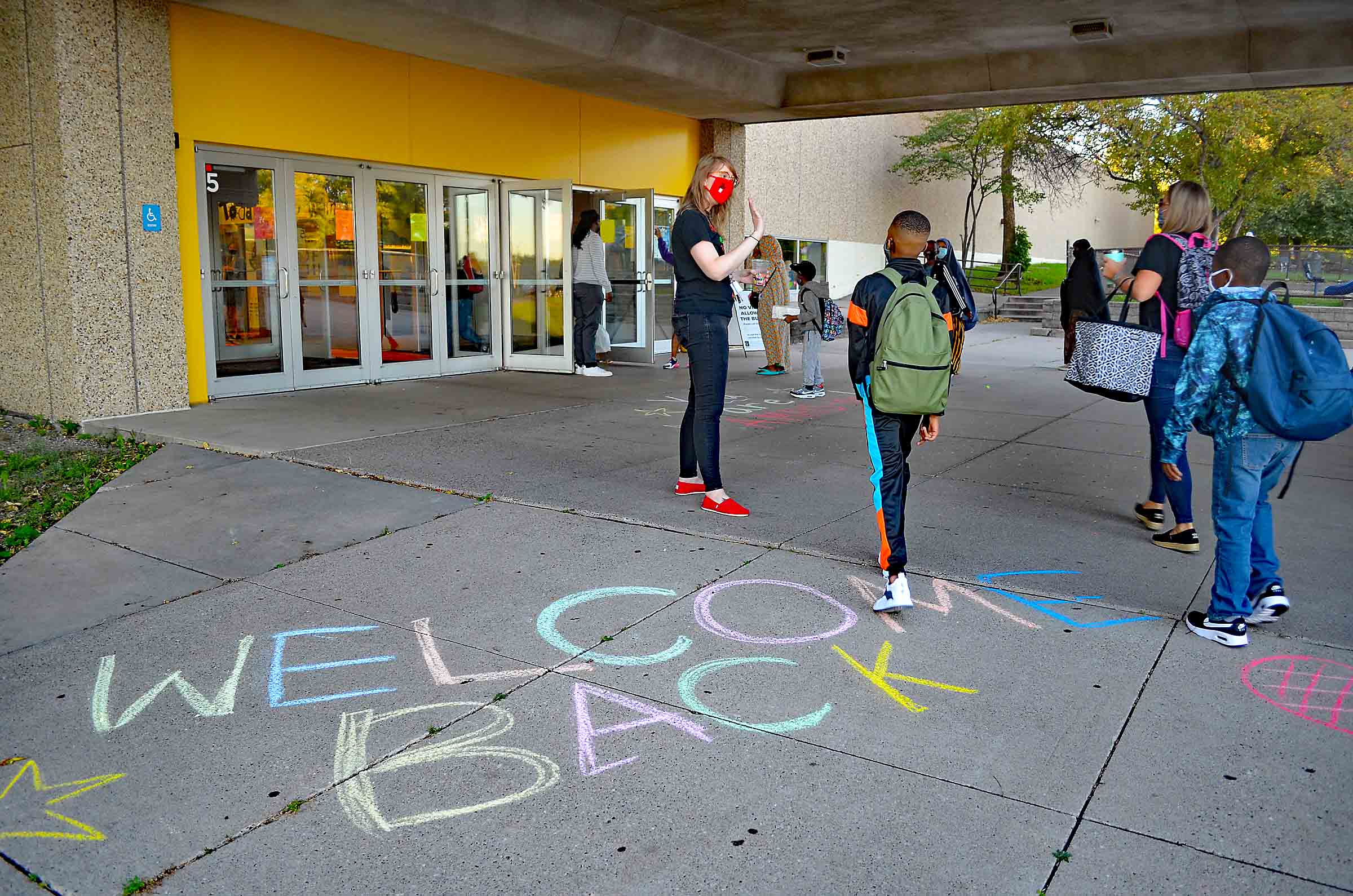
On the first day of school Benjamin E. Mays elementary school in St. Paul last year, teachers greeted returning students at with sidewalk chalk and confetti.

As public schools across Minnesota scramble to fill open positions before classes resume, union members coming back to work this fall asked families for patience, and called on school leaders to offer more incentives – financial and professional – to ease the staffing shortage.

“The working conditions in our schools have suffocated many teachers’ passion for teaching,” said Dr. Mara Borges-Gatewood, who teaches English-language learners in the White Bear Lake district. “There are just so many things being asked from us, and we can’t do them anymore.”

U.S. schools are looking to fill 300,000 positions nationwide, according to an estimate from the nation’s largest teachers’ union, the National Education Association (NEA).

It’s likely to be a rocky start to the school year for many, and Education Minnesota President Denise Specht asked for patience from parents and students.

“Take a breath and remember that the educators and staff who chose to come back this fall did so because they really care about the students and want them to succeed,” she said.

Staffing challenges hit school districts hard after the COVID-19 outbreak, but Borges-Gatewood and other school employees, speaking during a press conference today, said the issues driving workers to leave began well before the pandemic. They include unsustainable workloads, uncompetitive pay and, for hourly workers, lack of access to unemployment-insurance benefits.

Brooke Malek, a licensed school nurse in the Morris Area School District, said nurses are stretched thin across multiple school buildings, with many “leaving for better paying jobs.” Jeanne Fox, an education support professional from Osseo, said her district nickeled and dimed support staff in contract negotiations, despite piling on responsibilities – like covering for absent classroom teachers – over the last two years.

“This extra workload burnt out a lot of school support staff,” Fox said. “They’re expected to step up to the plate, but their extra effort didn’t result in more pay.”

The State of Minnesota’s projected $9.4 billion budget surplus offered lawmakers an opportunity to give school districts more funds to recruit and retain workers. But Republicans who control the Senate never took up a spending package, backed by Gov. Tim Walz and the DFL-controlled House, that would have delivered $1 billion to schools.

Lawmakers also failed to pass legislation that would extend unemployment benefits to hourly school employees in Minnesota, one of just a handful of states that bar school bus drivers, custodians, nutritional workers and others from access.

Without help from the Capitol, union members said, school districts should look for ways to collaborate with their employees to address to the staffing crisis.

Cat Briggs, a bus driver in the Rosemount-Apple Valley-Eagan district, said her union, SEIU Local 284, bargained for higher wages and a retention bonus. It also helped identify opportunities to merge part-time jobs – like crossing guard and bus monitor – into more attractive, full-time positions with benefits.

“We’re calling on every district in the state to make these jobs a career,” Briggs said. “Get all the jobs, including the starting wages, above poverty level.”

Education Minnesota’s think tank, the Educator Policy Innovation Center, released a report earlier this month analyzing firsthand accounts from educators about the challenges of working through the pandemic – and what changes are needed to keep more from leaving the profession.

Authors recommended giving educators more time to build relationships and collaborate within the school community, a greater say in school policies and more authentic opportunities for professional development.

“We can lighten loads; we can take stress off of people’s plate,” said Specht, president of the statewide educators’ union. “We can reach out to licensed staff who have chosen to walk away from teaching and ask them why, ask them what they need to come back.”

As driver shortage hampers start of school, unions point to low pay, benefits

A shortage of school bus drivers hampered the start of school in St. Paul and districts across the state this fall, but it came as no surprise to local union leaders, who have long pushed officials to head off the crisis with better wages and benefits, including unemployment insurance.

“We can fix this problem, but first we have to understand what caused the shortage,” said Teresa Jakubowski, a driver in the Rosemount-Apple Valley-Eagan district. “If we want to get out of this mess, it has to be done with higher wages, better benefits and access to unemployment benefits.”

A steward with Local 284 of the Service Employees International Union, Jakubowski spoke with reporters during a virtual press conference arranged by her union as school districts scrambled to address the driver shortage.

In the St. Paul Public Schools, administrators abruptly changed start times the week before school was to begin. Families in several districts reported finding out they would temporarily need to arrange transportation to and from school for their children.

Teamsters Local 320, which represents transportation workers in the Minneapolis Public Schools, said the bargaining unit, which typically includes about 170 workers, was down to 90.

“This is not a bus driver shortage; this is a bus driver crisis,” Local 320 Communications Director Gus Froemke said. “People are on the edge.”

Split shifts, limited hours

Typical wages for drivers are $17 to $20 per hour, according to Local 284 President Kelly Gibbons, who drove bus for 18 years in the West St. Paul-Mendota Heights-Eagan Area Schools.

But driving bus is part-time work, and the split between morning and afternoon shifts makes it hard for bus drivers to supplement their income with a second job. Drivers often must build up seniority to bid for additional duties, like field trips and extracurricular routes, Gibbons added.

“Sometimes a beginning bus driver can’t get more than four hours a day,” she said. “Who can live on four hours a day?

“You come in the morning, and you come in the afternoon. It’s split up, there’s down time in between and sometimes there’s not enough time even to go home. Some drivers are just sitting in the transportation center, not getting paid.”

In the Rosemount district, Jakubowski said, drivers see just four full paychecks per year, with scheduled school breaks, cancelations and holidays cutting into the rest. Drivers able to work in the summer see their hours cut in half, she said.

Long fight for UI

Access to unemployment insurance would help retain drivers through the lean times, advocates said.

While construction workers, landscapers, resort workers and other seasonal employees are eligible for unemployment, hourly school employees are not, according to the state’s unemployment statute, because they have a “reasonable assurance” of returning to work.

Earlier this year, the DFL-controlled House included language reversing that policy in its jobs bill, but a lobbying group for school districts succeeded in keeping it out of the Senate bill. The measure never made it to Gov. Tim Walz’s desk.

Gibbons did not mince words in pinning partial responsibility for the transportation crisis facing local districts on the administrators and lawmakers who blocked the unemployment measure.

“This is a discriminatory law, and it’s time to make real positive change for the workers, for the kids and for the school districts we represent,” Gibbons said. “Our members were on the front line every single day since this pandemic started. Our members have gotten sick. They’ve had long-term effects of COVID. Some have died.

“We need to make sure they are respected, valued and paid.”

Pandemic makes things worse

Bus driver shortages plagued school districts before the pandemic, but COVID-19 exacerbated the problem everywhere. In a survey of school transportation providers conducted earlier this year by three industry groups, 78% of respondents indicated the shortage is getting worse.

Jakubowski said many drivers who left her district were people who previously retired from a different career and had taken jobs as drivers to keep busy and serve their community. But when the pandemic hit, the risks of continuing to drive outweighed the benefits.

“We’ve been relying on (previously retired workers) for a long time, and we shouldn’t be,” Jakubowski said. “We need to bring in new workers who are younger, who will be there for a lot longer.”

That means anteing up for higher wages and better benefits.

“The people who safely drive your children to and from school should be valued, full-time employees with a livable wage,” Jakubowski said. “That would allow us to draw new employees from all age groups.”

Excluded from unemployment benefits, hourly school workers speak out: ‘It is insulting’

School employees on the video press conference (clockwise from top-left): Teresa Jakubowski, Ronnie Sprigler, Rochelle Stoffel, Sieara Washington and Kelly Gibbons.

For decades, hourly school employees in Minnesota have been fighting to change a state law that restricts their access to unemployment insurance benefits, but to no avail.

Now, school bus drivers, paraprofessionals, teaching assistants and support staff across the state are being left behind as unemployment benefits, bolstered by $600 per week through the federal CARES Act, keep many Americans from slipping into poverty during the COVID-19 pandemic.

“It is insulting we aren’t treated the same as other workers when it comes to unemployment,” Sieara Washington, an education support professional in the Osseo school district, said. “It’s really telling us how they feel about ESPs. I guess we aren’t valuable enough.”

Washington spoke out during a virtual press conference hosted today by four Minnesota unions that represent hourly school employees: Local 284 of the Service Employees International Union, Education Minnesota, AFSCME Council 5 and Teamsters Local 320.

Union members called on state lawmakers, who began a special legislative session Monday, to take emergency action providing relief for hourly school employees, who are simultaneously dealing with the uncertainty of what their jobs will look like – assuming they exist at all – in the fall semester.

Kelly Gibbons, president of SEIU Local 284, said hourly school employees want both “short term solutions and long-term structural change.”

While construction workers, landscapers, resort workers and other seasonal employees are eligible for unemployment, school employees are not, according to the state’s unemployment statute, provided they have a “reasonable assurance” of returning to work in the fall.

“I think it’s discriminatory,” Gibbons said, noting that hourly positions in school districts are “more female-dominated” than other seasonal jobs like construction. “We’re being excluded from the law, so I think it’s not equitable. I don’t think it’s fair.”

Meanwhile, union stewards on the press call described the mounting financial pressures facing hourly workers, some of whom have been out of work since March.

Local 320 steward Ronnie Sprigler, a teaching assistant in the St. Paul Public Schools, said the sudden loss of income has been “catastrophic” for many of her fellow Teamsters, particularly single parents. Sprigler, herself a widow who cares for a disabled son, has incurred “serious debt and quality-of-life issues” as a result of the pandemic.

“But I also know that I am far from alone,” Sprigler said, noting that calls have been streaming in from distressed co-workers. “There’s a level of mental and emotional damage happening to people I hear from every week.”

Rosemount-Apple Valley-Eagan bus driver Teresa Jakubowski, a steward with Local 284, said that while she’s able to weather the storm by taking on debt, others without access to credit have faced heartbreaking decisions. One member of her bargaining unit recently sold her mother’s engagement ring for cash, Jakubowski said, and another couldn’t afford to replace her broken-down car.

“Food and rent are the biggest worries,” Jakubowski said. “We are frustrated, and we are fearful.”

AFSCME steward Rochelle Stoffel, a middle-school office clerk in St. Paul, said she gets “calls and emails constantly” from members in a panic about their unemployment status.

“They thought because programming was cancelled and they lost their position, they would receive unemployment, only to find out they’re in a pending status, with no help or estimation from the unemployment office when or if they will see a benefit at all,” Stoffel said. “It’s a terrible feeling.”

As painful as the last three months have been for hourly school employees and their families, union members on the press call said they were hopeful the crisis would finally lead to action, which workers like Gibbons have been pressing lawmakers to take for decades.

“I don’t think it’s any coincidence that this law applies to jobs that are traditionally done by women and people of color,” Gibbons said. “But this work is way too important to be treated this way. We need action from our state leaders.”

Resources for workers impacted by COVID-19 response

Efforts to halt the spread of COVID-19 are creating immediate economic hardship for many working families.  

Minnesota employers slashed payrolls after Gov. Tim Walz issued emergency orders temporarily shutting down restaurants, schools, movie theaters and other spaces where contagion was likely to occur.

As of last Friday, over 204,000 Minnesotans had applied for unemployment insurance benefits, flooding the state’s website with such a high volume of traffic that the agency today rolled out a new process limiting who can apply on certain days of the week based on Social Security number.

Unions, meanwhile, have been busy advocating for broad health and economic protections for workers during the pandemic response, while also scrambling to connect impacted members with support they need.

Twin Cities worker center CTUL, which advocates for people working in low-wage industries, has compiled a “Know Your Rights” list with information on access to safety equipment, earned sick time and other protections during the COVID-19 emergency.

The Saint Paul Labor Studies and Resource Center, the nonprofit arm of the St. Paul Regional Labor Federation, has compiled a evolving list of resources that may be available to help people make ends meet during the public-health crisis. 

Unemployment Insurance can provide immediate, emergency relief for many workers impacted by COVID-19, including people who have been laid off or who have seen their hours reduced. Gov. Tim Walz moved quickly to streamline UI benefits during the crisis.

People seeking health insurance during the COVID-19 outbreak can shop for coverage on the state’s health exchange, MNsure.org. 

Greater Twin Cities United Way is a longstanding partner in the AFL-CIO Community Services program, and the nonprofit is stepping up to help working families during the COVID-19 response in several ways. 

Evictions have been suspended during the COVID-19 pandemic, but resources remain are available to working people concerned about keeping their homes. 

Financial assistance may be available through your county. Call to arrange an intake interview. 

Xcel Energy has announced it will not disconnect any household’s utilities during the pandemic. Learn more about the company’s response here. 

Some schools are giving students free meals while schools are closed due to the COVID-19 virus. 

The deadline for filing state and federal income taxes has been pushed back to July 15, 2020. 

Student loan borrowers may be able to suspend payments during the pandemic response. Click here for more information. 

The American Red Cross has a “critical need” for blood donors right now. To schedule an appointment call  651-291-6789, or click here to find a drive. 

Be on the lookout for scams! Here’s a list of tips from the Federal Trade Commission on how to avoid scams related to the coronavirus. 

Unions praise Dayton’s approach to building a ‘state that works for everyone’

MNSTOSIn his State of the State Address last night, Minnesota Gov. Mark Dayton called on legislators to join him in addressing the state’s racial and geographic disparities, and in making needed investments in public education, transportation and infrastructure.

Afterward, union leaders from across the state praised Dayton’s speech.

Education Minnesota President Denise Specht called Dayton the “Education Governor.” Minnesota AFL-CIO President Bill McCarthy said he “demonstrated his commitment to ensuring that Minnesota is a state that works for everyone, not just the wealthy few.”

“Hardworking Minnesotans have always formed the backbone of our economy,” AFSCME Council 5 Director Eliot Seide added. “We applaud Gov. Dayton’s focus on infrastructure, transportation, and expanding economic opportunity for all Minnesotans. Those smart investments will help build a better Minnesota that works for all of us.”

Supporting workers left behind

Early in the address, Dayton reiterated his support for extending aid to Iron Range workers suffering from a slowdown in the mining industry and to minority communities that have yet to reap the benefits of Minnesota’s economic recovery.

Illegally dumped foreign steel has flooded the U.S. market, leading Iron Range mining companies to lay off an estimated 2,000 workers in the last year. The slowdown has impacted an additional 4,700 workers in mining-related jobs.

A relief package would extend unemployment benefits for about 2,750 workers, but Republicans, who control the House of Representatives, insist on pairing the relief package with tax breaks for businesses.

“To hold $29 million of desperately needed unemployment benefits hostage to $272 million in fund cuts is unnecessary,” Dayton told Republicans. “And it’s cruel.”

Dayton also cited several sobering statistics regarding racial and ethnic disparities in the state. Compared with Minnesota’s white families, he said, U.S.-born African American families’ annual income is 55 percent less, and their poverty rate is more than 4 times greater. Mexican-American, Ojibwe and Somali families also have fallen behind.

“We cannot resolve these disparities in one legislative session, but we must begin now,” Dayton said, pledging a “significant initiative” to increase economic opportunities for Minnesotans of color.

He also called on the state’s businesses to increase its outreach into minority communities and set a goal of doubling the percentage of minorities working in state government by the time he leaves office.

Modest investments, targeted tax cuts

As for how to approach Minnesota’s $900 million budget surplus for the next two years, Dayton said he would support pairing “modest spending increases” with tax cuts targeted for middle-class families, like an increase in the child-care tax credit.

But the governor, who faced a $6 billion budget shortfall when he took office in 2011, emphasized the importance of keeping the state on firm financial footing.

“Some people are proposing permanent tax cuts, which would put our state’s budget, once again, on a fiscal precipice,” he said.

“What we have been doing is working,” Dayton added. “Minnesotans are working. Minnesota is working. How could we stop now, when there is more work left to do?”

Investments in statewide broadband access, clean energy, rural water-treatment facilities, infrastructure, roads and bridges would create jobs and expand economic opportunities statewide, Dayton said. And he renewed his call for greater investment in early education to “prevent achievement gaps before they appear.”

Specht, president of the statewide educators’ union, praised Dayton’s support for learners at all levels.

“Gov. Dayton understands the foundation of our state is a great system of public education that prepares all students for successful lives,” she said. “His commitment to expand access to high-quality preschool and to support public colleges and universities will reduce the opportunity gaps which hold back too many of our students.”

House Republicans play politics with unemployment extension for steelworkers

capitolSteelworkers pleaded with members of a House committee yesterday to pass a clean bill extending unemployment benefits to workers impacted by the Iron Range mining slowdown, but they couldn’t convince Republicans, who continued holding the relief package hostage for $271 million in tax cuts for businesses.

“Believe me, this is not an easy thing for us proud Iron Rangers to do,” Cliff Tobey, president of United Steelworkers Local 2660, told members of the House Job Growth and Energy Affordability Committee.

Tobey and another laid-off Steelworker traveled to St. Paul to testify in favor of extending benefits by 26 weeks for workers impacted by the crisis, which was triggered by an influx of cheap foreign steel that flooded the U.S. market and left ore prices at a 10-year low.

Most of the region’s 11 mining outfits have issued layoffs in the last 12 months, and by the time the legislative session starts Tuesday, about 1,200 Iron Range workers will have exhausted their unemployment benefits.

Toby urged committee members to pass the extension “without attaching unnecessary demands,” but Republicans couldn’t resist including a tax rebate for businesses that pay into the state’s unemployment insurance fund.

The bill passed the committee over objections from members of the DFL minority, who said the two issues – extending benefits for steelworkers and reforming the state’s unemployment insurance system – deserve separate consideration.

Rep. Jason Metsa, whose District 6B includes the heart of taconite mining country, choked up as he appealed to his Republican colleagues.

“These guys gotta go back to their families and their friends and tell them we didn’t get it done,” Metsa said of the Steelworkers who testified. “Let’s do the right thing and set these (issues) on two different tracks.”

The committee’s vote cast doubt on whether lawmakers will be able to pass an extension of benefits during the first week of session, a goal set by Gov. Mark Dayton and legislative leaders.

The Minnesota Department of Employment and Economic Development estimates mining companies have laid off 2,000 workers since March 1, 2015, and the slowdown has impacted an additional 4,700 Iron Range workers in mining-related jobs.

DEED has crafted a relief package to extend benefits for about 2,750 workers at a cost to the unemployment insurance trust fund of $29.7 million. The Republican tax break would siphon nearly 10 times that amount from the state’s unemployment trust fund, leaving its balance below federal guidelines, DEED Commissioner Katie Clark Sieben said.

“We know that a recession can deplete reserves quickly,” Sieben warned.

In 2009, for example, the unemployment fund paid out $1.7 billion – more than its current $1.57 billion balance. Faced with $1.4 billion in claims in 2010, the fund was forced to borrow from the federal government to meet its obligations, a debt that took almost three years to pay back.

“Putting the future solvency of our unemployment insurance trust fund at risk is unconscionable,” Minnesota AFL-CIO President Bill McCarthy told the committee.

But with each additional day Republicans play politics with the issue, more Iron Range families see their benefits disappear.

Tobey, a third-generation miner, said his local has 360 members “out on the street right now trying to feed their families, trying to pay their mortgages, trying to get by.” He questioned whether Republicans would insist on business tax cuts before providing flood relief or assistance in the wake of a bridge collapse.

“We have no more control over other countries flooding our market (with cheap steel) than the people of Minnesota have over falling bridges and flooding rivers,” he said.