‘Bill of Rights’ would fund $25 minimum wage, health benefits for hourly school staff

Sara Rapp, a school cook on strike in Hastings, testified at the Capitol in support of the ESP Bill of Rights.

As striking food service workers in Hastings put a spotlight on hardships faced by some of the lowest-paid school employees, state lawmakers this week debated bold, new legislation to lift standards for all hourly school workers.

The “Education Support Professionals’ Bill of Rights,” introduced by DFLers in both the House and Senate, would establish a minimum wage of $25 for paraprofessionals, bus drivers, clerical workers and other hourly employees.

It would also require schools to offer affordable, year-round health coverage and to sustain hourly workers’ pay during e-learning days, among other provisions.

To cover schools’ increased costs, the measure would provide new state funding – beyond increases to the per-pupil formula – determined by a district’s ESP staffing needs.

Rep. Brad Tabke of Shakopee, lead author in the House, touted the bill as a matter of fairness for the trusted adults who work in their communities’ school systems.

“All throughout the summer (while) talking to folks, I ran into dozens and dozens of paras, janitors, bus drivers, lunch workers that are really struggling,” he told members of the House Education Finance Committee on Tuesday. “As a state we should be valuing that work.”

Senate author Alice Mann (D-Edina) said school districts need new, dedicated funding to make their hourly positions competitive with other employers.

“You can walk down the street to McDonald’s and get paid more to work there than in our schools taking care of our children, feeding our children, transporting our children and helping to educate them,” Mann said during a Senate committee hearing Tuesday.

Labor market data shows the job vacancy rate at school districts across the nation has been rising for a decade. In Minnesota, where overall workforce participation is higher than the national average, employment in school districts has dropped by 6.4% since October 2019, according to data compiled by the Economic Policy Institute’s Economic Analysis and Research Network (EARN).

“There’s a lot of reasons why this could be, but the most simple and obvious one is compensation,” EARN policy coordinator Dave Kamper said. “Workers are leaving ESP jobs for higher-paying gigs elsewhere.”

Rep. Brad Tabke holds a press conference with school employees after committee hearings on the ESP Bill of Rights.

Hourly school workers who want to continue serving students have found it increasingly difficult to make ends meet, as several ESPs – including one food service worker on strike for higher wages – testified at the Capitol.

Sara Rapp, a cook at Hastings High School, earns just $15.05 per hour in her fourth year with the district. A $10-per-hour raise, she said, “would mean we could take care of ourselves and our families with the same care and compassion we take care of our students.”

Staffing shortfalls in her district have gotten so bad, Rapp told lawmakers, that three employees recently were tasked with doing the work of eight.

“And we know it’s not just us,” said Rapp, a member of Service Employees Local 284. “Our strike shows the crisis facing school workers because of the low wages and disrespect we are facing. We need to fix this before the staffing crisis gets worse, so we can do what we do best – caring for our students.”

Carloline Long, a special-ed teacher in the Minneapolis Public Schools and member of Education Minnesota, said most hourly school employees work multiple jobs to cover rising costs. Health care costs, in particular, have risen faster than ESPs’ wages, she said.

“I believe everyone who works with children should have access to affordable health care,” Long said. “Due to the low wages, some ESPs will work all their hours in one pay period and not have anything to show for it because every dime they made went to pay for health insurance offered by their employer.”

In addition to a $25 minimum wage and affordable health care, the ESP Bill of Rights would require schools to dedicate two days of paid training to all school staff members who work with students, and to build time into special education teachers’ schedule for managing their students’ individualized education program (IEP).

Annie Gibson, a paraprofessional in the South Washington County Schools, said steps to recruit, retain and treat ESPs like the professionals they are will ultimately benefit students.

“Our children with IEPs are so much more successful when they have consistency in staffing,” Gibson said. “I take pride in building my relationships with each child, and I love being a part of a child’s growth, education, and social and emotional wellbeing.

“We need to make this a profession people seek out and stay in for a long time. This legislation would be a great start.”

School board ducks meeting after striking workers plan to show

Laurie Potthoff, a food service worker at Hastings High School, speaks during an impromptu union rally after school board members canceled their scheduled meeting.

Striking food service workers in Hastings have a lot of questions for members of the local school board, who were scheduled to have a public meeting this afternoon.

Why won’t the district come back to the bargaining table?

Why does the superintendent deserve a 6% raise when 2% is the best he can offer food service workers?

What’s changed since the height of the pandemic, when frontline staff were praised as heroes for helping deliver thousands of meals to the community?

Unfortunately for workers, the board abruptly canceled its noon meeting, avoiding a face-to-face encounter with workers like Laurie Potthoff, a high school cook who spoke during a rally outside Kennedy Elementary instead of before the board.

“We are ready to settle this strike, and we are ready to go back and feed the kids. But the board won’t meet with us,” said Potthoff, who has six years of experience with the district. “Come on, school board. Bring us back to the table.”

In bargaining, the district’s negotiators have held firm that most food service workers should accept 35- to 40-cent raises. If the district’s elected leaders share that position, they should look workers in the eye and say as much, Service Employees (SEIU) Local 284 Executive Director Kelly Gibbons said.

“I have a message for the Hastings School Board,” Gibbons said. “Shame on you. Shame on you for not coming to the table and not coming to this meeting and talking to these workers.”

Local 284 represents the 35 food service workers who have been on strike since Feb. 7.

Workers have refused to accept the district’s offer to raise their wages by 2%, with a one-time bonus. Union members want the wage scale increased by $3 per hour, and they say one-time bonuses won’t do enough to keep Hastings’ pay competitive with other districts in the area.

Starting pay for food service workers in the nearby South Washington County School District is $16.50, compared to $3.85 per hour in Hastings, where some workers with three years of experience are making just $15.05 per hour.

Hastings workers also accuse the district of inequitable treatment when it comes to ensuring a minimum number of work hours, and they are fighting to maintain affordable dental and family insurance premiums.

Striking food service workers picket outside Kennedy Elementary in Hastings.

The two sides, who had been working with a state mediator, haven’t met since Feb. 2, despite requests from the union to resume talks.

Instead of sitting down with workers, school administrators attempted last week to bully SEIU members back to work, sending out letters that warned they would lose their health care benefits and citing “End of Employment” as the reason.

It is illegal to fire striking workers under Minnesota public sector labor law. Members who have paid into their health insurance should have access to their benefits through the end of the month, Local 284 Executive Director Kelly Gibbons said.

“The district should be coming to the table to find a fair deal to get these incredible workers back on the job feeding Hastings students,” Gibbons added. “Instead they are sending letters that are misleading and possibly even illegal, hoping to scare our members into accepting a contract.”

Gibbons, a former school food service worker herself, said she hasn’t seen “such solidarity and commitment from a group of workers in a long time.”

The Hastings community, meanwhile, has shown striking workers overwhelming support, with multiple deliveries of food and drinks to the picket line. The feeling is mutual, according to Potthoff, who said she and her co-workers are ready to “get the warm meals back into our students’ bellies so they have the nourishment they need.”

“A frozen sandwich does not cut it,” she added.

The school board’s next scheduled public meeting is Wednesday, Feb. 22.

Hastings food service workers strike for higher wages

Striking food service workers line the sidewalk outside the entrance to Hastings Middle School on Day 1 of their strike.

About 35 school food service workers in Hastings went on strike for higher wages today, demanding more from a school district that recently increased its superintendent’s pay to over $200,000 per year.

“We feed their kids,” school cook Julie Clark said. “They should do more to help us feed ours.”

But in last-ditch talks with a state mediator Thursday, Independent School District 200 refused to put more money on the table, union leaders said on the picket line outside Hastings Middle School today.

The workers, members of Service Employees (SEIU) Local 284, are seeking wage increases of $3 per hour, but the district has refused to budge from an offer of roughly 2% per year, plus one-time bonuses.

Most workers in the bargaining unit earn between $15 and just over $18 per hour, with head cooks’ pay scale running about $7 per hour higher. Union members say one-time bonuses will do nothing to recruit and retain kitchen staff.

“I have kids ranging from 27 down to 11 years old, and my older kids make more money than I do with less required training,” said Clark, who earns $15.05 per hour after three years working in the district. “To be a cook, we’re required to take trainings and pass tests. My senior in high school is making $20 to $25 per hour.”

Hastings food service workers also accuse the district of inequitable treatment when it comes to ensuring a minimum number of work hours, and say they are fighting to maintain affordable dental and family insurance premiums.

But wages have been the biggest sticking point since negotiations began last June. Local 284’s previous, two-year contract expired June 30.

“I would prefer not to go on strike, but we haven’t seen much movement,” high school cook Sara Rapp said.

On Day 1 of the strike, union members picketed in two shifts, at the beginning and end of the school day. During the morning shift, several supporters honked their horns and waved as they drove by, and the picket line was overflowing with donated coffee and donuts.

Rapp said students at the high school were particularly supportive after workers, who voted to authorize a strike in December, publicly announced their strike date last month.

“The students have been really, really kind,” Rapp said. “I would hate to not serve them food, but at the same time they would hate to see us continue to make (the wages) we make.”

Union members said they plan to move their picket line to other school sites as the strike continues. They are asking supporters to join them on the picket line (follow the union’s Facebook page for locations) and sign onto a letter to the superintendent and school board members.

Food service workers in Hastings schools set Feb. 7 strike date

Hastings food service workers plan to strike Feb. 7. (SEIU Local 284 photo)

Food service workers today put the Hastings public school district on notice of their intent to strike Feb. 7 unless the two sides reach agreement on a new union contract before then.

“We’re united, and we’re ready to strike if the district won’t pay us what we’re worth and stop nickel-and-diming us about our working hours and snow days,” said Sara Rapp, a cook at Hastings High School and member of the union’s bargaining team.

Contract negotiations between Independent School District 200 and the 35-person bargaining unit, represented by Service Employees (SEIU) Local 284, began last June and later entered mediation. The previous, two-year contract expired June 30.

No bargaining dates are currently on the calendar between now and Feb. 7, according to Local 284.

The two sides remain far apart when it comes to wages, Local 284 contract organizer Hal Goetz said, with workers holding out for an increase roughly double what the district is offering.

Most workers in the bargaining unit earn between $15 and just over $18 per hour. A few are paid less, and head cooks’ pay scale runs about $7 per hour higher, Goetz said.

Union members also are fighting to maintain affordable dental and family insurance premiums, and for language ensuring a minimum number of work hours. A union statement said workers “have been clear that any settlement needs to include a fair wage increase to combat the impact of historic inflation and maintain stability through regular hours and health insurance benefits.”

Workers voted in December to authorize a strike, and they are asking supporters to sign onto a letter to the superintendent and school board members at seiu.mn/hastings.

Staffing crisis prompts school employees to ask for support, patience

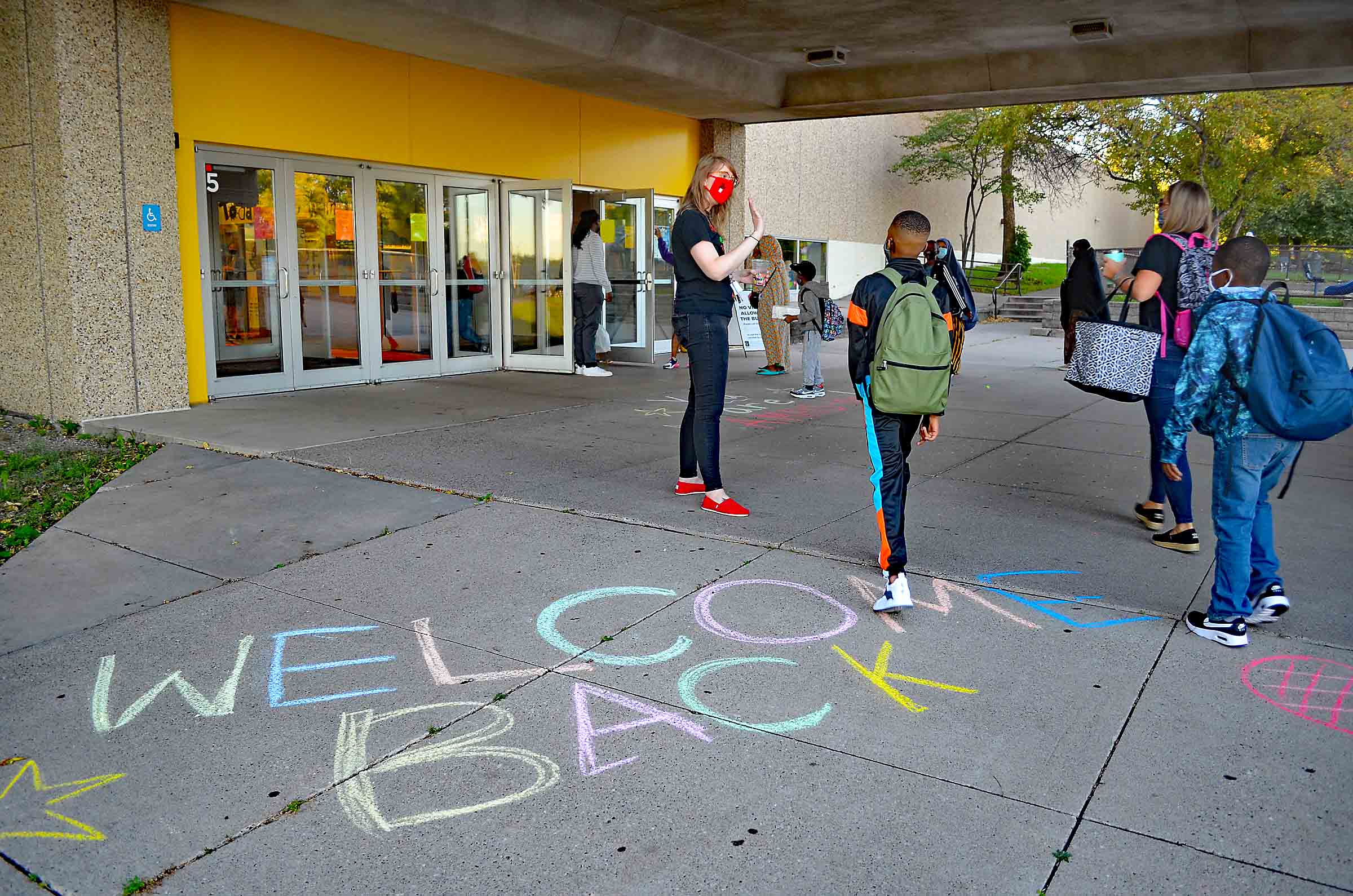
On the first day of school Benjamin E. Mays elementary school in St. Paul last year, teachers greeted returning students at with sidewalk chalk and confetti.

As public schools across Minnesota scramble to fill open positions before classes resume, union members coming back to work this fall asked families for patience, and called on school leaders to offer more incentives – financial and professional – to ease the staffing shortage.

“The working conditions in our schools have suffocated many teachers’ passion for teaching,” said Dr. Mara Borges-Gatewood, who teaches English-language learners in the White Bear Lake district. “There are just so many things being asked from us, and we can’t do them anymore.”

U.S. schools are looking to fill 300,000 positions nationwide, according to an estimate from the nation’s largest teachers’ union, the National Education Association (NEA).

It’s likely to be a rocky start to the school year for many, and Education Minnesota President Denise Specht asked for patience from parents and students.

“Take a breath and remember that the educators and staff who chose to come back this fall did so because they really care about the students and want them to succeed,” she said.

Staffing challenges hit school districts hard after the COVID-19 outbreak, but Borges-Gatewood and other school employees, speaking during a press conference today, said the issues driving workers to leave began well before the pandemic. They include unsustainable workloads, uncompetitive pay and, for hourly workers, lack of access to unemployment-insurance benefits.

Brooke Malek, a licensed school nurse in the Morris Area School District, said nurses are stretched thin across multiple school buildings, with many “leaving for better paying jobs.” Jeanne Fox, an education support professional from Osseo, said her district nickeled and dimed support staff in contract negotiations, despite piling on responsibilities – like covering for absent classroom teachers – over the last two years.

“This extra workload burnt out a lot of school support staff,” Fox said. “They’re expected to step up to the plate, but their extra effort didn’t result in more pay.”

The State of Minnesota’s projected $9.4 billion budget surplus offered lawmakers an opportunity to give school districts more funds to recruit and retain workers. But Republicans who control the Senate never took up a spending package, backed by Gov. Tim Walz and the DFL-controlled House, that would have delivered $1 billion to schools.

Lawmakers also failed to pass legislation that would extend unemployment benefits to hourly school employees in Minnesota, one of just a handful of states that bar school bus drivers, custodians, nutritional workers and others from access.

Without help from the Capitol, union members said, school districts should look for ways to collaborate with their employees to address to the staffing crisis.

Cat Briggs, a bus driver in the Rosemount-Apple Valley-Eagan district, said her union, SEIU Local 284, bargained for higher wages and a retention bonus. It also helped identify opportunities to merge part-time jobs – like crossing guard and bus monitor – into more attractive, full-time positions with benefits.

“We’re calling on every district in the state to make these jobs a career,” Briggs said. “Get all the jobs, including the starting wages, above poverty level.”

Education Minnesota’s think tank, the Educator Policy Innovation Center, released a report earlier this month analyzing firsthand accounts from educators about the challenges of working through the pandemic – and what changes are needed to keep more from leaving the profession.

Authors recommended giving educators more time to build relationships and collaborate within the school community, a greater say in school policies and more authentic opportunities for professional development.

“We can lighten loads; we can take stress off of people’s plate,” said Specht, president of the statewide educators’ union. “We can reach out to licensed staff who have chosen to walk away from teaching and ask them why, ask them what they need to come back.”