Educators call on MN lawmakers to restore the promise of their pension

Members of Education Minnesota rallied for pension reform Feb. 29 at the Capitol.

Hundreds of educators from across Minnesota packed the Capitol rotunda yesterday to demand that lawmakers fix inequities in the state-run pension plan covering most public school employees.

Several DFL legislators joined the rally and pledged to advance legislation that would invest some of the state’s projected $3.7 billion surplus into educators’ pension fund and reduce financial penalties some longtime educators face when looking to retire before age 66.

“Penalties are for hockey, not for pensions,” Sen. Heather Gustafson (D-Vadnais Heights) said, shouting out a hand-made sign that one educator brought to the Thursday-afternoon event.

Rep. Kaohly Her (D-St. Paul), chair of the Legislative Committee on Pensions and Retirement, said the newly announced surplus gives the state an opportunity to live up to its responsibility to education workers.

“We have a promise that we made to you that we would take care of you if you sacrificed the best years of your lives to take care of our children,” Her said. “That is why we need to do right by all of you.”

The statewide educators’ union, Education Minnesota, is making pension reform a legislative priority as disparities that have been baked into the Teachers Retirement Association since 1989 are coming to a head.

That’s when state lawmakers scrapped the “Rule of 90” – a formula that allowed pension participants to retire early with full benefits based on their combined age and years of service – for school employees hired after June 30, 1989, creating a two-tier system.

Now, thousands of “Tier II” teachers with 30-plus years of experience are facing a difficult choice that their colleagues hired before the cutoff never faced. They can work until age 65 and retire with a full pension, or retire early and lose a significant amount of their benefit to penalties.

Educators at the rally said the new system is bad for teachers, students and school districts.

“We have trapped teachers into staying beyond their own expectations of themselves,” Eastview High School social studies teacher Joe Wollersheim said. “Because it is so financially irresponsible to leave before a certain age, teachers are staying when they know they are not as effective as they want to be. And district budgets are squeezed, as they continue paying those at the top of the pay scale.”

Minnesota’s pension tiers not only create inequities within the state’s education workforce, but they also put Minnesota educators behind their colleagues in neighboring states. In Iowa, Michigan, Wisconsin, North Dakota and South Dakota, the combined average age at which an educator can retire without pension reductions is 57.

Gustafson, herself a “Tier II” participant in the teachers’ pension plan, introduced a bill this session that would reduce penalties for early retirement. She said making the pension benefit more attractive would help schools attract and retain teachers at a time when most districts are short staffed.

“I know just how much we sacrifice financially to do the job,” she said. “We put our hearts, our souls, our tears and very often our own money into this job, and for most of us the one thing we have to rely on is that when we’re done, we’ll have a pension.”

Whether Minnesota educators can continue to rely on that promise – “a promise that we earned, that we paid for with every paycheck,” Education Minnesota President Denise Specht said – is up to lawmakers.

“We are not asking for a favor,” Specht said. “We are asking for fairness.”

– Michael Moore, Union Advocate editor
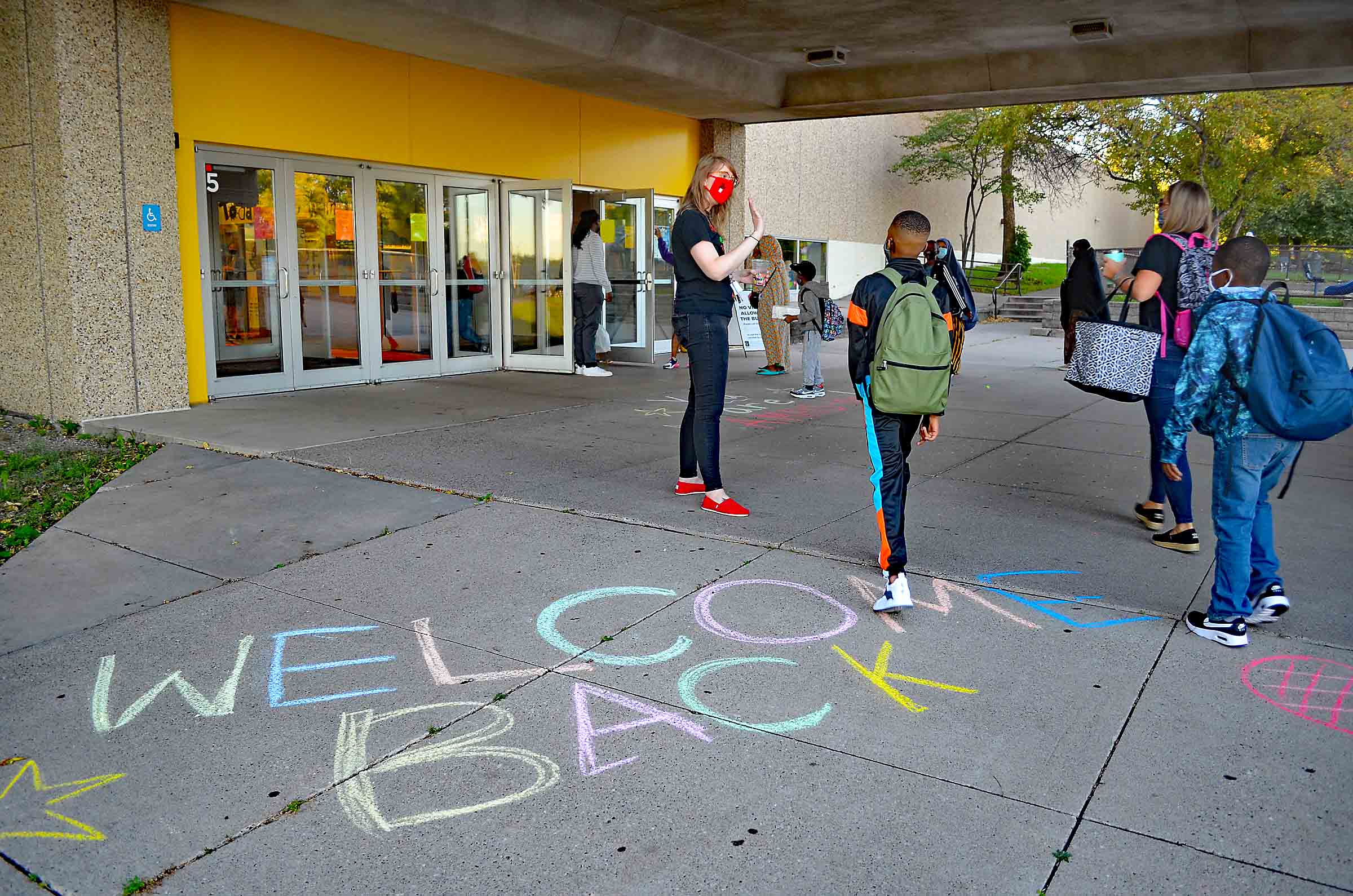
Staffing crisis prompts school employees to ask for support, patience

On the first day of school Benjamin E. Mays elementary school in St. Paul last year, teachers greeted returning students at with sidewalk chalk and confetti.

As public schools across Minnesota scramble to fill open positions before classes resume, union members coming back to work this fall asked families for patience, and called on school leaders to offer more incentives – financial and professional – to ease the staffing shortage.

“The working conditions in our schools have suffocated many teachers’ passion for teaching,” said Dr. Mara Borges-Gatewood, who teaches English-language learners in the White Bear Lake district. “There are just so many things being asked from us, and we can’t do them anymore.”

U.S. schools are looking to fill 300,000 positions nationwide, according to an estimate from the nation’s largest teachers’ union, the National Education Association (NEA).

It’s likely to be a rocky start to the school year for many, and Education Minnesota President Denise Specht asked for patience from parents and students.

“Take a breath and remember that the educators and staff who chose to come back this fall did so because they really care about the students and want them to succeed,” she said.

Staffing challenges hit school districts hard after the COVID-19 outbreak, but Borges-Gatewood and other school employees, speaking during a press conference today, said the issues driving workers to leave began well before the pandemic. They include unsustainable workloads, uncompetitive pay and, for hourly workers, lack of access to unemployment-insurance benefits.

Brooke Malek, a licensed school nurse in the Morris Area School District, said nurses are stretched thin across multiple school buildings, with many “leaving for better paying jobs.” Jeanne Fox, an education support professional from Osseo, said her district nickeled and dimed support staff in contract negotiations, despite piling on responsibilities – like covering for absent classroom teachers – over the last two years.

“This extra workload burnt out a lot of school support staff,” Fox said. “They’re expected to step up to the plate, but their extra effort didn’t result in more pay.”

The State of Minnesota’s projected $9.4 billion budget surplus offered lawmakers an opportunity to give school districts more funds to recruit and retain workers. But Republicans who control the Senate never took up a spending package, backed by Gov. Tim Walz and the DFL-controlled House, that would have delivered $1 billion to schools.

Lawmakers also failed to pass legislation that would extend unemployment benefits to hourly school employees in Minnesota, one of just a handful of states that bar school bus drivers, custodians, nutritional workers and others from access.

Without help from the Capitol, union members said, school districts should look for ways to collaborate with their employees to address to the staffing crisis.

Cat Briggs, a bus driver in the Rosemount-Apple Valley-Eagan district, said her union, SEIU Local 284, bargained for higher wages and a retention bonus. It also helped identify opportunities to merge part-time jobs – like crossing guard and bus monitor – into more attractive, full-time positions with benefits.

“We’re calling on every district in the state to make these jobs a career,” Briggs said. “Get all the jobs, including the starting wages, above poverty level.”

Education Minnesota’s think tank, the Educator Policy Innovation Center, released a report earlier this month analyzing firsthand accounts from educators about the challenges of working through the pandemic – and what changes are needed to keep more from leaving the profession.

Authors recommended giving educators more time to build relationships and collaborate within the school community, a greater say in school policies and more authentic opportunities for professional development.

“We can lighten loads; we can take stress off of people’s plate,” said Specht, president of the statewide educators’ union. “We can reach out to licensed staff who have chosen to walk away from teaching and ask them why, ask them what they need to come back.”

Wait for vaccines to reopen schools, St. Paul educators say

Hamza Dirie, 9, shows support for teachers’ safety during a car rally staged by the St. Paul Federation of Educators.

St. Paul educators, parents and community members wary of the district’s plan to resume in-person learning staged a car rally Jan. 12, calling on administrators to hold off on reopening buildings until COVID-19 vaccines are available to school staff.

St. Paul Public Schools plans to begin a phased-in reopening of elementary schools and some other programs Feb. 1, with new guidelines, protocols and facilities upgrades in place to prevent the virus’ spread among students and staff.

Those measures drew skepticism from rally-goers like Brittany Livaccar, an emergency-room nurse at United Hospital who drove to the rally with her family of five. She said district leaders should reconsider their timeline now that restaurants, bars and gyms are open, and a more contagious strain of the virus is spreading.

“Our hospitals are going to be overwhelmed soon, so it’s really important we keep our students and teachers safe,” said Livaccar, a member of the Minnesota Nurses Association. “I know it’s difficult, but we can’t go backwards now, when our COVID numbers are still high and we don’t have a vaccine for everyone.”

The SPPS plan for reopening received a vote of no confidence from members of the St. Paul Federation of Educators Executive Board, the union’s president told supporters at the car rally.

“We want to keep our community safe, we want to keep our students safe and we want to keep our members safe,” SPFE President Nick Faber said. “That’s why we are here tonight.”

Union members and supporters will be back in the streets tomorrow, Jan. 19, rallying outside Central high school from 4:30 to 5:30 p.m. The district’s Board of Education is scheduled to meet later that evening.

Vaccines are coming

After across-the-board shutdowns last spring, Minnesota school districts have navigated COVID-19 differently during the 2020-21 school year. But none of the myriad local learning models has managed to avoid disruptions and frustrations resulting from the outbreak.

To create more certainty for the state’s youngest learners, Gov. Tim Walz in December eased guidelines for opening elementary schools, allowing districts to reopen classrooms even if community spread of the virus is higher than previously allowed.

But educators warn that, regardless of guidelines, community spread will impact schools’ ability to remain open – at least until their frontline workers are vaccinated.

“One of the hard lessons we’ve all learned from this pandemic is that you can’t operate schools when the virus is spreading too fast through the community because too many educators get sick or go into quarantine,” Education Minnesota President Denise Specht said. “Wearing masks, washing hands, keeping your distance – these are the choices that will decide when our school buildings reopen and stay open.”

Educators got some good news Jan. 18, when Walz’s administration unveiled a pilot program to prioritize vaccination of school staff and child care workers. But officials emphasized that the state’s allotment of vaccine doses from the federal government remains limited.

“While we do not have enough doses for everyone who wants a vaccine to receive one right away, we are building the system and structure so that once we receive those additional doses from the federal government, we can move quickly to support our school staff and bring even more students back into our classrooms,” Deputy Education Commissioner Heather Mueller said.

A plea for patience

At the rally in St. Paul last week, union members and parents urged district leaders to hold off on in-person learning until it’s clear students and educators returning to the classroom are there to stay.

“We are so close to finally feeling comfortable returning to our classrooms,” Bridge View elementary teacher Christin Fleming said. “Being vaccinated would be an absolute game changer.”

Reopening before it’s safe, SPFE leaders warned, will cost the district qualified educators at a time when they are in short supply.

Results of an Education Minnesota survey released last fall showed a majority of members who responded said teaching during the pandemic has left them stressed, anxious and overwhelmed. Nearly three in 10 were thinking about quitting or retiring, and applications for pension benefits were on the rise.

A post on SPFE’s social-media account in the days following the car rally reported that two kindergarten teachers assigned to in-person learning at one elementary school in the district already have resigned.

Janet Nelson has seen the attrition firsthand while working in the district’s child-care program for essential workers’ families. The SPFE member said staff turnover is a “constant challenge” for the program. Among staff assigned to the site when the school year began in September, Nelson said, she’s the only one still working there.

Faber and other union leaders pledged to keep pressure on SPPS to alter its course, urging supporters to sign an online petition to Superintendent Joe Gothard and contact members of the school board individually.

“It is not too late to turn this around,” Faber said.

Labor-endorsed candidates back investments in public education, from pre-K to higher ed

Supporters line the sidewalk outside St. Paul Public Schools headquarters during a rally in support of the teachers' contract campaign.

Bold investments in public schools and early learners. Higher education that’s affordable for working families. An aggressive approach to narrowing the achievement gap between white students and students of color.

Labor-endorsed candidates have high hopes when it comes to education in Minnesota, but they will need to win a majority in the House – and maintain one in the Senate – to see their hopes turn into results.

“With a DFL majority in the House and Senate we can continue our work to build a positive future for Minnesota working families by investing in education at all levels,” labor-endorsed Sen. Greg Clausen, a longtime administrator in the Rosemount-Apple Valley-Eagan school district, said.

Clausen speaks from experience. With DFL majorities during his first two years in office, 2013-14, lawmakers expanded all-day kindergarten statewide and paid back money borrowed from school districts – over Gov. Mark Dayton’s objections – during a budget shortfall in 2011.

But efforts to think big during the last session, including Dayton’s push for a major investment in pre-kindergarten, fell flat. In a compromise, lawmakers settled on 2 percent annual increases in state funding and a modest pilot program for pre-K.

Don Slaten, a union retiree from Hastings seeking office in House District 54B, said he was disappointed to see school funding fail to keep up with inflation. “Republicans offered six-tenths of a percent, and they finally settled on 2 percent,” Slaten said. “We can do better.”

Slaten and other labor-endorsed candidates want to expand the $25 million pre-K program to meet existing demand. Nearly 7,000 four-year-olds missed out on pre-K because the pilot project lacked sufficient funding.

They also want to make investments in higher education, where state funding dipped by 55.8 percent from 1980 to 2011.

“By defunding higher education, we have essentially imposed a tax on behavior that we absolutely want to encourage – obtaining a secondary degree,” Matt Klein, the labor-endorsed candidate in Senate District 52, said. “Our state is a top draw for employers because we have an educated workforce. If we create barriers to higher education, our state economy will suffer.”

Education Minnesota President Denise Specht said legislative horse trading and last-minute compromises haven’t served students well.

“Gridlock doesn’t hurt the people at the top, but the rest of us need the Legislature to do its job and give a hand up to working families,” she said. “In education, that means investing in our state’s future by giving every child access to high-quality pre-K and taking on the teacher shortage so every student has the opportunity to learn from an experienced, well-qualified teacher.

“Preparing young people for successful lives has never been more challenging. Educators and parents need more partners at the Capitol.”

Staff cuts at embattled St. Paul charter school target union leaders

Community School of Excellence is a charter school focused on Hmong language and culture in St. Paul's North End.

Community School of Excellence is a charter school focused on Hmong language and culture in St. Paul’s North End.

A St. Paul charter school’s campaign to deny employees a voice on the job reached a new low yesterday, when administrators announced a wave of staff cuts eliminating several key areas of classroom programming and decimating the union’s bargaining team.

The number of teachers and support staff let go remains in flux, union leaders said this morning, but at least 22 teachers and all 30 aides at the Community School of Excellence have been told they will not return next school year. Among them are four members of the union’s five-person negotiating team.

“We had finally been making some progress at the negotiating table, with a number of (issues) tentatively agreed upon,” said Blythe Inners, president of the bargaining unit, whose job teaching English language learners was among the cuts. “But this move by the administration certainly appears aimed at slowing that down.”

Inners said teachers and staff members are holding out hope that administrators will reverse the cuts and do what’s necessary to save the school they helped to establish. Staff and supporters plan a show of solidarity at tonight’s school board meeting, scheduled to begin at 4:30 p.m. at 170 Rose Ave. W. 

“The educators of CSE have been working for years to build a school that serves the special needs of its community,” Inners said. “More than three quarters of our students are English language learners and we’re proud of their progress. We’re willing to keep fighting to provide the education our students need to thrive.”

CSE, located in the North End, delivers a curriculum focused on Hmong language and culture. About 100 teachers and other staff members voted two years ago to join the Federation of Charter School Employees, an affiliate of Education Minnesota.

Since then, school administrators have dragged out negotiations of a first contract and refused to respect employees’ decision to unionize.

The school drew a stiff rebuke from the National Labor Relations Board last year for retaliating against union supporters with disciplinary actions, and in January the NLRB’s regional director dismissed an attempt by CSE to decertify the union, citing a “tainted” atmosphere.

The current wave of layoffs, Education Minnesota President Denise Specht said, is an indication that CSE hasn’t changed its ways.

“We’re shocked a school would decimate its curriculum to punish its employees for exercising their right to bargain collectively,” Specht said. “It’s appalling that a school for an immigrant community would deny its students access to dedicated teachers of English language learners, gifted and talented programs, educational support staff and media specialists.”

CSE’s troubles prompted its original authorizing organization, Concordia University, to drop the school. All Minnesota charter schools must have the backing of a legal authorizer, and if CSE does not find a new one by July 1, it will be forced to close.

Ironically, CSE’s best hope for opening at all next year may be with the Minnesota Guild, a charter-authorizing organization sponsored by the Minneapolis Federation of Teachers. The Guild’s governing board includes current and former local union presidents, who are unlikely to look kindly on layoffs targeting union activists.

“We urge the administrators of the Community School of Excellence to reconsider these foolish and vindictive staff cuts and save their school,” Specht said. “The more than 86,000 members of Education Minnesota are standing behind the educators of CSE today. We will help them save their school, which they helped build with dedication and caring. But if the school cannot be saved from the destructive decisions of its current leaders, we will be there to assist our colleagues in the next stages of their careers.”

Friedrichs is history (maybe), but Minnesota workers aren’t letting their guard down

Workday Minnesota Editor Barb Kucera (L) moderated a panel discussion with public-sector union leaders, including (L to R) Debbie Prokopf of MAPE, Tee McClenty of MSEA and Denise Specht of Education MN.

Workday Minnesota Editor Barb Kucera (L) moderated a discussion with public-sector union leaders (L to R) Debbie Prokopf of MAPE, Tee McClenty of MSEA and Denise Specht of Education MN.


Labor History Month kicked off in St. Paul last night with a discussion of history in the making, as panelists offered insight into public-sector workers’ recent push to breath new life into their unions and defend their right to a voice on the job.

The public forum, titled “The Friedrichs Case and the Future of the Labor Movement,” opened Untold Stories, the labor-history series staged annually in May by The Friends of the St. Paul Public Library, with support from a number of unions.

[Programming continues tomorrow with an author talk at the Merriam Park Library. Click here to view details and a full lineup of events.]

At last night’s forum, held at the new St. Paul Labor Center, leaders of three Minnesota unions that represent public-sector workers reviewed recent legal and legislative challenges to their organizing rights – and talked about the ways their organizations are responding.

Debbie Prokopf, attorney and business agent for the Minnesota Association of Professional Employees, said corporate-backed politicians and anti-worker legal funds seemingly come up with new ways to “chip away” at public-service workers’ rights every day.

“They’re trying all these wacky, right-wing theories to see what sticks,” Prokopf said, pointing to measures that would require unions to hold recertification votes every year and to negotiate in public, or would severely limit the scope of their contract talks.

Such attacks never gained traction in Minnesota, and that allowed many public-sector unions to “become very complacent,” Education Minnesota President Denise Specht acknowledged. “With our state’s strong labor laws, we’ve taken a lot for granted.”

Two developments woke Minnesota’s public-sector unions out of that slumber.

First, Wisconsin Gov. Scott Walker, after making scapegoats of teachers and other public workers on the campaign trail, signed legislation designed to cripple their collective bargaining power. And working people in this neighboring state took notice.

The first Untold Stories event of 2016 took place in the new St. Paul Labor Center, at 353 W. 7th St.

The first Untold Stories event of 2016 took place in the new St. Paul Labor Center, at 353 W. 7th St.

“When unions aren’t able to do their work, then we get Wisconsin,” Specht said. “They’re kind of the poster child now – but not in a good way – and that’s helped us in getting our members to realize what’s at stake.”

The U.S. Supreme Court raised those stakes even higher last year when it agreed to hear Friedrichs v. CTA. The case challenged public-sector unions’ ability to collect fair-share fees from workers they represent, and during oral arguments in January, the court’s conservative majority appeared poised to issue a ruling that would make “Right to Work” the law of the land in the public sector.

‘Don’t wast a good crisis’

The writing, it seemed, was on the wall, and public-sector unions last year began scrambling to convert as many “fair-share fee-payers” into full union members as they could before the court issued its ruling.

The Minnesota School Employees Association, which represents 6,000 workers in more than 60 school districts statewide, set a course for signing up 5 percent of its fee-payers.

Executive Director Tee McClenty said the union surveyed fair-share fee-payers and found many had no idea they weren’t paying full dues. MSEA trained stewards, rank-and-file members and staff for one-on-one conversations about fee-payers’ issues and concerns. And within 11 months, the union had reached its goal.

MAPE and Education Minnesota, as well as unions like AFSCME and SEIU, rolled out similar internal-organizing initiatives, with similarly successful results.

“They say don’t waste a good crisis,” Prokopf said. “And I think Friedrichs was a very good crisis for us in that it shook us out of our complacency.”

Bullet or boomerang?

Ironically, the doomsday ruling anticipated in the Friedrichs case never came. After conservative Justice Antonin Scalia died, the court issued a 4-4 decision upholding the status quo.

Will public-sector unions in Minnesota let down their guard again? Not likely, panelists said.

“We didn’t dodge a bullet; we dodged a boomerang,” Prokopf said of Friedrichs, noting that plaintiffs in the case already have filed for a second hearing before the court. “It’s coming back.”

McClenty said MSEA’s annual delegate assembly last month included a training session on Friedrichs.

“People were like, ‘What? We’re done with this now,’” McClenty said. “But we can’t get too comfortable. We feel like there’s momentum happening at MSEA, and we want to keep it going.”

Even if a pro-worker justice replaces Scalia, attacks on public-sector workers at the legislative level – including a “poison pill” attachment to the bill approving state workers’ contracts this session – aren’t likely to stop anytime soon.

“We’re not going to let up,” Specht said. “This is the labor movement at stake. We’re all depending on each other to be strong. We’re going all in, and we’re not stopping.”

Unions praise Dayton’s approach to building a ‘state that works for everyone’

MNSTOSIn his State of the State Address last night, Minnesota Gov. Mark Dayton called on legislators to join him in addressing the state’s racial and geographic disparities, and in making needed investments in public education, transportation and infrastructure.

Afterward, union leaders from across the state praised Dayton’s speech.

Education Minnesota President Denise Specht called Dayton the “Education Governor.” Minnesota AFL-CIO President Bill McCarthy said he “demonstrated his commitment to ensuring that Minnesota is a state that works for everyone, not just the wealthy few.”

“Hardworking Minnesotans have always formed the backbone of our economy,” AFSCME Council 5 Director Eliot Seide added. “We applaud Gov. Dayton’s focus on infrastructure, transportation, and expanding economic opportunity for all Minnesotans. Those smart investments will help build a better Minnesota that works for all of us.”

Supporting workers left behind

Early in the address, Dayton reiterated his support for extending aid to Iron Range workers suffering from a slowdown in the mining industry and to minority communities that have yet to reap the benefits of Minnesota’s economic recovery.

Illegally dumped foreign steel has flooded the U.S. market, leading Iron Range mining companies to lay off an estimated 2,000 workers in the last year. The slowdown has impacted an additional 4,700 workers in mining-related jobs.

A relief package would extend unemployment benefits for about 2,750 workers, but Republicans, who control the House of Representatives, insist on pairing the relief package with tax breaks for businesses.

“To hold $29 million of desperately needed unemployment benefits hostage to $272 million in fund cuts is unnecessary,” Dayton told Republicans. “And it’s cruel.”

Dayton also cited several sobering statistics regarding racial and ethnic disparities in the state. Compared with Minnesota’s white families, he said, U.S.-born African American families’ annual income is 55 percent less, and their poverty rate is more than 4 times greater. Mexican-American, Ojibwe and Somali families also have fallen behind.

“We cannot resolve these disparities in one legislative session, but we must begin now,” Dayton said, pledging a “significant initiative” to increase economic opportunities for Minnesotans of color.

He also called on the state’s businesses to increase its outreach into minority communities and set a goal of doubling the percentage of minorities working in state government by the time he leaves office.

Modest investments, targeted tax cuts

As for how to approach Minnesota’s $900 million budget surplus for the next two years, Dayton said he would support pairing “modest spending increases” with tax cuts targeted for middle-class families, like an increase in the child-care tax credit.

But the governor, who faced a $6 billion budget shortfall when he took office in 2011, emphasized the importance of keeping the state on firm financial footing.

“Some people are proposing permanent tax cuts, which would put our state’s budget, once again, on a fiscal precipice,” he said.

“What we have been doing is working,” Dayton added. “Minnesotans are working. Minnesota is working. How could we stop now, when there is more work left to do?”

Investments in statewide broadband access, clean energy, rural water-treatment facilities, infrastructure, roads and bridges would create jobs and expand economic opportunities statewide, Dayton said. And he renewed his call for greater investment in early education to “prevent achievement gaps before they appear.”

Specht, president of the statewide educators’ union, praised Dayton’s support for learners at all levels.

“Gov. Dayton understands the foundation of our state is a great system of public education that prepares all students for successful lives,” she said. “His commitment to expand access to high-quality preschool and to support public colleges and universities will reduce the opportunity gaps which hold back too many of our students.”

‘Vote Yes’ campaigns in school districts across East Metro win labor support

12036412_489470271235376_258311348679741501_nVoters in the Forest Lake Area School District last year rejected a $176 million levy request, leaving the district’s facilities in critical need of updates and repair.

Now, the district is back with another request on the Nov. 3 ballot, seeking $161 million over two unique referendums. Supporters of the local “Vote Yes” campaign, including parents, students and local unions, acknowledge facing an uphill climb.

But Forest Lake Education Association President Allison Whittlef said she’s holding out hope “due to the grassroots movement of community champions who are actively seeking support and communicating with residents in a variety of ways.

“With the passage of this bond an already robust education setting will be made stronger by providing quality facilities and improved opportunities for all learners. But help is needed from the local level to make a good system great.”

The Forest Lake district isn’t alone in seeking support from local taxpayers. A recent survey of the state’s school districts, conducted by the Minnesota School Boards Association, showed a record 68 districts seeking building bond or capital project levies this year, in addition to 53 districts seeking operating levies.

Education Minnesota President Denise Specht said it’s difficult to generalize the many reasons districts put levies on the ballot. Enrollment increases and aging schools are contributing factors, she said, as are rising costs of transportation, health care, security and information technology.

School districts have seen the state’s per-pupil funding formula increase each year that Mark Dayton has served as governor. But Specht said those increases haven’t made up for a decade of disinvestment prior to the Dayton administration, when state funding failed to keep pace with inflation.

“Getting back to even could take a few more years,” she said. State funding increases, Specht added, often go toward operating costs, leaving little left over to pay for capital improvements – like repairing a leaky roof in Forest Lake, or updating the technology available to students in the Lakeville Area Public Schools.

“Our per-pupil funding from the state is currently at 2004 levels when adjusted for inflation,” said Don Sinner, president of the Lakeville teachers’ union. “After several years of cuts, we need to finally provide the children of our communities, every single one of them, with the high-quality learning environment and opportunities they deserve – and the economy of the future needs.”

Levies enjoy broad labor support, both in the East Metro and statewide – and not just because school districts employ a lot of union members. Strong schools help build strong communities, Whittlef said.

“With the passage of the bond, our community will prosper by attracting families and businesses to our area,” Whittlef said. “That in turn will create expanded job and career opportunities for our fellow brothers and sisters.”

Other labor-endorsed “Vote Yes” campaigns in the East Metro include referendums in the Farmington, North St. Paul-Maplewood-Oakdale, Rosemount-Apple Valley-Eagan and South Washington County school districts. Click here to view a full list of labor endorsed school referendums and candidates on the Nov. 3 ballot across the East Metro.

Dayton, DFL legislators reversed trend of dwindling support for schools

UA layout_UA layoutJeff Johnson, the Republican nominee for governor, provided a glimpse of his leadership style May 15, telling a Tea Party group he would “go all Scott Walker on Minnesota” if elected Nov. 4. So what is it about Walker’s Wisconsin that Johnson believes is worth replicating?

To answer that question – and to get a sense of what a Johnson administration might mean for union families – we’re analyzing the different approaches taken by Walker and labor-endorsed Minnesota Gov. Mark Dayton on four key issues over the last four years:

[Related: A governor who will ‘go all Scott Walker’ on Minnesota? No thanks, unions say.]

Education. In addition to slashing teachers’ benefits and bargaining rights, Walker cut state funding for public school districts in Wisconsin by $834 million in his first year in office. That’s roughly the amount of new funding the state has funneled into public schools during Dayton’s four years in office.

Stephanie Bloomingdale, secretary-treasurer of the Wisconsin AFL-CIO, called Walker’s first education budget “the largest cut to schools in state history.” With 73 percent school districts in Wisconsin cutting staff or programming as a result of the budget cuts, she added, “our children are paying the price.”

Education Minnesota President Denise Specht, who leads the state’s largest union of school employees, warned that Johnson would lead Minnesota down a similar path.

“Walker has been a disaster for Wisconsin students, so it’s baffling why someone running for office in Minnesota would choose him as a role model,” she said. “Wisconsin is now investing $1,000 less per student than in 2008, which means the Wisconsin workforce will be at a competitive disadvantage for decades.”

Walker also has expanded Wisconsin’s private-school voucher program, which Specht called “out of control.” According to published reports, the voucher program has funneled $139 million from state coffers into failing private schools over the last 10 years – funds that could otherwise have supported public school districts.

Minnesota, meanwhile, is on the opposite path.

As a candidate, Dayton pledged to reverse a decade-long trend of dwindling support for Minnesota’s public schools. With help from pro-worker majorities elected to the Legislature two years ago, he signed bills to repay more than $2 billion borrowed from school districts, reduce class sizes and guarantee statewide access to all-day kindergarten.

That progress is at risk if Johnson is elected governor, Specht said

“If you’re in a working family that cares about the education of your children, there’s something you should know when you hear someone say he wants ‘go all Scott Walker’ on your state,” Specht said. “You should know that is a threat you can’t ignore.”

Teachers will make anti-bullying law a priority at Capitol next year

i_heart_safe_schools_cta_bannerAs the 2013 Legislative Session drew to a close in May, supporters of a bill to strengthen Minnesota’s anti-bullying laws made one last push, urging their state senators to vote on the Safe and Supportive Schools Act, which had already won approval in the House.

The session gaveled to a close before senators could take that vote, but members of Education Minnesota, the statewide educators’ union, will help kick off a campaign next week to make sure the anti-bullying bill gets a vote in 2014.

Education Minnesota President Denise Specht said members have been vocal in support of efforts to prevent bullying in schools, prompting union leaders to declare the bill, which would give Minnesota the nation’s strongest anti-bullying laws, a top priority for the upcoming session.

“Our members know that in order for students to do well, we need safe and welcoming schools,” Specht said. “We’re stepping up our efforts to make sure the bill passes and gets over the finish line.”

That effort kicks off Sunday afternoon with a “call to action” at Minneapolis South High School, where students, parents, educators and community members will unite in support of the Safe and Supportive Schools Act. [Click here to view the event page on Facebook.]

On Monday, a national day of action in support of public education, Education Minnesota will co-host a press conference and rally in support of the anti-bullying bill at St. Paul Central High School. [Click here to view the event page on Facebook.]

Having teachers play a visible role in efforts to pass the Safe and Supportive Schools Act is critical, OutFront Minnesota Executive Director Monica Meyer said. Her organization gathered a coalition of supporters to push for new anti-bullying laws in 2009, and it has since attracted more than 100 member organizations, including Education Minnesota and the St. Paul Federation of Teachers.

“Teachers are looking at how to be proactive in addressing the bullying they are seeing, and how to create an environment in the schools that will help all students thrive,” Meyer said.

In a 2010 survey of Minnesota students, 13 percent reported that they were bullied at least monthly. A 2011 report from the U.S. Department of Education rated Minnesota’s anti-bullying law the weakest in the nation.

But parents and teachers don’t need statistics to know bullying is a problem.

“We know anecdotally, and we hear stories everyday from students and parents and teachers who see firsthand the bullying that exists,” Meyer said. “There’s a real hunger out there from Minnesotans to have the Legislature pass something that’s proactive about making our schools safe.”

Supporters say the Safe and Supportive Schools Act, co-authored by Sen. Scott Dibble and Rep. Jim Davnie, would replace the weakest anti-bullying law in the country with the strongest.

Instead of leaving bullying policy up to individual school districts, the bill would establish uniform policies in accordance with the Minnesota Human Rights Act. Doing so would protect all students, Meyer said, from discrimination or harassment “on the basis of anything from race, ethnicity or disability to immigration status, sexual orientation, gender identity or religious beliefs.”

“It’s a comprehensive policy,” Meyer added. “You really know that a lot of students can see themselves in it. We want to make sure they know that they are protected.”

The bill also would provide training opportunities, a key provision for educators.

“It speaks to training and resources for school staff, students and volunteers around bullying prevention and intervention,” she said.

Teachers plan to echo events in the metro Sunday and Monday across Greater Minnesota, Specht added. Education Minnesota members will be circulating petitions and having conversations with their school board members and lawmakers before the Legislature reconvenes Feb. 25.

“We’re going to show lawmakers how broad based the support is for passing this legislation,” Meyer said.

[Click here to sign a petition showing your support for safe schools!]