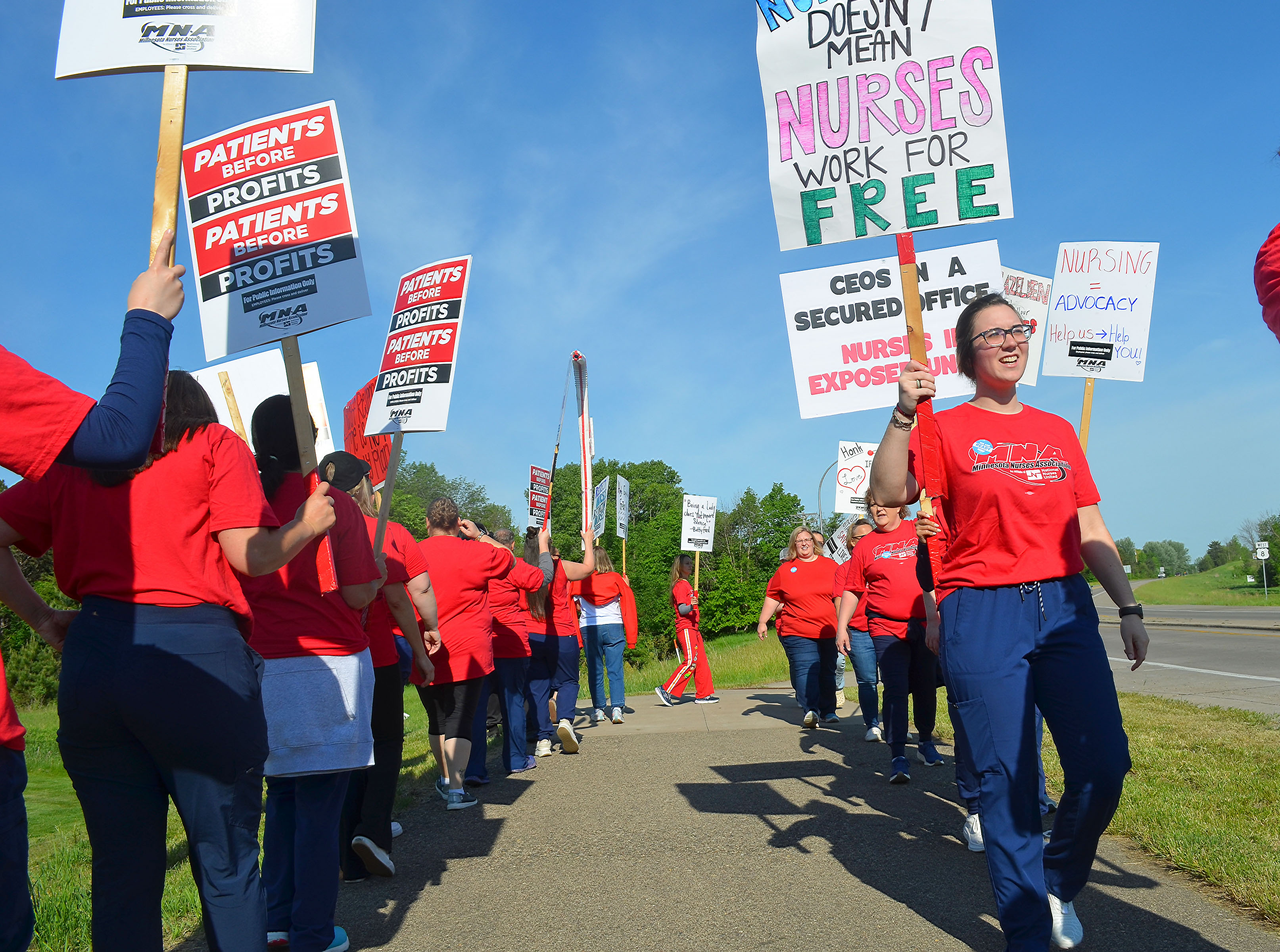
MNA members picket outside Hazelden Betty Ford’s facility in Center City.
Nurses bargaining a first union contract with the Hazelden Betty Ford Foundation held informational picketing June 2 at the renowned addiction-treatment facility in Center City, looking to raise awareness of their safety and staffing concerns.
Members of the Minnesota Nurses Association had hoped Hazelden administrators would take a collaborative approach to addressing the issues behind their vote to unionize in January 2025.
But those hopes have fizzled over 16 months of mostly unproductive talks.
“A lot of things that we propose, they’ll propose back that they don’t need it to be written out,” Cara Bergner, a registered nurse in Hazelden’s detox unit, said on the picket line. “They just want it up to management’s discretion, which kind of defeats the whole purpose of the contract.
“I think their hopes are that if they put it off, we’ll get tired and give up. But I don’t see that being the case.”
Anne Coleman, another registered nurse in the detox unit, said nurses are bargaining for changes that will make their jobs more sustainable – and they’re doing it because they believe in the Hazelden Betty Ford mission.
“We take people in a crisis situation who, a lot of the time, come in very broken, and I just love to see them get their lives back, to get the confidence and light back in their eyes,” Coleman said. “I love to see them heal.
 “We wouldn’t be here if we didn’t love the mission, the patients and the many things that Hazelden has done for the community and nationwide. But the healthcare system itself is broken, and, unfortunately, it’s trickled down to Hazelden.”
As the rate of violence against healthcare workers rises nationwide, Hazelden nurses are increasingly treating patients under the influence of highly potent drugs like fentanyl. Union members say de-escalation tactics, which they are trained to use when a patient becomes violent, are insufficient alone.
“We’re bringing in higher-acuity, more severe cases of people who have mental-health issues and severe addictions,” Bergner said. “We don’t have any other safeguards (besides de-escalation) and any true, straightforward protocols for staff members’ safety.”
In bargaining, nurses have floated proposals like round-the-clock security, panic buttons and minimum staffing levels. Some units, Bergner and Coleman said, have just one nurse on the floor at times, leaving staff overwhelmed.
Perhaps predictably, an increasing number of Hazelden nurses are leaving the bedside. Turnover has affected about a third of MNA’s 60-person bargaining unit of registered and licensed practical nurses, according to the union.
Coleman said factors behind the attrition include stagnant wages over the last two years, recent benefit cuts and management’s unwillingness to agree to measures that would make nurses feel safer and more supported on the job.
Newly hired nurses are leaving too. “They come here,” Bergner said, “and before they really get a love for the job, they’re like, ‘This space is crazy.’”
For nurses who remain, the turnover creates more short staffing and extends their shifts. Coleman said she has worked as many as 16 hours straight.
“I’m happy to do it because I want my patients to have the support they need and the safety,” she said. “However, it’s not sustainable.
“We’ve got so many experienced nurses who really, truly care for our patients that we’ve lost. All that we’re asking is for Hazelden to work with us.”
– Michael Moore, Union Advocate editor
 Union Advocate