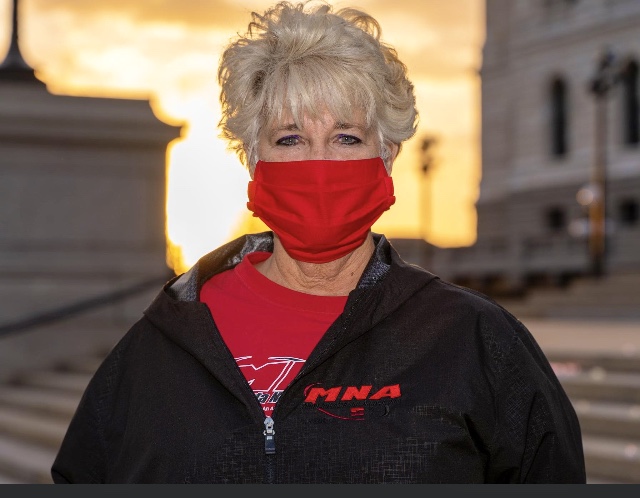
MN nurse on Biden task force: ‘I’m the one who brings reality’

MNA President Mary C. Turner

As the Biden-Harris administration assembled its COVID-19 Health Equity Task Force in the weeks following the inauguration, there was one health care leader the president asked for by name: Mary C. Turner, president of the Minnesota Nurses Association.

Turner had moved Biden to tears during a press conference roundtable in November 2020, as she described what she and other nurses working in North Memorial Health Hospital’s intensive care unit were experiencing at the height of the COVID-19 pandemic.

Turner accepted Biden’s appointment to the 12-member task force, but admits that she initially felt intimidated to be working among experts in public health and other fields, who were accustomed to high-level discussions of data and policy. “I’m just a bedside-care nurse, who the hell am I anyway?” she remembered thinking.

A phone call to Dr. Marcella Nunez-Smith, chair of the task force, erased any lingering doubts.

“She said this to me,” Turner recalled. “‘Out of all 12 people, you’re the only one President Biden knows personally. He said that Mary Turner is so passionate about her patients, we’ve got to have her on the task force. Just be who you are, and you’re going to be just fine.’”

The task force began meeting in late February and will deliver its final recommendations to President Biden in October. Turner discussed the experience this interview, which has been edited for length.

UA: When the task force began meeting, vaccine production was just starting to ramp up. How has the scope of its work changed since then?

MT: We’ve had different topics, everything from vaccine hesitancy to the mental health of frontline workers and children. Then we did personal protective equipment, testing and what do we might do for the next pandemic. We’ve had four subgroups that meet, too. It’s been a lot of reading, a lot of meetings.

UA: What perspective or guidance has the task force delivered to the administration?

MT: The topic we started out with, vaccine hesitancy and immunizations, was cool because we had recommendations right away that we got to the president. Now, that’s not to say every state used those suggestions, but I know we did here in Minnesota. One of the recommendations was for migrant workers, to actually go in vans and take the vaccines right to them. And going by zip codes, into neighborhoods – those were all recommendations that came in that first month.

We also were instrumental in pushing OSHA to implement emergency temporary standards (in June), which, unfortunately, only covered health care workers. In the final report, we are pushing not just temporary but permanently updated OSHA standards, rather than guidelines, for all workers.

UA: I imagine you’re guided here not just by your experience as a nurse, but also as a labor leader.

MT: It’s funny because one of the chairs of our committee is a hospital administrator. He’s trying to say we don’t want standards, we want guidelines. I say, ‘No we don’t! Guidelines aren’t enforceable!’ …

If OSHA would have implemented standards instead of guidelines from the start, so many (workers) wouldn’t have died. That’s the reality of it. Guidelines give our employers free rein to just think of the bottom line and not necessarily keeping workers safe. If I do nothing else on this task force but to push through permanent, updated OSHA standards, I’ll consider my work successful.

I’ll be honest, though. It seems like whenever we run into a problem, especially in health care access, inevitably somebody will say, ‘Mary, the only way that’s going to be solved is Medicare for all or some kind of system where everyone has health care.’ A lot of the issues with our pandemic are due to our broken health care system.

UA: How do you feel you’ve influenced the task force?

MT: I may not be the one who can bring all the fancy data, but what I am is the only frontline worker with eyewitness testimony. I’m the one who brings reality. They’re all wonderful people, but I’m the only one who has been not just in my COVID ICU, but at the forums and picket lines and actions, where I have been with other frontline workers from different industries. I’ve heard all their stories. I am the dose of reality.

UA: What is it like to work closely with these experts, and then turn on the TV or log into social media and see disinformation on full blast?

MT: I think we all have a family member who’s in denial and watches more YouTube than they should. But it’s heartbreaking at the bedside for me. People coming in now, unvaccinated, it’s so tragic. That’s what all of that misinformation is doing. So it’s almost a joy to go back to any meeting of the task force and be back to reality.

Wait for vaccines to reopen schools, St. Paul educators say

Hamza Dirie, 9, shows support for teachers’ safety during a car rally staged by the St. Paul Federation of Educators.

St. Paul educators, parents and community members wary of the district’s plan to resume in-person learning staged a car rally Jan. 12, calling on administrators to hold off on reopening buildings until COVID-19 vaccines are available to school staff.

St. Paul Public Schools plans to begin a phased-in reopening of elementary schools and some other programs Feb. 1, with new guidelines, protocols and facilities upgrades in place to prevent the virus’ spread among students and staff.

Those measures drew skepticism from rally-goers like Brittany Livaccar, an emergency-room nurse at United Hospital who drove to the rally with her family of five. She said district leaders should reconsider their timeline now that restaurants, bars and gyms are open, and a more contagious strain of the virus is spreading.

“Our hospitals are going to be overwhelmed soon, so it’s really important we keep our students and teachers safe,” said Livaccar, a member of the Minnesota Nurses Association. “I know it’s difficult, but we can’t go backwards now, when our COVID numbers are still high and we don’t have a vaccine for everyone.”

The SPPS plan for reopening received a vote of no confidence from members of the St. Paul Federation of Educators Executive Board, the union’s president told supporters at the car rally.

“We want to keep our community safe, we want to keep our students safe and we want to keep our members safe,” SPFE President Nick Faber said. “That’s why we are here tonight.”

Union members and supporters will be back in the streets tomorrow, Jan. 19, rallying outside Central high school from 4:30 to 5:30 p.m. The district’s Board of Education is scheduled to meet later that evening.

Vaccines are coming

After across-the-board shutdowns last spring, Minnesota school districts have navigated COVID-19 differently during the 2020-21 school year. But none of the myriad local learning models has managed to avoid disruptions and frustrations resulting from the outbreak.

To create more certainty for the state’s youngest learners, Gov. Tim Walz in December eased guidelines for opening elementary schools, allowing districts to reopen classrooms even if community spread of the virus is higher than previously allowed.

But educators warn that, regardless of guidelines, community spread will impact schools’ ability to remain open – at least until their frontline workers are vaccinated.

“One of the hard lessons we’ve all learned from this pandemic is that you can’t operate schools when the virus is spreading too fast through the community because too many educators get sick or go into quarantine,” Education Minnesota President Denise Specht said. “Wearing masks, washing hands, keeping your distance – these are the choices that will decide when our school buildings reopen and stay open.”

Educators got some good news Jan. 18, when Walz’s administration unveiled a pilot program to prioritize vaccination of school staff and child care workers. But officials emphasized that the state’s allotment of vaccine doses from the federal government remains limited.

“While we do not have enough doses for everyone who wants a vaccine to receive one right away, we are building the system and structure so that once we receive those additional doses from the federal government, we can move quickly to support our school staff and bring even more students back into our classrooms,” Deputy Education Commissioner Heather Mueller said.

A plea for patience

At the rally in St. Paul last week, union members and parents urged district leaders to hold off on in-person learning until it’s clear students and educators returning to the classroom are there to stay.

“We are so close to finally feeling comfortable returning to our classrooms,” Bridge View elementary teacher Christin Fleming said. “Being vaccinated would be an absolute game changer.”

Reopening before it’s safe, SPFE leaders warned, will cost the district qualified educators at a time when they are in short supply.

Results of an Education Minnesota survey released last fall showed a majority of members who responded said teaching during the pandemic has left them stressed, anxious and overwhelmed. Nearly three in 10 were thinking about quitting or retiring, and applications for pension benefits were on the rise.

A post on SPFE’s social-media account in the days following the car rally reported that two kindergarten teachers assigned to in-person learning at one elementary school in the district already have resigned.

Janet Nelson has seen the attrition firsthand while working in the district’s child-care program for essential workers’ families. The SPFE member said staff turnover is a “constant challenge” for the program. Among staff assigned to the site when the school year began in September, Nelson said, she’s the only one still working there.

Faber and other union leaders pledged to keep pressure on SPPS to alter its course, urging supporters to sign an online petition to Superintendent Joe Gothard and contact members of the school board individually.

“It is not too late to turn this around,” Faber said.