LIUNA summit digs into Minnesota’s infrastructure outlook

State Sen. Erin Murphy accepts an Infrastructure Champion award from LIUNA Local 563 Business Manager Joe Fowler (L) and LIUNA Minnesota and North Dakota President Joel Smith.

Advocates for public infrastructure gathered Oct. 10 at the Minnesota Laborers’ Training Center in Lino Lakes to take stock of the state’s investment needs and celebrate recent legislative gains.

The 2025 LIUNA Infrastructure Summit and Open House, sponsored by LIUNA Minnesota and North Dakota, brought together over 100 representatives of unions, contractors, state agencies and other infrastructure-minded groups.

The half-day event covered topics like water and energy infrastructure, incentives for high-road housing development, workforce development and initiatives within the industry to increase workers’ access to mental-health resources.

Gov. Tim Walz and Lt. Gov. Peggy Flanagan addressed the summit, and LIUNA officers presented awards recognizing lawmakers and the union’s lobbying partners for their work to strengthen and expand prevailing wage and secure new investments in transportation, water, energy and other infrastructure needs statewide.

Walz noted that the awards recognized both Democrats and Republicans. He called it a testament to LIUNA’s ability to work “bipartisanly” in support of public investments and standards like prevailing wage, ensuring infrastructure jobs go to safe, highly trained and fairly compensated tradespeople.

“It’s a really difficult job right now to try to find common lines, and LIUNA and the Building Trades have been doing it year after year,” Walz said.

Earlier this year, Walz signed a $700 million infrastructure jobs bill into law. It will chip away at a backlog of requests from communities and agencies across the state that has surpassed $7 billion.

The governor struck a hopeful note that lawmakers will continue to invest.

“I think we have set a precedence with this leadership that’s here at the Legislature that it just makes good sense to continue to pass robust bonding bills every year to make sure that we’re staying ahead of what needs to be done,” he said.

In anticipation of that work, LIUNA Minnesota and North Dakota, which represents about 14,000 workers, will expand its apprenticeship and training programs to include a second campus in North Branch, where the union recently acquired 96 acres.

The Lino Lakes facility already operates Minnesota’s largest registered apprenticeship program. The site delivers about 150,000 training hours each year, LIUNA Minnesota and North Dakota President Joel Smith said, at no cost to taxpayers.

“This campus represents our commitment to connecting Minnesotans, including more women, people of color and veterans, to lifelong careers with family-sustaining wages, excellent benefits and dignified retirement,” Smith said.

Recipients of LIUNA’s 2025 Infrastructure Champion awards included two state lawmakers, Sen. Judy Seeberger (D-Afton) and Rep. Nathan Nelson (R-Hinckley), who authored legislation that appropriates $1 million to promote mental-health initiatives in the construction industry, where suicide rates are over three times higher than the U.S. average.

State Reps. Kaela Berg (D-Burnsville) and Mary Franson (R-Alexandria), Sens. Jen McEwan (D-Duluth), Rob Kupec (D-Moorhead), Grant Hauschild (D-Hermantown) and Erin Murphy (D-St. Paul), and U.S. Sen. Tina Smith also received awards.

– Michael Moore, Union Advocate editor

Updated prevailing wage standards ‘a tremendous win’ for tradespeople

Sen. Tina Smith (R) and Wage and Hour Division Administrator Jessica Looman announced new prevailing wage standards in Minnesota.

The Labor Department has updated federal prevailing wage standards in Minnesota, a move local Building Trades unions hailed as critical to ensuring that the tradespeople working on historic infrastructure investments passed during President Joe Biden’s first term are paid fairly and consistently.

Tom Dicklich, executive director of the Minnesota State Building and Construction Trades Council, called the Wage and Hour Division’s announcement “a tremendous win for the working women and men of Minnesota.”

“The implementation of new prevailing wage standards will provide our workers with the financial security they deserve and ensure that our construction projects are carried out by skilled, fairly compensated professionals,” Dicklich said. “We’re excited to see the tangible benefits this will bring to our communities.”

Under the new standards, the prevailing wage rates applied to federally funded building, highway and heavy construction projects will be the same as the state’s prevailing wage rates.

Minnesota’s prevailing wage rates better reflect the labor costs incurred by responsible contractors, like unions’ signatory contractors, Wage and Hour Division Administrator Jessica Looman said at a press conference May 31 at the St. Paul Labor Center.

Looman, who served as executive director of the Minnesota Building Trades council before accepting a post in the Biden administration, said the change to federal rates here is part of the “most comprehensive review” of prevailing wage standards undertaken at the Labor Department in “more than 40 years.”

“The new prevailing wage standards will ensure that workers on federally funded projects are compensated fairly, reflecting the true value of their labor,” Looman said. “This initiative will help close wage gaps and set a higher standard for transparency and fairness in the construction industry.”

Under the Davis Bacon Act, contractors carrying out most federal building projects are required to pay the local “prevailing wage” – an hourly rate, plus benefits – determined by the Labor Department. Many states and municipalities also have their own prevailing wage standards.

Prevailing wage laws ensure that workers on publicly funded construction projects are paid wages that reflect area standards – and prevent low-road contractors from squeezing workers’ pay in order to win a public bid.

The Wage and Hour Division announcement comes at a time when billions of additional dollars are being invested in Minnesota under two of Biden’s signature legislative achievements, the bipartisan infrastructure law and the CHIPS and Science Act.

Sen. Tina Smith, who joined Looman at the event, said the new prevailing wage standards add to Biden’s record as “the most pro-worker administration” in her lifetime. Smith ran down a list of pro-worker advancements since Biden took office, from expanding eligibility for overtime pay to banning noncompete agreements.

But the change will also benefit construction employers, she said, by streamlining the bidding process and ensuring greater fairness and transparency.

“This is a significant step in ensuring fair wages and consistency for our workers on federally funded construction projects,” Smith said. “From boosting American manufacturing and construction through unprecedented infrastructure investments to improving wage transparency for workers and contractors in Minnesota, we are making historic progress in supporting our workers and strengthening our labor unions.”

– Michael Moore, Union Advocate editor

Minnesota unions praise historic legislative session

Gov. Tim Walz spoke to supporters before signing 12 budget bills into law.

In a historically productive legislative session that ended on time Monday, labor-endorsed lawmakers delivered on nearly all their campaign promises, from investments in public infrastructure and schools to expansion of family-supporting benefits, union rights and workplace protections.

Union activists and leaders were among hundreds who celebrated the session’s accomplishments today on the Capitol grounds, as Gov. Tim Walz held a signing ceremony for 12 budget bills that will fund state government for the next two years.

Walz likened the newly approved budget to the “Minnesota Miracle” of 1971, when the state drew nationwide acclaim for investing in public education.

“If this is ‘Minnesota Miracle 2.0,’ the difference between then and now is … we’re leaving no one behind,” Walz said.

Labor leaders praised Walz and DFL legislators for rising to the occasion created by a projected budget surplus that swelled to $17.5 billion – thanks, in part, to one-time federal stimulus dollars that Republicans blocked the state from allocating one year ago.

After winning all three levers of power – with support from union volunteers – during the 2022 election, DFLers invested the surplus in infrastructure projects and jobs, schools, nursing homes and targeted tax relief for working families, including an expanded child tax credit that will return up to $1,750 per child to lower-income families.

Lt. Gov. Peggy Flanagan, former director of the Minnesota Children’s Defense Fund, said the budget is “deeply rooted in equity and decades in the making.” She credited organizers and activists who have devoted years to fighting for policies that will soon become law, like earned sick and safe time and paid family leave.

“We have played the long game,” Flanagan said. “And we won.”

Children and families will also benefit from $2.26 billion in new funding for Minnesota’s public schools over the next biennium. The 10.5% increase will help school districts cover rising costs – and recruit and retain educators and other employees. And the budget allocates $600 million to hire and retain child care teachers.

Walz and DFL lawmakers focused on issues that matter to workers and families, Minnesota AFL-CIO President Bernie Burnham said, noting that their work stands in contrast to Republican-controlled chambers in other states that have sought to ban abortion, weaken child-labor laws and meddle in school curriculum.

“While other states are putting 14- and 15-year-olds to work on assembly lines, Minnesota is making sure parents have the time and resources to care for and sustain their families; while other states ban books in our schools and libraries, Minnesota is making sure no student goes hungry at school; and while other states make it harder to vote, Minnesota is expanding our Democracy to make sure every eligible voter has the freedom to make their voice heard,” Burnham said.

Walz is also expected to sign a $2.3 billion infrastructure deal that contains a mix of borrowing – a so-called “bonding” bill – and cash investments. It would be the first bonding bill the state has passed since 2020.

Sen. Sandy Pappas, the lead author, said the measure “will create thousands of well-paying union jobs and ensure businesses have the infrastructure they need to build in Minnesota for years to come.”

On the Capitol grounds today, Walz gave a shout to people in hard hats throughout the crowd. “All of these good union jobs have built the middle class and built Minnesota,” he said. “It is going to continue that way.”

In addition to historic investments approved this session, Minnesota lawmakers took up several policy changes long sought by union members, including an extension of unemployment benefits to hourly school employees, a ban on private prisons and a new Nursing Home Workforce Standards Board with the authority to set standards like pay and benefits.

Lawmakers expanded and strengthened union rights, enshrining public-sector workers’ ability to bargain on non-economic issues like safe staffing and class sizes, giving workers in the newly legalized recreational cannabis industry a path to collective bargaining and banning “captive audience meetings,” in which workers are forced to listen to their bosses’ religious, political or anti-union views.

Funds allocated this session will also bolster the state’s film industry tax credit, raise pay for home care and nursing home workers and strengthen public pensions.

A measure to address hospital staffing shortfalls, however, fell short of the Minnesota Nurses Association’s expectations. The bill established new safety protections and recruitment bonuses for health care workers, but it left out language that would have would have required hospitals to create labor-management committees to determine appropriate staffing in their wards.

Support for a safe staffing law dwindled after Mayo Clinic threatened to withhold investments in its Rochester campus if it passed.

“I hope Minnesotans know how hard nurses fought for your care and safety,” MNA President Mary Turner said. “And I hope corporate executives and our public officials know that our fight is not over to put patients before profits in our health care system.”

State to invest $240 million in replacing lead pipes

In April, Gov. Walz visited the site of ongoing lead-pipe replacement work in St. Paul, accompanied (L to R) by Rep. Sydney Jordan, SPRWS Director Patrick Shea and Council Member Chris Tolbert.

Minnesota will make a $240 million, jobs-creating investment in mapping and removing lead water pipes across the state, thanks to legislation Gov. Tim Walz signed into law this week.

Currently, about 100,000 water service lines in the state leach lead into the drinking water they carry, according to an estimate from the state Department of Health. Lead exposure can damage vital organs and slow childhood development.

Walz touted the legislation during an April 20 event in St. Paul’s North End neighborhood, held on a residential street where a union crew from St. Paul Regional Water Services was working on the capital city’s ongoing $14.5 million initiative to remove and replace lead pipes.

The governor said St. Paul’s program, which taps into funding from the 2021 American Rescue Plan Act, was “visionary” in demonstrating what the state might accomplish with a portion of its $17.5 billion budget surplus.

“No matter where you live, we’re making investments that will improve your quality of life,” he said. “Our proposal will fund local projects to identify and replace lead pipes across the state at no cost to families and homeowners. Minnesotans deserve to know where their water comes from and that it is safe and healthy.”

Several construction unions, including the Laborers (LIUNA), banded together with environmental groups and local governments to lobby in support of the statewide legislation, authored by Rep. Sydney Jordan (D-Minneapolis) and Sen. Jennifer McEwan (D-Duluth).

Lt. Gov. Peggy Flanagan greeted a crew of Laborers working to replace lead pipes in St. Paul.

The measure drew bipartisan support, passing 64-2 in the Senate and unanimously in the House.

While health risks associated with lead pipes have been known for decades, a statewide approach to identifying and replacing them in residences has long eluded Minnesota lawmakers.

The mechanism they traditionally use to fund major infrastructure projects – bonding – was a non-starter, as the state constitution prohibits bonding funds from improving privately owned property. Water service lines extend from the public right of way to the private residence.

“You can’t replace half a pipe,” Rep. Jordan quipped at the April 20 event.

Joel Smith, president of LIUNA Minnesota and North Dakota, said the coalition of supporting organizations “worked tirelessly for years” to get lead-pipe removal on state lawmakers’ agenda. The historic budget surplus, bolstered by one-time federal relief funding, created a golden opportunity for action.

“LIUNA members will be put to work to combat the serious and statewide health threat posed by lead water lines, and get the lead out,” Smith said. “The tradespeople who do this work are excited to contribute to protecting the water and health of our communities, lakes and rivers.”

In Ramsey County, SPRWS has ramped up hiring to meet the demand for its lead-pipe replacement initiative, partnering with LIUNA Local 363 on a fast-track career training program tailored for entry-level jobseekers.

“For the folks doing this, it’s really great work,” Walz said. “I really believe we are at the beginning of a great renaissance of infrastructure investments in America.”

Senate Republicans block $1.9 billion infrastructure jobs proposal

IUPAT members (L to R) Tadd Tratar, David Kroger, Jordan Fry and Zach Thoemke rallied for the bonding will with Tim Stender (R) from the Carpenters union.

Before the Minnesota Senate voted today on infrastructure jobs bills worth $1.9 billion, union tradespeople pleaded with Republican members not to hold up the package of local public-works projects as leverage in a political fight with the DFL majority.

“Quit playing little games with my livelihood,” Carpenters Local 1382 member Mandy Reese, from Zumbrota, told lawmakers. “Do your jobs, get back to work and get this bonding bill passed today.”

Unfortunately for Reese and nearly 100 other union members who gathered outside the Senate chambers, most Republicans chose politics over jobs. The bonding proposal, which would see the state borrow $1.5 billion for infrastructure projects, fell shy of the three-fifths majority needed to pass the Senate, despite gaining bipartisan support in the House earlier this month.

The result prompted DFL leaders to scrap plans for a vote on a separate package of infrastructure projects that would be paid for with nearly $400 million from the state’s projected budget surplus.

Sen. Sandy Pappas (D-St. Paul), chair of the Senate Capital Investment Committee, said during a press conference before the vote that if the borrowing bill failed, DFLers in both chambers would begin crafting a new all-cash package, which they could pass with simple majorities.

But that bill is unlikely to be as robust as the two bills they had hoped to approve today, Pappas warned. And because it won’t need a three-fifths margin, the cash bill may also not be as inclusive of Republican spending proposals.

LIUNA Local 563 member Carolyn Wood of Rosemount spoke in support of the $1.9 billion local jobs and projects bills. “By creating good construction jobs, thousands of Minnesotans will gain access to the Trades and a better future like I did, including our young people, more women, people of color and veterans,” she said.

Pappas called the proposal rejected by Republicans today “the fairest and the largest” bonding bill in state history. She touted a 50-50 split between projects funded in metro and rural areas, and singled out proposed transportation, water-treatment and public-safety projects in GOP-represented districts.

“Frankly, it’s embarrassing for me to go back to these communities time after time, year after year, and they’re still waiting” for lawmakers to fund local capital projects, Pappas said.

As for an all-cash bill, she added, “I don’t know if it can be as balanced” as the borrowing proposal.

On the Senate floor, Minority Leader Mark Johnson (R-East Grand Forks) recognized the strong support from organized labor for the infrastructure jobs bill, calling out several unions by name. But he said support from Republican leaders hinged on inclusion of tax relief.

“We wanted to help you,” Johnson said. “We Republicans wanted to get these projects done in the state of Minnesota. We have one simple request. Let’s get this done, but let’s ensure Minnesotans are taken care of as well, make sure that they have tax relief, make sure that we know what’s happening in our fiscal policy.”

The construction season is approaching quickly, and Minnesota’s asset upkeep falls further behind schedule – and costs continue to increase – each time lawmakers fail to act on a bonding bill, as they have since October 2020.

“We shouldn’t be talking about these projects,” said Bradley Peterson, director of the Coalition of Greater Minnesota Cities. “We should be talking about the next round of projects.”

Dems’ climate measure ties tax credits to prevailing wage, apprenticeship

Matt Campanario, executive director of the Carpenters Training Institute, leads Sen. Tina Smith on a tour of the LJ Shosten Training Center in St. Paul, which houses the union’s pile driver and millwright apprenticeship programs.

The Inflation Reduction Act, signed into law by President Joe Biden in August, promises the most aggressive action to combat climate change in U.S. history, a $369 billion investment that aims to reduce carbon emissions by 40% this decade.

But what most excites some union leaders about the IRA are long-sought provisions that will ensure the transition to a cleaner-energy economy creates and sustains union jobs – and taps into the job-training capacity of unions’ registered apprenticeship programs.

In a win for Building Trades unions, businesses looking to claim tax credits available under the IRA must commit to paying prevailing wages and employing a minimum number of registered apprentices on their jobsites.

The requirements apply to most tax credits that were greatly expanded by the historic legislation, which Democratic majorities spent months shepherding through Congress.

The tax credits will spark private-sector construction of energy-efficient commercial buildings, housing and electric vehicle charging stations, as well as investments in energy sources outside of fossil fuels.

An analysis released by the University of Massachusetts at Amherst projects the IRA’s climate and energy investments will create 9 million jobs over the next decade.

By insisting on strong labor provisions, said Adam Duininck, director of government affairs for the North Central States Regional Council of Carpenters, Biden and other lawmakers ensured those investments will create good-paying jobs for skilled American workers.

“The expanded tax credits included in the Inflation Reduction Act will benefit businesses that pay prevailing wages and hire our apprentices,” Duininck said. “Paying workers prevailing wages will further support our communities where workers live and spend their money. This will give local businesses and our public services like education, public safety and well-maintained infrastructure the financial backing they should be receiving from hard working, middle-class workers.

“Our communities miss out on billions of tax dollars by unethical business practices of dishonest contractors. It is great to see support for those who conduct business in a manner that benefits people rather than lining the pockets of only a few individuals.”

Carpenters apprentice Amanda Heiser tells Smith recently passed infrastructure and climate bills “definitely provide a more stable future” for apprentices like her.

The IRA also includes penalties for firms that pledge to pay prevailing wages but don’t follow through, requiring them to make workers whole – plus interest.

Meanwhile, industrial unions hailed domestic content requirements included in the IRA, which will encourage the use of American-made batteries, solar and wind components and other technologies on clean energy projects.

The requirements will stimulate job growth in the U.S. manufacturing sector, said Jason Walsh, director of the BlueGreen Alliance, which brings together unions and environmental groups.

“Few pieces of legislation this century have come close to such sweeping job creation potential,” Walsh said. “This bill’s investments offer an opportunity to support and create good union jobs and for workers and communities to reap the economic gains of the clean economy.”

For the Biden administration, the IRA delivers – again – on a campaign promise to make union jobs the focus of its economic policy.

A $1 trillion infrastructure law, which Biden signed in November 2021, is already creating work for union tradespeople in Minnesota. Over 100 projects statewide have tapped into $1.4 billion in federal funding available through the bill so far, including a $22 million project at Minneapolis-St. Paul International Airport.

Prevailing-wage rates are set by the federal government and vary by location. The rates reflect the average wage paid to similarly employed workers in a specific occupation in that area.

As session begins, Minnesota unions see opportunity for investments in infrastructure, frontline workers

Essential workers marched outside the Capitol during a union rally last summer.

With a projected $7.7 billion budget surplus, state lawmakers have an historic opportunity, union leaders said, to fully invest in public services, infrastructure and frontline workers during the 2022 legislative session, which began today.

Lawmakers traditionally take up capital investments – the so-called “bonding bill” – in even-numbered years, but the record surplus, coupled with unspent federal pandemic relief funds, could allow for more broad spending measures this year, including long-delayed compensation for frontline workers.

Unions also plan to lobby for pro-worker policy changes like paid family leave, and to remain vigilant in preventing attacks on existing worker rights and protections from gaining traction.

While Gov. Tim Walz and a labor friendly DFL majority in the House have expressed an appetite for robust investments and pro-worker policies, the outlook is less rosy in the Senate, where Republicans hold a narrow majority.

“The Senate has proven to be an obstacle – if not a roadblock – for years to paid family and medical leave, as well as more recently frontline worker pay,” said Melissa Hysing, the Minnesota AFL-CIO’s legislative and strategic research director. “The challenge is always going to be the Senate.”

Minnesota unions are sure to advance their own priorities to the Capitol with solidarity from the labor community. But here’s a look at the agenda unions crafted together as part of the Minnesota AFL-CIO, which unites over 1,000 affiliate unions and 300,000 working people.

Union tradespeople called on lawmakers to pass a bonding bill outside the Capitol in 2020.

• Infrastructure jobs

Not only is it a bonding year, but the $1 trillion federal infrastructure bill, signed into law by President Joe Biden last November, gives Minnesota an opportunity to leverage additional funds for capital investment and create tens of thousands of family-sustaining jobs.

The Minnesota Building and Construction Trades Council, the voice of the state’s construction unions, praised Walz’s Local Jobs and Projects Plan, unveiled earlier this month. In a statement, Executive Director Tom Dicklich said the $2.7 billion infrastructure bill would leverage funding to support “statewide projects for years to come.”

“The passage of the Local Jobs and Projects act will provide an opportunity to create a solid pipeline of projects that can sustain the construction industry and the jobs it provides,” Dicklich said. “We thank Governor Walz and his team for putting forward this plan and urge all lawmakers to work together to make these needed investments in the jobs and infrastructure that Minnesota deserves.”

At a rally in downtown Minneapolis in December 2021, advocates called on legislators to stop playing politics with a fund created to compensate essential workers.

• Frontline worker pay

Last July, Minnesota lawmakers set aside $250 million in funds to compensate essential workers for keeping the state running during the COVID-19 pandemic. But workers never received a penny, as lawmakers on a bipartisan working failed to agree on who should be eligible.

Republicans on the working group blocked any plan that did not direct the payments to a narrow pool of health care workers, first responders and long-term-care workers. But unions, including the Minnesota Nurses Association, argued against excluding any frontline worker.

Hysing said the Minnesota AFL-CIOwill support Walz’s proposal to give each of the state’s estimated 667,000 frontline workers a $1,500 bonus, calling it “unfinished business.”

Julie Bleyhl, executive director of the American Federation of State, County and Municipal Employees (AFSCME) Council 5, called Senate Republicans “disrespectful” for seeking to exclude retail workers, bus drivers, janitors and others from the payments. Many Minnesotans have churned through their paid time off – or gone without pay – to quarantine or provide care for themselves and their families.

“While the need for public services has increased dramatically for many years, the COVID-19 pandemic has had a particularly devastating impact on our workforce, through forced overtime and COVID-19 exposure,” Bleyhl said. “That is why our union remains steadfast in our commitment to fighting for frontline worker bonus pay for all frontline worker heroes.”

• Paid family leave

In more unfinished business, the Minnesota AFL-CIO will continue to co-chair a statewide coalition of labor, faith and community organizations lobbying to extend paid family and medical leave benefits to all workers in the state.

The coalition supports creating a statewide insurance pool that would cover the cost of replacement wages for workers who take time off for the birth or adoption of a child, or to be with an ailing family member. Workers would be eligible for up to 12 weeks of leave, with benefits ranging from 55 to 80 percent of their typical wages.

The program is included in Walz’s proposed spending package, and House DFL leaders have proposed using part of the budget surplus to pre-fund benefits for two years.

“Working people should never be forced to choose between a paycheck and taking care of themselves and the people they love, and lawmakers can take action so we never have to make that choice again,” Minnesota AFL-CIO President Bill McCarthy said.

• Workers’ Compensation eligibility

Unions will encourage lawmakers to extend the law, passed in 2020, creating a presumption that first responders and health care workers who contract COVID-19 did so on the job, making them eligible for Workers Compensation benefits.

• Wage theft

Despite passing with bipartisan support in 2019, Minnesota’s new wage theft law – the strongest in the nation – has been a target of attempts to weaken its protections and soften penalties on offending employers. Hysing pointed to Republican proposals last year that would have stripped language requiring employers to notify new workers of their wages before their first shift.

“So workers wouldn’t know until after they’ve received their first paycheck what they’re supposed to receive,” she said. “One of the first defenses against wage theft is workers knowing what they’re supposed to be paid – that shared understanding between the worker and employer about what the wage is for work performed.

“We will continue to work to maintain these hard-won protections and make sure workers get paid for the work they’ve done.”

For updates on the Minnesota AFL-CIO’s work at the Capitol and alerts about how to take action, follow the federation on Facebook and Twitter, sign up for text and e-mail alerts.

Home care workers, clients push Congress to act on ‘jobs, care, justice’

In St. Paul, home care workers, clients and allies march in support of federal investments in home- and community-based care.

With a march, rally and celebration near the Capitol in St. Paul today, Minnesotans of all ages joined activists nationwide in lifting up the call for a $400 billion federal investment in essential home care jobs.

“The future of work is service and care jobs,” said LaTanya Hughes, a home care worker and vice president of SEIU Healthcare Minnesota, which organized the event locally. “It’s time we finally, really value the jobs that we all call essential.”

President Joe Biden’s $2 trillion infrastructure proposal, the American Jobs Plan, includes $400 billion for home- and community-based care, enough to create over 1 million living-wage jobs in the industry.

The proposal also includes jobs-creating investments in roads, bridges, transit, schools, housing, research and manufacturing. Home care workers and clients across the U.S. are organizing, with support from SEIU, to make sure their industry – the so-called “caring infrastructure” – isn’t left behind as the legislative process plays out.

More than 90,000 people work as home health aides and personal care assistants in Minnesota, and home care workers here already have formed a union to improve their wages, benefits and training opportunities.

But advocates say the federal government must do more to stabilize and professionalize the industry’s workforce, which is marked by high rates of turnover.

“The home care industry has been ignored for too long,” said Lauren Thompson, a disability rights advocate who has cerebral palsy. “The workers are underpaid and overworked. This causes a dangerous domino effect that trickles down to me and clients like me.”

Lack of stable care, she said, limits opportunities for many Americans with disabilities to live independently. Thompson called it a choice “between our freedom and our safety” that results in a “loss of our humanity.”

“Stable home care means stable client lives,” she added.

Jillian Nelson, an autistic adult who works as a policy advocate for the Autism Society of Minnesota, attended the march and rally with two members of her home care team. Their work, she said, makes it possible for Nelson to pursue her own career, and the result is a net gain for the economy as a whole.

“Far too long, we have been framed as a burden on society,” Nelson said. “We don’t just use resources, but create jobs and community… It is time that that economic framework be valued and strengthened like every other sector of our country’s economy.”

Investing in the care economy is also a matter of racial and economic justice, advocates said.

The home care workforce is overwhelmingly made up of women and people of color. That makes the Biden plan, which includes “neutrality” language requiring projects funded through the legislation to offer workers a fair opportunity to form a union, an opportunity to create the foundation of a more diverse, resilient middle class.

“It would be a jobs act, it would be a racial justice act and it would be a care act,” Hughes said.

Home care workers and clients also took time at the event to celebrate gains made during the recently concluded legislative session, including approval of workers’ union contract with the state. That agreement will raise minimum pay to $15.25 in July 2022 and expand workers’ access to paid time off and holiday pay.

The St. Paul event was part of a 24-city day of action organized by SEIU, kicking off a major campaign centered around jobs, care and justice for the 2.3 million home care workers nationwide.

In meeting with Smith, home care workers, clients back Biden plan to fund ‘caregiving infrastructure’

Sen. Tina Smith talks with Lauren Thompson, a home care client and disability-rights advocate with cerebral palsy.

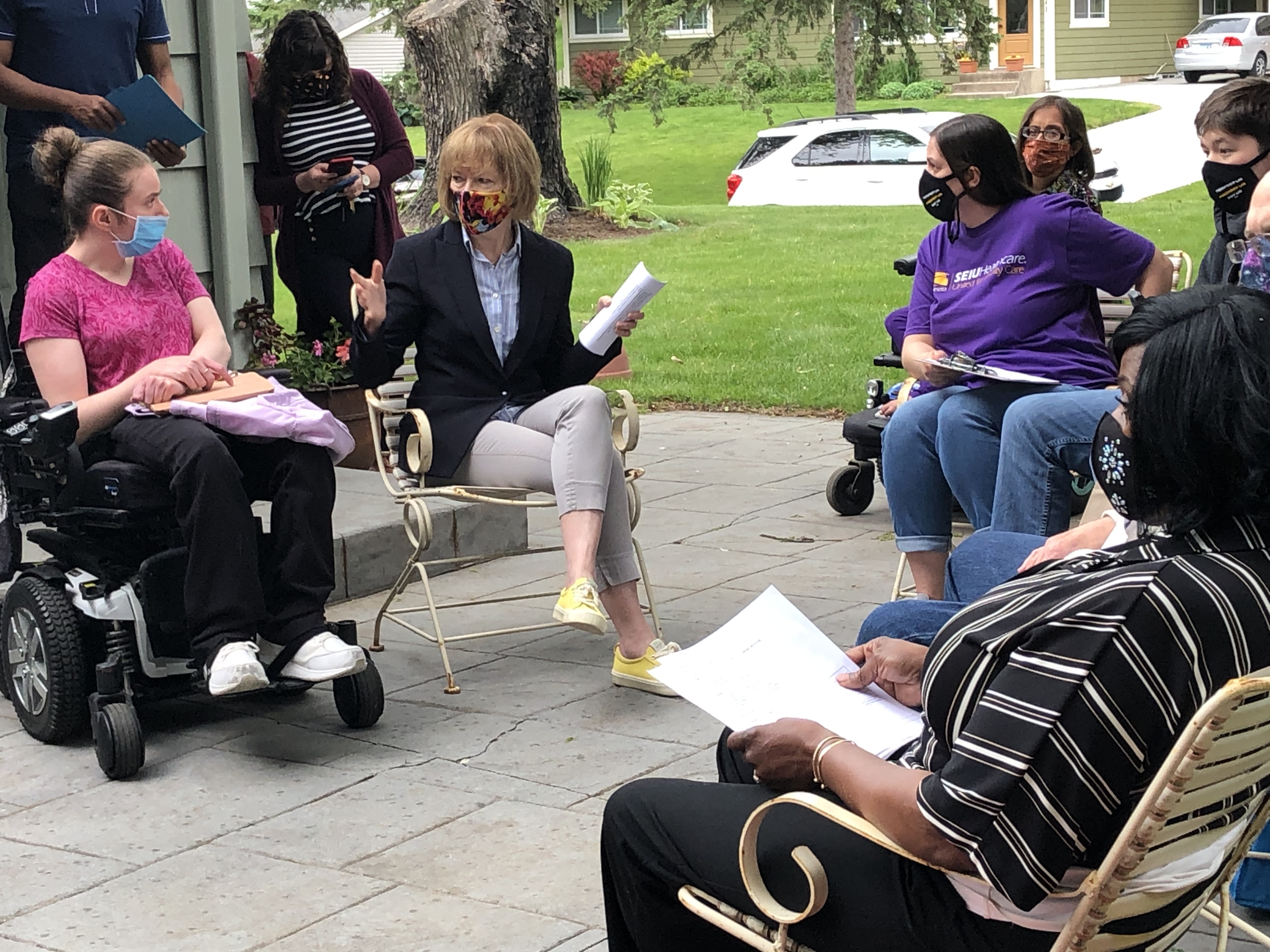
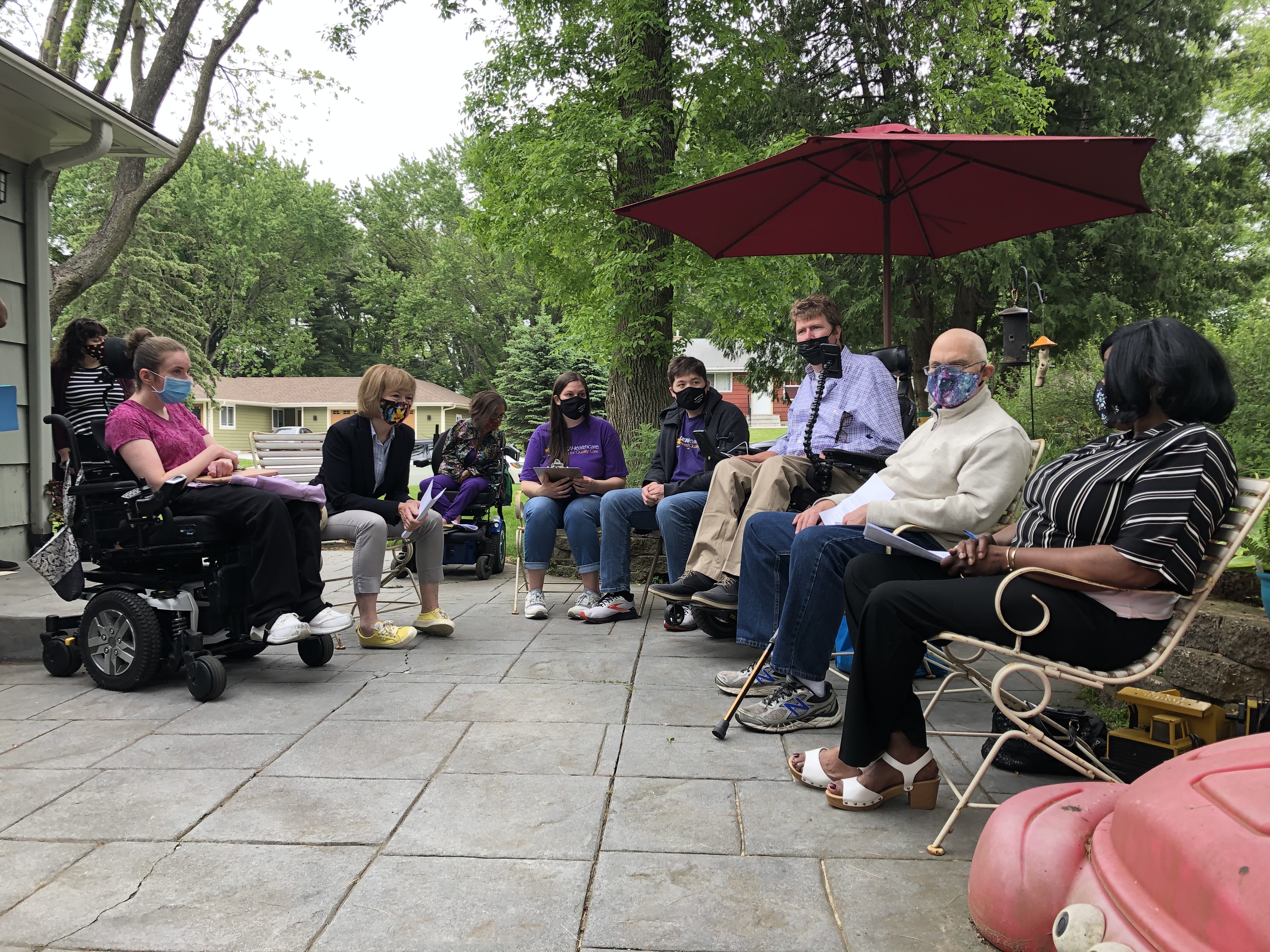
OAKDALE – With Congress poised to take up President Joe Biden’s infrastructure plan this month, workers, retirees and people with disabilities are teaming up to lobby in support of a provision that would provide $400 billion in federal funding for in-home and community-based care. 

It’s a pitch home care worker Jacqueline Kelly delivered from her own backyard, along with other advocates, to U.S. Sen. Tina Smith yesterday at a listening session planned by SEIU Healthcare Minnesota, which represents over 20,000 home care workers statewide.

Home care investments in President Biden’s proposal would create an estimated 1 million jobs and improve wages and benefits for workers in the industry. That would be a win for workers, Kelly told Smith, and for the clients they serve, like Kelly’s 16-year-old son.

“I worry that if I can’t offer living wages, benefits and a viable long-term career path, caregivers will choose to move into other employment situations that have more stability and less risk,” Kelly said.

Kelly and other advocates at the event also noted that most home health care workers are women and people of color, who “have been left out or left behind for far too long.”

“After COVID, I hope we all know better now,” Kelly said. “Our communities, our families, our economy – we are all depending on the women doing this work to keep all of our lives going. And what could be more valuable than that?”

Restoring the country 

The home care measure is just one part of Biden’s $2 trillion infrastructure proposal. The American Jobs Plan also calls for jobs-creating investments in roads, bridges, transit, schools, housing, manufacturing, research, climate change mitigation and more.

SEIU and other unions are backing the president’s plan. AFL-CIO President Richard Trumka called the “unprecedented federal investment” an important and necessary step toward “repairing, rebuilding and restoring our country.”

“It’s time for Congress to step up and deliver the funding we need to tackle the climate injustice, racial injustice and economic injustice facing working families while creating a new generation of well-paying union jobs,” Trumka said.

Indeed, Biden’s proposal includes “neutrality” language requiring projects funded through the legislation to offer workers a fair opportunity to form a union. That includes expanded support for home health care through Medicaid, which a White House fact sheet asserts would “put in place an infrastructure to create good middle-class jobs with a free and fair choice to join a union.”

An investment in independence 

More than 90,000 people work as home health aides and personal care assistants in Minnesota, and home care workers here already have formed a union to improve their wages, benefits and training opportunities.

But advocates say the federal government must do more to stabilize and professionalize the industry’s workforce, which is marked by high rates of turnover.

Lauren Thompson, who has cerebral palsy, told Smith that her struggle to find consistent, affordable home care has “impacted every aspect of my life.” Over the last 10 years, Thompson said, she has bounced between in-home and “facility-style” care, and now lives in a group home with three other people.

“I’m the safest I’ve been in years, but I’ve lost my freedom and my privacy,” Thompson said. “Everyone needs to know that there’s a large demographic of Americans who aren’t truly living free because of this care crisis.”

While some workers rely on roads or transit or internet access to get to work, millions of American workers with disabilities rely on home health care, Rob Wudlick, a clinical research project manager at the University of Minnesota’s medical school, told the senator.

“Being able to live in the community allows me to work,” said Wudlick, who suffered a life-changing injury as a teenager. “Having a strong health care workforce – those are my arms and legs. Without that, I am not able to get out of bed. I would have to live in a facility somewhere and wouldn’t be able to work.”

‘Infrastructure for families’ 

Smith, a member of the Senate Health Committee, pledged to take the stories of workers and clients back to Congress as debate over Biden’s American Jobs Plan begins. Funding home care is an investment in “infrastructure for families,” she said.

“These jobs have been consistently undervalued, and that has often had devastating impacts, not only for families who need help, but also for the folks themselves that are doing this work and at the same time are often making poverty wages,” Smith said.

The event at Kelly’s home in Oakdale was the first in a series of town halls planned in 23 states, as home care workers, clients and advocates seek to use the power of their personal stories to boost support for Biden’s proposal.

https://platform.twitter.com/widgets.js

Outside Amazon fulfillment center, workers demand tax fairness

Tyler Hamilton is in his fourth year working at Amazon’s fulfillment center in Shakopee.

SHAKOPEE – Minnesota workers unfurled a “Tax the Rich” banner outside Amazon’s MSP1 fulfillment center here today. It was a not-so-subtle suggestion to state lawmakers about how they might pay for investments in child care, paid family leave, education, infrastructure and other supports for working families.

Tyler Hamilton, in his fourth year working at MSP1, said he and others inside the facility could use a little support right now.

“Honestly, I’m tired,” the Maplewood resident said during a press conference organized by local unions. “And I’m not just tired from working night shift, even though I’m a night-shift guy.

“I’m tired from working in this building behind me for over a year during the coronavirus pandemic and having to deal with all the stupid stuff Amazon does all the time – and they get away with.”

But the pandemic has been anything but exhausting for corporations like Amazon and the wealthiest Americans. With stock markets posting record gains over the last year, the super-rich have consolidated even more wealth. U.S. billionaires increased their combined wealth by $1.62 trillion, or 55 percent, between March 2020 and April 2021, according to an analysis published last month.

Inequality in the U.S., already sped up by corporate tax cuts in 2017, has shifted into overdrive. “Evidently, those tax cuts don’t go toward their workforce,” Hamilton said. “It’s really frustrating.”

Minnesota lawmakers have an opportunity to restore some fairness to the system before the Legislature’s scheduled adjournment May 17, other speakers at the event outside Amazon said.

Mary Solheim, a child care provider from Maplewood, described a state of “chronic underinvestment in care for the children” of Minnesota’s workforce – a crisis made worse by the pandemic, as frontline workers not eligible for essential care struggled to find care for their children after school buildings shut down.

Solheim was precise about where to pin the blame. “We know there is enough for everyone to thrive in Minnesota,” she said. “But for too long, corporations haven’t paid their fair share.”

Public school educators have seen chronic underinvestment firsthand too, said Kate Schmidt, president of Dakota County United Educators.

Meeting students’ needs, she said, requires smaller class sizes, more access to counselors and other specialists, healthy meals and safe buildings. But instead of fully funding those priorities, school districts across Minnesota are preparing to lay off teachers, a response to uncertain state funding.

“This year let’s demand that our Legislature ensure the wealthiest among us pay their fair share,” Schmidt said. “That’s how we fund the future of our students, by ensuring every child has what they need to focus on all they can become, whether they are black, brown or white.”

Chelsie Glaubitz Gabiou, president of the Minneapolis Regional Labor Federation, emcees a press conference calling on corporations like Amazon and the super-rich to pay more taxes.

Octavio Chung, a union Laborer from Hugo, said improvements to the state’s transportation system and other infrastructure are urgently needed. Corporate profits rely on getting products to customers, after all.

“Corporations like Amazon need to pay their fair share so we can address decades of delayed essential maintenance and upgrades to provide all Minnesotans with safe roads and bridges, more affordable housing and functional school buildings,” Chung said. “It is long past time.”

Debate over whether to fund these and other priorities is likely to heat up at the Capitol next week, as the deadline to adjourn draws closer.

Gov. Tim Walz has proposed – and Republicans in control of the Senate have opposed – small tax hikes on some corporations and on individual income over $500,000, or over $1 million for married couples filing jointly.

Among the proposed investments Walz and DFLers who control the Minnesota House would make with the extra revenue is paid family leave for all Minnesota workers. That’s a measure Hamilton, who believes he contracted COVID-19 while working at MSP1 last year, said is long overdue.

“I was out of work for a month, the majority of that being unpaid,” Hamilton said. “It’s tiring having to work hard to pay your bills – 10-hour shifts, 12-hour shifts – only to be hit with something like getting sick and falling behind because we don’t have paid family medical leave or paid sick leave like we should.”