Home care workers, clients push Congress to act on ‘jobs, care, justice’

In St. Paul, home care workers, clients and allies march in support of federal investments in home- and community-based care.

With a march, rally and celebration near the Capitol in St. Paul today, Minnesotans of all ages joined activists nationwide in lifting up the call for a $400 billion federal investment in essential home care jobs.

“The future of work is service and care jobs,” said LaTanya Hughes, a home care worker and vice president of SEIU Healthcare Minnesota, which organized the event locally. “It’s time we finally, really value the jobs that we all call essential.”

President Joe Biden’s $2 trillion infrastructure proposal, the American Jobs Plan, includes $400 billion for home- and community-based care, enough to create over 1 million living-wage jobs in the industry.

The proposal also includes jobs-creating investments in roads, bridges, transit, schools, housing, research and manufacturing. Home care workers and clients across the U.S. are organizing, with support from SEIU, to make sure their industry – the so-called “caring infrastructure” – isn’t left behind as the legislative process plays out.

More than 90,000 people work as home health aides and personal care assistants in Minnesota, and home care workers here already have formed a union to improve their wages, benefits and training opportunities.

But advocates say the federal government must do more to stabilize and professionalize the industry’s workforce, which is marked by high rates of turnover.

“The home care industry has been ignored for too long,” said Lauren Thompson, a disability rights advocate who has cerebral palsy. “The workers are underpaid and overworked. This causes a dangerous domino effect that trickles down to me and clients like me.”

Lack of stable care, she said, limits opportunities for many Americans with disabilities to live independently. Thompson called it a choice “between our freedom and our safety” that results in a “loss of our humanity.”

“Stable home care means stable client lives,” she added.

Jillian Nelson, an autistic adult who works as a policy advocate for the Autism Society of Minnesota, attended the march and rally with two members of her home care team. Their work, she said, makes it possible for Nelson to pursue her own career, and the result is a net gain for the economy as a whole.

“Far too long, we have been framed as a burden on society,” Nelson said. “We don’t just use resources, but create jobs and community… It is time that that economic framework be valued and strengthened like every other sector of our country’s economy.”

Investing in the care economy is also a matter of racial and economic justice, advocates said.

The home care workforce is overwhelmingly made up of women and people of color. That makes the Biden plan, which includes “neutrality” language requiring projects funded through the legislation to offer workers a fair opportunity to form a union, an opportunity to create the foundation of a more diverse, resilient middle class.

“It would be a jobs act, it would be a racial justice act and it would be a care act,” Hughes said.

Home care workers and clients also took time at the event to celebrate gains made during the recently concluded legislative session, including approval of workers’ union contract with the state. That agreement will raise minimum pay to $15.25 in July 2022 and expand workers’ access to paid time off and holiday pay.

The St. Paul event was part of a 24-city day of action organized by SEIU, kicking off a major campaign centered around jobs, care and justice for the 2.3 million home care workers nationwide.
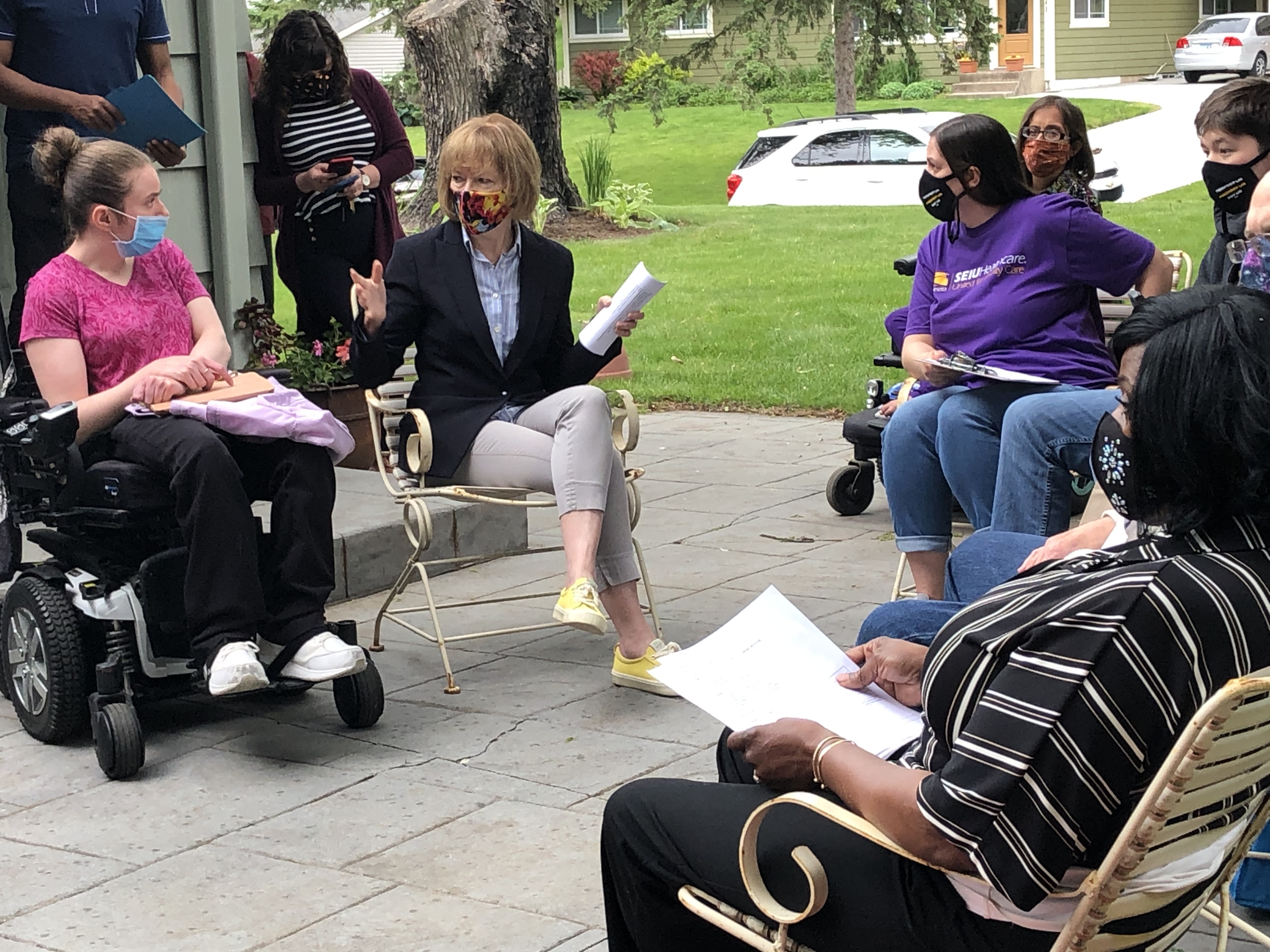
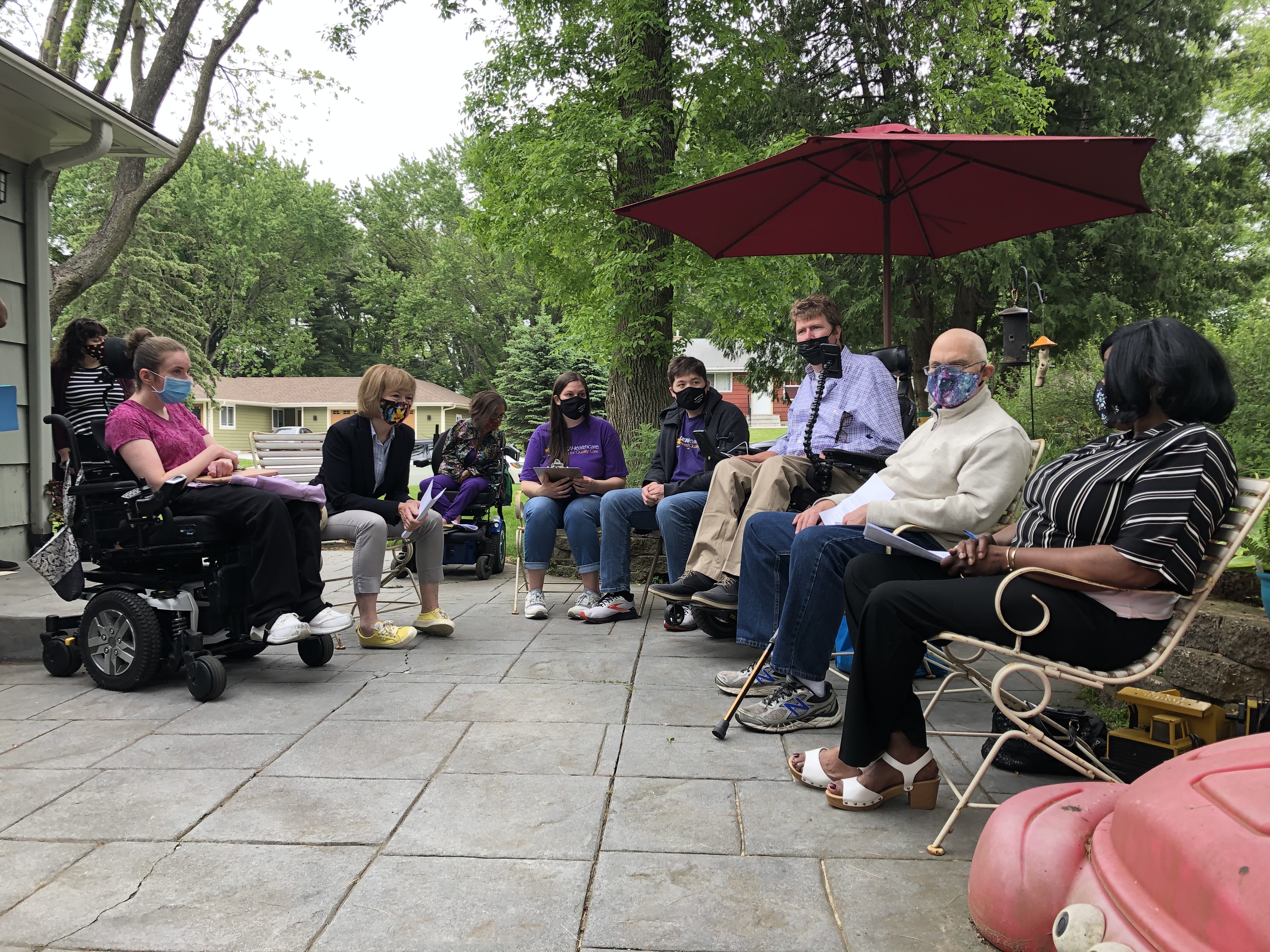
In meeting with Smith, home care workers, clients back Biden plan to fund ‘caregiving infrastructure’

Sen. Tina Smith talks with Lauren Thompson, a home care client and disability-rights advocate with cerebral palsy.

OAKDALE – With Congress poised to take up President Joe Biden’s infrastructure plan this month, workers, retirees and people with disabilities are teaming up to lobby in support of a provision that would provide $400 billion in federal funding for in-home and community-based care. 

It’s a pitch home care worker Jacqueline Kelly delivered from her own backyard, along with other advocates, to U.S. Sen. Tina Smith yesterday at a listening session planned by SEIU Healthcare Minnesota, which represents over 20,000 home care workers statewide.

Home care investments in President Biden’s proposal would create an estimated 1 million jobs and improve wages and benefits for workers in the industry. That would be a win for workers, Kelly told Smith, and for the clients they serve, like Kelly’s 16-year-old son.

“I worry that if I can’t offer living wages, benefits and a viable long-term career path, caregivers will choose to move into other employment situations that have more stability and less risk,” Kelly said.

Kelly and other advocates at the event also noted that most home health care workers are women and people of color, who “have been left out or left behind for far too long.”

“After COVID, I hope we all know better now,” Kelly said. “Our communities, our families, our economy – we are all depending on the women doing this work to keep all of our lives going. And what could be more valuable than that?”

Restoring the country 

The home care measure is just one part of Biden’s $2 trillion infrastructure proposal. The American Jobs Plan also calls for jobs-creating investments in roads, bridges, transit, schools, housing, manufacturing, research, climate change mitigation and more.

SEIU and other unions are backing the president’s plan. AFL-CIO President Richard Trumka called the “unprecedented federal investment” an important and necessary step toward “repairing, rebuilding and restoring our country.”

“It’s time for Congress to step up and deliver the funding we need to tackle the climate injustice, racial injustice and economic injustice facing working families while creating a new generation of well-paying union jobs,” Trumka said.

Indeed, Biden’s proposal includes “neutrality” language requiring projects funded through the legislation to offer workers a fair opportunity to form a union. That includes expanded support for home health care through Medicaid, which a White House fact sheet asserts would “put in place an infrastructure to create good middle-class jobs with a free and fair choice to join a union.”

An investment in independence 

More than 90,000 people work as home health aides and personal care assistants in Minnesota, and home care workers here already have formed a union to improve their wages, benefits and training opportunities.

But advocates say the federal government must do more to stabilize and professionalize the industry’s workforce, which is marked by high rates of turnover.

Lauren Thompson, who has cerebral palsy, told Smith that her struggle to find consistent, affordable home care has “impacted every aspect of my life.” Over the last 10 years, Thompson said, she has bounced between in-home and “facility-style” care, and now lives in a group home with three other people.

“I’m the safest I’ve been in years, but I’ve lost my freedom and my privacy,” Thompson said. “Everyone needs to know that there’s a large demographic of Americans who aren’t truly living free because of this care crisis.”

While some workers rely on roads or transit or internet access to get to work, millions of American workers with disabilities rely on home health care, Rob Wudlick, a clinical research project manager at the University of Minnesota’s medical school, told the senator.

“Being able to live in the community allows me to work,” said Wudlick, who suffered a life-changing injury as a teenager. “Having a strong health care workforce – those are my arms and legs. Without that, I am not able to get out of bed. I would have to live in a facility somewhere and wouldn’t be able to work.”

‘Infrastructure for families’ 

Smith, a member of the Senate Health Committee, pledged to take the stories of workers and clients back to Congress as debate over Biden’s American Jobs Plan begins. Funding home care is an investment in “infrastructure for families,” she said.

“These jobs have been consistently undervalued, and that has often had devastating impacts, not only for families who need help, but also for the folks themselves that are doing this work and at the same time are often making poverty wages,” Smith said.

The event at Kelly’s home in Oakdale was the first in a series of town halls planned in 23 states, as home care workers, clients and advocates seek to use the power of their personal stories to boost support for Biden’s proposal.

https://platform.twitter.com/widgets.js

Home care workers ratify new contract, urge lawmakers to get serious about looming care crisis

Home care workers and clients kicked off the campaign for a new contract covering more than 20,000 workers statewide in September 2016.

Union members who provide in-home health services to clients across Minnesota have ratified a new contract with the state that will lift wages, provide holiday pay, boost paid-time off and expand training opportunities for an estimated 27,000 home care workers statewide.

The new contract, home care workers’ second since voting to join SEIU Healthcare Minnesota three years ago, will take effect July 1. The union announced results of a week-long ratification vote this morning.

Home care workers said the new contract builds on their union’s effort to raise wages and working conditions in the home care industry – improvements they say are necessary to meet the needs of Minnesota’s seniors and people with disabilities.

But it doesn’t go far enough, said Yasmine Soud-Reynolds, a home care worker from White Bear Lake.

“On one hand I feel like the contract is good,” Soud-Reynolds said. “We do get a little bump in pay, also time and a half for holidays. On the other hand, I feel like it needs to be improved.”

The contract ratified this month looks different from the tentative agreement reached by SEIU members and the state earlier this year. That’s because elected officials cut funding for the contract in half during last-ditch budget negotiations at the Capitol last month, forcing workers and the state to renegotiate the pact.

The decrease in funding will slow efforts to address the care crisis facing vulnerable Minnesotans, home care workers warned, and they pinned much of the blame on anti-union attorney Doug Seaton and the Center of the American Experiment, which is funding an effort to decertify their union.

In legislative testimony, these groups urged legislators to vote down raises and new benefits for home care workers, who vowed to continue fighting to restore funding in the next legislative session.

Soud-Reynolds, who cares for a client recovering from a massive brain hemorrhage, said she earns less than the $15 per hour her stepsister makes at a local gas station, and called the Legislature’s move to defund her union’s contract “very frustrating.”

“I feel like legislators won’t really understand what home care workers are going through or asking for until they either have to work in the field themselves or, God forbid, one of their family members needs a home care worker,” Soud-Reynolds said. “What I do is hard, and I definitely don’t feel like it’s valued.”

The new contract creates a $12 wage floor, with a new 5 percent increase for workers like Soud-Reynolds who provide care for the highest-need clients.

The state also agreed to create an online matching registry to help clients find quality care workers. Several clients who receive in-home health services participated in SEIU Healthcare Minnesota’s home care contract campaign.

Jim Carlisle, who relies on care for himself and his wife to be able to stay in their home, said the crisis facing the home care industry is “well beyond the point where any half-measures will suffice.”

“This is, without exaggeration, a life or death situation for someone like me who relies on quality caregivers to get out of bed and do basic tasks like eating and leaving my house,” Carlisle added. “I’m proud we won the gains we did, but we are still a long way from where we need to be. What we’ve proven over the last few months is that we won’t let any attacks or setbacks stop us. We will fight to ensure every person who needs care has access to quality caregivers.”

In contract talks, home care workers hope to address crisis facing state, industry

Home care workers and clients kick off the campaign for a new contract covering more than 20,000 workers statewide.

Home care workers and clients kick off the campaign for a new contract covering more than 20,000 workers statewide.

Minnesota’s home care workers are set to begin negotiating a new union contract Friday. At a Capitol press conference today, workers and their clients framed the talks as an opportunity for the state to begin addressing the workforce crisis in their industry.

As Minnesota’s population continues to age, the demand for workers who provide in-home health care is expected to increase sharply. The Minnesota Department of Employment and Economic Development projects nearly 38,000 new openings for home-health and personal-care aides over the next 10 years.

Home care clients and advocates worry those jobs will remain vacant unless working conditions in the industry improve – a process that starts with raising wages and respecting the work, home care client Nikki Villiavicencio said.

The Maplewood resident said a “huge shortage” of home care workers already exists in the state. “It’s a crisis that Minnesota leaders have not valued home care workers and the services they provide enough,” she said.

Represented in negotiations with the state by SEIU Healthcare Minnesota, home care workers said they plan to seek a $15 minimum wage in their next union contract, as well as expanded benefits and training opportunities specific to the type of care they provide.

Additionally, workers said they want the state to commit to long-range strategies for growing the industry’s worker pool and, along the same lines, improving job satisfaction among home care workers.

"I can be a better father, a better husband a better member of society with her," Jonathan Spika of St. Paul, left permanently disabled by MS, said of his home health care worker.

“I can be a better father, a better husband a better member of society with her,” Jonathan Spika of St. Paul, left permanently disabled by MS, said of his home health care worker.

“Most people don’t stay in these positions for very long because … this is one of the lowest-paying jobs in Minnesota,” home care worker Jasmine Laducer-Kitto said.

For Laducer-Kitto, the rewards of home care work go beyond the paycheck. But if state lawmakers value giving people the option of receiving care in their homes, she said, they need to invest in the workers who make it possible.

“We have to look at the this as an important job,” Laducer-Kitto said.

Home care workers’ first contract with the state, bargained after their historic organizing drive, is set to expire in July 2017. It raised the industry’s wage floor to $11 per hour and gave home care workers paid-time-off benefits for the first time.

Still, Villiavicencio said, “the progress we’ve made hasn’t been enough to lift us out of the crisis we’re in now.”

SEIU Healthcare Minnesota’s contract covers more than 20,000 home care workers across the state. Negotiators said they hope to have a tentative agreement before the 2017 legislative session begins so that lawmakers can vote to approve it for inclusion in the 2017-18 fiscal year budget.

Home care workers, clients not backing down from anti-union group’s legal challenge

Cortney Phillips, a home care worker from Annandale, speaks to media after a court hearing challenging her collective bargaining rights.

Cortney Phillips, a home care worker from Annandale, speaks to media after listening to oral arguments in a federal court case challenging her collective bargaining rights.

A week ago, Francis Hall made history as the first known home care worker in Minnesota to take a paid vacation day. Today, Hall stood outside the federal courthouse in St. Paul and condemned the well funded, extremist groups suing to deny her that benefit – and take away her newly formed union.

“We’ve come too far,” Hall said. “The home care industry is too important to not stand up and fight back.”

Hall was among a handful of home care workers who observed oral arguments today in a pair of court cases challenging their right to organize a union and negotiate with the state for better wages and working conditions.

Francis Hall is the first known home care worker to use paid time off.

Francis Hall is the first known home care worker to use paid time off.

Home care workers voted to join SEIU Healthcare Minnesota last year, after Gov. Mark Dayton approved a measure expanding collective bargaining rights to home care workers paid with state subsidies. Home care workers negotiated and ratified a contract with the state that went into effect July 1, extending higher wage floors, paid time off and other benefits to more than 26,000 workers statewide.

But legal challenges have pestered the home care workers’ campaign, which became a target of the Virginia-based, anti-union National Right to Work Legal Defense Foundation.

A federal judge in Minneapolis twice rejected legal challenges to the Minnesota home care workers’ union. Now the foundation, funded by millionaires and billionaires, is bankrolling a lawsuit filed by nine home care workers who argue being covered by the union contract amounts to forced association – and a violation of their First Amendment rights.

During oral arguments today, according to Workday Minnesota, a lawyer for the State of Minnesota countered that home care workers are not required to pay dues, making it impossible for the plaintiffs to claim they are harmed by the union contract.

After the hearings, workers said the absurdity of the plaintiffs’ position lays bare the National Right to Work Foundation’s agenda. And it’s not about improving workers’ lives or the home care industry.

“The industry deserves more value,” Cortney Phillips, a home care worker from Annandale, said. “Our union is ready to provide that. And joining the union is completely voluntary.”

The National Right to Work Foundation and its deep-pocketed donors, Phillips added, want to reverse the gains home care workers have made through collective bargaining. Losing their union, she said, “would be bad for clients and providers, and it could push us back into the shadows.”

“I see this court case as a direct attack on women and people of color,” Deb Howze said.

Deb Howze, a home care worker from Minneapolis, added that women and people of color make up a majority of home care workers in Minnesota. “I see this court case as a direct attack,” she said.

Several home care recipients joined union workers inside the hearings to show their support for the union, including Nikki Villavicencio of Maplewood. “We won’t ever let them stop us from fighting for quality care,” she said.

The National Right to Work Foundation’s lawsuit not only threatens to undermine home care workers’ progress, but the progress teachers, nurses and other workers have made through collective bargaining as well.

“The same group that continues to attack home care workers … will simply come after teachers and nurses next,” Education Minnesota Secretary-Treasurer Rodney Rowe said.

Ellison joins home care worker on the job, reaffirms support of Fight for $15

U.S. Rep. Keith Ellison (L) chats with Clara Nakumbe and her sons Siran and Shmel Bogan (R).

U.S. Rep. Keith Ellison (L) chats with Clara Nakumbe and her sons Siran and Shmel Bogan (R).

Clara Nakumbe is fighting for $15 an hour, but the Minneapolis resident doesn’t work in a fast-food restaurant or behind the scenes at the airport. She works in her own home, providing round-the-clock care for her son Siran, who lives with a severe form of multiple sclerosis.

It’s work that earns Nakumbe $11 per hour, thanks to a new contract between the State of Minnesota and home care workers, members of SEIU Healthcare Minnesota, that went into effect this summer.

Nakumbe was an early supporter of the union drive that led to that historic first contract. Now, she’s among a growing number of home care workers nationwide raising their voices as part of the “Fight for $15.”

“Just because we’re doing this doesn’t mean we don’t have bills,” Nakumbe told U.S. Rep. Keith Ellison during a visit at her kitchen table today. “People need decent wages because they still have responsibilities.”

Ellison, a DFLer from Minnesota’s 5th Congressional District, visited Nakumbe’s north Minneapolis home as part of an event organized by SEIU to expose lawmakers to the challenges home care workers face on a daily basis.

He asked several questions of Clara, Siran’s brother Shmel Bogan and Siran himself, who could offer only “yes” or “no” as answers. The conversation ranged from Siran’s life before his diagnosis to the family’s daily routine.

“What do you think about the home care workers getting $15 an hour?” Ellison asked Siran.

“He said yes!” Clara laughed.

web.homecare-ellison32Although Social Security benefits help, Nakumbe said her income remains far below what she was earning at the job she left in order to keep Siran out of a nursing home – a decision that not only keeps Siran close to family, but saves the state money as well. She said she supports the Fight for $15 movement for the same reasons she supported the union drive four years ago.

“We fought for the union in order to have a voice,” she said. “If more of us come together collectively, we can do more than we can individually.”

Ellison said seeing home care work firsthand reinforced his belief that both home care workers and clients deserve better than wages that keep workers at or below the poverty line.

“If we pay this work fairly, it means we value all members of our community,” Ellison said. “We’re all one injury or one illness away from needing the care you all provide for Siran.

“If his home care worker is paid the right way, then he’ll be taken care of properly. But if you’re paying (home care workers) not even enough to stay out of poverty, how can you expect them to continue to do the work?”

Leading scholars to discuss past, present and future of labor movement

esfl-bldg

East Side Freedom Library

The East Side Freedom Library will host a conversation on labor history July 18 with two of the nation’s leading activist scholars in the field. The event is free and open to all.

University of California at Santa Barbara professors Eileen Boris and Nelson Lichtenstein will lead the informal conversation. Boris and Lichtenstein “have produced path-breaking studies which highlight the ways that employment, work, the workforce, and the labor movement have changed in the past and are changing now,” according to the ESFL’s press release. “Their work has provided a series of vantage points from which to consider the development of strategies and campaigns to reshape the labor movement of the future.”

  • What: “Labor History: What’s Work Got To Do With It?”
  • Where: East Side Freedom Library, 1105 Greenbrier Street, St. Paul
  • When: Saturday, July 18, 1 to 2:30 p.m.
  • Who: Eileen Boris, a professor of history and feminist studies at UC-Santa Barbara, whose work has focused on women workers and the home as a changing site of paid and unpaid work; and Nelson Lichtenstein, professor of history and director of the Center for the Study of Work, Labor, and Democracy at UC-Santa Barbara, whose research began with manufacturing workers and has shifted in recent years to retail workers.

For more information on the event, contact info@eastsidefreedomlibrary.org or 651-774-8687.

Day One: Minnesota home care workers’ first contract takes effect today

Pro-union home health care workers celebrated the results of their organizing election last August.

Pro-union home health care workers celebrated the results of their organizing election last August.

The union contract that goes into effect today between the State of Minnesota and home care workers statewide is a big deal to Tallaya Byers. But it’s about more than paid time off, wage increases and other benefits that kick in today, the 38-year-old from St. Paul said.

“I’m being recognized as an employee,” said Byers, who provides care for her 6-year-old autistic son. “It’s really great to be recognized now and to know that there’s a family – a union family – that is looking out for my best interests.”

The historic first contract covers 27,000 workers like Byers who provide state-subsidized, in-home care for elderly and disabled Minnesotans.

Ratified by members of SEIU Healthcare Minnesota and approved by state lawmakers last session, the contract increases the wage floor in the industry to $10.50 this year (and $11 next year), allows workers to accrue up to five paid-time-off days per year and provides access to training opportunities and grievance procedures.

It’s a big step forward for home care workers, who organized a union to gain a stronger voice in an industry that took for granted a low-wage, high-turnover workforce. That’s an insult not only to home care workers, Byers said, but to the seniors and people with disabilities they serve.

“A lot of people – disabled adults, senior citizens – are in their homes instead of nursing homes because of the work we do,” she said said. “For a lot of people, this is not just something they want to do for family members, but as a career. Now they can get compensated, get training – it’s really great.”

Negotiations between SEIU Healthcare Minnesota and the state began after workers voted decisively to form a union in August 2014. The two sides reached a tentative agreement in January, and over 95 percent of voting members ratified the agreement.

Although membership in the bargaining unit is voluntary, the contract will cover all home care workers statewide. Byers said she expects more will sign up to become union members after the benefits of the new contract hit home.

“For a lot of people, our union is still brand new,” Byers said. “So we still have a lot of information to get out to the PCA’s about why it’s important and how beneficial it is.”

It’s official: Dayton signs Minnesota home care workers’ contract into law

Pro-union home health care workers celebrated the results of their organizing election last August.

Pro-union home health care workers celebrated the results of their organizing election last August.

In a victory for 27,000 home health care workers across Minnesota, Gov. Mark Dayton today gave final approval to a historic first union contract that will dramatically improve working conditions in the industry when it takes effect July 1.

Dayton’s signature on the Omnibus Health and Human Services bill, passed by the Legislature with bipartisan support, made the contract official. It’s the first new union contract with the State of Minnesota in decades, according to SEIU Healthcare Minnesota, the union representing home care workers.

For workers, the contract means the wage floor in the industry will jump from $9 to $11 by 2016. The contract also includes paid time off – five days per year for full-time workers – plus increased training opportunities and grievance and arbitration procedures.

The contract represents a victory not only for workers, but for the seniors and people with disabilities they serve. Clients joined workers in supporting the union drive – a process that took several years and involved changing state law – and together, they cheered the governor’s final signature today.

“Invisible No More” was the slogan of home care workers’ organizing campaign. Nikki Villavicencio, a home care recipient from Maplewood, said the new contract provides more than just wages and benefits; it shows the state values the freedom home care workers provide thousands of Minnesotans who choose to stay in their homes.

Nicole Villavicencio (L) talked about why they support their home health care providers’ efforts to join SEIU Healthcare Minnesota during the lobbying effort two years ago.

Nicole Villavicencio (L) offered her support to home care providers organizing s to join SEIU Healthcare Minnesota as the campaign kicked off two years ago.

“This contract will mean a better life for workers, but also for families across the state like mine,” Villavicencio said. “My family will benefit from the increased stability that will come with a higher pay floor, paid time off, new training funds and the other benefits that this contract will provide the workers who care for us.”

The contract will also help reduce turnover among workers the industry by cutting down on wage theft. Sadie Hawkins, a home care worker from White Bear Lake, is in the middle of a fight to get the wages she’s owed – a fight the new contract will help her win.

“The grievance process will give those of us who have gone through wage theft a clear way to get the pay we are due for the work we have done – without going to smalls claims or another unpredictable process,” Hawkins said. “I worked for Forest Lake home care and my agency failed to pay me for a month of my work, but I couldn’t stop working because my client needed support. Two months later and I’m still waiting on my money.”

Although membership in the bargaining unit is voluntary, the contract will cover all home care workers serving clients in so-called “self-directed care” programs, which are supported with public funds. The new Health and Human Service bill appropriates $16.227 million toward the home care contract over two years, and its economic impact will be double that because of federal Medicaid matching, SEIU Healthcare Minnesota said.

The contract elevates standards in an industry marred by low wages, part-time schedules and few benefits, and it’s a welcome change, said home care worker Alberta McCurdy of Minneapolis.

“I currently make $9 an hour and this wage increase will help me pay my bills and pay my rent,” she said.

“I’m so excited to get paid time off after working for all these years without it,” Christine Hale, a home care worker and mother of three from Crosby, said. “The last time I had a surgery I had to go back to work right away because I was the only provider for my family – and it was really hard.”

Negotiations between SEIU Healthcare Minnesota and the state began after workers voted decisively to form a union in August 2014. The two sides reached a tentative agreement in January, and over 95 percent of voting members ratified the agreement.

On lobby day, Service Employees find bipartisan support

Rep. Denny McNamara offers support for SEIU home care workers like Rosemary Van Vickle (red coat), who are pushing lawmakers to OK their tentative contract agreement with the state.

Rep. Denny McNamara and other legislators pledge support for SEIU home care workers like Rosemary Van Vickle (red coat), who want lawmakers to OK their tentative contract agreement with the state.


A bipartisan group of Minnesota legislators lined up on the Capitol steps today to show support for a bill to ratify and fully fund home care workers’ first contract with the state.

Winning legislative approval for the contract, ratified by members of the newly organized unit in voting last month, is one of a handful of priorities members of the Service Employees International Union talked with their lawmakers about today during the union’s annual lobbying push.

Union members at a (mercifully) brief outdoor rally laid out other top priorities, including equitable funding for the state’s public schools and legislation enabling all Minnesotans to obtain driver’s licenses, regardless of immigration status.

SEIU Local 26 member James Matias emceed the rally on the Capitol steps.

SEIU Local 26 member James Matias emceed the rally on the Capitol steps.

Rep. Denny McNamara, a Republican from Hastings, said progress on the license issue would be a “small step” in fixing the nation’s broken immigration system. He also pledged to carry a bill in the House to ratify the pending contract for home care workers.

“The contract offers some really great things going forward, and I’m really proud to be a part of it,” McNamara said.

Indeed, the contract would raise the wage floor for 27,000 home care workers statewide to $11 per hour. It would fund training opportunities, protect workers against lost wages and provide full-time workers with five days of paid time off annually.

“These important gains won’t happen until the Legislature funds and ratifies our contract,” Crosby home care worker Rosemary Van Vickle said. “We need lawmakers to do the right thing.”