Updated prevailing wage standards ‘a tremendous win’ for tradespeople

Sen. Tina Smith (R) and Wage and Hour Division Administrator Jessica Looman announced new prevailing wage standards in Minnesota.

The Labor Department has updated federal prevailing wage standards in Minnesota, a move local Building Trades unions hailed as critical to ensuring that the tradespeople working on historic infrastructure investments passed during President Joe Biden’s first term are paid fairly and consistently.

Tom Dicklich, executive director of the Minnesota State Building and Construction Trades Council, called the Wage and Hour Division’s announcement “a tremendous win for the working women and men of Minnesota.”

“The implementation of new prevailing wage standards will provide our workers with the financial security they deserve and ensure that our construction projects are carried out by skilled, fairly compensated professionals,” Dicklich said. “We’re excited to see the tangible benefits this will bring to our communities.”

Under the new standards, the prevailing wage rates applied to federally funded building, highway and heavy construction projects will be the same as the state’s prevailing wage rates.

Minnesota’s prevailing wage rates better reflect the labor costs incurred by responsible contractors, like unions’ signatory contractors, Wage and Hour Division Administrator Jessica Looman said at a press conference May 31 at the St. Paul Labor Center.

Looman, who served as executive director of the Minnesota Building Trades council before accepting a post in the Biden administration, said the change to federal rates here is part of the “most comprehensive review” of prevailing wage standards undertaken at the Labor Department in “more than 40 years.”

“The new prevailing wage standards will ensure that workers on federally funded projects are compensated fairly, reflecting the true value of their labor,” Looman said. “This initiative will help close wage gaps and set a higher standard for transparency and fairness in the construction industry.”

Under the Davis Bacon Act, contractors carrying out most federal building projects are required to pay the local “prevailing wage” – an hourly rate, plus benefits – determined by the Labor Department. Many states and municipalities also have their own prevailing wage standards.

Prevailing wage laws ensure that workers on publicly funded construction projects are paid wages that reflect area standards – and prevent low-road contractors from squeezing workers’ pay in order to win a public bid.

The Wage and Hour Division announcement comes at a time when billions of additional dollars are being invested in Minnesota under two of Biden’s signature legislative achievements, the bipartisan infrastructure law and the CHIPS and Science Act.

Sen. Tina Smith, who joined Looman at the event, said the new prevailing wage standards add to Biden’s record as “the most pro-worker administration” in her lifetime. Smith ran down a list of pro-worker advancements since Biden took office, from expanding eligibility for overtime pay to banning noncompete agreements.

But the change will also benefit construction employers, she said, by streamlining the bidding process and ensuring greater fairness and transparency.

“This is a significant step in ensuring fair wages and consistency for our workers on federally funded construction projects,” Smith said. “From boosting American manufacturing and construction through unprecedented infrastructure investments to improving wage transparency for workers and contractors in Minnesota, we are making historic progress in supporting our workers and strengthening our labor unions.”

– Michael Moore, Union Advocate editor

Dems’ climate measure ties tax credits to prevailing wage, apprenticeship

Matt Campanario, executive director of the Carpenters Training Institute, leads Sen. Tina Smith on a tour of the LJ Shosten Training Center in St. Paul, which houses the union’s pile driver and millwright apprenticeship programs.

The Inflation Reduction Act, signed into law by President Joe Biden in August, promises the most aggressive action to combat climate change in U.S. history, a $369 billion investment that aims to reduce carbon emissions by 40% this decade.

But what most excites some union leaders about the IRA are long-sought provisions that will ensure the transition to a cleaner-energy economy creates and sustains union jobs – and taps into the job-training capacity of unions’ registered apprenticeship programs.

In a win for Building Trades unions, businesses looking to claim tax credits available under the IRA must commit to paying prevailing wages and employing a minimum number of registered apprentices on their jobsites.

The requirements apply to most tax credits that were greatly expanded by the historic legislation, which Democratic majorities spent months shepherding through Congress.

The tax credits will spark private-sector construction of energy-efficient commercial buildings, housing and electric vehicle charging stations, as well as investments in energy sources outside of fossil fuels.

An analysis released by the University of Massachusetts at Amherst projects the IRA’s climate and energy investments will create 9 million jobs over the next decade.

By insisting on strong labor provisions, said Adam Duininck, director of government affairs for the North Central States Regional Council of Carpenters, Biden and other lawmakers ensured those investments will create good-paying jobs for skilled American workers.

“The expanded tax credits included in the Inflation Reduction Act will benefit businesses that pay prevailing wages and hire our apprentices,” Duininck said. “Paying workers prevailing wages will further support our communities where workers live and spend their money. This will give local businesses and our public services like education, public safety and well-maintained infrastructure the financial backing they should be receiving from hard working, middle-class workers.

“Our communities miss out on billions of tax dollars by unethical business practices of dishonest contractors. It is great to see support for those who conduct business in a manner that benefits people rather than lining the pockets of only a few individuals.”

Carpenters apprentice Amanda Heiser tells Smith recently passed infrastructure and climate bills “definitely provide a more stable future” for apprentices like her.

The IRA also includes penalties for firms that pledge to pay prevailing wages but don’t follow through, requiring them to make workers whole – plus interest.

Meanwhile, industrial unions hailed domestic content requirements included in the IRA, which will encourage the use of American-made batteries, solar and wind components and other technologies on clean energy projects.

The requirements will stimulate job growth in the U.S. manufacturing sector, said Jason Walsh, director of the BlueGreen Alliance, which brings together unions and environmental groups.

“Few pieces of legislation this century have come close to such sweeping job creation potential,” Walsh said. “This bill’s investments offer an opportunity to support and create good union jobs and for workers and communities to reap the economic gains of the clean economy.”

For the Biden administration, the IRA delivers – again – on a campaign promise to make union jobs the focus of its economic policy.

A $1 trillion infrastructure law, which Biden signed in November 2021, is already creating work for union tradespeople in Minnesota. Over 100 projects statewide have tapped into $1.4 billion in federal funding available through the bill so far, including a $22 million project at Minneapolis-St. Paul International Airport.

Prevailing-wage rates are set by the federal government and vary by location. The rates reflect the average wage paid to similarly employed workers in a specific occupation in that area.

With Biden’s signature, postal reform measure will lift ‘5-ton weight’ dragging down USPS

Advocates of preserving six-day mail delivery rallied outside the Minneapolis Post Office in 2013.

After more than a decade of advocacy in Congress and sometimes in the streets, U.S. Postal Service employees and their unions celebrated a landmark victory last month, when senators joined the House in passing a bill to put the agency on solid footing for the long haul.

The Postal Service Reform Act passed both chambers with bipartisan support, and President Joe Biden is widely expected to sign it into law.

“I’ve been serving people for 25 years, and I’ve never before seen all the unions, management associations, Democrats and Republicans finally say this is something everybody can support,” former St. Paul Postal Workers (APWU) President Todd Elkerton said. “We’re going to be able to deliver packages and letters and bills and prescriptions to everyone in a timely manner now.”

The measure is expected to end the cycle of red ink and service cuts that has plagued the Postal Service since 2006, when then-President George W. Bush signed a law that, among other things, required the agency to prefund its retirees’ health benefits 75 years into the future – an accounting measure virtually unheard of in the public or private sector.

The prefunding mandate has accounted for 85% of USPS budget shortfalls since taking effect, and postal unions have pushed hard on lawmakers to undo what opponents at the time considered a poison pill to defund the agency, long a target of right-wing, free-market ideologues who thrived in the Bush White House.

At marches and protests outside post offices in the Twin Cities and across the nation, union members rallied public support to save the Postal Service. And it worked, U.S. Sen. Tina Smith said during a celebratory Zoom call with union leaders days before she joined 78 other senators in voting to pass the bill.

“My view is what happened is that everybody just got so sick of what they were seeing happen, and they just love the post office – it’s highly, highly popular,” she said. “Citizens, especially in rural areas, came together and spoke out.

“Ultimately, members of Congress listened to that and got serious about getting the job done.”

The reform bill eliminates the prefunding mandate, which Smith likened to “a five-ton weight around the ankles” of the USPS, and takes steps to maximize retirees’ participation in Medicare.

It also writes six-day-per-week pickups and delivery into federal law and imposes more public accountability on top Postal Service brass.

“With this legislation, the U.S. Postal Service has survived attempts to privatize it and kill it off, and we are now ensuring it will survive stronger than ever,” said Smith, a co-sponsor of the bill.

Elkerton, who recently accepted a new position as business agent for the APWU, said the COVID-19 pandemic was a turning point in the campaign to pass reform legislation.

After the outbreak in 2020, Americans turned to postal delivery as an alternative to crowded stores and long lines at their polling places. When Trump-appointed Postmaster General Louis DeJoy forged ahead with his plan to slow down first-class delivery and close postal sorting centers, more than 1 million people signed onto a petition to remove him from the job.

“I think the pandemic put a microscope on the service changes and how essential the post office was,” Elkerton said. “When people started ordering packages, our buildings filled up, and because we had shrunk our processing facilities, we could no longer deliver in the timely manner people expected.

“That was all a result of the prefunding mandate that was just sucking money out of the post office.”

– PAI Union News Service contributed to this report.

In meeting with Smith, home care workers, clients back Biden plan to fund ‘caregiving infrastructure’

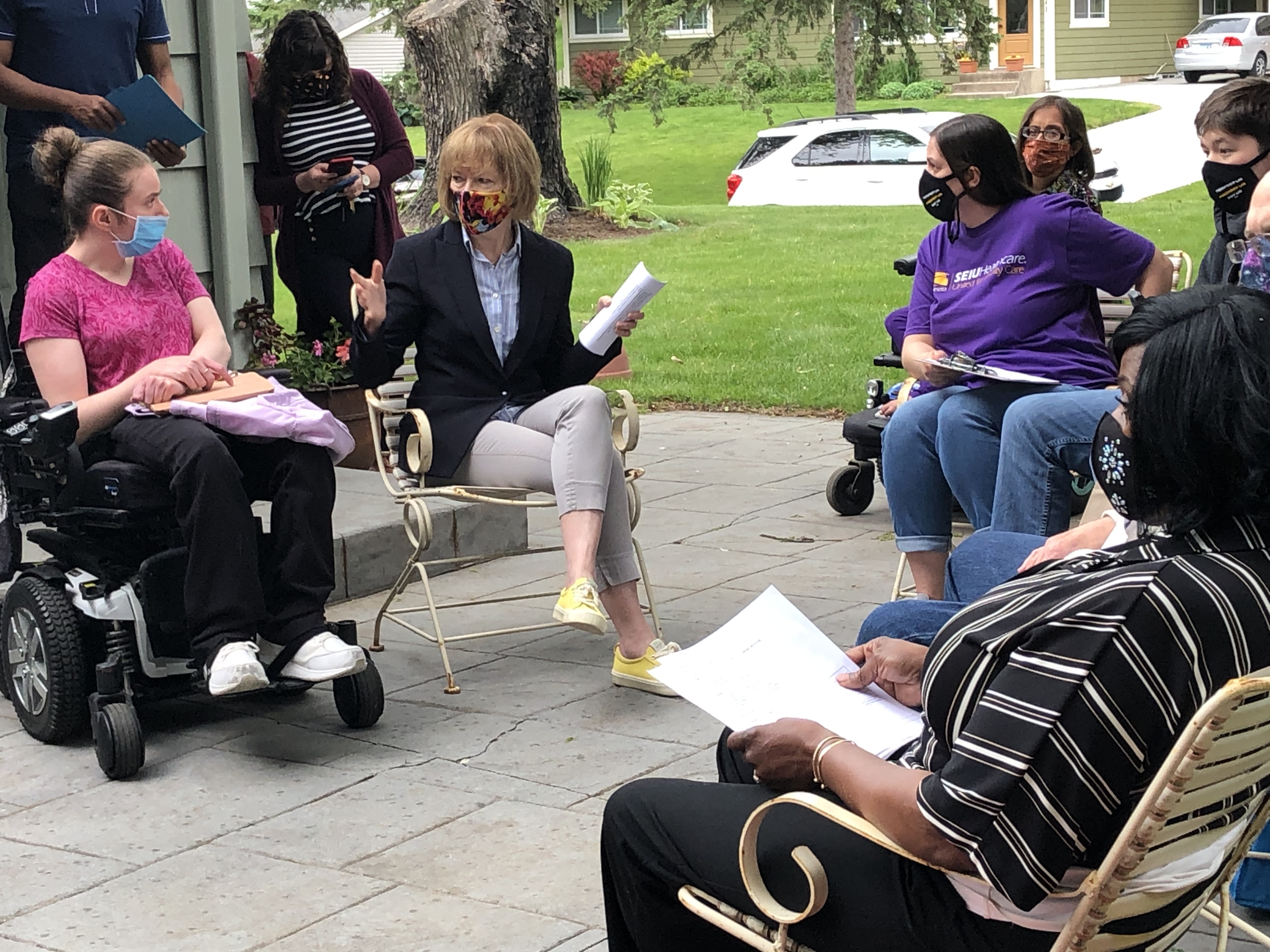
Sen. Tina Smith talks with Lauren Thompson, a home care client and disability-rights advocate with cerebral palsy.

OAKDALE – With Congress poised to take up President Joe Biden’s infrastructure plan this month, workers, retirees and people with disabilities are teaming up to lobby in support of a provision that would provide $400 billion in federal funding for in-home and community-based care. 

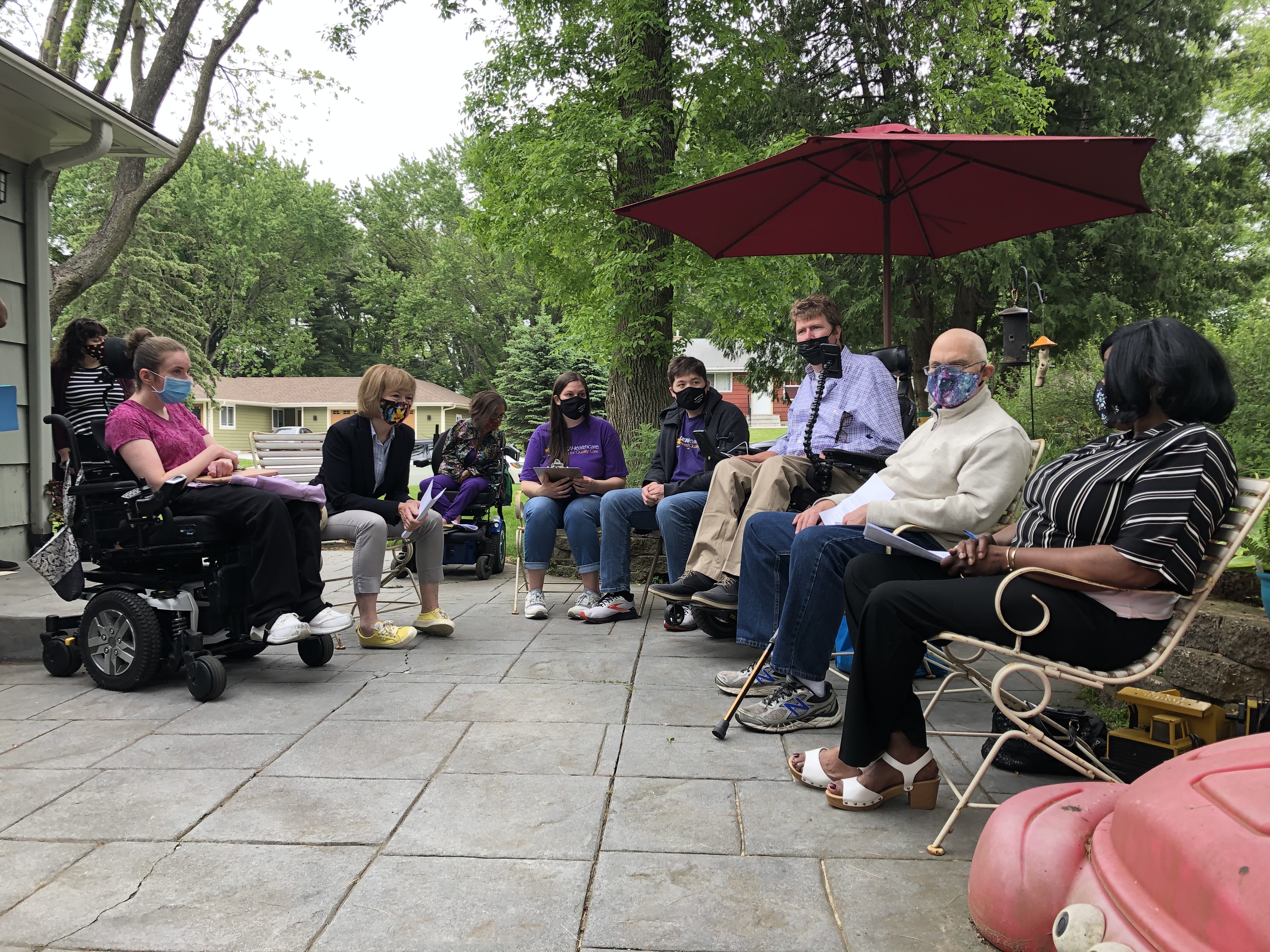
It’s a pitch home care worker Jacqueline Kelly delivered from her own backyard, along with other advocates, to U.S. Sen. Tina Smith yesterday at a listening session planned by SEIU Healthcare Minnesota, which represents over 20,000 home care workers statewide.

Home care investments in President Biden’s proposal would create an estimated 1 million jobs and improve wages and benefits for workers in the industry. That would be a win for workers, Kelly told Smith, and for the clients they serve, like Kelly’s 16-year-old son.

“I worry that if I can’t offer living wages, benefits and a viable long-term career path, caregivers will choose to move into other employment situations that have more stability and less risk,” Kelly said.

Kelly and other advocates at the event also noted that most home health care workers are women and people of color, who “have been left out or left behind for far too long.”

“After COVID, I hope we all know better now,” Kelly said. “Our communities, our families, our economy – we are all depending on the women doing this work to keep all of our lives going. And what could be more valuable than that?”

Restoring the country 

The home care measure is just one part of Biden’s $2 trillion infrastructure proposal. The American Jobs Plan also calls for jobs-creating investments in roads, bridges, transit, schools, housing, manufacturing, research, climate change mitigation and more.

SEIU and other unions are backing the president’s plan. AFL-CIO President Richard Trumka called the “unprecedented federal investment” an important and necessary step toward “repairing, rebuilding and restoring our country.”

“It’s time for Congress to step up and deliver the funding we need to tackle the climate injustice, racial injustice and economic injustice facing working families while creating a new generation of well-paying union jobs,” Trumka said.

Indeed, Biden’s proposal includes “neutrality” language requiring projects funded through the legislation to offer workers a fair opportunity to form a union. That includes expanded support for home health care through Medicaid, which a White House fact sheet asserts would “put in place an infrastructure to create good middle-class jobs with a free and fair choice to join a union.”

An investment in independence 

More than 90,000 people work as home health aides and personal care assistants in Minnesota, and home care workers here already have formed a union to improve their wages, benefits and training opportunities.

But advocates say the federal government must do more to stabilize and professionalize the industry’s workforce, which is marked by high rates of turnover.

Lauren Thompson, who has cerebral palsy, told Smith that her struggle to find consistent, affordable home care has “impacted every aspect of my life.” Over the last 10 years, Thompson said, she has bounced between in-home and “facility-style” care, and now lives in a group home with three other people.

“I’m the safest I’ve been in years, but I’ve lost my freedom and my privacy,” Thompson said. “Everyone needs to know that there’s a large demographic of Americans who aren’t truly living free because of this care crisis.”

While some workers rely on roads or transit or internet access to get to work, millions of American workers with disabilities rely on home health care, Rob Wudlick, a clinical research project manager at the University of Minnesota’s medical school, told the senator.

“Being able to live in the community allows me to work,” said Wudlick, who suffered a life-changing injury as a teenager. “Having a strong health care workforce – those are my arms and legs. Without that, I am not able to get out of bed. I would have to live in a facility somewhere and wouldn’t be able to work.”

‘Infrastructure for families’ 

Smith, a member of the Senate Health Committee, pledged to take the stories of workers and clients back to Congress as debate over Biden’s American Jobs Plan begins. Funding home care is an investment in “infrastructure for families,” she said.

“These jobs have been consistently undervalued, and that has often had devastating impacts, not only for families who need help, but also for the folks themselves that are doing this work and at the same time are often making poverty wages,” Smith said.

The event at Kelly’s home in Oakdale was the first in a series of town halls planned in 23 states, as home care workers, clients and advocates seek to use the power of their personal stories to boost support for Biden’s proposal.

https://platform.twitter.com/widgets.js

After ‘six years of purgatory,’ retirees celebrate pension fix with Smith

Sen. Tina Smith met with Central States pensioners at the St. Paul Labor Center in March 2018 to discuss the Butch Lewis Act, which she fought to include in the latest round of COVID relief. (file photo)

The $1,400 stimulus checks made headlines, but the $1.9 trillion American Rescue Plan, signed into law by President Joe Biden March 11, also includes $86 billion to stabilize distressed multiemployer pension funds over the next three decades.

The emergency funds will protect pension benefits earned by 1.5 million active and retired workers nationwide, including about 22,000 Minnesota retirees who paid into the Central States Pension Fund.

It’s a historic win for local retirees and their grassroots fight for pension relief, and for Sen. Tina Smith, who has championed the issue from her seat on the committee overseeing pension law since taking office three years ago.

During a Zoom call to celebrate the victory March 19, Teamster retiree Dennis Kooren, who lives in the Fargo-Moorhead area, told Smith it felt like he and other Central States pensioners had been through “six years of purgatory,” waiting to see if their earned benefits would be stripped or saved.

“This is bittersweet,” Kooren said. “We’ve been fighting so hard for so long, it’s hard to believe we even won.”

After the Great Recession, trustees for the troubled fund warned that, without federal relief, it would run out of money around 2025. Instead, Congress passed a law in 2014, authored by former Minnesota Rep. John Kline, allowing multiemployer pension funds to seek authorization to cut retirees’ benefits.

But retired Teamsters in Minnesota and across the Midwest pushed back hard against the proposed cuts.

Steve Baribeau, a Teamster retiree and co-chair of the Twin Cities-based group Save Our Pensions MN, remembered a hearing on the University of Minnesota campus, where people using “wheelchairs, walkers and canes” crowded into an auditorium to plead with a Treasury representative not to approve Central States’ proposed cuts.

“It was clear they could not go back to work, and they needed their pensions,” said Baribeau, who himself faced a 47% reduction in benefits under the proposal.

After the Treasury Department rejected Central States’ rescue plan, retirees in every corner of the state began organizing, mobilizing and lobbying in support of the Butch Lewis Act, named in memory of a Teamster from Ohio who led the fight to protect pension benefits.

Smith has often said a 2018 meeting with retirees in Duluth, during her first weekend as a U.S. Senator, stuck with her, guiding her work on the issue. In her call with pensioners, Smith recalled a conversation with one woman in Duluth who said she had no backup savings.

“She said, ‘Senator, I saved, and I did everything right. But it’s hard for me to work right now. And I don’t have a Plan B. My Plan B is living under a bridge if I lose my pension.’”

As negotiations played out over the latest round of COVID-19 relief, Smith fought for inclusion of the Butch Lewis Act. The measure provides funds to prevent benefit cuts, but also to stabilize multiemployer pension funds that are struggling financially, keeping intact the federal Pension Benefit Guaranty Corporation as a backstop for benefits.

Additionally, the Butch Lewis Act restores benefits to tens of thousands of retirees and workers whose pensions have been cut since Kline’s 2014 law took effect.

Community rallies around refinery workers as Marathon lockout enters third week

Gov. Tim Walz rallies with locked-out refinery workers in St. Paul Park.

ST. PAUL PARK – As picketing at the refinery in this small, suburban community entered a third week, members of Teamsters Local 120 and Gov. Tim Walz ratcheted up the pressure on Marathon last night with a rally highlighting workers’ safety concerns.

Each day the lockout continues, Local 120 steward Tylor Sardeson warned, Marathon is putting its workers and surrounding communities at risk.

“We’re on this side of the fence,” said Sardeson, a crude operator at the facility. “It’s the wrong side of the fence to make sure this place stays safe.”

Nearly 200 Teamsters are standing together to resist the company’s demand for dramatically different staffing inside the refinery, including the ability to replace union members with workers from lowest-bidder subcontractors.

“They’re going to add more jobs to my plate, and I don’t even feel comfortable with the ones I have right now,” Local 120 steward Dean Benson said. “Safely, it’s just not possible.”

Walz listened as workers and family members laid out the stakes of contract negotiations with Marathon. Rhiannon Sklavenitis fought back tears as she recalled a serious burn injury her husband suffered at the refinery, which left her more afraid for his safety than when he was deployed into combat with the Navy.

The governor then took the stage and called on Marathon “to get back to the table” and “make sure safety is at the center” of talks. He praised union members for taking a stand.

“It’s about the safety of this community,” Walz said. “I can’t tell you how grateful I am for that.”

Elected officials have tread a beaten track to St. Paul Park since the work stoppage began, offering their support to Teamsters on the picket line. Some lawmakers have taken managers at the refinery to task for locking out experienced workers.

U.S. Rep. Betty McCollum, in a letter to local Marathon executive Amy Macak, noted ownership of the refinery has changed multiple times in recent years, but its “dependable, highly-skilled, local union-represented workforce” has been a constant presence.

“The breakdown of contract negotiations and use of outside contractors by Marathon raises serious questions about safety,” McCollum wrote, adding that the 2018 explosion at Husky Energy’s refinery in Superior, Wis., serves as a “grave reminder of the need to maintain the highest standards for safety.”

Members of other local unions are showing their solidarity with locked-out Teamsters as well, joining them on the picket line, providing food and other supplies, and contributing to workers’ defense fund.

“There are a whole bunch of unions in this crowd,” Kera Peterson, president of the 66,000-member St. Paul Regional Labor Federation, told locked-out workers during the rally. “This fight is Minnesota’s fight, and we are with you in this for the long haul, as long as it takes.”

Teamsters who work at the St. Paul Park refinery – electricians, operators, maintenance and other workers – originally went on strike Jan. 21, three weeks after their union contract expired.

After 24 hours on the picket line, striking workers offered to return to their jobs, but they were turned away at the gate – a move Local 120 President Tom Erickson called the most reckless he’s seen in 30 years negotiating contracts.

The two sides have held at least one bargaining session since the lockout began. But like the 24 sessions leading up to the lockout, it was negotiations in name only, union members said.

Jim Swanson, an electrician at the refinery, told U.S. Sen. Tina Smith on the picket line Saturday that union members make sure to bring their phones into bargaining, so they have something to read after the company’s negotiators walk out of the room.

Local 120 members Luke Naber and Tyler Sardeson demonstrate outside the Speedway in St. Paul Park, informing potential customers about the refinery lockout.

“They just haven’t negotiated at all,” Swanson said. “It seemed like they had an agenda right from the beginning. I think they planned to not even negotiate and have us go on strike.

“We never brought up money once,” he added. “I don’t think anybody here is concerned about money. It’s issues in the refinery – safety stuff and trying to eliminate positions.”

As the lockout drags on, Local 120 members have begun following trucks from the refinery to local freight yards and Speedway gas stations, looking to raise awareness of the lockout.

While they cannot legally call for a boycott of Speedway, workers can advise potential customers that the fuel being sold crossed a picket line, and that the company has locked out workers whose training and experience keeps St. Paul Park and its surrounding communities safe.

“We don’t want the Husky incident to happen here,” Sardeson said. “I live in Cottage Grove. My children go to school here in Cottage Grove. It’s very important to me that the facility stays running and stays safe.”

Smith earned labor endorsement in Senate race with hard work

Terry Nelson (L), Painters and Allied Trades District Council 82’s business manager, leads Sen. Tina Smith and Susan Kent, the Minnesota Senate’s minority leader, on a tour of the union’s apprenticeship center in Little Canada.

During Tina Smith’s first week as a U.S. senator, after Gov. Mark Dayton appointed her to the seat in December 2017, Smith traveled to Duluth, where she met with workers and retirees fighting to save their pension fund.

The Central States Pension Fund, with some 400,000 participants, had recently announced it would run out of money in the next 10 years, putting at risk the earned benefits of 273,000 retirees, mostly former Teamsters.

Smith remembers meeting one union member at the event who said she didn’t think she could afford to retire without her pension. “I don’t have a Plan B,” she told Smith. “That’s my only plan for making sure I can stay in my house, that I can pay my bills.”

Smith was officially sworn into office a month later. Since then she has made pension reform one of her top priorities, signing on as a supporter of the union-backed Butch Lewis Act. And from her seat on the Senate Committee on Health, Education, Labor and Pensions, Smith has raised awareness of the looming crisis Central States and other funds face without federal action.

But the encounter in Duluth stuck with Smith, she said, both as an example of the “deep economic inequity” plaguing our country and as a reminder of what the junior senator from Minnesota tries to prioritize in Washington, D.C.

“It was so motivating to me,” Smith said. “Here are people who did everything they were supposed to do. They paid into the pension, and their employers did, too. And yet there were members of Congress … trying to shirk the responsibility we have to protect people’s pensions.”

Smith has been on working people’s side throughout her career in politics, and working people are on her side as she seeks re-election – with the labor endorsement – to her first full term in the Senate.

Minnesota AFL-CIO President Bill McCarthy said Smith shares union values, like “dignity, justice and freedom for working people.” Jessica Looman, executive director of the Minnesota Building and Construction Trades Council, called Smith an ally of union tradespeople and all working people.

“As the former lieutenant governor of Minnesota, she understands what the workers in our state need, and has been an effective voice for Minnesota in Washington,” Looman added.

Being on labor’s side is “everything to me,” Smith said.

Sticking up for workers

Growing up in a politically active family, Smith said, she developed an early respect for the powerful role unions play in advocating for all working people. And after graduating from high school, she learned firsthand the benefits of carrying a union card.

Smith worked that summer as a bull cook on the Trans-Alaska Pipeline. Crews had to be flown into Prudhoe Bay, where they worked 12-hour days for six weeks straight before getting two weeks off.

“That was how the contract was negotiated,” Smith said. “Everybody wanted to go up there and just work like hell and then come home again. But because of that experience, because of being a member of a labor union, I was able to help put myself through college.”

Smith hasn’t stopped working hard since entering politics. As former Gov. Dayton’s chief of staff and, later, lieutenant governor, Smith has focused on leveling the playing field for working people – the same way unions do, she said.

“Certainly, labor unions stick up for their members, as well they should. But they stick up for regular folks doing jobs that are not organized too,” Smith said. “It’s that advocacy for a higher minimum wage, for paid family leave, for health care people can count on.”

Tina Smith meets with postal employees outside the Eagan distribution center.

A record of trust

Union leaders are quick to point out highlights of Smith’s work since Minnesotans voted to keep her in office two years ago.

• Weeks after that election, the federal government shut down. When it reopened in January 2019, following the longest shutdown in history, lawmakers agreed to repay federal employees for their lost wages.

But they left out federal contract workers, including many people in low-wage jobs like food service, custodial and security work. Smith authored a bill to make those forgotten workers whole, but the Republican majority refused to take it up.

• Later in 2019, Smith introduced the 21st Century Workforce Partnerships Act, which would encourage relationships between businesses and high schools to provide students the skills they need to find good-paying jobs and careers, including work in the union construction trades.

• This summer, when members of postal unions approached Smith with concerns that President Trump’s new postmaster general was making drastic changes that slowed down mail delivery, Smith used her position to sound the alarm. She and other elected officials questioned the postmaster about the impact his moves would have on election integrity. And it helped generate enough public outcry to get the administration to back off on further reforms for now.

More challenges await

But Smith wants to see Congress do more for working families, particularly with no end to the COVID-19 pandemic in sight. “We still have work to do,” she said, to keep workers, businesses, schools and local governments afloat.

After hearing from working parents and employers in Minnesota that a shortage of child care has only gotten worse during the pandemic, Smith teamed up with Sen. Elizabeth Warren of Massachusetts to write a bill that would invest $50 billion in expanding access nationwide.

“Child care is like the infrastructure we need in our communities for families to really be able to function,” Smith said, noting that the measure would also boost pay for child-care providers. “These are predominantly women, often women of color, and they often are making barely $20,000 a year. That’s not even enough to take care of their own families.”

Smith also believes Congress should craft an “industrial and manufacturing strategy” that puts the nation in a position to address the climate crisis – and, in the process, create jobs that are “clean and green and strong.”

And to make sure those jobs guarantee workers the right to join together, Smith supports the union-backed PRO Act, which would add teeth to nation’s outdated labor laws.

In it for the long haul

That’s a long to-do list, but union members who have worked closely with Smith don’t see her backing down.

Just ask members of Teamsters Local 120 who worked at Lakeville Motor Express. When the local trucking company closed abruptly in 2016, stiffing workers out of two weeks’ worth of wages, Smith, lieutenant governor at the time, blasted the company publicly and helped launch an official investigation.

“In my experience if Tina Smith does not say, ‘This is just like stealing from these workers, and I am paying attention to what is happening here,’ then Lakeville may have succeeded,” Local 120’s Paul Slattery said.

It took two and a half years, but Lakeville Motor Express agreed last year to a $1.25 million settlement that provided lost compensation to its former workers.

“Sometimes you have to be in the fight for a long time,” Smith said. “You don’t get immediate gratification, but you have to keep on fighting.”

And Smith said she is still fighting for that pensioner she met three years ago in Duluth, doing it the only way she knows how.

“I put my head down, I get the work done and I get results,” she said.

In meeting with Smith, postal employees pledge to ‘go the extra mile’ to ensure mail-in ballots count

Tina Smith meets with postal employees outside the Eagan distribution center.

As U.S. Sen. Tina Smith met with postal workers, letter carriers and reporters outside the sprawling mail distribution center in Eagan today, a pickup truck exiting the facility slowed to a stop near the crowd. The driver lowered her window and barked out a brief message for Smith before speeding away.

“Thank you, senator!” she yelled. “Give him hell.”

That’s exactly the treatment new Postmaster General Louis DeJoy has received from Smith and other Minnesota DFLers over the last month, as structural changes at the USPS have slowed down mail delivery in many parts of the country and, just 11 weeks from Election Day, cast doubt on the agency’s ability to accommodate a vote-by-mail surge during the COVID-19 pandemic.

“I have been hearing from many, many of my constituents about mail that is late, that is unreliable,” Smith said after an inspection of changes at the Eagan facility. “And that’s not the fault of the people who work so hard inside that building. That is the fault of the chaotic approach and rapid-fire change we’ve been seeing at the federal level.”

In response to criticism from both Democrats and Republicans, DeJoy issued a statement shortly before Smith’s scheduled tour, announcing that the Postal Service would put further restructuring plans on hold through Election Day.

“That doesn’t give me any great confidence,” Smith said, adding that she worries DeJoy shares President Donald Trump’s “politicized” view of the Postal Service. “It makes me wonder what their true intentions are.”

The USPS Board of Governors, stacked with six Trump appointees, tapped DeJoy to serve as postmaster general May 6, and he took office in June.

For DeJoy, who has contributed millions to Republican candidates and over $1.2 million to the Trump Victory Fund, it was his first job with the public Postal Service after a 35-year career in the private shipping industry. He and his wife recently held investments of between $30 and $75 million in companies that compete directly with USPS – a blatant, but not illegal conflict of interest.

Union leaders warned DeJoy’s appointment was like putting a fox in charge of the hen house, and he has done little in the last two months to prove otherwise.

In July, DeJoy announced processing facilities like the one in Eagan would hold onto mail not sorted in time to meet strict distribution schedules, a move he described as necessary to curb overtime pay. Previously, drivers and postal workers would work in tandem to move as much of the day’s mail off the shop floor before closing the truck gate, ensuring timely, dependable delivery.

Todd Elkerton, president of the APWU’s St. Paul branch, speaks during a press conference outside the Eagan facility.

“We were taught if that mail doesn’t go out the next day, we were going to get in trouble,” said Todd Elkerton, president of the American Postal Workers Union in St. Paul. “Now we’re seeing it happen. It’s being directed from above. And we’re really having a hard time dealing with it.”

Meanwhile, the Postal Service has removed 671 sorting machines from stations across the country, leading to further delays. And photos of mailboxes ripped off the streets in several communities spread widely on social media last week, prompting more public outrage.

The Eagan facility has lost seven sorting machines since the restructuring began, Elkerton said. It’s not the first time he has seen machines “tarped” – or taken out of service – during periods of low mail flow, but it is more than Elkerton has ever seen at once.

So far, postal workers in Eagan have been able to keep disruptions in mail service to a minimum. But the facility was understaffed before the restructuring, and the sorting machines Eagan lost were capable of processing nearly 5 million pieces of mail per day. Elkerton and Joe Malkush, president of the National Association of Letter Carriers in St. Paul, said that doesn’t bode well for the inevitable increase in mail volume.

Smith and other federal lawmakers from Minnesota have demanded DeJoy reverse the changes, alarmed by reports from constituents whose medications have been slow to arrive by mail.

Rep. Angie Craig, a DFLer who represents Minnesota’s 2nd Congressional District, sent a letter to DeJoy and Veterans Affairs Secretary Robert Wilkie, Jr., earlier this month, noting that the VA fills nearly 80% of veterans’ prescriptions by mail.

Joe Malkush, president of the St. Paul letter carriers union, say if his members can deliver the mail on time for the holidays, “we can do it during the election.”

“I will not stand by and watch these recent attempts to politicize, dismantle and delay postal services, which put the lives of more than 330,000 veterans every day at unnecessary risk,” Craig said. “The politicization of the Postal Service is a grave disservice to the hardworking employees of the Postal Service and puts American veterans in harm’s way.”

In May, Craig and 4th District Rep. Betty McCollum voted with other House Democrats to keep the agency afloat during the pandemic with $25 billion in emergency funding, part of the HEROES Act. Trump and Senate Republicans have balked at the amount.

The president has acknowledged the emergency funding would improve the agency’s ability to handle mail-in voting, which he opposes. “They need that money in order to have the post office work so it can take all of these millions and millions of ballots,” Trump said in an interview with Fox Business.

Further stoking election-related fears, the Postal Service sent letters to 46 states warning that mail-in ballots may not be delivered in time to be counted. But local postal employees said they remain confident every ballot cast through the mail here will be delivered to election officials on time – “even if we have to go the extra mile,” Elkerton said.

Delivering the mail, Smith quipped to reporters, is embedded in postal employees’ DNA.

“We do it during Christmas,” Malkush added. “We can do it during the election.”

Kera Peterson: In uncertain times, voting is sure way to make an impact

– Kera Peterson is president of the St. Paul Regional Labor Federation, AFL-CIO. She wrote this “Labor Voices” column for the August 2020 issue of The Saint Paul Union Advocate.

*****

“In these uncertain times …”

It’s the marketing catchphrase of 2020, and for good reason. Our lives have been upended by three crises at once: a public health pandemic, an economic free fall and long-standing structural racism. Both locally and nationally, our labor movement is responding to each crisis with urgency and solidarity, and we will carry that same energy into our next big challenge of 2020, the election.

That much I am certain about.

Working people need safe jobs, economic security and freedom from systemic racism. We won’t get it with elected leaders who take orders from the corporate lobbyists and CEOs whispering in their ears. We’re seeing what happens when our federal government puts profits and stock prices before working people’s health and safety, and the results have been tragic.

A staggering number of Americans have lost their lives to COVID-19, more than any other country on earth. And an unacceptable number of cases are being traced back to the worksite, where essential workers have too often felt expendable, forced into the impossible choice between getting sick and getting paid. We can’t have a healthy economy without healthy workers. But the Trump administration was painfully slow ramping up production of the protective equipment and testing needed to keep workers safe, and the president has repeatedly undermined his own agencies’ guidelines for preventing the virus’ spread. OSHA, the federal agency charged with protecting workers, was understaffed before the pandemic. Now, as thousands of complaints pour in from the front lines, the agency stays mostly on the sidelines. We deserve better.

Failing to protect the health and safety of frontline workers has only made our nation’s persistent racial disparities worse. COVID-19 hospitalization and death rates are higher for members of Black and Latinx communities, who make up a disproportionate share of the essential workforce. At the same time, protests of systemic racism, sparked by the killing of George Floyd in Minneapolis police custody, have spilled into the streets nationwide.

Stopping the free fall into even deeper and deadly racial inequality, ensuring the health and economic security of working people, putting our country on a path to prosperity for all – these are our goals as a movement, and they are goals we share with our labor-endorsed candidates. We know this because, over the last four months, local union members have screened these candidates, discussed where they stand on the issues and recommended them for endorsement.

Now, the work of our Labor 2020 campaign begins. Minnesota’s primary election is Aug. 11, and at least one labor-endorsed candidate, U.S. Sen. Tina Smith, will appear on every primary ballot. Across the metro, labor-endorsed congressional candidates and state legislative candidates face primary challenges as well. They need your vote.

Unions are about bringing people together, and our political work is no exception. While the physical distance necessary to fight this pandemic means bringing people together – and getting them the polls – will look a little different in 2020, I know we will find creative and ways to succeed. The easiest way to make a difference right now is to make sure your voter registration is current and to request an absentee ballot, so you can vote by mail in both the primary and general elections. It takes just a few minutes on the Minnesota Secretary of State’s website.

Distance may be inevitable, but division is not. Fundamentally, that’s what the choice in 2020 comes down to. We can join together behind a vision of equality and prosperity for all, or we can continue to be divided by those familiar fault lines of race, religion, sexual orientation, region and beyond. This is a moment that demands clear action and common purpose. And while, in these uncertain times, no one knows exactly how the election will play out, you can be certain which side the labor movement is on.

Labor backs Smith in Senate re-election bid

Sen. Tina Smith talked with striking GM workers on the picket line in Hudson last year.

The state’s largest labor federation, the Minnesota AFL-CIO, issued its first endorsements of the 2020 election cycle earlier this month, backing Sen. Tina Smith’s reelection campaign and DFLers in the 1st and 7th Congressional Districts.   

Smith, who will be back on the ballot just two years after winning an election to serve the remainder of Al Franken’s term, serves on the Senate Committee on Health, Education, Labor and Pensions.  

Already, she has emerged as a leading advocate for several of organized labor’s top legislative priorities, including pension reform and protections for workers employed by the federal government and its contractors.  

Earlier this month, she introduced a bill that would prevent companies that mistreat their employees and repeatedly break workplace-protection laws from receiving taxpayer-funded federal contracts. The Fair Pay and Safe Workplaces Act is largely similar to an executive order issued by President Obama and repealed in 2017. 

“If companies break the law, then they should not receive taxpayer-funded government contracts,” Smith said. “But right now too many federal contracts are being awarded to companies with egregious and repeated violations of worker protection laws. While most contractors treat their workers fairly, we should be cracking down on the bad actors that put workers’ lives and livelihoods at risk.” 

The Minnesota AFL-CIO General Board also voted to endorse 7th District Rep. Collin Peterson’s re-election bid, and Dan Feehan in the 1st District. 

“No matter where we were born or what we look like, the members of Minnesota’s labor movement are united in common purpose to elect leaders who share our values of dignity, justice and freedom for working people.” Minnesota AFL-CIO President Bill McCarthy said, adding that endorsed candidates “have demonstrated a strong commitment to working Minnesotans and our values.” 

More labor endorsements are expected in the coming months.