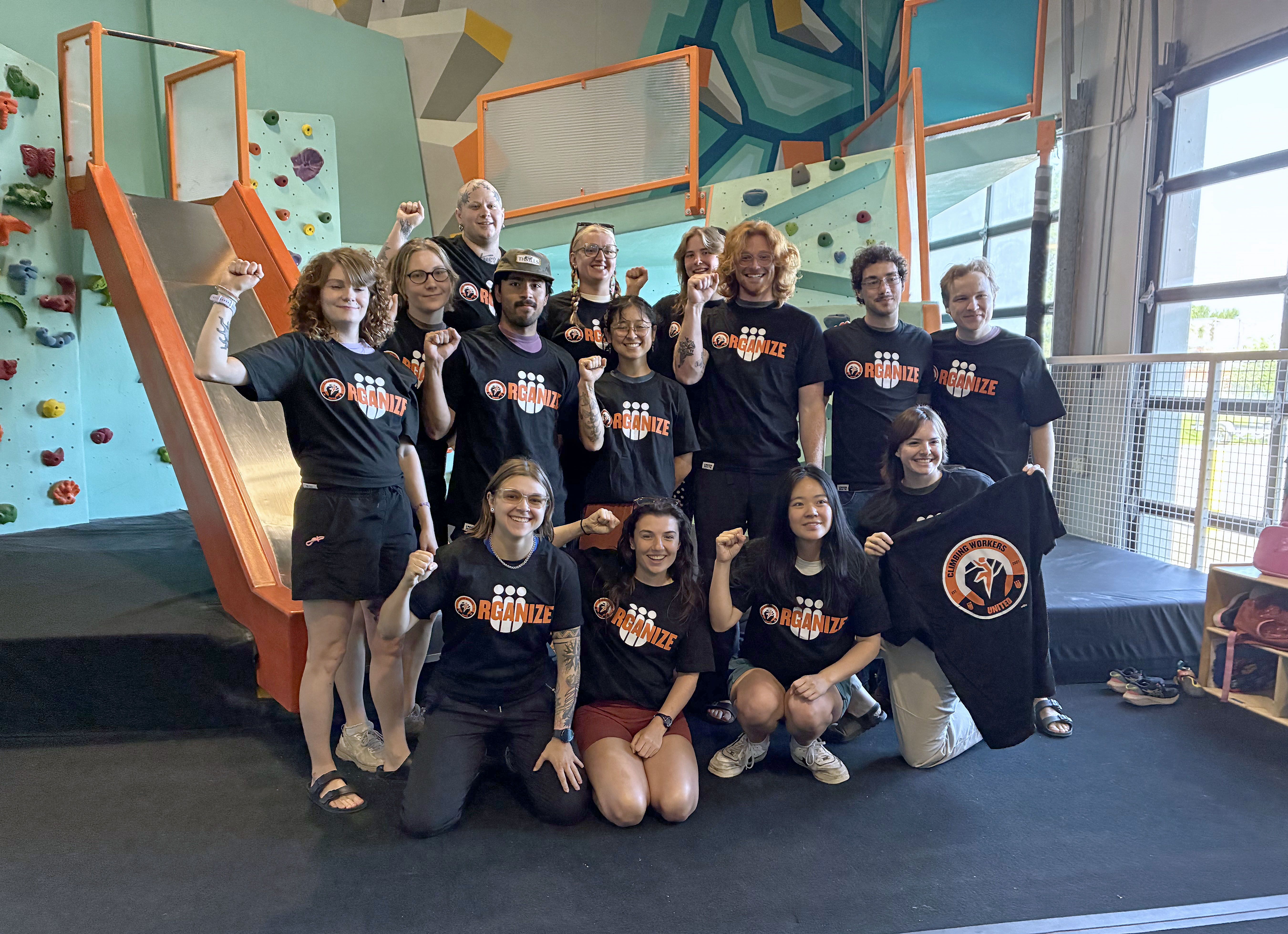
Bouldering Project workers formed a union with Workers United, an SEIU affiliate.
After a meeting with the CEO left more questions than answers, workers at two Bouldering Project gyms in the Twin Cities moved quickly to organize a union.
Workers voted to 79-7 to form a bargaining unit with Workers United, an affiliate of the Service Employees (SEIU), in a landslide election Aug. 6 overseen by the National Labor Relations Board.
The new unit brings together 117 workers at the St. Paul and Minneapolis climbing gyms, from climbing supervisors and youth programming staff to front-desk and maintenance workers.
The climbing industry has expanded steadily over the past decade, and with projections to continue growing, the industry is attracting outside investment, including from private equity.
Climbing workers, in turn, have been forming unions to protect their voice as the industry changes. Vertical Endeavors workers in the Twin Cities unionized in 2023 with the United Food and Commercial Workers. Bouldering Project gyms in Brooklyn and Boston saw successful union drives over the last year, and Workers United represents staff at over 30 climbing gyms nationwide.
The organizing bug reached Bouldering Project’s Twin Cities gym via an unlikely source: a gym member who traveled to Brooklyn and, by coincidence, met Bouldering Project workers there who had recently unionized. The member connected the Brooklyn worker with a Minneapolis worker after returning home.
From there, the campaign took shape, tapping into a growing sense that the culture at Bouldering Project was changing, according to Arrow Shipp, a supervisor in the St. Paul gym entering their fourth year on the Bouldering Project staff. Shipp said some workers trace the shift to a round of private-equity investment after the COVID pandemic.
“Part of the reason people want to be at the Minneapolis Bouldering Project is the community they’ve built – the vibes, the inclusivity, being local at the core,” Shipp said. “I think a lot of people were feeling like we’re pushing promos for new members more than we are building community with current members. We’re losing those core values that the company claims, and I think people were getting tired of the energy.”
Soon after organizing began, Bouldering Project CEO Trever Ackerman announced plans to hold town-hall meetings with workers across the U.S. When Ackerman came to the Twin Cities, workers – some involved in the not-yet-public union drive and some not – were ready with direct questions, expecting a give-and-take dialogue, Shipp said.
That wasn’t what they got.
“It felt very performative,” Shipp said. “We asked Trever questions directly, and he kind of danced around the answers.”
Ackerman asked for more time to process workers’ concerns and pledged to respond. That response came June 1 with a letter announcing wage rates would increase by 1% to 5% for nine Twin Cities positions, including six non-management roles.
But Front-desk workers like Shipp were excluded from the raises. Some workers Shipp talked to reported seeing raises of 13 to 25 cents per hour.
“Those raises felt kind of like a slap in the face,” Shipp said. “They weren’t hearing us; they were trying to appease us.”
Now that they’ve unionized, Twin Cities workers will look to address their issues with a seat at the bargaining table.
Priorities for a first contract, according to the union, will likely include job security and pay. The wages of some full-time workers are low enough that they could qualify for public assistance.
Shipp, 27, said the organizing process has deepened connections between co-workers, many of whom have never been members of a union before.
“We learned that we have a shared passion for community and the fight for workers’ rights,” Shipp said. “Spending time talking about that and getting together to work toward this common goal was really incredible.
“Sometimes society feels like it’s in a really tough spot right now. It’s so cool to have people come together and support each other.”
– Michael Moore, Union Advocate editor

