Bree Halverson: Minnesota’s clean economy should power good-paying, safe jobs

Gov. Walz signed the 2040 clean energy standard into law during a ceremony at the St. Paul Labor Center in February 2023. (Minneapolis Labor Review photo)

Minnesota has a new law that puts us on a path to 100% clean energy by 2040. That’s indisputably good for the environment. Thanks to the strong labor standards and equity provisions in the bill, it will also be great for all workers in our state, specifically union workers.

Our nation has been struggling with economic inequality for decades, and it has only worsened over the years. The U.S. Census Bureau reported that income inequality in 2018 – the gap between the wealthiest Americans and the average worker – had reached the highest level recorded since the bureau started tracking the gap. According to the Economic Policy Institute, CEOs in 2020 were paid over 350 times more than the typical worker.

This is also a problem facing Minnesotans. The income gap here is significant, particularly for people of color, who are 300% more likely to be in poverty than white people. Unionization is a key pathway to fixing this growing problem facing our state.

There is a major reason why the 100% clean energy bill had such strong support from unions and why it was signed by Gov. Tim Walz at the St. Paul Labor Center. The measure rightfully tied specific labor and equity standards to the implementation of the bill.

For example, there is an emphasis on creating local, high-quality jobs in Minnesota. The bill encourages new energy generating facilities to be sited in communities where fossil-fuel generating plants have been retired or are scheduled for retirement. It also says that emissions reductions that clean up our air should also make the air cleaner for communities that are facing environmental injustice, and that all workers and communities should see the benefits of this law.

Perhaps the most important provision is a requirement to recognize the rights of workers to organize.

Kevin Pranis of LIUNA Minnesota spoke during the bill signing ceremony.

Unions matter. There is a direct correlation between the increase in income inequality and the decrease of worker power, as the share of workers in a union has fallen from 24% in 1979 to under 11% now. Unions also make job sites safer. Unionized workers are better trained and better protected to blow the whistle if they see something dangerous going on, without fear for retribution from management because the union has their back. Finally, unions can help overcome long-standing inequities for people of color in our state.

Clean energy has been great for our economy. Workers around the state are making buildings more energy efficient, constructing wind turbines and more. There are an estimated 57,000 jobs in clean energy, energy efficiency, advanced transportation and other clean sectors in our state. Now, as we grow those jobs, more and more of them will be good-paying, safe, union jobs.

Our environment also matters. Climate change is already here and impacting us all. The action we take now will determine the future of our state. We should be fixing what was broken and leaving future generations a cleaner environment than the one we inherited from previous generations. This bill will reduce the emissions driving climate change. That’s a good thing for everyone.

The future is bright for workers and our climate. The federal investments in the Inflation Reduction Act and the bipartisan infrastructure law, coupled with Minnesota’s own investments and policies like 100% Clean Energy, will ensure we are installing utility-scale solar with well-trained, local labor. We will expand the number of local wind jobs, keep workers safe on the job and build the technology of the future – like geothermal – here in Minnesota with union labor.

Thank you to the House and Senate DFL majorities and Gov. Walz for delivering this victory for workers and the environment.

– Bree Halverson is the Midwest States Director for the BlueGreen Alliance, a national partnership of labor unions and environmental organizations.

Dems’ climate measure ties tax credits to prevailing wage, apprenticeship

Matt Campanario, executive director of the Carpenters Training Institute, leads Sen. Tina Smith on a tour of the LJ Shosten Training Center in St. Paul, which houses the union’s pile driver and millwright apprenticeship programs.

The Inflation Reduction Act, signed into law by President Joe Biden in August, promises the most aggressive action to combat climate change in U.S. history, a $369 billion investment that aims to reduce carbon emissions by 40% this decade.

But what most excites some union leaders about the IRA are long-sought provisions that will ensure the transition to a cleaner-energy economy creates and sustains union jobs – and taps into the job-training capacity of unions’ registered apprenticeship programs.

In a win for Building Trades unions, businesses looking to claim tax credits available under the IRA must commit to paying prevailing wages and employing a minimum number of registered apprentices on their jobsites.

The requirements apply to most tax credits that were greatly expanded by the historic legislation, which Democratic majorities spent months shepherding through Congress.

The tax credits will spark private-sector construction of energy-efficient commercial buildings, housing and electric vehicle charging stations, as well as investments in energy sources outside of fossil fuels.

An analysis released by the University of Massachusetts at Amherst projects the IRA’s climate and energy investments will create 9 million jobs over the next decade.

By insisting on strong labor provisions, said Adam Duininck, director of government affairs for the North Central States Regional Council of Carpenters, Biden and other lawmakers ensured those investments will create good-paying jobs for skilled American workers.

“The expanded tax credits included in the Inflation Reduction Act will benefit businesses that pay prevailing wages and hire our apprentices,” Duininck said. “Paying workers prevailing wages will further support our communities where workers live and spend their money. This will give local businesses and our public services like education, public safety and well-maintained infrastructure the financial backing they should be receiving from hard working, middle-class workers.

“Our communities miss out on billions of tax dollars by unethical business practices of dishonest contractors. It is great to see support for those who conduct business in a manner that benefits people rather than lining the pockets of only a few individuals.”

Carpenters apprentice Amanda Heiser tells Smith recently passed infrastructure and climate bills “definitely provide a more stable future” for apprentices like her.

The IRA also includes penalties for firms that pledge to pay prevailing wages but don’t follow through, requiring them to make workers whole – plus interest.

Meanwhile, industrial unions hailed domestic content requirements included in the IRA, which will encourage the use of American-made batteries, solar and wind components and other technologies on clean energy projects.

The requirements will stimulate job growth in the U.S. manufacturing sector, said Jason Walsh, director of the BlueGreen Alliance, which brings together unions and environmental groups.

“Few pieces of legislation this century have come close to such sweeping job creation potential,” Walsh said. “This bill’s investments offer an opportunity to support and create good union jobs and for workers and communities to reap the economic gains of the clean economy.”

For the Biden administration, the IRA delivers – again – on a campaign promise to make union jobs the focus of its economic policy.

A $1 trillion infrastructure law, which Biden signed in November 2021, is already creating work for union tradespeople in Minnesota. Over 100 projects statewide have tapped into $1.4 billion in federal funding available through the bill so far, including a $22 million project at Minneapolis-St. Paul International Airport.

Prevailing-wage rates are set by the federal government and vary by location. The rates reflect the average wage paid to similarly employed workers in a specific occupation in that area.

Bree Halverson: Buying clean and fair for workers and the environment

Bree Halverson is Midwest states director for the BlueGreen Alliance.

Infrastructure is at the forefront of the minds of policymakers in our state. Minnesota will see an influx of funding from the Bipartisan Infrastructure Law, passed by Congress and signed by President Biden last year. The Minnesota Legislature is focusing on the state’s significant budget surplus, and the prospect of a bonding bill this year could mean long-awaited improvements to our water and transit systems, roads and bridges, and more. These investments will put Minnesotans to work.

Our state desperately needs this investment. Our overall infrastructure was given only a “C” grade by the American Society of Civil Engineers in their 2018 report card. In particular, our drinking water infrastructure is in dire need of repair. The U.S. Environmental Protection Agency estimates Minnesota will need over $7.5 billion in investment in our water infrastructure over the next 20 years. Doing that work will make our drinking water safer and create good-paying jobs for workers around the state.

It only makes sense that as the state makes these investments, we use materials and products for these projects that are made in places like Minnesota – and the rest of the country – with high environmental standards. That’s the basic concept of a policy called “Buy Clean.” It is a policy to promote spending taxpayer dollars on materials that are manufactured in a cleaner, more efficient, environmentally friendly manner. This reduces industrial pollution and health impacts, while supporting family-sustaining jobs and building globally competitive domestic manufacturing.

Buy Clean is something the BlueGreen Alliance and our partners have advocated for in other states. And we’ve achieved victories. Since its passage in California in 2017, states like Colorado, Washington and, most recently, Oregon have all adopted Buy Clean for materials used in infrastructure projects.

In Minnesota, a study of Buy Clean and Buy Fair policies was passed by the Legislature in 2021, with the leadership of Reps. David Lislegard (D-6B), Jamie Long (D-61B), Frank Hornstein (D-61A) and Zach Stevenson (D-36A), and was signed into law by Gov. Tim Walz. Buy Fair is a related policy which takes into account how companies treat workers, in the same way that Buy Clean weighs the emissions from making the products and materials.

The study called for in the 2021 bill was conducted by the University of Minnesota and presented to the Minnesota Legislature. Using the study as a guide, Minnesota House Climate and Energy Committee Chair Long and Rep. Lislegard are working to craft a Buy Clean and Buy Fair policy to be introduced this session that will help the state choose construction materials with the lowest amount of carbon, and that have been produced by companies that treat their workers right. They are working with unions, industry groups and government departments to make sure the policy will support the unique resources we have here in Minnesota.

The bottom line is that we make steel, concrete and other materials in America, and we do it better and cleaner. When it comes to the materials we use to rebuild and modernize Minnesota’s infrastructure, our state should reward workers and companies doing things the right way to reduce the emissions driving climate change by buying clean and buying fair. We should pass Buy Clean and Buy Fair this session.

– Bree Halverson is the Midwest states director for the BlueGreen Alliance, a national partnership of unions and environmental organizations headquartered in Minnesota.

Building a clean economy ‘on the high road’

When the U.S. House of Representatives passed the PRO Act last month, the labor movement celebrated – and for good reason. The measure would give working people a fairer shot at organizing unions, bargaining better wages and fighting back against rising income inequality.

But the PRO Act would be a win for the planet, too. That’s according to the BlueGreen Alliance (BGA), which lobbied for the PRO Act on behalf of 13 labor and environmental organizations.

Why? To address the climate crisis, the U.S. and other countries will need to replace fossil fuels with clean energy, and they will need to do it quickly. Mustering public support for that kind of massive political effort won’t happen, BGA Executive Director Jason Walsh said, unless there’s something in it for working people.

“We have to rebuild our infrastructure, we have to retool our manufacturing and we have to repower our grid with clean sources,” Walsh said in an interview for the March 2020 issue of the The Union Advocate. “That’s daunting, but it’s also an opportunity. And if we do it right, if we build this clean-energy economy on the high road, we have the ability to make this a more just and equal country and economy.”

Jason Walsh is executive director of the BlueGreen Alliance.

UA: The BGA works to advance policies that protect workers and the environment. That seems like divisive terrain right now. Where do you see potential to cut through the tension?

JW: Environmentalists and labor activists agree on much more than we disagree on. There have certainly been fights and disagreements. I’m not ignoring that. Those are hard, and they’re hard right now in places like Minnesota. But fundamentally, our labor partners and our environmental partners understand the interconnectedness of the fight for workers’ rights and environmental protection.

The PRO Act is an example of that. It’s obvious why our labor partners would support the PRO Act. Our environmental partners understand workers who are organized and empowered fight not only for their wages and benefits and job security, they also fight for things like making sure their plants don’t blow up, making sure that industries are not egregious polluters. Unions like the Steelworkers were some of the most important supporters of our bedrock environmental laws, like the Clean Air Act, because their members lived it and worked it.

UA: What does the clean-energy economy look like, and how do those jobs need to change?

JW: Not enough of the jobs created or promised are family-sustaining jobs. In 2019 only 4% of workers in solar electric power generation were union members, and only 5% of workers in wind power generation were union members. Obviously, the clean economy is much bigger than that, but those are the two fastest-growing sectors within it.

Companies within the clean-energy economy have just flat-out violated their employees’ rights to unionize. There’s Tesla, of course. There was also a solar company, Bright Power, in New York City, where workers were trying to join IBEW and were fired. And last year we saw at a company called Gestamp Wind in Texas, the company unlawfully firing and suspending employees, making threats, engaging in surveillance… It was so egregious that the National Labor Relations Board under the Trump administration ordered them to bargain with (Plumbers and Pipefitters) Local 404.

Why do those companies do that? They do it because they can, because our existing labor laws are completely toothless. That is why the PRO Act is so important as we make this monumental shift to a clean-energy economy.

UA: What’s the scope of this change our economy will need to go through?

JW: We’ve barely scratched the surface. We’ve seen a shift in the last 10 years within the power sector to renewable sources, but zero-emission power is still below 20% of the total. We have a transportation sector that is now the biggest source of greenhouse gas emissions in the country. And we’ve got an industrial sector that is the fastest-growing source of emissions.

We’re going to have to shift all of them to zero-emissions sources by 2050, and we’ve never done anything at that scale before in this country.

UA: What potential is there for working people?

JW: To give a taste, just take the offshore wind industry, which is potentially enormous. There is, at this point, one offshore wind facility in this country, off of Block Island, Rhode Island, and it was built with union labor. This was just five turbines, but it created 300 jobs – electricians, welders, ironworkers, pile drivers, backhoe operators. That wind farm is now producing enough clean, local electricity to power 17,000 homes. We’ve got to do that by orders of magnitude more across the country.

There is a ton of work here, but we’re at this inflection point as to whether we’re going to continue what we’ve seen – mostly low-road, often low-quality jobs, almost exclusively nonunion – or build this economy along the high road.

USW’s Parzino made a career of paper, politics and putting working folks first

Gerry Parzino at the District 11 offices in northeast Minneapolis.

Philip and Genevieve Parzino were working at Brown and Bigelow when they met in the 1920s. Eventually, they fell in love and married.

Their story may sound typical, but Genevieve and Philip were 12 and 13 years old when they met on that calendar factory floor. It’s a bit of family history their son Gerard never forgot as he pursued a 44-year career in the United Steelworkers Union, fighting to improve the lives of working people.

“Luckily, there were unions to change child labor laws,” he said. “Otherwise, I would have probably fallen into the same type of path.”

Instead, Gerry Parzino graduated from high school in 1974 and took a job at International Paper, where he became a member of St. Paul-based United Paperworkers International Union Local 264. (Today, it’s Steelworkers Local 264.)

Parzino served as the local’s secretary, vice president, president and business agent before taking a full-time job with Steelworkers District 11 almost 18 years ago. His focus there remained the paper industry, but Parzino rose through the ranks to become district sub-director for Minnesota and North Dakota.

Over that time, he and his wife, Joan, raised a family of three children, all of whom now have children of their own. Household chores are the only child labor any of them have ever known.

March 2 was Parzino’s last day on the job before retirement. He looked back on his career in this interview, edited for length and clarity.

UA: What’s your earliest memory, as a local agent or with the district, of tackling something big?

GP: Just after I was elected business agent in January 1995, the Waldorf paper mill’s contract was up, and the international staff wasn’t available to help much. I was a new business agent with 700-plus members at the plant – bigger than the whole local is now. That was a huge challenge, but we delivered that contract without a strike.

UA: It’s amazing to think the mill had more members then than the local does now. So much has changed in the industrial landscape here.

GP: I’ve gone through 10 permanent closures in the forest products industry, almost 1,100 members and families who’ve been affected. It’s just been devastating for families, and I’ve seen it more than any person would want to. Probably the most difficult was the Sartell local in 2012, with the explosion and fire (at the Verso Paper Mill) that burnt out of control for about 10 days. We lost a member in that fire; it was his first day back from a layoff recall. The combined loss of jobs and loss of life, that was really tough.

Parzino (L) showed a visitor from Denmark around the Waldorf paper mill in St. Paul during an international exchange event in 1995. (file photo)

UA: How are Steelworkers fighting back against job losses in the industry?

GP: We’ve been really proactive on illegal trade practices; we’ve won dozens and dozens of cases.

In 2015 we had a small group of workers who make a calcium carbonate slurry up in Cloquet, and their employer wanted to eliminate their pension and their rule of 90, cut their health care plan and give a zero wage increase. We had five guys that went on strike for four and a half months, and they brought that multinational corporation to its knees. It was a 100 percent successful strike, and those five workers stood for everybody in the industry.

UA: The international union also has been proactive in getting ready for inevitable greening of our global economy. How successful has that been?

GP: The bottom line is we really do have more in common, as labor and environmental groups, than we do in opposition. Steelworkers have always believed in strong health and safety, not only for ourselves but the communities we live and work in.

UA: A lot of these fights come back to political issues. Have you enjoyed that part of the job?

GP: I’ve always been politically active… Just take a look at what’s happened to our east, whether it’s Wisconsin, Michigan, Indiana, Ohio, Kentucky… We’d be long gone if it wasn’t for Gov. Dayton. Without his veto pen, we’d be in the same boat.

UA: What are Steelworkers seeing in those right-to-work states?

GP: Obviously, it’s going to affect our membership. When employers can use a divide-and-conquer strategy, it’s going to leak into the strength of our collective agreements. That’s basically the strategy behind right to work.

UA: What’s next for you?

GP: A lot of travel with my wife. Hunting, fishing, golfing. And grandkids.

At Washington conference, McCollum calls for investments in clean energy

Rep. Betty McCollum addresses the Good Jobs, Green Jobs conference. (photo submitted)

Rep. Betty McCollum addresses the Good Jobs, Green Jobs conference. (photo submitted)

U.S. Rep. Betty McCollum of Minnesota’s 4th Congressional District outlined a vision for “using the power of American manufacturing to secure America’s energy independence” in remarks made at the Good Jobs, Green Jobs National Conference in Washington, D.C. last month.

The conference, now in its sixth year, met April 16-18, bringing together leaders from labor unions, environmental organizations and businesses united behind the idea of growing a clean-energy economy that fosters social, economic and environmental justice.

McCollum called for “smart” public investments in infrastructure and the energy grid, as well as “targeted tax credits” that will spark private investments necessary to “make America a powerhouse in the green economy.”

“Our responsibility as federal legislators is to create an environment that encourages that growth,” McCollum said. “If we want homegrown energy and homegrown jobs, we need to plant the seeds.”

McCollum also pledged to fight for legislation that would make federal agencies, including the Department of Defense, more energy efficient.

“My door is always open to you, and I’m here to work with you,” she told conference goers. “But we need to get more members of Congress on board!  You need to spread the message.”

Expand transit to keep state’s economy competitive, coalition says

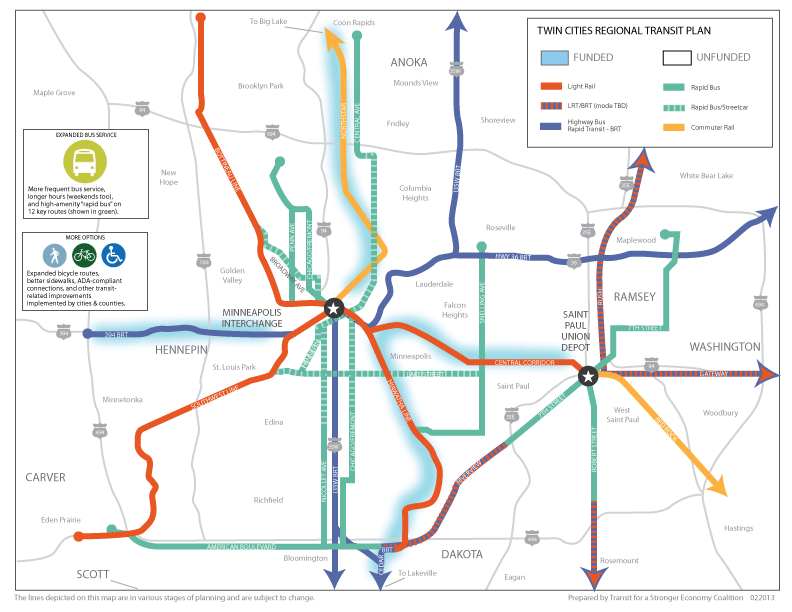
A map shows proposed expansion of commuter transit lines in the Metro Area.

A map shows proposed expansion of commuter transit lines in the Metro Area.

Transit advocates gathered at the Capitol today to show broad-based support for expanding investments in the state’s transportation system, from commuter rail and bus lines to bike paths and sidewalks.

Such investments deliver a “trifecta” of benefits for state taxpayers, spurring business and job growth, reducing pollution and providing low- and moderate-income workers with greater access to family-sustaining jobs.

That’s according to members of Transit for a Stronger Economy, a statewide coalition of 51 groups – including eight labor unions – working to steer more tax dollars toward public transit.

The coalition is backing bills in the House (HF 1044) and Senate (SF 927) that would raise sales taxes in the Metro Area to provide dedicated funding for urban and suburban transit systems, as well as bicycle and pedestrian infrastructure. The bills also would redirect existing state revenue to expand transit options in Greater Minnesota.

The goal is a “comprehensive build-out” of public transit in Minnesota, one designed to keep the state’s economy competitive – and its environment clean.

Transit is a “vital component to our cleaner future,” said Katie Gulley, regional program director for the BlueGreen Alliance, a coalition of labor and environmental groups. Expanding the transit system, she added, will reduce carbon emissions and “ensure people around the state can get where they need to go efficiently and cost effectively.”

Of course, transit investments also create jobs – a fact not lost on the hard-hat-wearing students from Summit Academy OIC, who flanked speakers at the transit press conference. The Minneapolis vocational school provides training for adults from economically depressed communities.

Sen. Bobby Joe Champion, a Minneapolis DFLer whose district includes Summit Academy, co-authored Senate File 297. “In addition to getting people to jobs, this bill is critical to jobs,” he said.

Still, coalition members acknowledged the bills were likely to face stiff opposition.

The 0.75 percent sales-tax hike in the Metro Area, in particular, could raise concerns from business interests. But Dane Smith, president of the Minnesota-based think tank Growth and Justice, said those concerns are not supported by economic research.

“Study after study,” Smith said, shows the benefits of transit investments extend to both workers and businesses. One study by the American Public Transportation Association found every dollar invested in public transportation generates about $4 in economic returns.

“We just hope those business interests understand the need for raising specific revenue for transit,” Smith said.

Unions and labor federations supporting the Transit for a Stronger Economy coalition include the Minnesota AFL-CIO, Amalgamated Transit Union Local 1005, the Communications Workers of America Minnesota State Council, Service Employees International Union Minnesota State Council, Sheet Metal Workers Local 10, United Food and Commercial Workers Local 1189 and Council 5 of the American Federation of State, County and Municipal Employees.