Union strong, Metro Mobility drivers fight to save their jobs

In a 2015 survey, Metro Mobility customers were asked to name their favorite thing about riding the transportation service for people with disabilities and health issues. The most common response: their drivers.

About 100 of those drivers are now fighting for their jobs, as the Met Council, which oversees Metro Mobility, considers moving one of its core services to a new, non-union contractor.

Drivers and clients will raise concerns about the proposed change when it comes before the council’s Transportation Committee April 23, according to Teamsters Local 120, the union that represents drivers.

“Every day our members are picking up the same people, and now they could potentially lose that continuity,” Local 120 Secretary-Treasurer Bill Wedebrand said. “We feel as though there should be some more discussion on this.”

The drivers, employees of First Transit, shuttle people to and from employment, training and rehabilitation centers and other programs. Known as “agency service,” it’s mandated by federal and state laws.

But increasing demand for Metro Mobility rides is straining the Met Council’s finances. Metro Transit hiked bus and light-rail fares last year, and the council still projects a shortfall of $86 million in its 2020-21 transportation budget.

Under pressure to cut costs, the Met Council appears poised to move forward with Maple Grove-based Transit Team’s $31.8 million, five-year proposal covering agency services after the current contract with First Transit expires Sept. 30.

Transit Team delivered a cheaper proposal than First Transit, but Wedebrand warned that disrupting the relationship between Metro Mobility drivers and the vulnerable adults they serve will come at a cost.

“Most of these drivers have being doing this job for many years, and they do it for the right reasons,” Wedebrand said. “They don’t make a lot of money, but they do it to help people who are vulnerable. And these vulnerable adults know them, trust them.”

Wedebrand said Local 120 intends to push hard for current drivers to keep their jobs – and their union contract – if the agency service contract moves to Transit Team. It’s a courtesy Metro Mobility drivers, who received a 95-percent satisfaction rating in the 2015 customer survey, have earned.

Show support for Metro Mobility agency drivers by turning out for the April 23 Transportation Committee meeting, which begins at 4 p.m. at 390 Robert St. N., St. Paul.

Transit operators, riders urge Dayton to stand strong against cuts

Doni Jones, a Metro Transit operator and ATU Local 1005 steward, speaks at a rally in support of transit funding.

Gov. Mark Dayton vetoed a transportation bill Monday that would have slashed funding for Metro Transit bus and rail services by $17.5 million over the next two years.

Transit riders and operators cheered the governor’s veto at a rally Tuesday outside the Capitol, urging Dayton to continue standing firm against service cuts and fare hikes.

Doni Jones, a steward for Amalgamated Transit Union Local 1005, said cuts proposed by Republican majorities in the Legislature would “devastate” the 3,000 Metro Transit employees who make up the union’s membership. Part-time employees would be laid off, he said, and full-time workers would see hours reduced.

In a letter to Republican leaders that accompanied his veto, Dayton said he would not sign a transportation bill that includes cuts to Metro Transit.

“Our transit system is vital to the economic health and competitiveness of the metro region and the state as a whole,” Dayton said, adding that 80 percent of people who access Metro Transit services are traveling to and from work or school.

Dayton told Republican leaders: “Your failure to adequately fund our transit system will have real life consequences for our seniors, students, low-income individuals and individuals with disabilities.”

Many of those people joined the rally yesterday, a scene Jones described as a “beautiful thing.”

“We see these people all the time,” he said. “We’re all in this together.”

Transit riders, drivers team up to fight proposed cuts, fare hikes

A rally in Leif Erickson Park urged investments – not cuts – in transit services statewide.

Transit riders and operators rallied at the Capitol light rail station in St. Paul yesterday, looking to derail House Republicans’ plan to cut funding for bus, rail and Metro Mobility services by $122 million over the next two years.

The Metropolitan Council, which operates Metro Transit and Metro Mobility, has warned the budget proposal would force both fare increases and a reduction in service by as much as 40 percent.

The prospect of paying more for less frequent bus and rail service didn’t sit well with more than 150 riders who joined the rally. One by one, they stepped up to the podium to describe the role transit plays in their lives – whether it’s getting to work or school, or simply getting around town.

“These drastic cuts would have a devastating impact on the elderly, low-income workers, communities of color, people with disabilities and all who are dependent upon transit to get around,” Jessica Treat, chair of the Transportation Forward campaign, said. “This is not what Minnesota needs.”

In addition to steep service cuts and fare hikes, the House proposal would mean layoffs for Metro Transit operators and maintenance staff, who are members of Amalgamated Transit Union Local 1005.

ATU Local 1005 President Mark Lawson

Mark Lawson, president of the local, warned job losses would impact communities of color and immigrant communities at a time when the state is trying to address troubling income disparities between white workers and workers of color. Metro Transit and Local 1005 have partnered in recent years to recruit new workers from neighborhoods Metro Transit serves, Lawson said.

“The workforce is looking more and more like our riders, which is a good thing,” Lawson said. “And did I mention these are union jobs with good pay, good benefits?”

Operators and riders also pointed to a Met Council report showing the service targeted by lawmakers for especially steep cuts – light rail – operates at the lowest public subsidy, about $1.84 per passenger, compared with more than $7 per passenger for bus services from Shakopee and Prior Lake.

“Why are they trying to get rid of the workforce that provides the best value for the Minnesota taxpayers?” Lawson asked.

‘Minnesotans are the losers’ when divided Legislature plays politics with transportation

MoveMN-signcapitolRepublicans and Democrats rarely agree, but when the Minnesota Legislature convened in January 2015, leaders of the GOP House and the DFL Senate were sounding an awful lot alike.

It was time to address the state’s transportation needs, they agreed. And the state could not afford to wait.

Nearly two years later, Minnesotans are still waiting for a long-term, comprehensive solution to the transportation problem. What happened?

“It’s just partisan politics,” said Russell Hess, political coordinator for the Laborers District Council of Minnesota and North Dakota.

A last-minute compromise bill floundered last session, after Republican leaders balked at funding for light-rail transit. A special session to reconsider the issue – as well as a jobs-creating capital investment bill – never materialized over the summer.

Hess said Republicans believed blocking light rail “would help them get votes in an election year.” Jennifer Munt, public affairs director for AFSCME Council 5, agreed.

“We can blame House Republicans for traffic jams and political gridlock,” Munt said. “It’s impossible to compromise on transportation when Republicans pit roads against transit, and pit Greater Minnesota’s needs against the metro.”

Indeed, traffic congestion now costs the average Minnesota commuter over $800 per year, according to the Minnesota Transportation Alliance, and that doesn’t account for the wear and tear inflicted on vehicles by potholes and aging infrastructure.

More than half of the state’s roads are 50-plus years old, and 40 percent of the state’s bridges are 40-plus years old. The number of roads in poor condition will grow by 74 percent over the next 10 years.

Anyone who takes a serious look at the issue, labor-endorsed Sen. Jim Carlson of Eagan said, realizes the state needs a long-term plan that pairs road-and-bridge funding with transit investments – and has a dedicated source of revenue.

“We have to be honest about it,” Carlson said. “We have a $600 million per year need that is going unmet. We need a dedicated funding system to create that revenue stream to fix our roads. That will not happen if we take money out of the general fund every two years.”

That’s the approach favored by Republicans, who would cut other areas of the state budget to pay for roads and bridges. Republicans don’t favor investments in transit either, and that’s not sitting well with voters in House District 43A, which includes Maplewood, White Bear Lake and other northeast suburbs.

“Mass transit is extremely frustrating not only for people living in my district, but people trying to travel to my district for education – including some really great programs at Century College – or for jobs,” labor-endorsed Rep. Peter Fischer said. “We’ve got to figure out how we connect people with the services they need.”

Labor-endorsed Rep. Barb Yarusso hears the same concerns in her north-metro House District 42A.

“In Arden Hills, there are more jobs than people, Shoreview has had a number of key business expansions and looks to add more, and Mounds View is seeing new development along County Highway 10,” Yarusso said. “Employers have access to a larger pool of employees if public transit is available.”

The cost of gridlock, meanwhile, is steep. The Transportation Alliance estimates project costs will increase by 10 percent each year lawmakers fail to act.

“Minnesotans are the losers, because the costs will only go up while our safety and economic competitiveness decline,” AFSCME’s Munt said.

So how can voters make sure the issue doesn’t remain a political football in St. Paul? It’s simple, according to Munt: “Let’s elect a Legislature that Gov. Dayton can work with to get transportation done right.”

Metro Transit workers vote to accept contract proposal

atu_newlogo-01In balloting held Sunday and Monday, Metro Transit workers accepted a proposed two-year contract with annual wage increases of 2.25 percent.

The contract, which covers about 2,400 members of Amalgamated Transit Union Local 1005, still must be approved by the Met Council before taking effect. The council is expected to consider the contract at its May 25 meeting.

“I don’t expect that to be anything more than a formality,” Local 1005 President Mark Lawson said.

Once finalized, the contract will provide Metro Transit operators and mechanics with raises retroactive to Aug. 1, 2015 – and another 2.25 percent bump in August 2016. Some workers will see larger increases as a result of changes in job classifications included in the contract.

Those terms represent an improvement on the “final offer” rejected by Local 1005 members in a near-unanimous vote in February. This time around, about 72 percent of voting members approved of the tentative agreement.

Other provisions of the pending contract include:

  • Expansion of night-shift differential – a 50-cent boost in hourly pay between 8 p.m. and 3 a.m. – to all workers in the bargaining unit.
  • Agreement to revisit and potentially amend a 25-year-old list of tools mechanics are required to buy out of their own pockets.
  • Continued health care cost sharing at “reasonable” rates, according to Lawson.

“The vast majority of members feel this is a contract they can live with and move on with,” Lawson said. “Because it’s a two-year deal, we’re going to be starting to work on the next contract, getting our proposals ready, by the end of this year.

“So we get a breather, and then we get to start all over again.”

Unions back Move MN rally for comprehensive, long-term transportation fix

MoveMN-signcapitolMarcus Smith would like more reliable bus service from south Minneapolis to his job in St. Paul. Jessica Treat wants dedicated lanes that make bicycling to work safer. James Boney hopes rebuilding and repairing the state’s roads and bridges will mean jobs for workers who need them.

From bicyclists to Building Trades members, public employees to people of faith, more than 300 people brought their concerns and priorities to the Capitol April 16, but they stood shoulder-to-shoulder behind the Move MN coalition’s push for a comprehensive, long-term transportation plan.

Minnesota AFl-CIO President Shar Knutson addresses the Move MN rally.

Minnesota AFl-CIO President Shar Knutson addresses the Move MN rally.

Unions took a leading role in the rally. Minnesota AFL-CIO President Shar Knutson acknowledged the transit workers, road maintenance workers and highway construction workers in the crowd.

“Ask them, and I bet they’ll tell you our transportation system is falling apart,” she said.

More than half of Minnesota’s roads are 50-plus years old, and 40 percent of the state’s bridges are 40-plus years old. The number of roads in poor condition will grow by 74 percent over the next 10 years, as freight traffic statewide is expected to increase by 30 percent.

Gov. Mark Dayton has offered an $11 billion plan to repair state highways, fund local transportation investments and support public transit across Minnesota.

Supporters at the rally said the plan would ease congestion, allow for economic and population growth, and create new jobs – 119,000 of them, according to the governor’s estimates.

Boney, an instructor at Summit Academy OIC, attended the rally with about two dozen participants in the North Minneapolis-based career training program. Wearing safety-yellow vests and hard hats, the trainees, Boney said, will graduate from the program this weekend – and enter the workforce next week.

Summit Academy OIC trainees attended the rally the day before their graduation ceremony.

Summit Academy OIC trainees attended the rally the day before their graduation ceremony.

“This transportation bill could provide more work for students when they graduate, when they go out into the world,” Boney said.

“The best social program in the world is a job,” Summit Academy President Louis J. King II added.

Not only do transportation investments create jobs, but they help people get to and from their jobs, whether by car, bus, bicycle or on foot.

Smith, an AFSCME member who commutes to his job near the Capitol, is among those people. He said the buses he relies on to get to work too often run late.

“We need more buses because they’re congested,” Smith said. “The more crowded the buses are, the slower the process is. Sometimes they’re running 20 or 25 minutes late because it’s so congested.”

Treat, executive director of Women on Bikes, said research shows women are less likely to commute by bicycle – but not for lack of interest.

MoveMN-bicycles“They tell us we want to ride our bikes more, but we don’t feel safe,” she said. Treat urged investments in dedicated bike lanes and paths, noting $1.3 billion worth of bicycle plans in need of funding statewide.

Lawmakers at the rally, including Dayton, House Minority Leader Paul Thissen and Sen. Scott Dibble, warned against attempts to pit greater Minnesota against the Twin Cities, transit needs against road and bridge maintenance or transportation against other budget items.

The only acceptable approach, they said, is a comprehensive, long-term approach.

Thissen said any transportation bill passed by the Legislature should be “the real deal,” and he railed against a House Republican plan to take “money from education and health care to pay for transportation.”

“This is all about our kids and it’s about our grandkids, and it’s about doing what’s best for Minnesota,” Dayton said. “For 25 years we’ve avoided this, and look where we are now. Look at the congestion, look at the deterioration, look at how far behind our public transportation system is.”

Jennifer Munt: Let’s move Minnesota in 2015

munt-mugMinnesota has an urgent transportation problem that’s making it difficult for Minnesotans to get to their next destination, whether that’s work, school, play or family.

Transportation is about opportunity for all no matter who you are or where you live. Workers need safer roads and better public transit to get to work. Our seniors need a ride to live independently. Our families need better bike and pedestrian routes that connect them to their schools, jobs and recreation. Our farmers need sturdy bridges to get their products to market. Our businesses require highways to quickly move their goods.

Crumbling Infrastructure, Shrinking Workforce

There’s no way our economy can grow, prosper and compete on crumbling infrastructure that takes a beating from our winter climate. Here are some facts that scream urgency. Half of our roads and bridges are more than 40 years old and in poor condition with nearly 2.5 million commuters driving across a structurally-deficient bridge every day.

Meanwhile, the state transportation department has 2,000 fewer maintenance workers than it did a decade ago. With MnDOT’s shrinking workforce, it’s impossible to keep up with our aging infrastructure. Much of Minnesota’s infrastructure was built in a short span of years – in the 1960s and ‘70s – so our roads and bridges are all wearing out at the same time. It’s like a circulatory system that can no longer pump.

Transportation employs about 65,000 workers in Minnesota, including 2,700 AFSCME members who maintain and repair state highways and bridges. Our members see the underbellies of our bridges, the poor pavement on our roads, and potholes that could swallow a car.

Everyone Deserves a Ride

Workers can save up to $8,000 a year if they can walk, bike or ride transit to work – instead of driving alone. Unfortunately, only 10 percent of the jobs in the metro area are easy to get to by bus or train.

Our aging population and persons with disabilities need adequate bus service to live independently. Demand is also exploding for bike and pedestrian routes that provide healthy, affordable, environmentally-friendly choices for getting around.

2015 is the Year to Fund Transportation

Minnesota has only 60 percent of what it needs for roads, bridges and transit. Each year we delay Minnesota’s urgent transportation needs, the cost to taxpayers increases.

Move MN has proposed a funding package that is comprehensive to address roads, bridges, transit, and bike and pedestrian connections. It fairly balances the needs of Greater Minnesota and the metro, urban and suburban communities, and the east and west metro. It’s a long-term, sustainable solution with funding dedicated to transportation.

Our funding package is just the beginning of the discussion. To fund roads and bridges, the Move MN proposal includes a sales tax on leased vehicles and wholesale oil distributors. A three-quarter cent increase in the seven-county metro sales tax would expand current metro and suburban transit systems. A portion of that sales-tax revenue would add bike and pedestrian connections in the metro and flexible federal dollars would be allocated for bike and pedestrian connections in other parts of the state.

Gov. Dayton, Senate Majority Leader Tom Bakk and House Speaker Paul Thissen have all said that 2015 will be the transportation session. Please urge your state legislators to fund transportation.

Our cherished quality of life and Minnesota’s economic vitality depend on safe roads and bridges, and easy access to public transit in communities where people can bike and walk.

To learn more, visit Move MN’s website.

– Jennifer Munt serves on the Metropolitan Council and is public affairs director for AFSCME Council 5.

An engine for economic growth, Green Line opens to big crowds

City, county, state and federal funding made the Green Line a reality, and elected officials from all four levels of government helped cut the ribbon at the Green Line's Opening Day celebration outside Union Depot. (UA photo by Mike Weerts)

City, county, state and federal funding made the Green Line a reality, and elected officials from all four levels of government helped cut the ribbon at the Green Line’s Opening Day celebration outside Union Depot. (UA photo by Mike Weerts)

Minnesotans celebrated the opening of Metro Transit’s Green Line with ribbon-cuttings, neighborhood-centric events and more than 107,000 free rides June 14-15. But there was more to celebrate than the long-anticipated arrival of a sleek, new transit option between the Twin Cities’ downtown areas.

Jobs – and plenty of them – were also reason to celebrate.

Construction of the $957 million light-rail line, with 9.8 miles of new track and 18 new stations, created more than 5,500 construction jobs, and payroll expenses for the project exceeded $252 million. Additionally, Metro Transit hired 200 operators and maintenance workers for the Green Line, according to the Metropolitan Council.

The project created work for members of Building Trades unions during an otherwise lean period for the construction industry, as investment capital dried up and development ground to a halt following the financial collapse of 2008.

“It was a blessing that it happened during a time when the construction industry saw unemployment at levels it hasn’t seen since the Great Depression,” Harry Melander, president of the Minnesota Building and Construction Trades Council, said.

But job creation isn’t confined to the Green Line’s rear-view mirror.

Riders looking out the train’s windows are likely to see scaffolding, cranes and other heavy equipment, signs of the private development that has been popping up along the Central Corridor since the Green Line since got the green light five years ago.

The Met Council predicts employment along the line will grow by more than 90,000 jobs over the next 16 years. Already, more than 100 projects have been built, are under construction or are in the planning phase along the Green Line. Together, the developments account for more than $2.5 billion in job-creating private investments.

“The development we’ve seen so far only marks the beginning of new opportunities in the Central Corridor,” Met Council Chair Sue Haigh said. “For decades to come, the Green Line will be a catalyst for employment and economic growth along its 11-mile route.”

In that regard the Green Line is an example of the “ripple effect” that makes transit a particularly effective public investment. Every dollar a community invests in public transportation brings approximately $4 in economic returns, according to the American Public Transit Association.

The nonpartisan organization also found that, in a study conducted between 2006 and 2011, residential property values performed 42 percent better, on average, if they were located near public transportation.

The Green Line also provided training opportunities that helped introduce young workers to careers in the Building Trades.

The Laborers District Council of Minnesota and North Dakota, for example, integrated a new, eight-hour course, “Introduction to Light Rail Construction,” into the curriculum at its Lino Lakes-based training center. Todd Pufahl, council president, said the $250,000 investment ensures the union and its contractors are ready to tackle transit investments coming down the pike.

“The Green Line will do great things for commuters and the communities it runs through,” said Pufahl. “We are also anxious and ready to get going on the Southwest Corridor project. Our skilled Construction Craft Laborers are skilled and ready to help improve quality of life and transportation choices for all of us.”

Abby Tomasek wore a cardboard light-rail costume to the ribbon cutting. She and other activists used the event as an opportunity to sign transit-users up for MoveMN, an advocacy group pushing broad investments in the state's transportation infrastructure.

Abby Tomasek wore a cardboard light-rail costume to the ribbon cutting. She and other activists used the event as an opportunity to sign transit-users up for MoveMN, an advocacy group pushing broad investments in the state’s transportation infrastructure.

State’s transportation needs can’t wait, coalition warns

Brian Beedle (left), a member of the North Central States Regional Council of Carpenters, checks out a map detailing potential job-creating investments in the Metro Area transit system.

Brian Beedle (left), a member of the North Central States Regional Council of Carpenters, checks out a map detailing potential job-creating investments in the Metro Area transit system.

Support for transportation and transit investments among state lawmakers this session appears lukewarm at best, and that baffles Rep. Alice Hausman.

“With all the grumbling and complaining about roads and potholes, you wouldn’t think funding transportation would be this hard,” the DFLer from St. Paul said.

Hausman, who chairs the House Capital Investment Committee, joined a rally with other transportation advocates at the Capitol on April 17. She urged “resiliency” in an uphill battle to pass a comprehensive transportation finance bill that makes new, needed investments in roads, bridges and public transit.

Minnesota Building & Construction Trades Council President Harry Melander addresses the rally.

Minnesota Building & Construction Trades Council President Harry Melander addresses the rally.

The rally, organized by the Transportation for a Stronger Economy coalition, drew support from labor unions, business groups, environmental activists and local government officials. Speakers urged supporters to tell their lawmakers that transportation investments can’t wait.

“Transportation problems don’t go away; they just get more expensive,” said Rep. Frank Hornstein, DFL-Minneapolis.

“Transportation jobs unite this state,” Minneapolis Mayor R.T. Rybak added. “We have underinvested in our transportation infrastructure. It puts our lives at risk, it puts our jobs at risk and it puts our lifestyles at risk.”

The coalition of transportation supporters got some good news a day after the rally, when the Senate Transportation Committee passed a comprehensive transportation finance  bill with bipartisan support.

The bill includes a small sales-tax hike in the seven-county Metro area, dedicated to transit, as well as some support for walking and biking paths. The bill also includes more than $20 million per year in new funding for transit in Greater Minnesota.

Transportation investments have the potential to create thousands of jobs and boost the state’s economy – a point of agreement for both Harry Melander, president of the Minnesota State Building and Construction Trades Council, and Will Schroeer, representing Minneapolis and St. Paul’s chambers of commerce.

“We have an investment opportunity in front of us today,” Schroeer said. “And if we don’t make it, that money will go someplace else.”

Expand transit to keep state’s economy competitive, coalition says

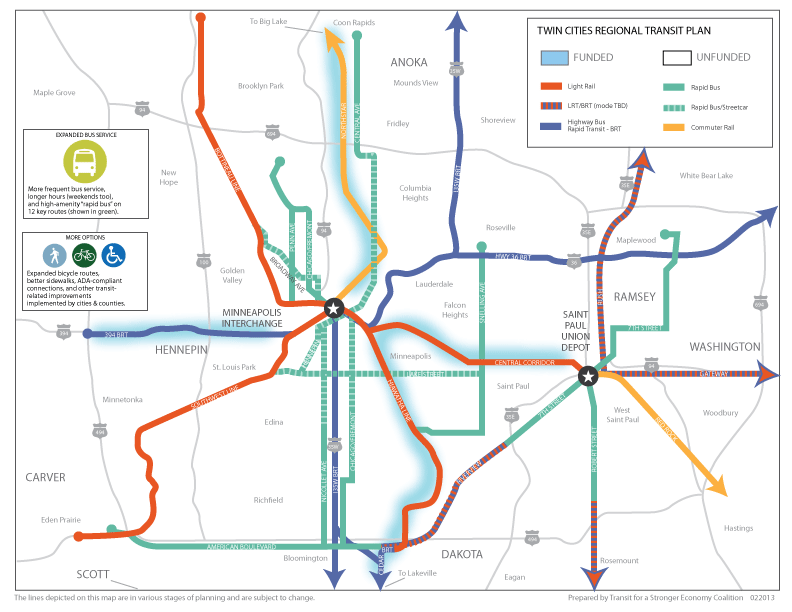
A map shows proposed expansion of commuter transit lines in the Metro Area.

A map shows proposed expansion of commuter transit lines in the Metro Area.

Transit advocates gathered at the Capitol today to show broad-based support for expanding investments in the state’s transportation system, from commuter rail and bus lines to bike paths and sidewalks.

Such investments deliver a “trifecta” of benefits for state taxpayers, spurring business and job growth, reducing pollution and providing low- and moderate-income workers with greater access to family-sustaining jobs.

That’s according to members of Transit for a Stronger Economy, a statewide coalition of 51 groups – including eight labor unions – working to steer more tax dollars toward public transit.

The coalition is backing bills in the House (HF 1044) and Senate (SF 927) that would raise sales taxes in the Metro Area to provide dedicated funding for urban and suburban transit systems, as well as bicycle and pedestrian infrastructure. The bills also would redirect existing state revenue to expand transit options in Greater Minnesota.

The goal is a “comprehensive build-out” of public transit in Minnesota, one designed to keep the state’s economy competitive – and its environment clean.

Transit is a “vital component to our cleaner future,” said Katie Gulley, regional program director for the BlueGreen Alliance, a coalition of labor and environmental groups. Expanding the transit system, she added, will reduce carbon emissions and “ensure people around the state can get where they need to go efficiently and cost effectively.”

Of course, transit investments also create jobs – a fact not lost on the hard-hat-wearing students from Summit Academy OIC, who flanked speakers at the transit press conference. The Minneapolis vocational school provides training for adults from economically depressed communities.

Sen. Bobby Joe Champion, a Minneapolis DFLer whose district includes Summit Academy, co-authored Senate File 297. “In addition to getting people to jobs, this bill is critical to jobs,” he said.

Still, coalition members acknowledged the bills were likely to face stiff opposition.

The 0.75 percent sales-tax hike in the Metro Area, in particular, could raise concerns from business interests. But Dane Smith, president of the Minnesota-based think tank Growth and Justice, said those concerns are not supported by economic research.

“Study after study,” Smith said, shows the benefits of transit investments extend to both workers and businesses. One study by the American Public Transportation Association found every dollar invested in public transportation generates about $4 in economic returns.

“We just hope those business interests understand the need for raising specific revenue for transit,” Smith said.

Unions and labor federations supporting the Transit for a Stronger Economy coalition include the Minnesota AFL-CIO, Amalgamated Transit Union Local 1005, the Communications Workers of America Minnesota State Council, Service Employees International Union Minnesota State Council, Sheet Metal Workers Local 10, United Food and Commercial Workers Local 1189 and Council 5 of the American Federation of State, County and Municipal Employees.