In meeting with Smith, home care workers, clients back Biden plan to fund ‘caregiving infrastructure’

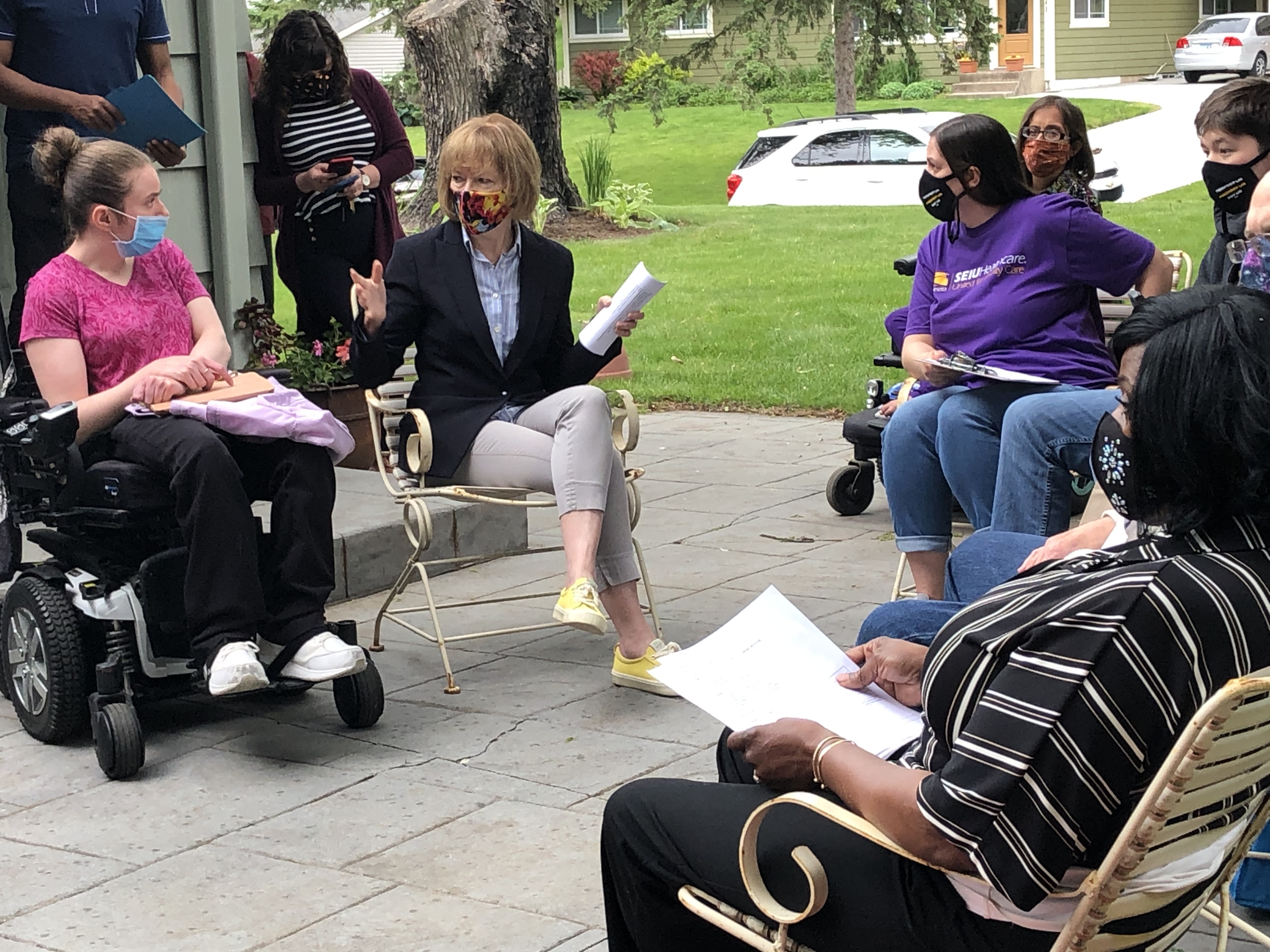
Sen. Tina Smith talks with Lauren Thompson, a home care client and disability-rights advocate with cerebral palsy.

OAKDALE – With Congress poised to take up President Joe Biden’s infrastructure plan this month, workers, retirees and people with disabilities are teaming up to lobby in support of a provision that would provide $400 billion in federal funding for in-home and community-based care. 

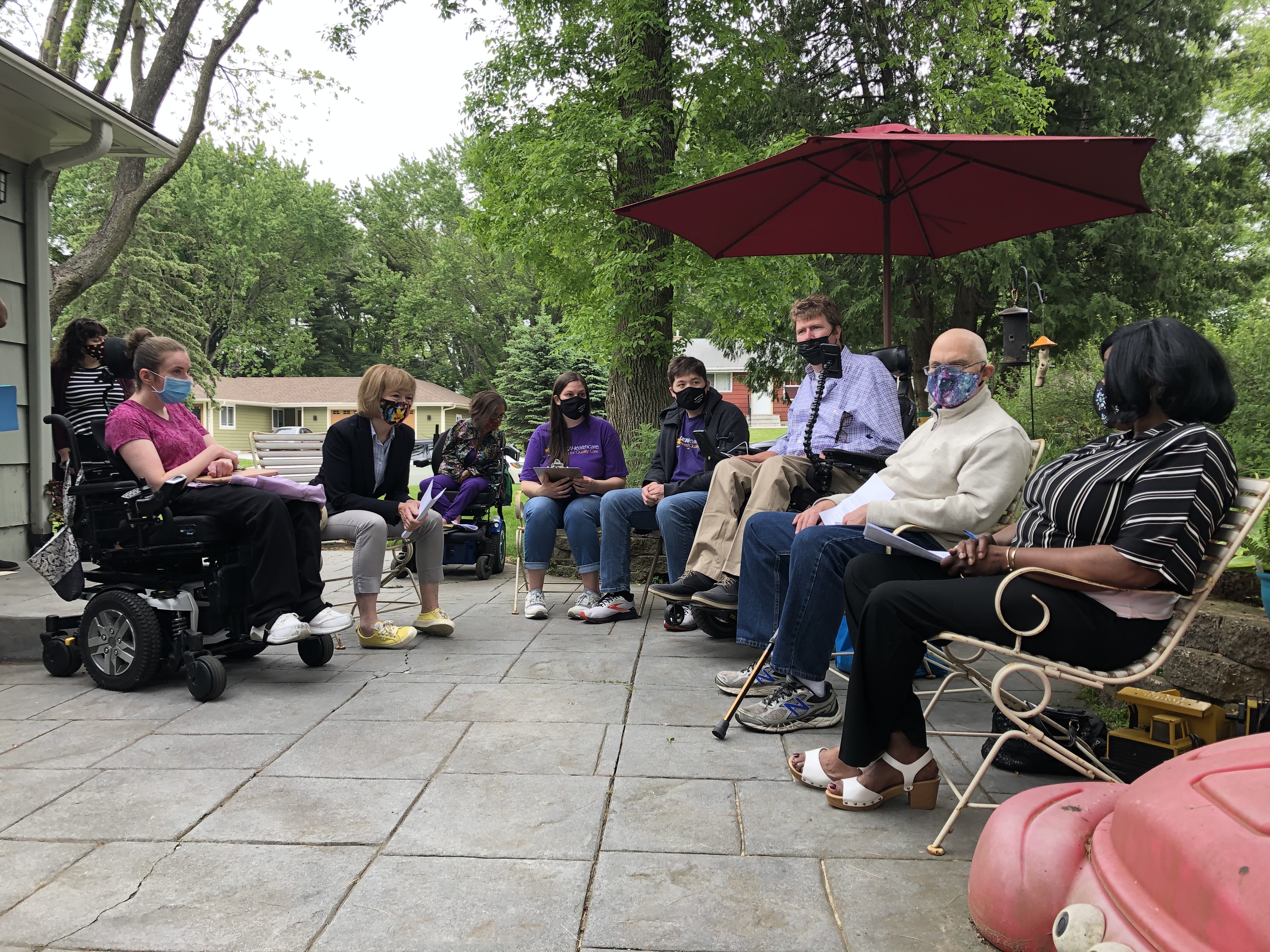
It’s a pitch home care worker Jacqueline Kelly delivered from her own backyard, along with other advocates, to U.S. Sen. Tina Smith yesterday at a listening session planned by SEIU Healthcare Minnesota, which represents over 20,000 home care workers statewide.

Home care investments in President Biden’s proposal would create an estimated 1 million jobs and improve wages and benefits for workers in the industry. That would be a win for workers, Kelly told Smith, and for the clients they serve, like Kelly’s 16-year-old son.

“I worry that if I can’t offer living wages, benefits and a viable long-term career path, caregivers will choose to move into other employment situations that have more stability and less risk,” Kelly said.

Kelly and other advocates at the event also noted that most home health care workers are women and people of color, who “have been left out or left behind for far too long.”

“After COVID, I hope we all know better now,” Kelly said. “Our communities, our families, our economy – we are all depending on the women doing this work to keep all of our lives going. And what could be more valuable than that?”

Restoring the country 

The home care measure is just one part of Biden’s $2 trillion infrastructure proposal. The American Jobs Plan also calls for jobs-creating investments in roads, bridges, transit, schools, housing, manufacturing, research, climate change mitigation and more.

SEIU and other unions are backing the president’s plan. AFL-CIO President Richard Trumka called the “unprecedented federal investment” an important and necessary step toward “repairing, rebuilding and restoring our country.”

“It’s time for Congress to step up and deliver the funding we need to tackle the climate injustice, racial injustice and economic injustice facing working families while creating a new generation of well-paying union jobs,” Trumka said.

Indeed, Biden’s proposal includes “neutrality” language requiring projects funded through the legislation to offer workers a fair opportunity to form a union. That includes expanded support for home health care through Medicaid, which a White House fact sheet asserts would “put in place an infrastructure to create good middle-class jobs with a free and fair choice to join a union.”
An investment in independence 

More than 90,000 people work as home health aides and personal care assistants in Minnesota, and home care workers here already have formed a union to improve their wages, benefits and training opportunities.

But advocates say the federal government must do more to stabilize and professionalize the industry’s workforce, which is marked by high rates of turnover.

Lauren Thompson, who has cerebral palsy, told Smith that her struggle to find consistent, affordable home care has “impacted every aspect of my life.” Over the last 10 years, Thompson said, she has bounced between in-home and “facility-style” care, and now lives in a group home with three other people.

“I’m the safest I’ve been in years, but I’ve lost my freedom and my privacy,” Thompson said. “Everyone needs to know that there’s a large demographic of Americans who aren’t truly living free because of this care crisis.”

While some workers rely on roads or transit or internet access to get to work, millions of American workers with disabilities rely on home health care, Rob Wudlick, a clinical research project manager at the University of Minnesota’s medical school, told the senator.

“Being able to live in the community allows me to work,” said Wudlick, who suffered a life-changing injury as a teenager. “Having a strong health care workforce – those are my arms and legs. Without that, I am not able to get out of bed. I would have to live in a facility somewhere and wouldn’t be able to work.”

‘Infrastructure for families’ 

Smith, a member of the Senate Health Committee, pledged to take the stories of workers and clients back to Congress as debate over Biden’s American Jobs Plan begins. Funding home care is an investment in “infrastructure for families,” she said.

“These jobs have been consistently undervalued, and that has often had devastating impacts, not only for families who need help, but also for the folks themselves that are doing this work and at the same time are often making poverty wages,” Smith said.

The event at Kelly’s home in Oakdale was the first in a series of town halls planned in 23 states, as home care workers, clients and advocates seek to use the power of their personal stories to boost support for Biden’s proposal.

https://platform.twitter.com/widgets.js

Home care workers push Walz to address ‘crisis of care’ with higher wages

Home care workers and their clients plan to rally at the Capitol Thursday, Jan. 31, at 11 a.m.

Home care workers in Minnesota are fighting for a $15 wage floor in ongoing contract negotiations with the state, and fighting alongside them are the clients and families they serve.

The connection is obvious to Lauren Thompson, a Minnesotan with cerebral palsy, who receives in-home care thanks to state and federal subsidies.

“Think about how you’d want to be cared for and the people you want taking care of you,” Thompson said. “A minimum wage of at least $15 an hour would start to create a stronger workforce. It would mean that good PCAs would be able to keep working.”

Thompson is part of a unique team bargaining on behalf of nearly 30,000 home care workers statewide. It not only includes members of the workers’ union, SEIU Healthcare Minnesota, but also the seniors, people with disabilities and families who rely on personal care to remain in their homes.

The united front reflects growing concern over a shortage of home care workers – there are currently 8,000 unfilled positions statewide, according to the union – at a time when the state’s population is aging.

The nonprofit research initiative Minnesota Compass projects the number of Minnesotans 65 and older will exceed those ages 5 to 17 for the first time ever “around 2020,” and nearly a third of people 65 and older have a disability.

The confluence of workforce and demographic trends amounts to a crisis, home care workers and clients warn. And addressing it starts with raising wages in the industry.

That’s the message they will deliver to lawmakers during a rally planned next Thursday, Jan. 31, at 11 a.m. in the Capitol. [Click here to RSVP on Facebook.]

“We have a huge shortage of care workers in south central Minnesota where I live,” said Dalene Annen, a home care worker from Winnebago. “If we can win at least a $15 minimum wage in our new contract, it will give good people an incentive to be home care workers instead of choosing to work at the grocery store or fast food because they pay more.”

Annen and other workers hope one lawmaker, in particular, is paying attention next Thursday.

On the campaign trail, Gov. Tim Walz backed a $15 minimum wage for all workers. His administration’s contract negotiations with home care workers offer an early opportunity to back up talk with action.

In addition, home care workers say getting to $15 now would ensure their pay remains in step with rising minimum-wage rates in Minneapolis and St. Paul, where thousands of them work.

The current wage floor for home care workers in Minnesota is $12, and it’s risen steadily since workers formed a union with SEIU in 2014. The union also has won paid time off, holiday pay and increased training opportunities since organizing.

Yet in spite of those gains, too many Minnesotans still are not getting the care they need to stay in their homes. Patsy Gibson, a home care worker from Bloomington, hopes this is the year things change. 

“We are losing valuable people in such an important profession,” Gibson said. “I really hope our government is aware of what is happening… When we say we can only afford to pay poverty wages it means people’s lives are at stake. We need our governor and elected officials to help us get to a decent living wage.”

SEIU anticipates reaching a tentative agreement with the state’s Department of Management and Budget on a new two-year contract in the coming weeks, so that it can be included in Walz’s first two-year budget proposal, expected early next month.

Home care workers ratify new contract, urge lawmakers to get serious about looming care crisis

Home care workers and clients kicked off the campaign for a new contract covering more than 20,000 workers statewide in September 2016.

Union members who provide in-home health services to clients across Minnesota have ratified a new contract with the state that will lift wages, provide holiday pay, boost paid-time off and expand training opportunities for an estimated 27,000 home care workers statewide.

The new contract, home care workers’ second since voting to join SEIU Healthcare Minnesota three years ago, will take effect July 1. The union announced results of a week-long ratification vote this morning.

Home care workers said the new contract builds on their union’s effort to raise wages and working conditions in the home care industry – improvements they say are necessary to meet the needs of Minnesota’s seniors and people with disabilities.

But it doesn’t go far enough, said Yasmine Soud-Reynolds, a home care worker from White Bear Lake.

“On one hand I feel like the contract is good,” Soud-Reynolds said. “We do get a little bump in pay, also time and a half for holidays. On the other hand, I feel like it needs to be improved.”

The contract ratified this month looks different from the tentative agreement reached by SEIU members and the state earlier this year. That’s because elected officials cut funding for the contract in half during last-ditch budget negotiations at the Capitol last month, forcing workers and the state to renegotiate the pact.

The decrease in funding will slow efforts to address the care crisis facing vulnerable Minnesotans, home care workers warned, and they pinned much of the blame on anti-union attorney Doug Seaton and the Center of the American Experiment, which is funding an effort to decertify their union.

In legislative testimony, these groups urged legislators to vote down raises and new benefits for home care workers, who vowed to continue fighting to restore funding in the next legislative session.

Soud-Reynolds, who cares for a client recovering from a massive brain hemorrhage, said she earns less than the $15 per hour her stepsister makes at a local gas station, and called the Legislature’s move to defund her union’s contract “very frustrating.”

“I feel like legislators won’t really understand what home care workers are going through or asking for until they either have to work in the field themselves or, God forbid, one of their family members needs a home care worker,” Soud-Reynolds said. “What I do is hard, and I definitely don’t feel like it’s valued.”

The new contract creates a $12 wage floor, with a new 5 percent increase for workers like Soud-Reynolds who provide care for the highest-need clients.

The state also agreed to create an online matching registry to help clients find quality care workers. Several clients who receive in-home health services participated in SEIU Healthcare Minnesota’s home care contract campaign.

Jim Carlisle, who relies on care for himself and his wife to be able to stay in their home, said the crisis facing the home care industry is “well beyond the point where any half-measures will suffice.”

“This is, without exaggeration, a life or death situation for someone like me who relies on quality caregivers to get out of bed and do basic tasks like eating and leaving my house,” Carlisle added. “I’m proud we won the gains we did, but we are still a long way from where we need to be. What we’ve proven over the last few months is that we won’t let any attacks or setbacks stop us. We will fight to ensure every person who needs care has access to quality caregivers.”

Home care union, state reach tentative agreement on new contract

Home care workers and clients kicked off the campaign for a new contract covering more than 20,000 workers statewide in September.

Home care workers and clients kicked off the campaign for a new contract covering more than 20,000 workers statewide in September.

After negotiations that took nearly four months to conclude, home care workers are poised to vote on a tentative agreement for a new union contract with the State of Minnesota that would raise their wage floor from $11 to $13.

The home care workers’ union, SEIU Healthcare Minnesota, announced the tentative agreement in a press release today, calling it a critical step toward addressing a growing workforce crisis in the state’s home health care industry.

“I am passionate about my job and proud of the good work home care workers do keeping Minnesotans safe and in their homes,” bargaining team member Dawn Burnfin, a home care worker from Chisholm, said. “The gains in the tentative agreement would begin to make home care workers feel like our time, skills and work are just as important as other jobs.”

According to SEIU, provisions of the proposed two-year contract include:

  • A $2-per-hour increase in the wage floor, to $13 per hour hour, and additional increases for workers providing support to clients with the highest, most complex care needs.
  • Investing over $1 million in training for home care workers, and new stipends for workers who access the training sessions.
  • Holiday pay – a first for Minnesota home care workers, many of whom provide essential care on holidays, allowing their clients to celebrate with family.
  • Increased paid time off, a benefit won in SEIU’s first contract with the state two years ago.
  • An online matching registry to help home care clients find workers and vice versa.

The contract negotiations impact more than 20,000 workers who provide state-subsidized, in-home care to disabled and elderly Minnesotans. The workers voted to form a union in August 2014.

If ratified by union members, the tentative agreement would advance to the Legislature for approval before reaching Gov. Mark Dayton’s desk.

As they did in negotiations two years ago, SEIU members invited several home care clients to join the union’s bargaining team.

Jim Carlisle, a disability rights advocate and home care client who served on the bargaining team, said the tentative agreement provides an opportunity for state lawmakers to address increased demand for workers who provide in-home health care as Minnesota’s population continues to age. The state’s Department of Employment and Economic Development projects nearly 38,000 new openings for home-health and personal-care aides over the next 10 years – jobs likely to remain open unless wages and working conditions in the industry improve.

“My wife and I have seen the best of home care workers, some of whom became like family to us,” Carlisle said. “But we’ve also experienced the trauma that comes when there are not real investments in care work.

“Everyone who wants and needs it should have access to good, safe care in their homes, and by ratifying this contract the Minnesota Legislature will be taking a strong step towards making that a reality. Having people with disabilities and seniors remain in our homes doesn’t just make our lives better; it also saves taxpayers millions of dollars, compared to having us in nursing homes or other institutional settings.”

In contract talks, home care workers hope to address crisis facing state, industry

Home care workers and clients kick off the campaign for a new contract covering more than 20,000 workers statewide.

Home care workers and clients kick off the campaign for a new contract covering more than 20,000 workers statewide.

Minnesota’s home care workers are set to begin negotiating a new union contract Friday. At a Capitol press conference today, workers and their clients framed the talks as an opportunity for the state to begin addressing the workforce crisis in their industry.

As Minnesota’s population continues to age, the demand for workers who provide in-home health care is expected to increase sharply. The Minnesota Department of Employment and Economic Development projects nearly 38,000 new openings for home-health and personal-care aides over the next 10 years.

Home care clients and advocates worry those jobs will remain vacant unless working conditions in the industry improve – a process that starts with raising wages and respecting the work, home care client Nikki Villiavicencio said.

The Maplewood resident said a “huge shortage” of home care workers already exists in the state. “It’s a crisis that Minnesota leaders have not valued home care workers and the services they provide enough,” she said.

Represented in negotiations with the state by SEIU Healthcare Minnesota, home care workers said they plan to seek a $15 minimum wage in their next union contract, as well as expanded benefits and training opportunities specific to the type of care they provide.

Additionally, workers said they want the state to commit to long-range strategies for growing the industry’s worker pool and, along the same lines, improving job satisfaction among home care workers.

"I can be a better father, a better husband a better member of society with her," Jonathan Spika of St. Paul, left permanently disabled by MS, said of his home health care worker.

“I can be a better father, a better husband a better member of society with her,” Jonathan Spika of St. Paul, left permanently disabled by MS, said of his home health care worker.

“Most people don’t stay in these positions for very long because … this is one of the lowest-paying jobs in Minnesota,” home care worker Jasmine Laducer-Kitto said.

For Laducer-Kitto, the rewards of home care work go beyond the paycheck. But if state lawmakers value giving people the option of receiving care in their homes, she said, they need to invest in the workers who make it possible.

“We have to look at the this as an important job,” Laducer-Kitto said.

Home care workers’ first contract with the state, bargained after their historic organizing drive, is set to expire in July 2017. It raised the industry’s wage floor to $11 per hour and gave home care workers paid-time-off benefits for the first time.

Still, Villiavicencio said, “the progress we’ve made hasn’t been enough to lift us out of the crisis we’re in now.”

SEIU Healthcare Minnesota’s contract covers more than 20,000 home care workers across the state. Negotiators said they hope to have a tentative agreement before the 2017 legislative session begins so that lawmakers can vote to approve it for inclusion in the 2017-18 fiscal year budget.