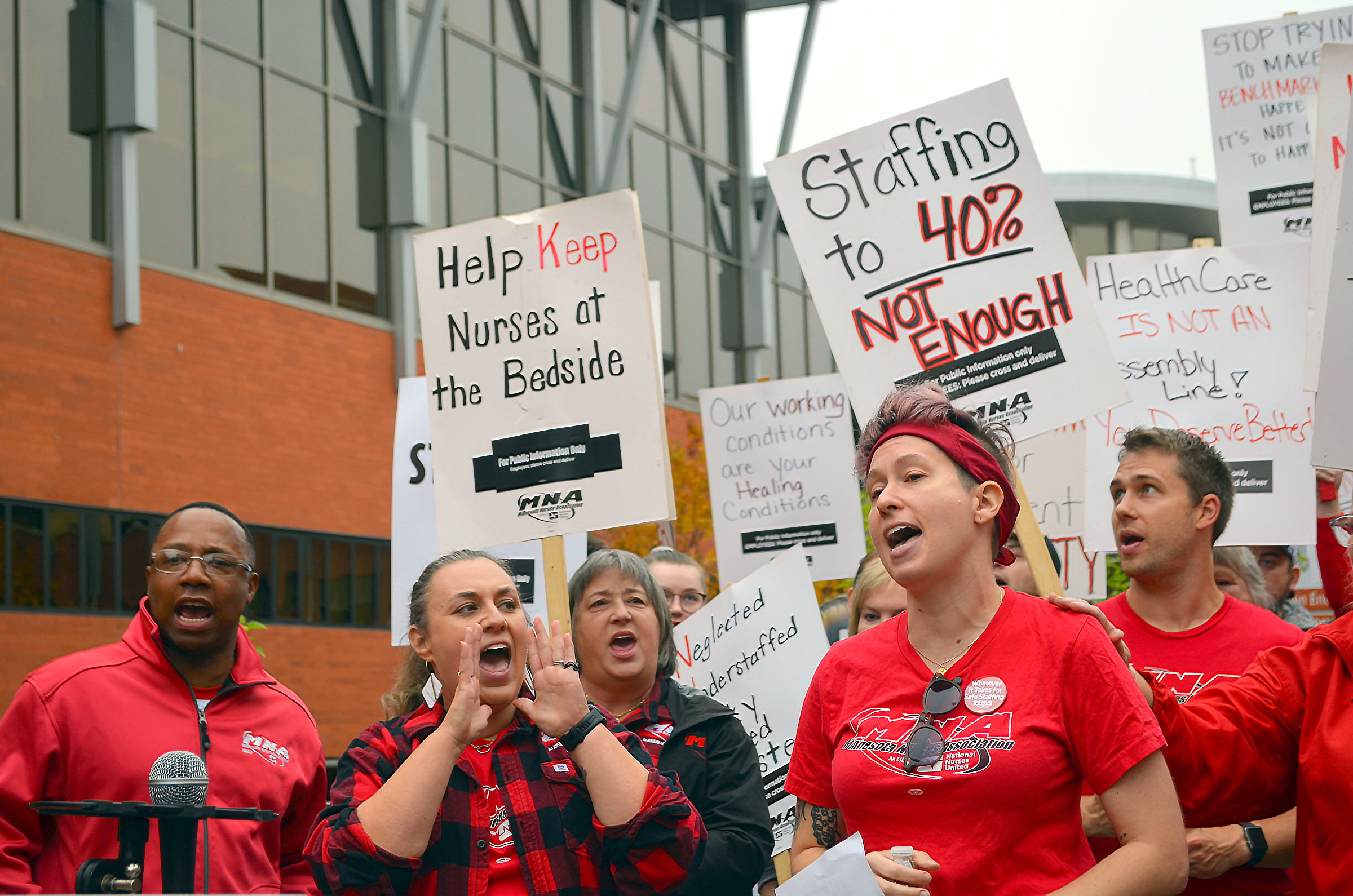
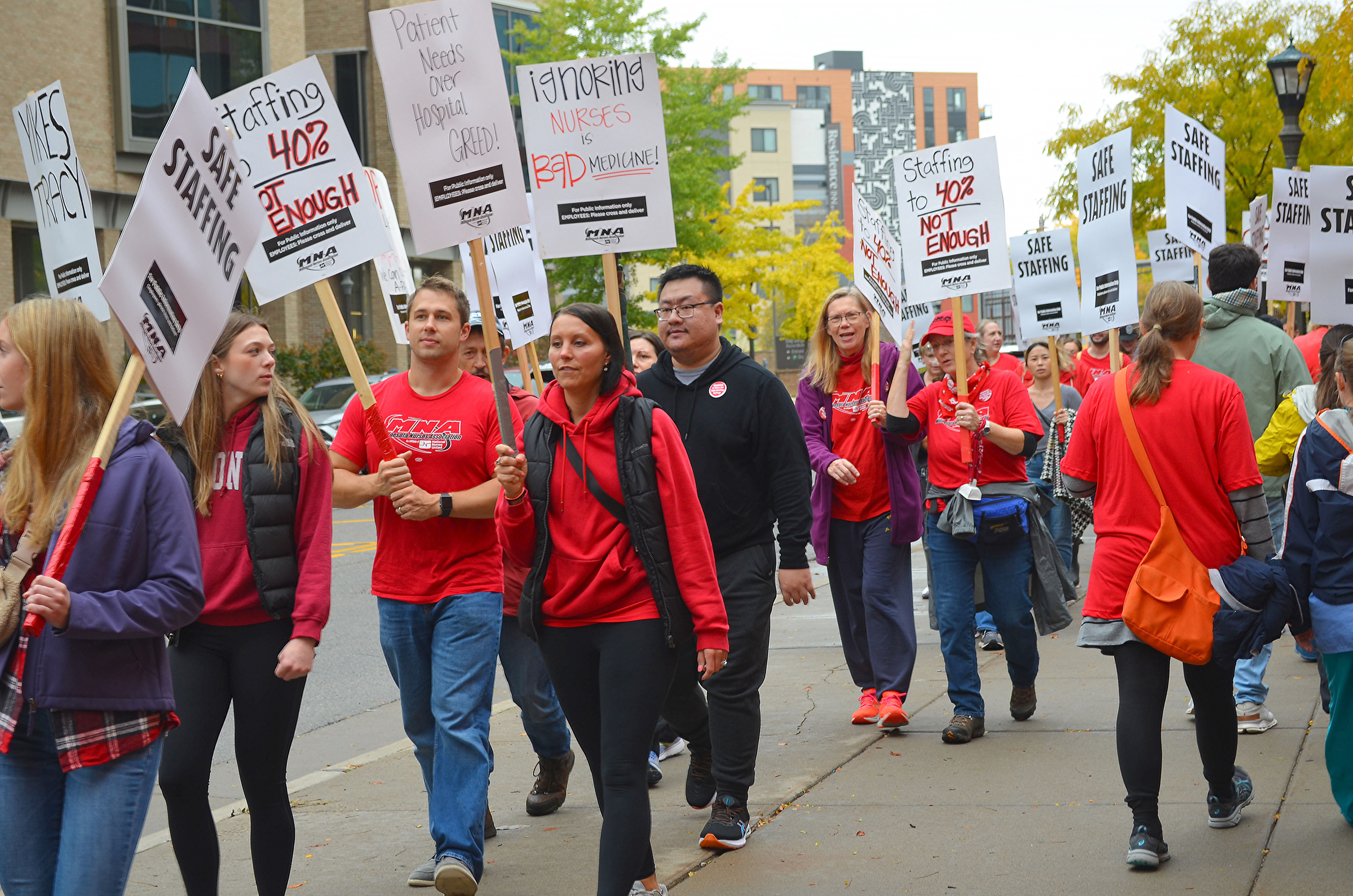
 Nurses and other health care workers took to the streets outside three Allina Health hospitals Oct. 26, protesting the provider’s plan to cut services and reduce nurse and nurse-aid staffing by as much as 30% in some units, according to their unions.
“We believe this has nothing to do with the betterment of patient care and everything to do with the bottom line,” Mercy Hospital nurse Venessa Soldo-Jones said during a press conference on the picket line outside United Hospital in St. Paul. “Nurses are not in this business for profit.”
Two unions, the Minnesota Nurses Association and SEIU Healthcare Minnesota and Iowa, organized the informational picketing at United, Mercy and Abbott Northwestern Hospital in Minneapolis.
Union members decried Allina for shutting down United’s adolescent mental health unit and Abbott Northwestern’s infusion care center, and they railed against another round of benchmarking – a process in which the system aligns its staffing levels with comparable hospitals across the country – in the works at their facilities.
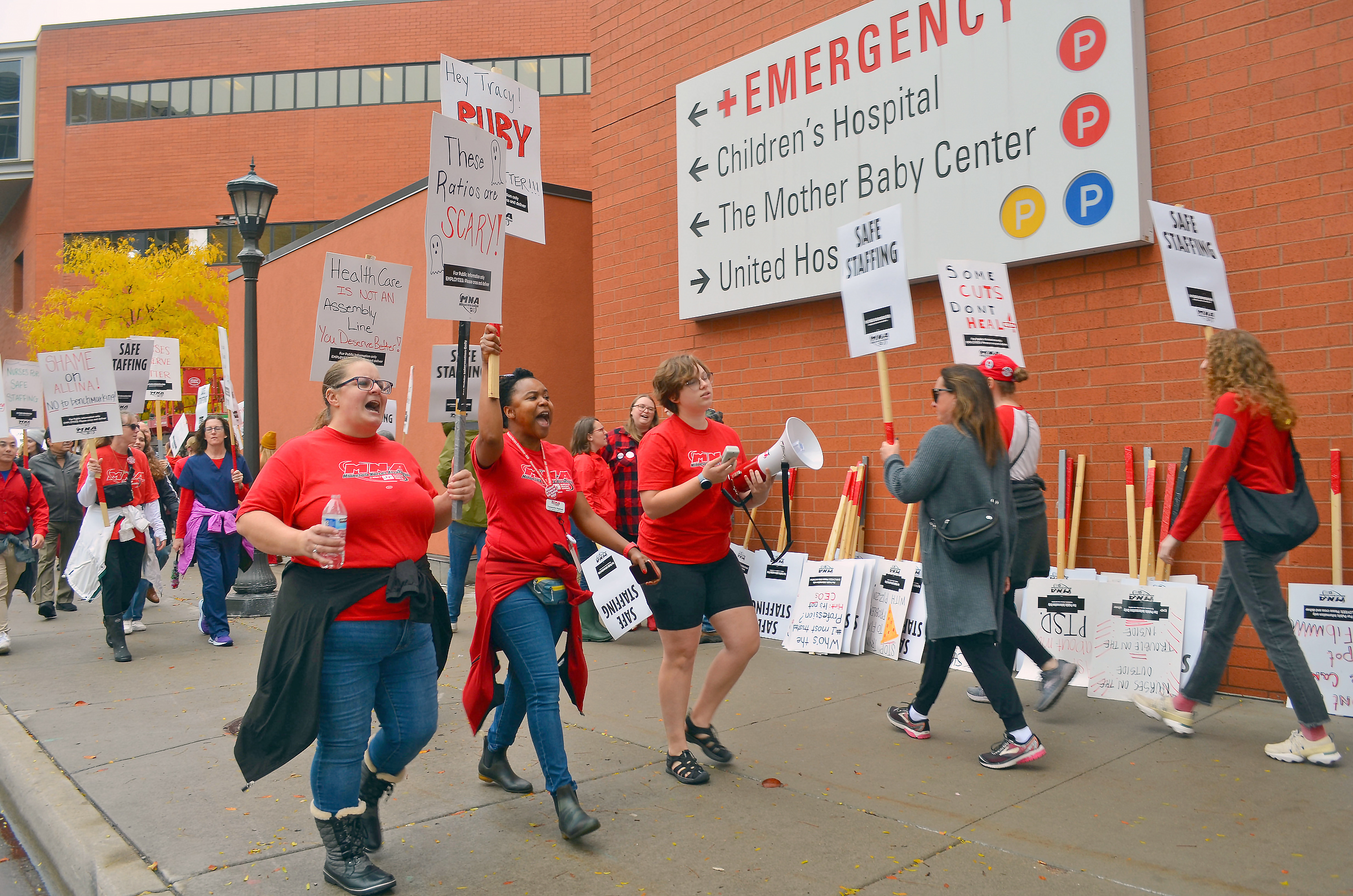 Health care workers said the process almost certainly will lead to lower staffing and higher workloads in many hospital units – outcomes Allina should be trying to avoid in an already tight labor market, SEIU Healthcare Vice President Brenda Hilbrich said.
SEIU’s 5,000 members who work for Allina are “worn out” from “four years of short staffing,” Hillbrich said. But instead of providing a “soft landing” from the pandemic, Allina “has decided it needs to run productivity tests, benchmarking and other evaluations to justify and normalize the continued short staffing.”
Allina hospital nurses, meanwhile, have been sounding the alarm about short staffing – and its impact on safety and patient care – for over a decade.
United nurse Ali Marcanti said Allina’s plan for more benchmarking is especially troubling in the wake of an annual report, issued last month by the Minnesota Department of Health, that documented 572 adverse events in the state’s hospitals in 2022, the second consecutive year in which adverse events increased. Twenty-one resulted in patient deaths, the highest total since 2006.
“Direct caregiver cuts are seen as an appropriate way to save money, but they always lead to increased patient injury and mortality,” Marcanti said. “There are preventable patient injuries and deaths happening right now in Minnesota – in this hospital – because of chronic understaffing and subsequent failure to rescue.”
 Although the COVID-19 pandemic disrupted health systems in 2022, MDH also acknowledged workforce shortages as a factor that contributed to the increase in adverse events last year. “Staffing shortages both limit the number of hands available to assist with patient care needs, such as repositioning and mobility, and create backups in transfers of care across facilities,” the MDH said.
Health care workers don’t want to see pandemic-level staffing become the new normal, Abbott Northwestern nurse Jessica Sherlock said. But that’s exactly what they fear Allina has in mind with this round of benchmarking.
“The pressure that these changes impose threatens to exacerbate our existing staffing shortages, pushing us all closer to the brink of quitting because of the moral injury that we take on every day,” Sherlock said. “Furthermore, we’re deeply troubled that these staffing changes could jeopardize our nursing licenses.”
Union members asked supporters – including elected officials – to contact members of the Allina Health Board of Directors and ask them to put patients before profits by backing away from the plan for more benchmarking.
“Stand by our side and hold Allina Health accountable for what appears to be a race to the bottom in Minnesota health care,” Sherlock said.
 Union Advocate