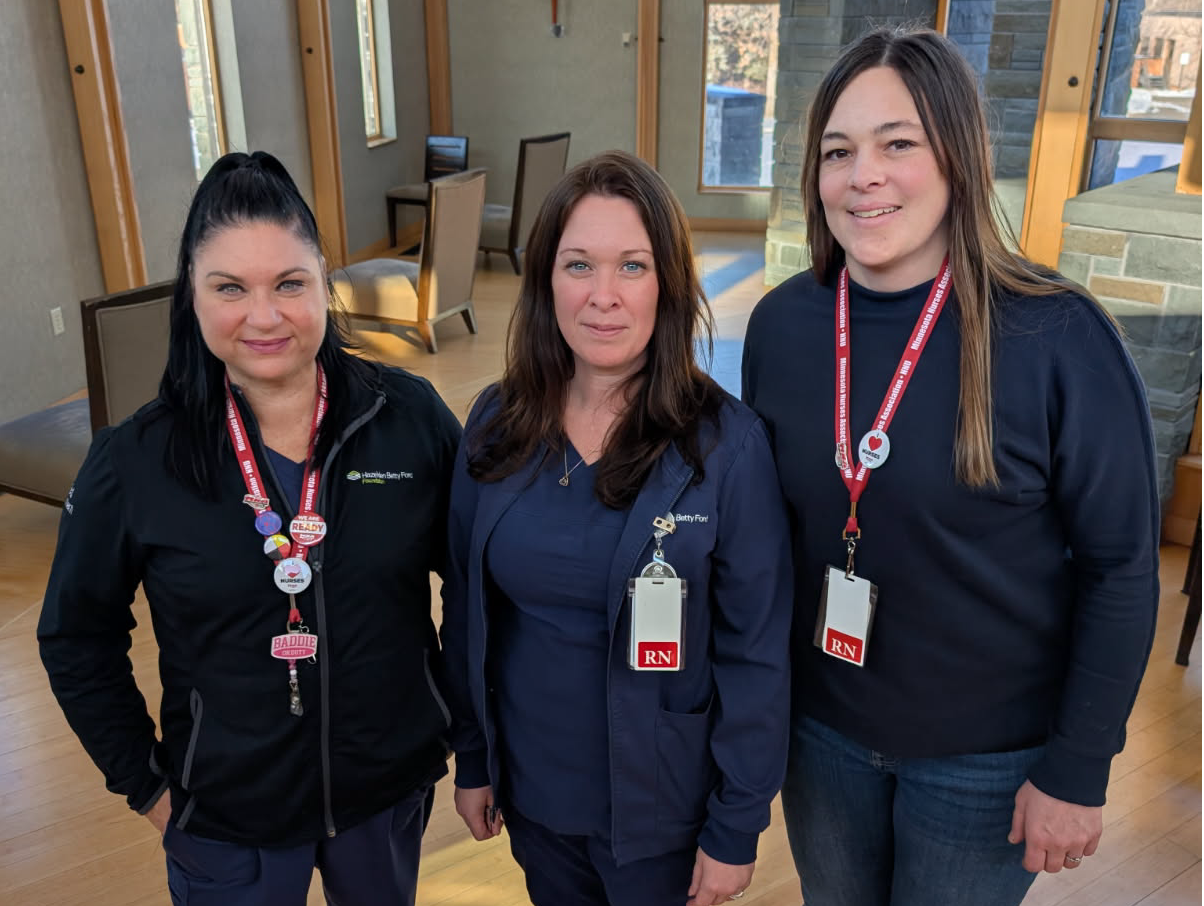
Newly unionized Hazelden staff members include (L to R) Jody Burton, an LPN, and registered nurses Crystal Olson and Meaghan Albrecht. (photo courtesy MNA)
Nurses at the esteemed Hazelden Betty Ford addiction treatment center in Chisago County voted to unionize last month, part of a recent organizing surge among health care workers in the Twin Cities area.
The new bargaining unit at Hazelden brings together 45 registered nurses and 11 licensed practical nurses, who voted in separate elections overseen by the National Labor Relations Board to join the Minnesota Nurses Association. About 75% of voting nurses supported the union drive.
Detox nurse Meaghan Albrecht called the union vote a “proud moment” for the tight-knit unit at Hazelden’s Center City campus, where nurses moved quickly to form a bargaining unit in response to benefit cuts announced by management last fall.
“Everyone cares deeply for each other and our patients, so it was not difficult to be unified, especially since this change was so significant and impacted so many people within our department,” Albrecht said. “Even those nurses who were not directly affected were impacted by the loss of morale on the team.”
Albrecht, who has worked at Hazelden for over six years, was among roughly 130 employees at the facility who were poised to lose their health care and other benefits after management moved to exclude anyone working under a .75 full-time equivalent (FTE), up from .6 previously.
The announcement caught Albrecht and other nurses off guard. They reconnected with the MNA, which had supported an organizing drive two years earlier that fizzled out before reaching an election.
This time around, Hazelden nurses saw the process through the finish line, and they will soon begin locking down their benefits – among other terms of employment – in the form of a union contract.
“Having MNA representing us gives us a seat at the table so we can make decisions about our wages, benefits, and safe working conditions,” Hazelden LPN Jody Burton said.
Minnesota-based Hazelden merged with the Betty Ford Center in 2014 to create the nation’s largest nonprofit alcohol and drug rehab provider.
The foundation was not supportive of nurses’ organizing campaign, Albrecht said.
“There were a lot of meetings held and discussions with the nursing team regarding the ‘negative impact’ that a union would bring to the organization,” she said. “They felt as though it would sever relationships, and they did not like the idea of a third party coming in.
“But we are the union. The nurses brought it in. We aren’t a third party.”
As Hazelden nurses’ focus shifts from organizing to bargaining a first contract, they will focus on fairness, inclusivity and transparency in the workplace, Albrecht said, as well as longstanding concerns around sustainable workloads.
“One of our goals is to foster meaningful dialogue with Hazelden management to create policies that prioritize staff well-being and patient care,” she said. “We think this is an opportunity to build a more just environment for nurses and patients alike.”
Nearly 700 health care workers in the Twin Cities area have organized unions in the last two months, led by a landmark victory for the MNA at North Memorial’s Maple Grove Hospital.
The total also includes nurses at Hazelden and 16 catheter-lab nurses at United Hospital, who organized with the MNA. And it includes members of the nursing staff at The Emeralds of St. Paul, a long-term care facility operated by Monarch Healthcare Management, where the union vote was a unanimous 27-0 in favor of joining SEIU Healthcare Minnesota and Iowa.
Nearly 100 more health care workers – unit coordinators at Park Nicollet Methodist Hospital in St. Louis Park – were scheduled to take a union vote Feb. 7, after a majority of eligible workers filed a petition to join SEIU Healthcare.
– Michael Moore, UA editor
 Union Advocate