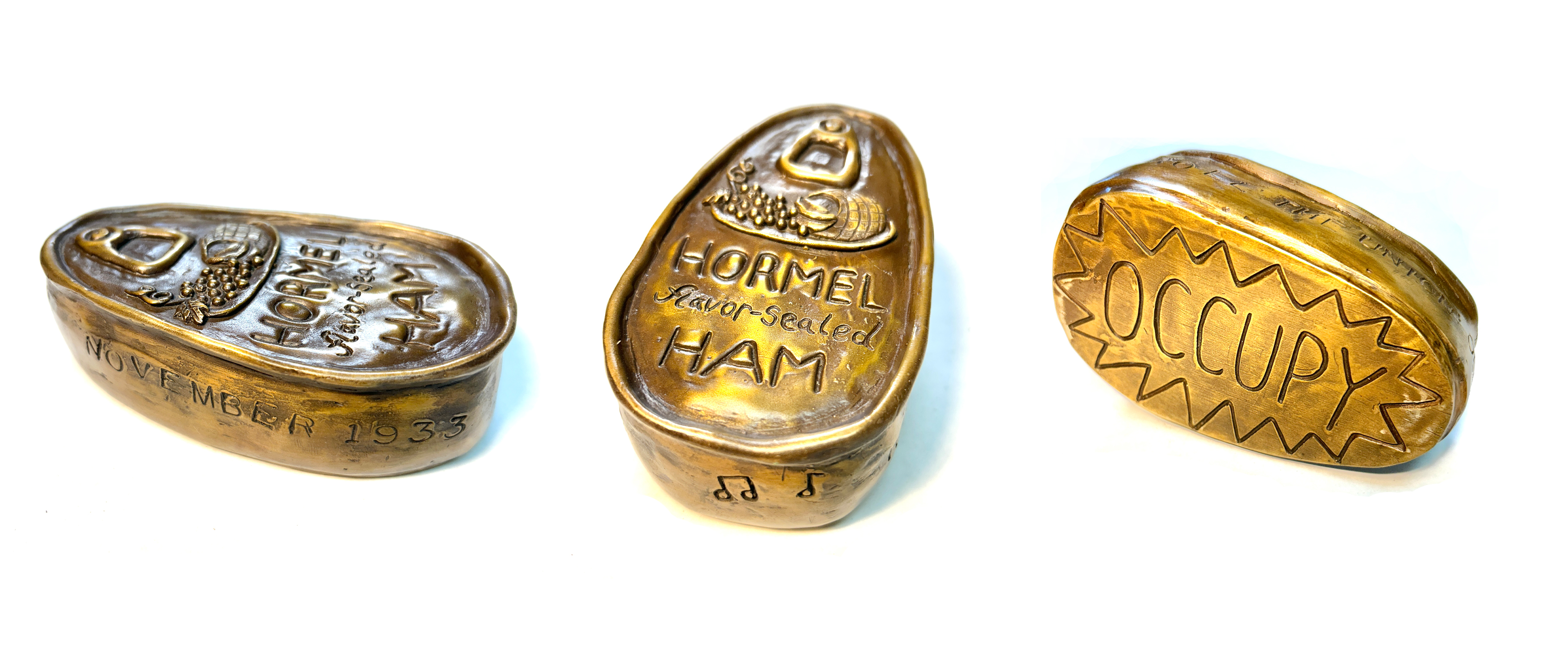
Sculptures by Gita Ghei will be on display at the East Side Freedom Library this spring.
From its founding in the 1920s through its political dominance in the 1930s and its merger with the Democratic Party in 1944, the Farmer-Labor movement united Minnesota workers, farmers and the unemployed, building solidarity across regional, political and racial or ethnic divides. Combining electoral politics, year-round organizing and political education toward a vision of a “cooperative commonwealth,” this movement created a model for progressive change still relevant today.
Lost to history by political repression and the Cold War ideology of the 1950s, the Farmer-Labor tradition was rediscovered by a group of labor activists and educators in the 1970s. They formed the Farmer-Labor Education Committee (FLEC), a non-profit organization with a mission to educate members of the public about the history and continued relevance of the progressive Farmer-Labor tradition. Like the movement they study, FLEC’s members are diverse and multi-generational, with rural and urban roots.
In 2022, FLEC produced “The Farmer-Labor Movement: A Minnesota Story,” a documentary about the history of the movement that has screened widely and prompted passionate conversations. There has been particular interest in the film’s contention that the Farmer Labor Party is best understood as part of a broader social movement that included co-operatives, educational institutions, newspapers and libraries, and cultural groups.
Now, FLEC has launched a new project, centered on art and artists. FLEC’s activists write: “Today, as much as ever, our desire to rekindle the solidarity of the Farmer-Labor movement is profound. In honor of the 100th anniversary of the Farmer-Labor Party and the remarkable movement of solidarity that supported it, FLEC, with financial support from Monument Lab’s Re-Generation initiative, commissioned public artist and teacher Gita Ghei to create a permanent traveling art exhibit commemorating the movement. FLEC and her team of artists have been working on the concept over much of last year and participating in a community engagement process that connects with the history and with Minnesotans throughout the state.”
Their work has been informed by their participation in community discussions following screenings of “The Farmer-Labor Movement.” Their goal is to promote further conversations not only between rural and urban residents, and members of different generations, but also between the past and present.
FLEC envisions the new exhibit, “You Betcha,” as a project of hope in challenging times. “Over the past decade, we have witnessed the resurgence of fascism and ultra-conservative organizing extending across the state,” they write. “At the same time, a divisive and reductive characterization of state political divisions has emerged, framing the Twin Cities as a progressive haven pitted against a white, conservative, and ‘backwards’ rural monolith. ‘You Betcha’ uses history as a way to trouble those narratives and engage … in dialogue that might both build and unearth solidarity across differences.”
“You Betcha” will make its first public appearance Feb. 20, from 6:30 to 8:30 p.m., at the East Side Freedom Library, 1105 Greenbrier Street, St. Paul. Artists and FLEC members will be present to engage audience members in conversation. The exhibit will be on display at ESFL until May 4. All are welcome to join in this conversation between past and present.
– Peter Rachleff is co-executive director emeritus of the East Side Freedom Library in St. Paul.
 Union Advocate