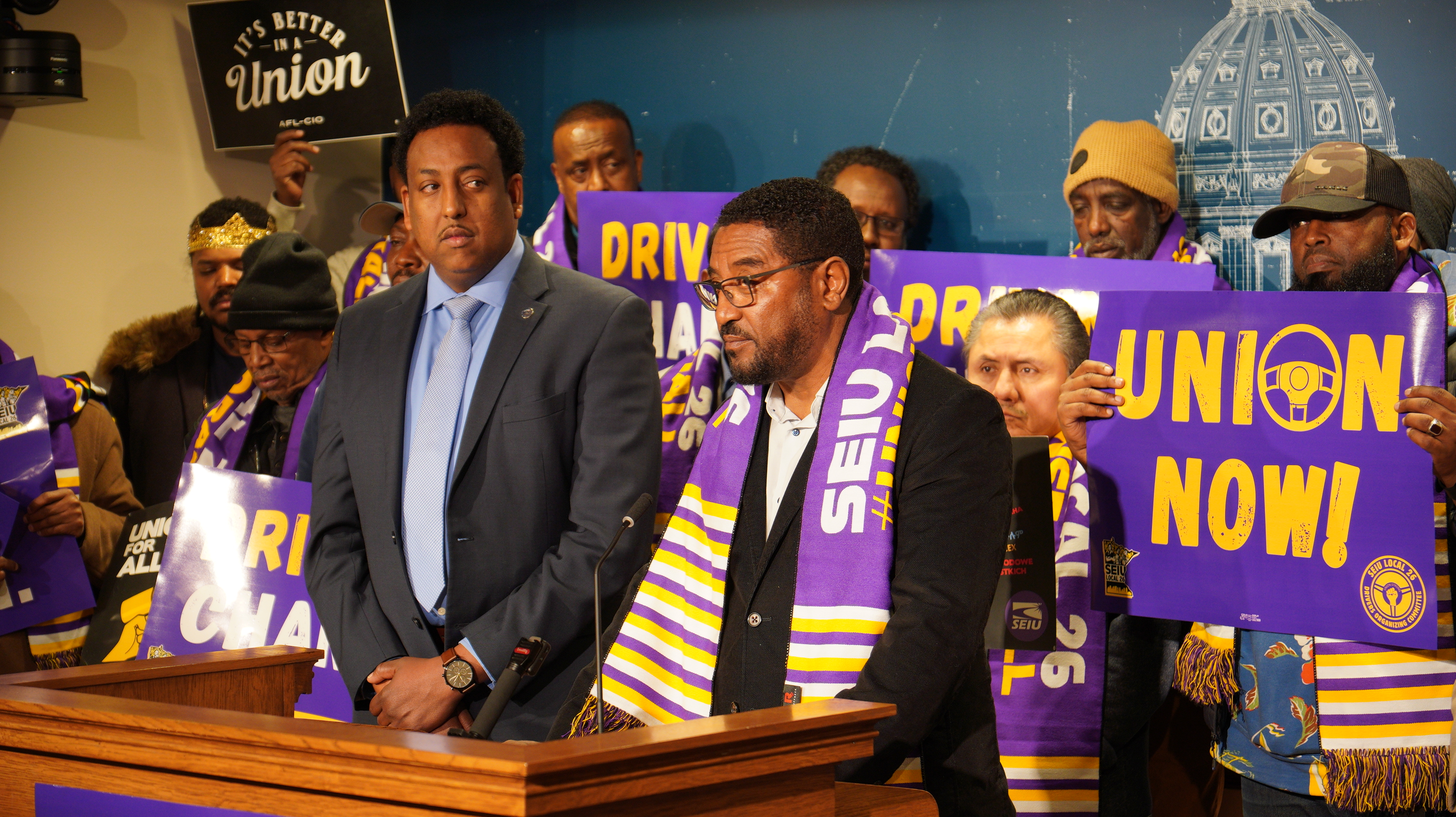
Dawit Kassa (R) spoke during a Capitol press conference on a bill that would allow Uber and Lyft drivers to unionize. (SEIU photo)
Two labor-endorsed state lawmakers announced plans last month to introduce legislation that would give drivers in Minnesota the right to unionize and bargain collectively with ride-hailing apps like Uber and Lyft.
Drivers in the Twin Cities have been organizing in recent years to push local and state officials to address low pay, safety concerns and a lack of transparency in their industry. State lawmakers responded last year with a bill establishing a new minimum wage and other guarantees.
But Dawit Kassa, a driver who served on Gov. Tim Walz’s task force to offer recommendations for the new law, said it doesn’t do enough to level the playing field between the ride-hailing companies and their drivers.
“No law is going to address all of the issues we are facing from these companies,” Kassa said. “We need a union. We need a seat at the table so we can ensure this industry works for us.”
Kassa was among roughly 20 Uber and Lyft drivers at a Capitol press conference Feb. 25. Most were wearing the Service Employees union’s trademark purple shirts, and SEIU Local 26 President Greg Nammacher said the union would support any Uber and Lyft drivers looking to organize.
Lead authors Rep. Samakab Hussein (D-St. Paul) and Sen. Zaynab Mohamed (D-Minneapolis) said they are modeling their bills after a historic ballot measure approved by Massachusetts voters in November.
The Massachusetts law establishes a process for drivers to organize a union and, if successful, bargain one contract with all the apps licensed to operate in the state, known as “sectoral bargaining.”
Drivers, like most other workers in the gig economy, are classified by law as independent contractors, making them ineligible to form a union without a special process like the one in Massachusetts.
Under the proposal from Hussein and Mohamed, pro-union drivers would need to sign up at least 25% of the potential bargaining unit – open to anyone who has completed 100 rides in the previous quarter – before contract talks could begin.
Any tentative agreement would need approval from a majority of voting union members and from the commissioner of the Minnesota Department of Labor before taking effect.
The proposal also establishes an arbitration process if the union and ride-hailing apps fail to reach an agreement within six months of opening talks.
Hussein said that stories from Uber and Lyft drivers confirmed that they need collective bargaining to address their shared concerns around fare transparency and pay for time spent waiting for a job.
And despite safeguards in the new state law, drivers continue to report being deactivated from their Uber or Lyft accounts – making it impossible for them to work – due to rider feedback, without getting an opportunity to respond in their defense.
“Without a voice, these problems are going to continue to come back to the Legislature,” Local 26’s Nammacher said. “The Legislature does not need to be the HR department for these multimillion-dollar, global corporations like Uber and Lyft,”
“Ride share companies continue to do the bare minimum while making millions,” Hussein added. “It’s time for change.”
 Union Advocate