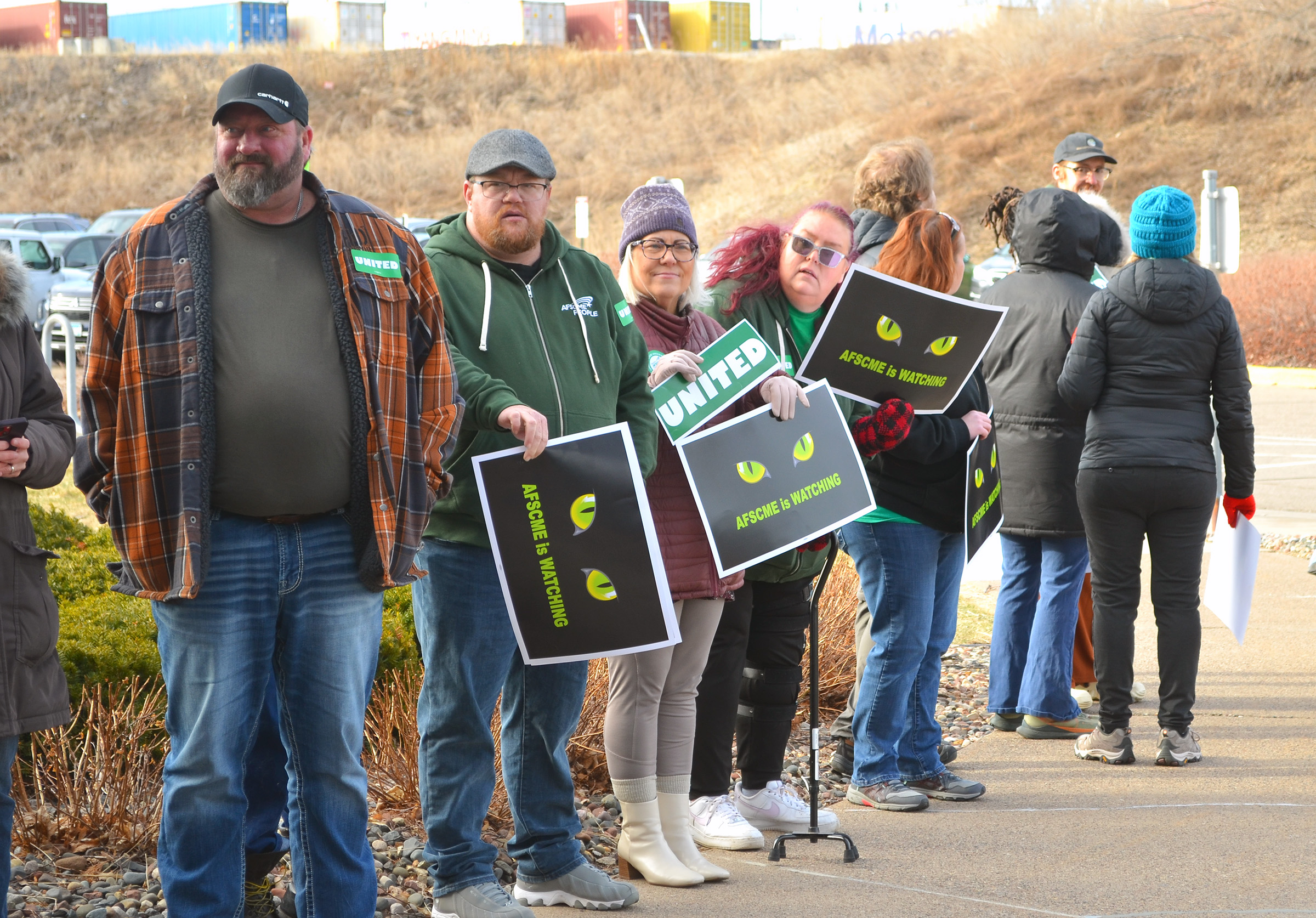
Members of AFSCME Council 5 lined the sidewalk outside the St. Paul office where their bargaining team held its first negotiations session with the State of Minnesota.
State employees say Gov. Tim Walz’s new return-to-work order, handed down abruptly in March and set to take effect June 1, has galvanized union members just in time for contract negotiations this spring.
Talks covering nearly 40,000 members of two unions, AFSCME Council 5 and the Minnesota Association of Professional Employees, got underway earlier this month. Both unions, which are bargaining at separate tables with Walz’s team at Minnesota Management and Budget for now, held early-morning actions on their first day of negotiations in St. Paul.
Workers lined the sidewalk outside the office building to welcome their bargaining teams – and put the state on notice that they are paying attention.
The state’s telework policy was top of mind for many workers at the events. Revenue examiner Nico Montas, 23, said Walz’s announcement, delivered without notice to or consultation with MAPE or AFSCME, was a “shocking” call to action.
Although he was covered by AFSCME Local 2829’s bargaining unit, Montas wasn’t even paying dues before the governor announced changes to the telework policy. Within a month, he had signed up to become a union steward, completed the training and organized more than a dozen of his colleagues to join Local 2829, too.
That’s momentum, Local 2829 Vice President Spencer Abbe said.
“We’ve got a bunch of people out here who have never been involved before,” Abbe said at the kickoff event, adding that many state employees consider the governor to be an ally at a time when public-sector workers are facing unprecedented attacks.
“It wasn’t a slap in the face, it was a stab in the back,” Abbe said. “We’re already feeling attacked on all sides, and to have that come from (Walz) felt like a sneak attack. It was really disappointing.”
Union negotiators pledged to hold the governor’s team accountable for its previous commitments to public services. That means respecting and compensating the workers who deliver them.
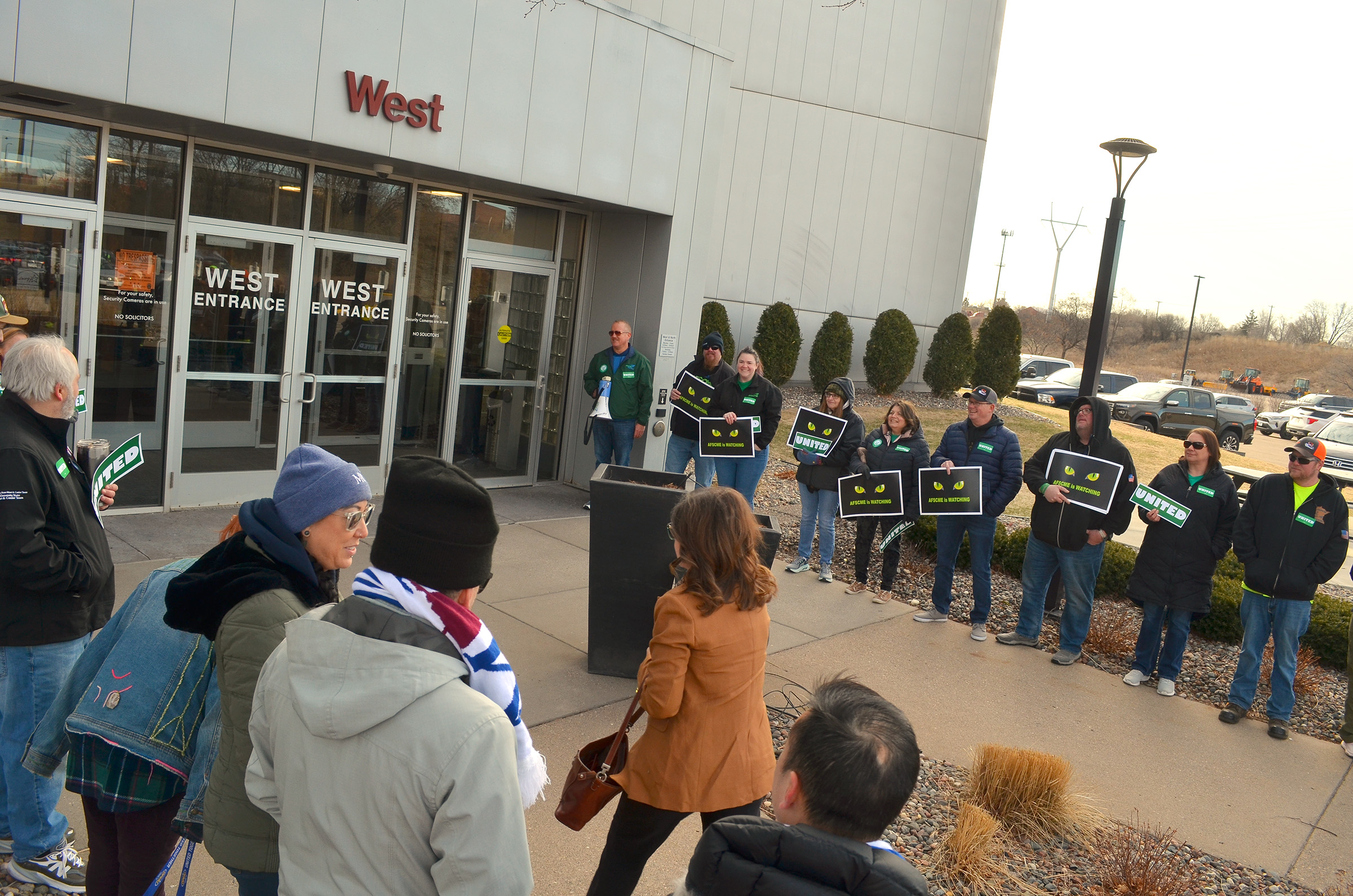
Members of AFSCME Council 5 formed a “gauntlet” to welcome their negotiators – and the employer’s – to the first day of contract talks covering about 18,000 workers.
“We are fighting for fair wages, fair benefits, fair insurance – and we will stand for nothing less,” Council 5 Executive Director Bart Anderson said.
But while unions came to the table with proposals to address workers’ concerns, MAPE President Megan Dayton said, MMB’s proposals sought to strip them of their union rights and protections.
“MMB’s proposals take aim at the foundations of workplace stability, weaken union representation, undermine due process and, most cruelly, strip away rights that protect employees during layoff,” Dayton said. “At a time when we are seeing hundreds of layoffs and we know more are coming, the employer chose to bring proposals that would accelerate harm.”
At the AFSCME rally, Montas said he is holding out hope that the state’s posture changes as bargaining plays out.
“If we can’t get any sort of wiggle room on being able to work from home, I’m hopeful that we can get better pay, some sort of reimbursement for travel time or parking,” Montas said. “You would expect that would be a minimum, but, unfortunately, it seems like that may be a reason they want people to go back – so they can extract as much money from us as possible.”
If that’s the case, Abbe, who works in public records, fears that many state workers – concerned about parking costs, accommodations for people with health conditions and losing the flexibility to care for their families – will abandon public service.
“We show up every day to serve people because we believe in what we do,” Abbe said. “We aren’t out here to get rich.”
– Michael Moore, Union Advocate editor
 Union Advocate