
Nurses picket outside United and Children’s hospitals in St. Paul.
For over a decade, Minnesota nurses have been fighting at the bargaining table, on the picket line and at the Capitol for staffing ratios that, they say, would help ensure quality patient care and keep nurses at the bedside.
Any hospital executive wondering whether members of the Minnesota Nurses Association would give up that fight got a resounding answer today, as thousands of nurses, dressed in MNA’s signature red, were back on picket lines at 17 hospitals in the Twin Cities and Duluth area.
“We’re not giving up on our patients,” United Hospital oncology nurse Asher Herndon said during a press conference outside the St. Paul facility. “We’re calling for safe staffing, we’re calling for dignity and we’re calling for a health care system that actually puts care first.”
MNA members picketed at Allina Health hospitals like United, as well as hospitals in the Children’s Minnesota, HealthPartners, M Health Fairview, North Memorial, Essentia and St. Luke’s systems, which are currently bargaining contracts covering over 15,000 MNA members.
The action was informational picketing, not a strike. But many union members outside United and Children’s Hospital in St. Paul wore blue stickers that said “Ready” — a warning that their next step is a strike-authorization vote if nurses don’t see progress on their top demands.
That means contract language that would set minimum staffing levels and ensure safe workloads for nurses and patients. But so far, Children’s nurse Melisa Koll said, executives across the table “simply are not interested in this idea.”
MNA President Chris Rubesch has said “shoestring, COVID-era staffing levels” remain in too many Minnesota facilities – a crisis that shows up in reports filed by hospital nurses who spot unsafe staffing in their units.
At Children’s Minnesota’s campuses alone, nurses have filed over 6,500 reports of concerns in the last 30 months, Koll said. “That means our youngest, most vulnerable patients didn’t get the care their nurses felt they needed or deserved.”
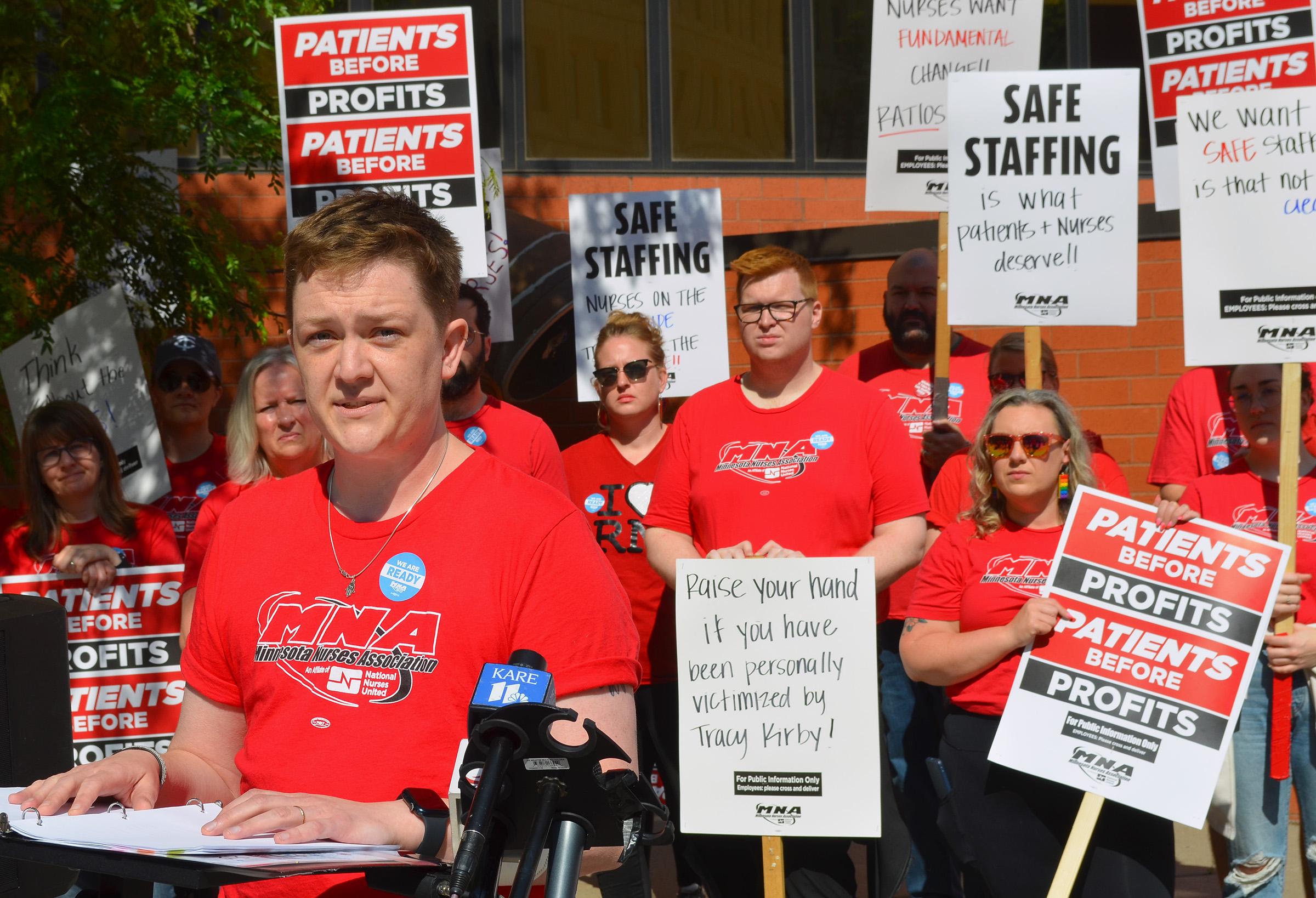
United nurse Asher Herndon speaks during a press conference on the picket line.
Some stories behind those reports are devastating.
Herndon, who said they have been assigned as many as five patients with complex medical issues at a time, recalled providing end-of-life care to a patient at the same time as they were caring for multiple others with acute needs.
“I was doing everything I could, but by the time I got back to him, he had already passed – without family, with no one there to hold his hand,” they said. “It’s not because we don’t care; it’s because there weren’t enough of us to be there for him.”
Another patient in Herndon’s unit got so frustrated waiting for help going to the bathroom that the patient tried to go alone and fell, resulting in serious injuries.
“These are not rare events,” Herndon said. “These are predictable outcomes of chronic, dangerous understaffing.”
Stories like Herndon’s are why MNA says short staffing is behind alarming levels of burnout among nurses, and increased medical costs incurred by hospitals and patients. It’s an idea backed up by research that has prompted other states – including Nevada earlier this week – to pass laws establishing limits on the number of patients that can be assigned to nurses.
Hospital systems here shouldn’t wait for lawmakers in Minnesota to act, Rubesch said. They should work together with nurses on safe staffing standards that meet local communities’ needs.
“Nurses are taking action because our health care system cannot afford more delays or excuses,” he said.
— Michael Moore, UA editor
 Union Advocate