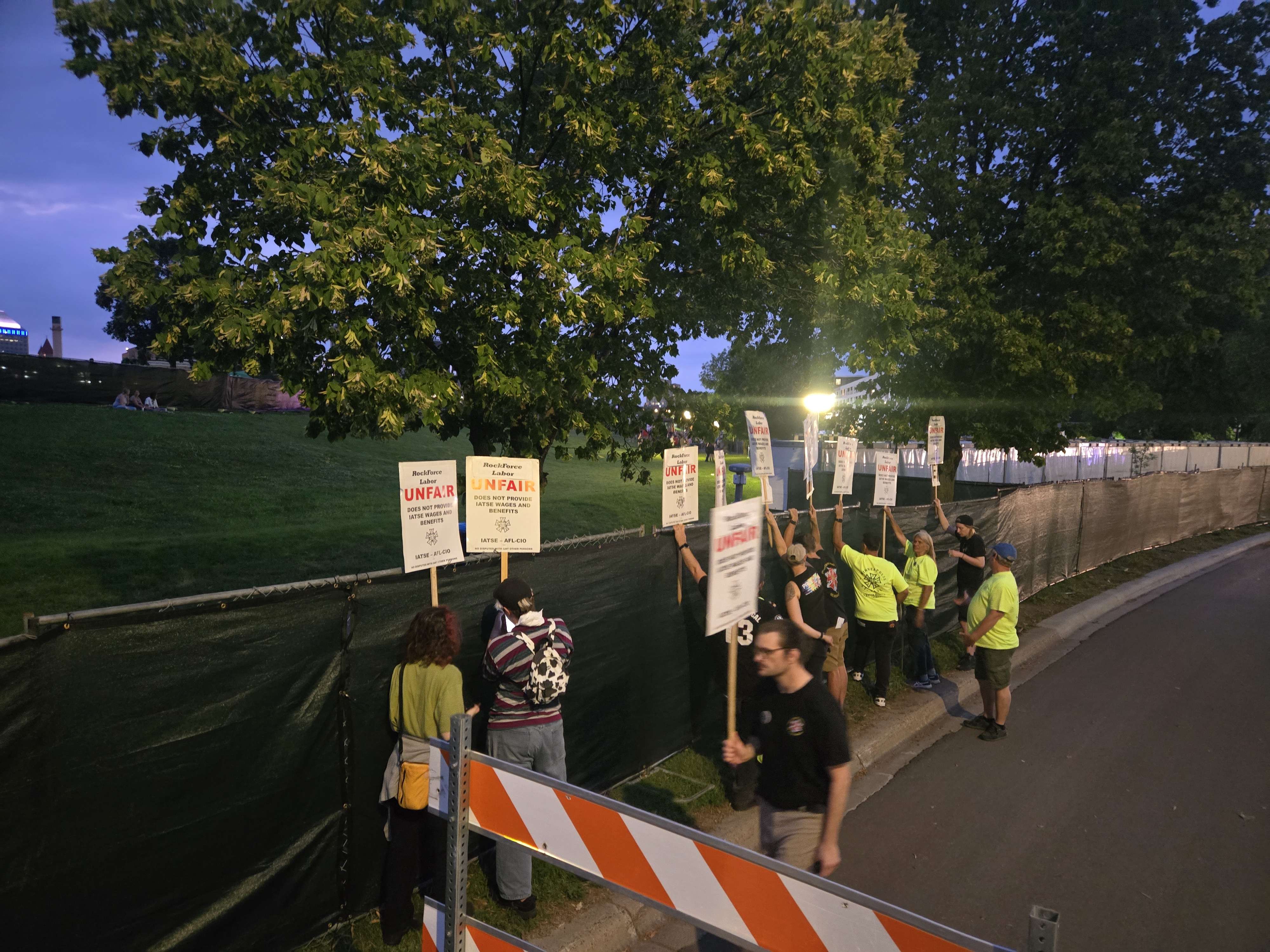
Local 13 members and supporters picket outside the stagehands’ gate during the Minnesota Yacht Club festival. (submitted photo)
Stagehands who worked the Minnesota Yacht Club festival in St. Paul last month got a bump in pay after union members set up a picket line outside the three-day event, IATSE Local 13 says.
“The picket worked, and I’m very proud that we put it up,” Local 13 business agent Kellie Larson said. “The goal was to inform workers that their working conditions were subpar, and we were able, through the informational picket, to get those conditions brought up to something that was better.”
Local 13 announced it would picket the Minnesota Yacht Club, which drew crowds of around 35,000 to Harriet Island July 17-19, after union members rejected a contract proposal from the live-events company behind the festival, RockForce Labor.
The wages, benefit contributions and work rules in RockForce Labor’s offer lagged area standards set by union stagehands in their contracts with local performing-arts venues, Larson said.
“They put up a hard final offer, I brought that to my membership and they voted it down,” she said. “They said they would rather bring awareness to the public that this was not safe or standard working practices.”
Timing played into the decision, too. Local 13 is currently in bargaining over its arena contracts, and union members worried that agreeing to a substandard contract, even temporarily, would send the wrong message to local employers.
“If I take a lowball offer in that way, just ‘to take the deal,’ I would be undercutting all of the working conditions we have in the Twin Cities,” Larson said.
Among the provisions the union found unacceptable were terms of the so-called “turnaround time,” the gap between when stagehands wrap work on one show and start work on the next. RockForce wanted Yacht Club stagehands to tear down after the last act ended its show and be back to work within six hours, Larson said. Local 13’s contracts provide at least eight hours.
“We start work when everyone leaves, from 10 p.m. to 2 a.m.,” she explained. “It’s hard work, and it’s dark, especially at outdoor festivals. You’re walking out of the place at 2 a.m. and walking back in six hours later for sound check? That’s really tight.”
Stagehands install speaker stacks and sound gear, stage lighting, monitors and more. For festivals like Yacht Club, work typically starts early, as stagehands unload and install gear for each act, then run it through a sound check.
“That’s five or six different looks we have to go through,” Larson said. “Sound check for band No. 1, let’s say Green Day, is at 8 a.m. We do a 90-minute sound check and start falling back to each act that will come before them. All day, we’re just unloading gear, doing sound checks, setting up for the next band.
“The work we do is dangerous and hard, and we’re doing it at a time of day that doesn’t make sense for most humans. That’s why we have some of these clauses in place, so we do have the best workers, with the best mental capacity to do the work.”
RockForce Labor launched this spring, consolidating nine live-events production companies into one, with eyes on luring business from “concerts, festivals, sporting events, live broadcasts, awards shows and corporate activities.”
It made a splash in the live-events industry, and Larson said she faced pressure from her international union to get a deal done and prevent any bad blood.
“I tried to bargain with the company,” she said. “I told them, ‘I can give on wages if you can get the turnaround time better. But the company just wouldn’t negotiate, and our members didn’t really feel safe working under those conditions.”
Instead, RockForce subcontracted the stagehands’ work to a Wisconsin-based company, and Local 13 members hit the picket line, where they engaged both concertgoers and stagehands passing through the gate.
“After three days on the line, what I heard from workers inside the gate was that they had transitioned from 1099s to W-2 work, with workers-comp insurance,” Larson said. “And they moved up to the $28-per-hour range. They also moved from no minimums and no double time to a 4-hour minimum and double time after midnight, which kicked in on Saturday.”
If true, it bodes well for Local 13 members’ chances of reaching a deal should the festival return to St. Paul next year.
“We’ll see what we can do to repair the relationship,” Larson said.
– Michael Moore, Union Advocate editor
 Union Advocate