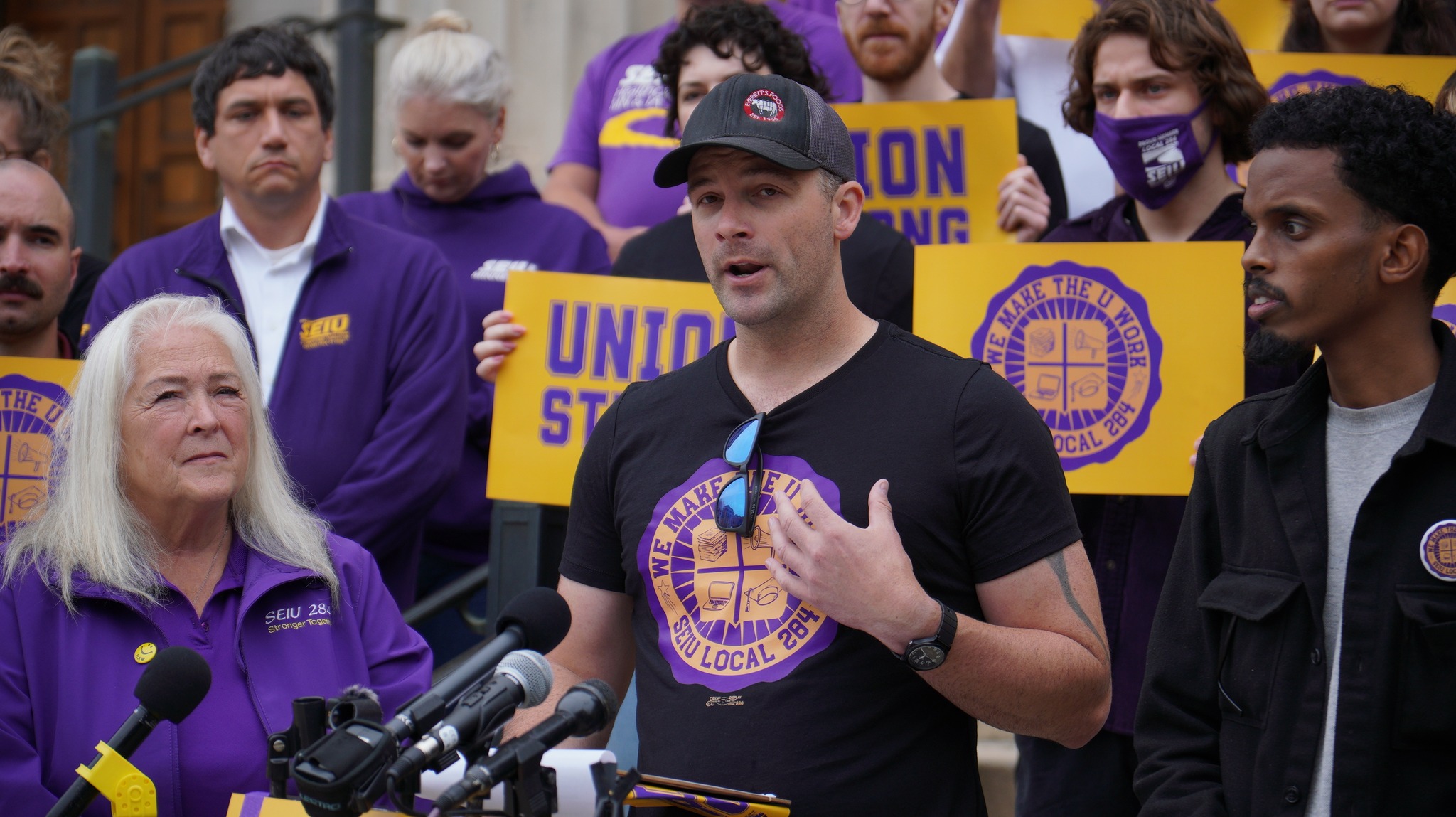
Michael Wilson, who works on grants and contracts in the School of Public Health, speaks during the launch of SEIU Local 284’s organizing drive. (SEIU photo)
The surge in union organizing on college campuses in Minnesota shows no sign of waning, as Service Employees (SEIU) Local 284 announced last month that the union had launched a campaign to bring together nearly 3,000 workers across five University of Minnesota campuses.
The bargaining unit would cover workers in four departments: information technology, marketing and communications, student-services, and grants and contracts.
Union leaders and worker-organizers announced the organizing push Sept. 9 on the Northrup Auditorium steps in Minneapolis. A union contract, they said, would provide workers with greater certainty at an uncertain time for higher-ed institutions like the U.
“We’ve all seen what the last six months have been like for workers across all industries – higher-education workers specifically,” Local 284 Executive Director Kelly Gibbons said, adding that “the very existence of higher ed” has come under attack.
“If there was ever a time to come together in a union, it is now,” she added.
Since taking office, President Donald Trump’s administration has sought to bully colleges and universities with executive orders, legal threats and funding clawbacks.
U of M grants and contracts professional Michael Wilson, whose work supports research in the School of Public Health, said the federal funding landscape has experienced “a level of disruption unseen by any of my colleagues, young and old.”
Wilson and other U of M workers at the kickoff rally said they believe collective bargaining will put them in a stronger position to weather the radical changes in higher ed, as well as challenges unique to their departments.
“There are real people like me who are doing quality labor … and we are passionate about recreating the stability that (we) deserve and our entire society deserves,” Wilson said. “And we know that collectively bargaining a union contract will help provide clarity, transparency and stability long term.”
Workers said they will organize around four goals for their first contract: workplace democracy, career security, healthy workplaces and closing the salary gap with U of M’s administrators.
Those pay gaps persist, Labor Education staff member Amie Stager said, despite announcements of layoffs and budget cuts across the system.
“My job and the jobs of all my colleagues deserve to be good union jobs,” Stager added. “We all deserve dignity and respect in our workplace.”
More U of M jobs are becoming union jobs thanks, in part, to reforms passed by labor-endorsed state lawmakers in 2024 that extended bargaining rights to more university employees and allowed for smaller, more targeted bargaining units, making it easier to organize.
Some 1,000 resident physicians at the U’s flagship hospital formed a union earlier this year, and graduate student workers ratified their first union contract last winter. Other local schools, including Macalester College and Augsburg University, have seen successful union drives in recent years too.
Mitchel Kruchten recently gave up a union job at the U to take on more responsibility in the IT department – and explained why he regrets the move during the kickoff rally last month.
After clashing with a manager who made “comments about my character that I felt were deeply unprofessional,” Kruchten received a poor performance review. Later, the same boss mocked Kruchten’s request for time off as a “vacation” when he was, in fact, about to undergo surgery.
“I saw similar patterns with my colleagues, all talented people who came here with a desire to make the university a better place, but all left due to bullying and toxic behavior from a senior leader,” he said. “This is why a union is so important. If I had remained in AFSCME, I would have been entitled to a fair review and representation.”
Local 284 represents 10,000 support staff in K-12 schools across Minnesota, as well as adjunct faculty members at colleges and universities in the metro.
– Michael Moore, UA editor
 Union Advocate