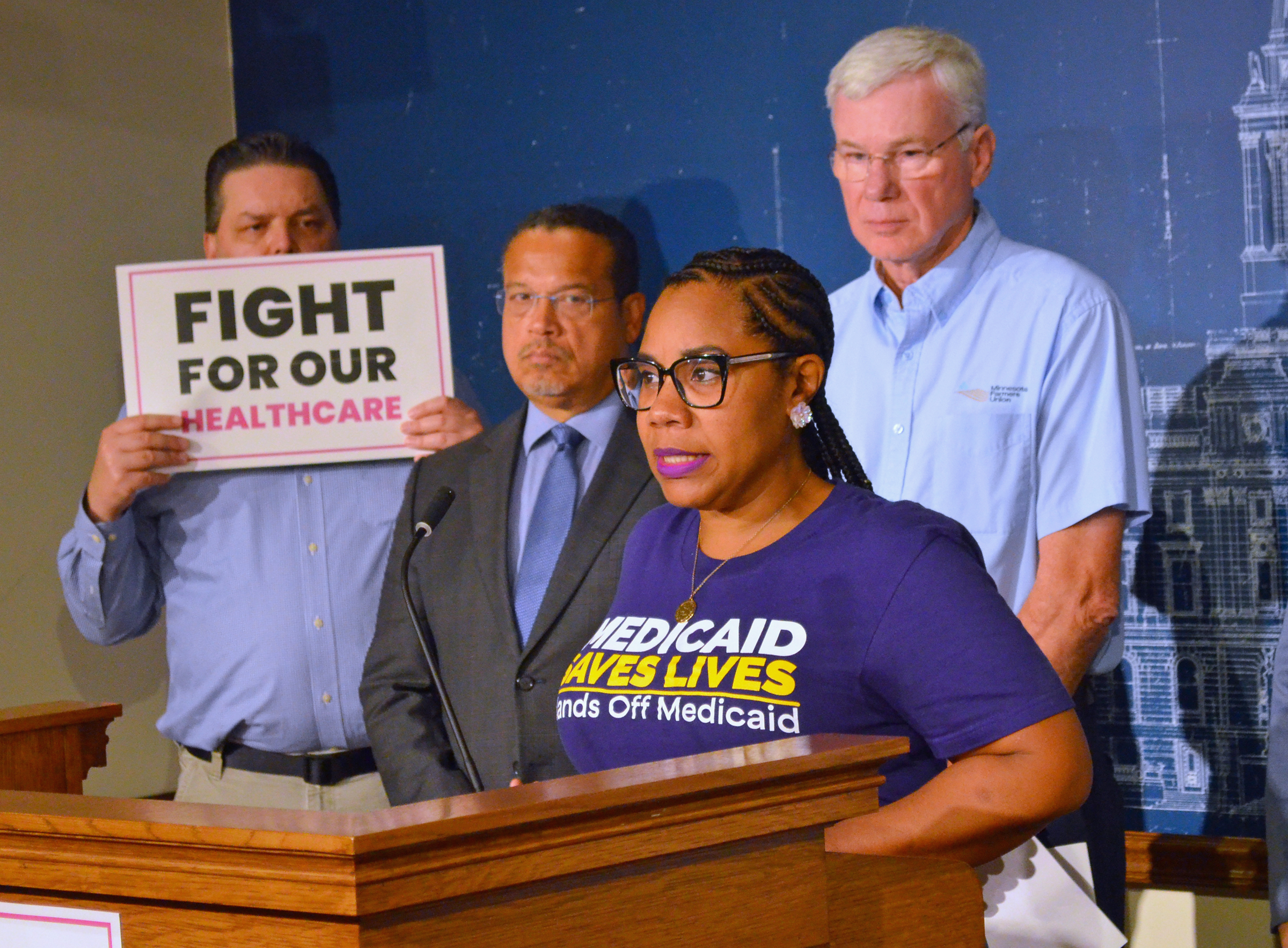
SEIU Healthcare Minnesota and Iowa member Tametria Johnson worries about the impact that cuts to Medicaid and expiring ACA subsidies will have on her family.
Using public-service workers as political pawns, President Donald Trump and the Republican-controlled Congress allowed the federal government to shut down Oct. 1 rather than negotiate with Senate Democrats over a mounting health care crisis.
As the shutdown extends into a fourth week, over 750,000 federal workers are locked out, furloughed or working without pay.
Trump and administration officials have made no attempt to hide their intent to use federal workers as leverage in the standoff. The president called it an “unprecedented opportunity” to slash payroll, and thousands of workers across multiple federal agencies had received reduction-in-force notices by mid-October.
The administration also floated a memo arguing furloughed workers were not entitled to back pay, flouting a law passed after the government shut down for 35 days in 2019.
Unions, led by the American Federation of Government Employees (AFGE), swiftly challenged both the firings and the memo, winning a temporary restraining order to block the reductions in force and threatening another lawsuit if the administration withholds back pay.
Still, the strain on federal workers and their families increases with each day the shutdown drags on, AFGE District 8 Vice President Ruark Hotopp said. District 8 represents over 19,000 federal workers in Minnesota and four other states.
“To be used as political footballs, to shut down the government and hold us hostage while many of our members are going without a paycheck – in many cases while they still perform their work – it’s just frustrating and maddening,” Hotopp, an immigration officer on leave while he works for his union, said. “People are feeling a lot of anxiety, a lot of uncertainty.
“But it’s par for the course with what we’ve been dealing with since January, with DOGE and (Office of Management and Budget Director) Russ Vought and Elon Musk, and agencies refusing to recognize our union contracts.”
Holding out for health care fix
While AFGE and other federal workers’ unions are calling for an immediate end to the shutdown, other labor unions have ramped up pressure on Trump and Republicans to negotiate a health-care fix with Senate Democrats as part of a spending bill.
Already, hospitals are bracing for a $900 billion cut to Medicaid coverage in the tax and spending bill Trump signed into law July 4, which will force providers to absorb billions in unpaid care costs.
Adding to the crisis, Trump and Republicans are set on allowing some tax credits that help people afford insurance through the Affordable Care Act expire Dec. 31. Over 22 million Americans, access the credits to make their health coverage more affordable.
MNsure, Minnesota’s ACA exchange, noted the impact of the expiring credits as it released rates and coverage options in advance of open enrollment beginning Nov. 1. Nearly 90,000 Minnesotans will pay more for coverage – on average, about $177 more each month – and another 20,000 will lose all financial assistance.
“These cuts would be a snowball that would be awful for so many families,” home care worker Tametria Johnson said during a press conference called by her union, SEIU Healthcare Minnesota and Iowa, on Day 1 of the shutdown.
Johnson works as a caregiver for her developmentally disabled adult daughter, a service reimbursed by Medicaid funding, but she gets her own health coverage through the ACA exchange. She worries her family’s Medicaid benefits are in jeopardy at a time when her premiums are set to increase by over 20%.
“Many of us live paycheck to paycheck,” Johnson said. “When costs go up … something has to go – groceries, medicine, gas to go to work or appointments, utilities, cell phone. It’s very scary.”
Make a deal or take a stand?
Labor leaders and Senate Democrats have acknowledged the tension between fighting to lower health care costs for union members like Johnson and getting federal workers back on the job. But they agree that the blame lands squarely on the White House.
“Our livelihoods should not be used as pawns or bargaining chips, whether it is threatening one set of workers after another, canceling construction projects, or jacking up electricity prices on top of higher health insurance premiums,” AFL-CIO President Liz Shuler wrote in a letter to Trump sent Oct. 7.
“We implore you to meet with the leaders of the House and Senate to find a solution that funds the government, fixes the health care crisis and puts working people first.”
One thing AFGE’s Hotopp is sure of, he said, is that the Trump administration’s attacks on federal workers won’t end when the government reopens. He recalled the argument that convinced enough Senate Democrats to sign off on a Republican budget the last time Congress reached the brink of a shutdown, in March.
“What we heard then was, ‘We had to make a deal to save your jobs,’” Hotopp said. “Then we watched DOGE rip through our staffing, watched agencies rip away our unions. It didn’t save any jobs.
“To insinuate that if there weren’t a shutdown that they wouldn’t terminate people? That’s simply not the truth.”
– Michael Moore, Union Advocate editor
 Union Advocate
[…] SNAP cuts will only add to the pain inflicted on workers during the shutdown. […]