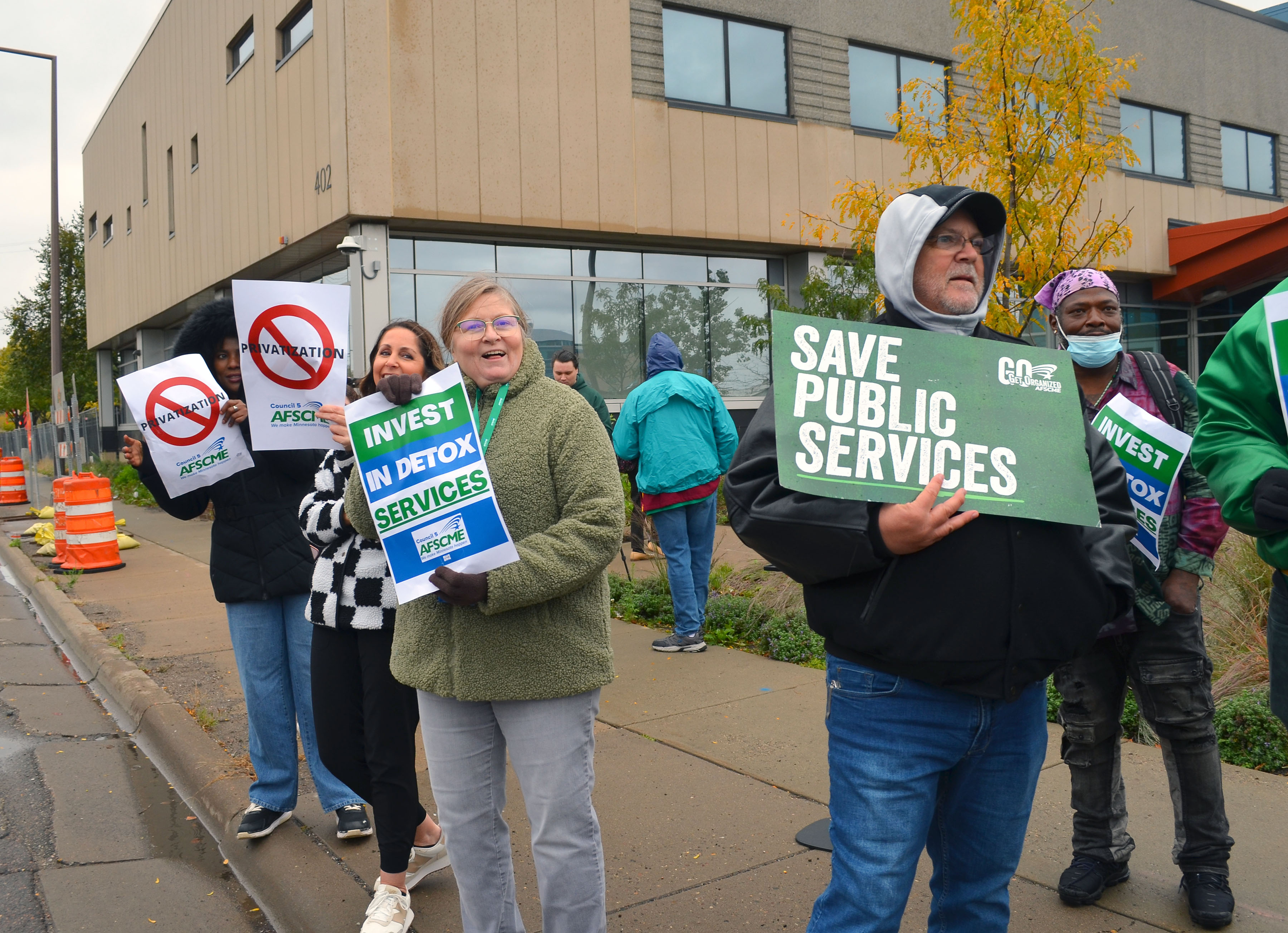
Community members rally outside the Ramsey County Detox Center.
Workers and community members staged a demonstration outside the Ramsey County Detoxification Center in St. Paul on Tuesday, protesting the county’s plan to wind down operations by the end of this year.
Members of the American Federation of State, County and Municipal Employees (AFSCME) criticized county leaders for scrapping the Detoxification and Withdrawal Management program during a substance-abuse crisis in the community.
“It’s life or death,” said Randy, a peer support specialist at the facility who asked that his last name not be published. “I know for a fact that there are people, if we do close, that have less of chance of just surviving. That’s not to be dramatic, but there are people who are really going to be in dire straits without our program.”
[Sign AFSCME’s petition to save Detox Services here.]
Shutting down the detox program will trim about $2 million from the annual budget, according to the county, which plans to partner with community providers to deliver detox services moving forward.
Counties are required to ensure detox services are available, but not to run their own facilities.
But workers at the rally voiced concerns about what those partnerships look like in practice – and whether community agencies are ready to absorb the clients Ramsey County begins turning away Jan. 1.
“They continue to push the narrative that there will be plenty of community providers out there, but all of the community providers are still asking us, what are they going to do when this is done?” nurse supervisor Channa Peters said.
There are no other detox facilities in the east-metro area, Peters added, and surrounding counties already steer their residents in need of services to the St. Paul site, located near Regions Hospital. After it closes, the nearest detox center will be at 1800 Chicago Ave. S. in Minneapolis.
Randy, a steward with AFSCME Local 151, said he worries that potential privatization of the services Ramsey County currently provides could jeopardize access for unhoused, uninsured and underinsured people in the community.
“If you get somebody that’s for-profit to come in and do these services, where’s their motivation to serve those most vulnerable people?” he asked.
The closure will eliminate about 43 positions at year’s end. The layoffs are poised to hit about a year after the detox program ramped up hiring to confront the opioid epidemic.
Already this year, the program has made contact with 1,700 clients, and it is on pace to serve about 1,900. That’s up from 1,567 last year and 1,269 in 2023.
Still, the county says its in-house program “has underperformed expected financial targets year-over-year and has had significant deficits for several years.”
But staff members say those targets were never laid out clearly by management, while the county’s inability to hire nurses has forced it to pay contractors at a much higher rate, inflating the program’s expenses.
“We know that we’re not going to be a moneymaking program, but we’ve saved people’s lives,” Peters said. “We had people stand up at the last board meeting and talk about how having a detox here has opened the door to becoming a homeowner in this county.”
Randy said he understands the financial challenges Ramsey County faces, “particularly with the cuts that we know are coming down from the federal level.” But he disputed the county’s characterization of detox services as ineffective or inefficient.
His message to county commissioners: “We probably are your best effective bet to do this if you can figure out a way to fund us. Have you done everything you can to figure that out?”
– Michael Moore, Union Advocate editor
 Union Advocate