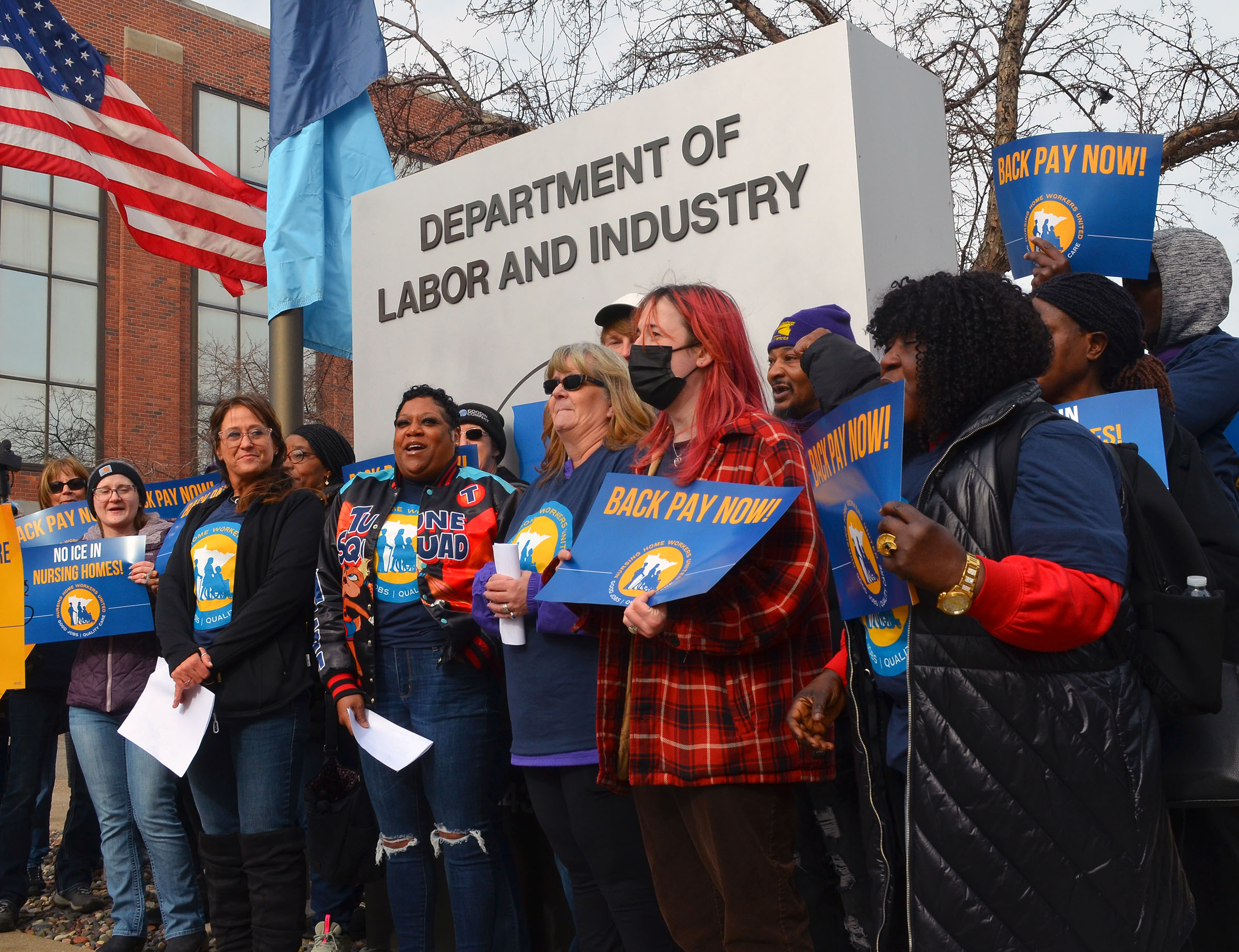
Minnesota nursing home workers who don’t have a union on the job have launched a new advocacy group, Nursing Home Workers United. Organizers rallied March 12 in St. Paul before a meeting of the state’s Nursing Home Workforce Standards Board. The new organization formed, in part, as a response to employer groups’ legal effort to disband the board altogether.
Researchers at Columbia University issued a report last week that shines a light on rampant union-busting in Minnesota’s nursing-home industry, particularly in facilities that rely heavily on public subsidies.
The report, “Democracy Denied at the Bedside: Union Avoidance in Minnesota’s Nursing Home Sector,” draws on years of qualitative research and a statewide survey of nearly 2,000 certified nursing assistants to reveal a “pattern of anti-union tactics” in the state’s nursing homes.
Columbia Labor Lab sociologist Adam Reich, one of six researchers who worked on the report, said the team began digging into labor relations in Minnesota’s nursing-home industry shortly after the pandemic, which sparked a surge in union-organizing efforts among health care workers.
In addition to analyzing data – from their CNA survey, from the Centers for Medicare and Medicaid Services (CMS) and from the Minnesota Department of Health – researchers embedded themselves into multiple union organizing efforts from 2021 to 2025.
The report includes firsthand accounts from workers reacting to their bosses’ anti-union campaign, including misinformation, so-called “captive audience meetings” and, most shockingly, appeals to nursing home residents and their families to encourage caregivers to vote “no.”
At one nonprofit nursing home with a religious affiliation, an administrator leaned on Biblical proverbs to suggest that union organizers were wolves in sheep’s clothing.
“One story that sticks in my mind is a worker whose manager told them that they were going to talk to the pastor of the church they both attended about how this worker was organizing,” Reich said.
But the report’s key finding is the crossover between homes that receive public funds and those that run union-avoidance campaigns. It’s already raising questions among unions in the industry about whether public funds are being used to stifle workers’ voices.
Rasha Ahmad Sharif, SEIU Healthcare Minnesota and Iowa’s vice president for the sector, said workers deserve answers.
“While not surprising, we are still outraged to see that money that workers have been pushing to go to essential workers caring for Minnesotans is being spent trying to stop workers from forming unions because employers are too scared of their workers practicing their federal rights and gaining the bare minimum that their employers refused to give them,” Ahmad Sharif said.
– Michael Moore, Union Advocate editor
 Union Advocate
Leave a comment