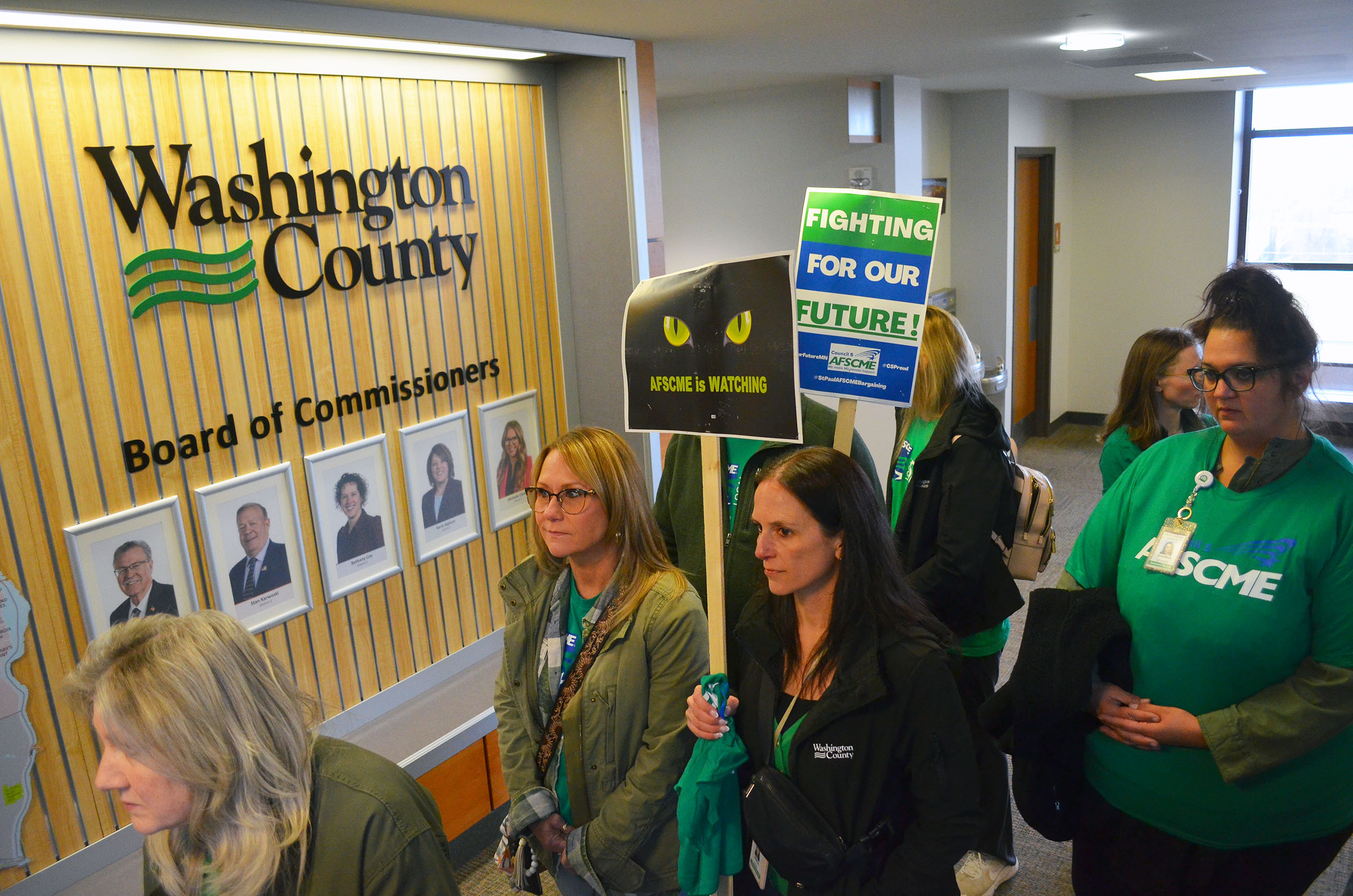
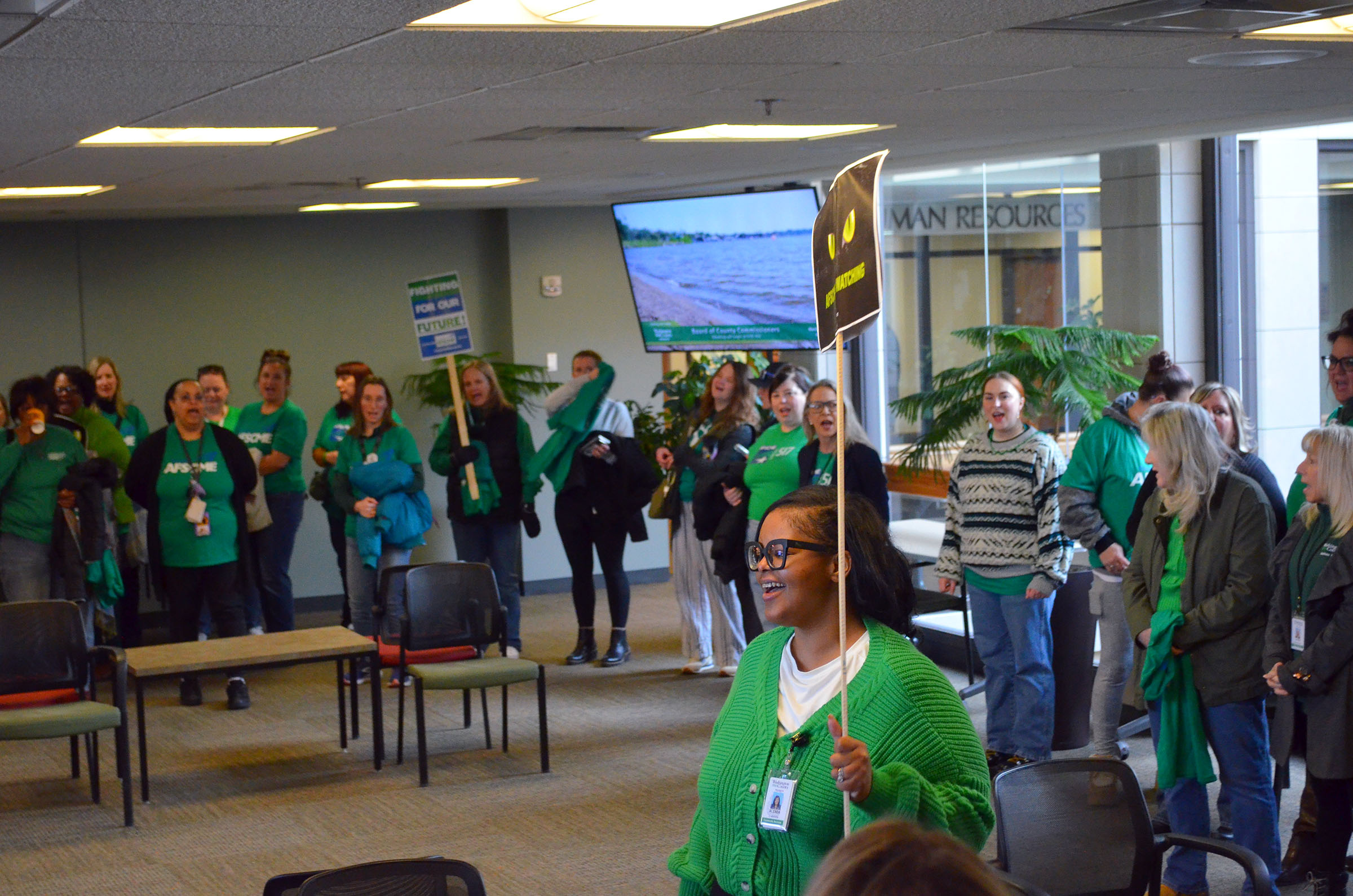
Members of AFSCME Local 517 march together into the Washington County Board meeting March 24.
Members of a bargaining unit representing nearly 900 Washington County employees voted in late February to authorize a strike, demanding a new union contract that addresses understaffing and improves their access to mental-health benefits.
Local 517 of the American Federation of State, County and Municipal Employees (AFSCME) delivered a petition with over 1,800 signatures to the Board of Commissioners this morning.
The bargaining unit brings together a range of county employees, from social workers and child support officers to workers who handle property records and maintain county facilities.
Local 517’s previous contract expired Dec. 31, although its terms remain in effect as talks continue. The two sides are scheduled to resume talks with a state mediator April 17.
Workers don’t want to strike, Local 517 President Benjamin Henry, an eligibility specialist with the county, said. But they do want the county to take their concerns seriously.
“As long as they’re willing to meet with us and work in good faith to come to an agreement that works for both sides, we have no intention of calling a strike at this particular time,” he said.
But Henry also noted that any work stoppage would cripple the county’s ability to deliver services because, as workers have been pointing out at the bargaining table, their departments are already stretched so thin.
“This county has been grinding people to the bone for countless years,” Henry said. “They run a skeleton crew almost everywhere. Even a loss of 40% of the workforce would be devastating.”
 Burnout on the front line
The union’s top two demands – accessible mental health care and better staffing – are related. Backlogs in some offices, Henry said, stretch months longer than state guidelines recommend, leaving staff members to deal with the stress of increasingly frustrated clients and community members.
“It’s not a sustainable model,” he said.
As their ranks have thinned through attrition, the work many members of the bargaining unit are doing has become more complex. That leads to what Carrie Genereux, a chief steward and Family Services worker for the county, called “secondary trauma.”
“A lot of the folks we’re working with on a daily basis have experienced some trauma, and the people who are helping are also impacted by that,” she said. “It plays a major role in why the focus on mental health is so important right now… Our jobs are hard, and they’ve always been hard, but it’s a different level of hard now.”
After the bargaining unit lost three people to suicide in recent years – with another worker attempting suicide and co-workers calling for a wellness check on a fifth – Local 517 came to the bargaining table with a dozen proposals for removing barriers that union members said they encounter in accessing mental health care.
The biggest barrier is out-of-pocket costs, which have increased by as much as 40% in recent years, and workers say their employer-sponsored insurance plans rate among the least affordable for county employees in the region.
“The high-deductible plan is what most of our folks can afford,” Henry said. “And for an individual, you’re looking at $3,500 as a deductible before $1 is covered on anything… people are finding it difficult to spend $200 to $250 once or twice a week to meet with a therapist.”
 ‘It didn’t feel like a negotiation’
In the first mediation session Feb. 2, county administrators leveled up their wage proposal, matching cost-of-living increases extended to two other bargaining units. But the employer brushed aside Local 517’s proposals around staffing and mental health, demanding the union bring their proposal to membership for a vote.
“It didn’t feel like a negotiation to me,” Henry said. “It felt like, you’ll take it and you’ll like it.”
Members voted to reject the offer and, Henry said, sent a message to county administrators that “they are failing to acknowledge that these are significant areas of impact for our members, who are standing up for themselves.”
Indeed, Local 517 has seen a surge in interest since the contract campaign began. Genereux said a significant number of workers covered by the bargaining unit have since signed up to join the union.
“If we’re not taken care of, we can’t take care of the community,” she said. “Our members want to make sure we are staffed appropriately and we are able to manage our own lives in a way that allows us to do our jobs and show up and serve this community.
– Michael Moore, Union Advocate editor
 Union Advocate
Leave a comment