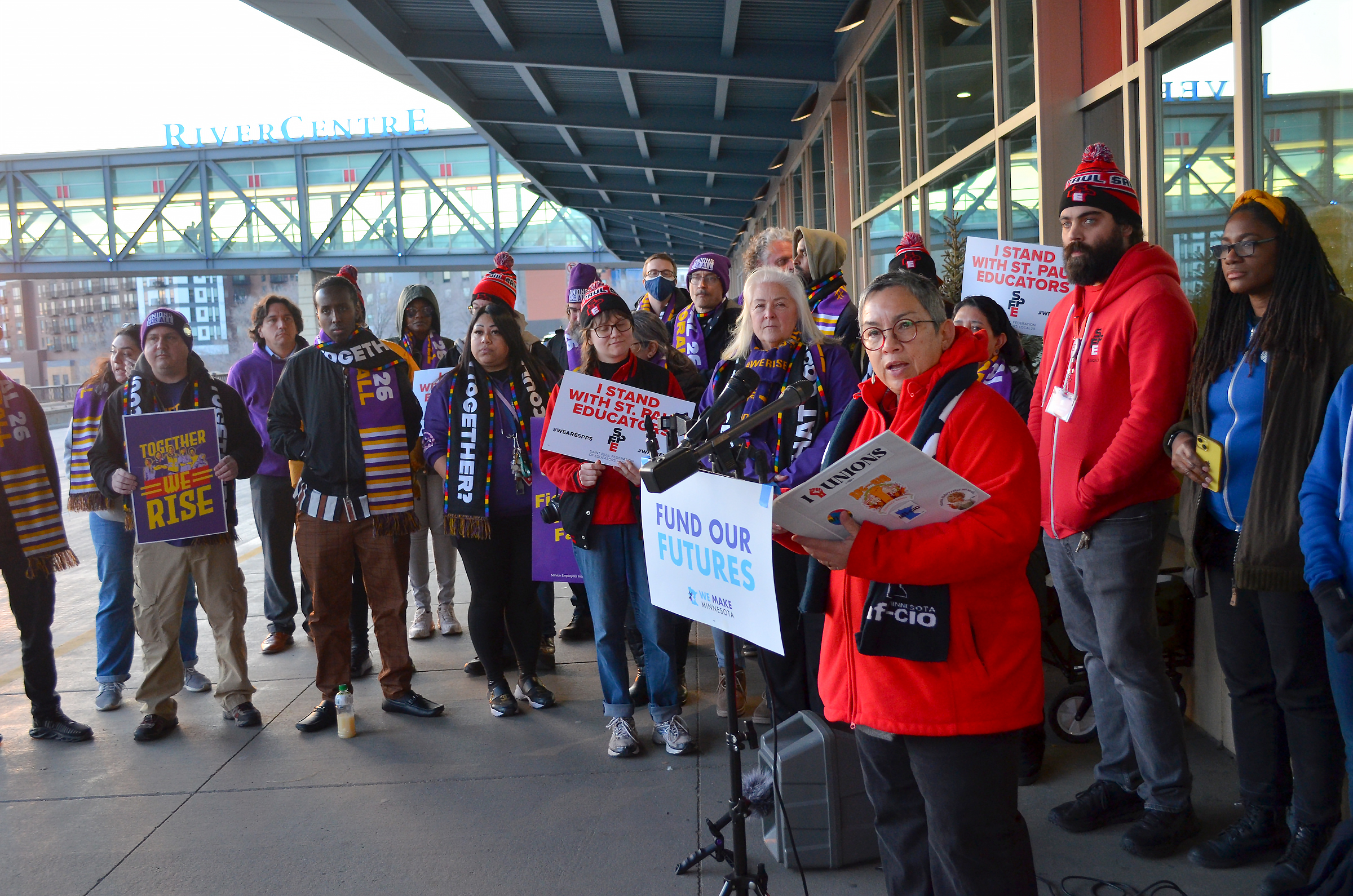
Minnesota AFL-CIO President Bernie Burnham spoke at a rally outside a business lobby event on the opening day of the 2024 legislative session.
Minnesota’s unions will approach the 2024 state legislative session looking to expand on – and defend – the historic package of labor standards and public investments passed by DFL lawmakers last year.
Legislators returned to St. Paul on Feb. 12. Before their deadline to adjourn May 20, they are sure to hear from union members pressing for action on a range of issues, including infrastructure investments, pension adjustments, protections for health care and railroad workers and more.
Of course, union members and their allies won’t be the only voices lawmakers hear from at the Capitol this spring. On Day 1 of the new session, the Minnesota Chamber of Commerce hosted a reception with legislators at River Centre in downtown St. Paul. The event’s theme was “Restore the Balance.”
To union members like Jake Anderson, a special education teacher in the St. Paul Public Schools, that sounded like going backwards – “and we are not going backwards,” he said at a rally outside the event.
“We won a lot of things last time around,” Anderson, a member of the St. Paul Federation of Educators, said. “Our kids get free school lunch. We get unemployment for our paraeducators. But it’s not enough, it’s just the beginning.”
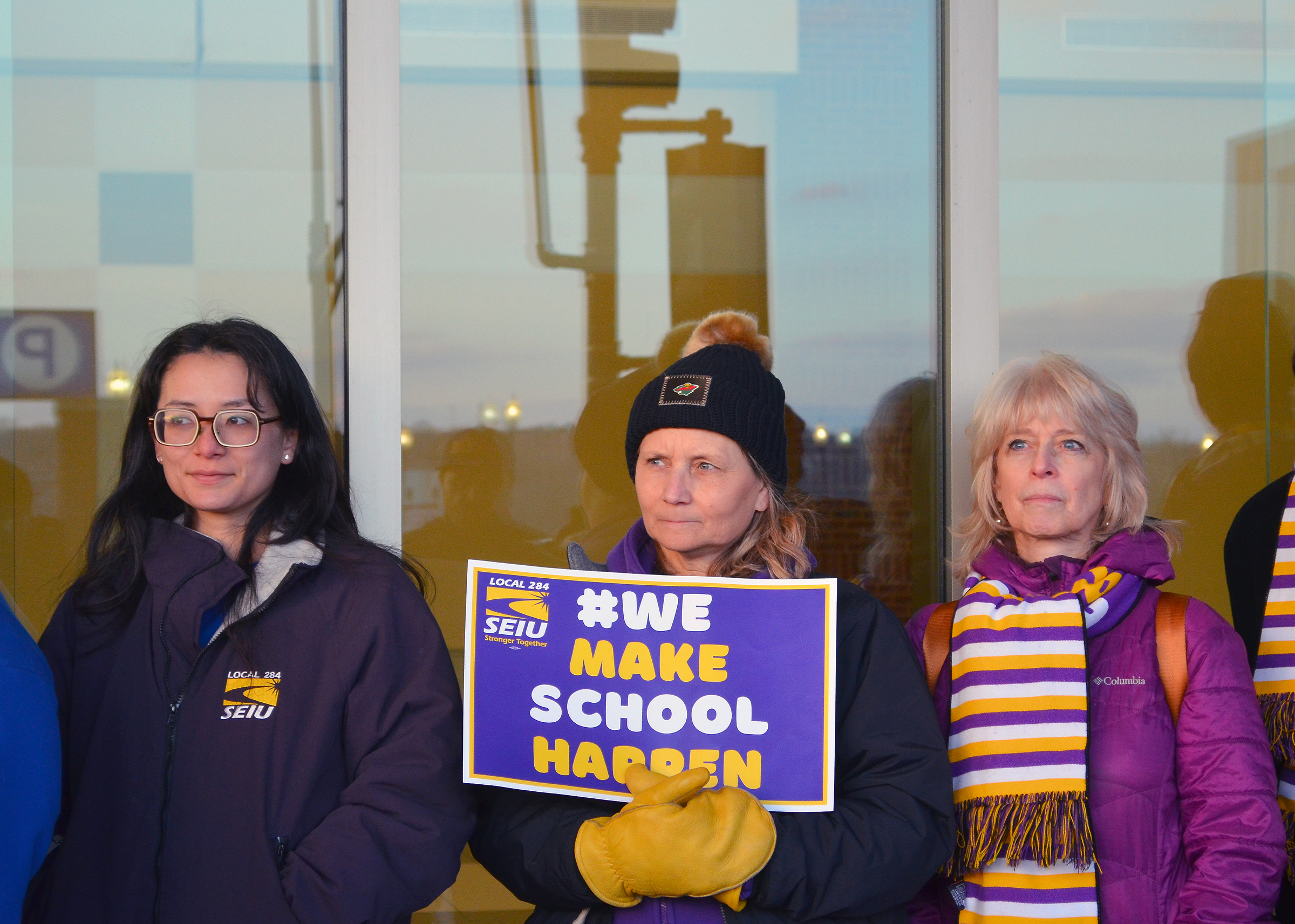
Kelly Gibbons, executive director of Service Employees (SEIU) Local 284, said 18,000 education support professionals accessed unemployment insurance last summer, after legislation passed to make hourly school employees eligible for the benefit. She said union members have told her that “unemployment insurance has changed their lives.”
“They’re going to talk about going back to the system that was rigged against us, the workers,” Gibbons said of the Chamber. “They want it to go back in their favor, and we’re here to say absolutely not.”
 The state’s largest labor federation, the Minnesota AFL-CIO, last month identified its top priorities for the session, and defending the gains made in 2023 is at the top of the list.
Minnesota AFL-CIO President Bernie Burnham said the federation developed its priorities through conversations with affiliate unions and labor leaders.
“First and foremost, we’ve got to protect the things we’ve got,” Burnham said. “We’re going to be working to make sure that paid family and medical leave and union rights – all of that and more – stay in place. What we’ve got can go away in a vote’s notice.”
Burnham said it’s an indication of just how much work lawmakers did on labor issues last year that there are few holdovers from 2023 on the federation’s list of legislative priorities.
Along with paid family leave and unemployment for school employees, union-backed measures to expand earned sick and safe time benefits, ban captive audience meetings, raise safety standards in refineries and give public-sector unions more bargaining rights all became law, not to mention historic one-time investments in public schools and infrastructure jobs.
Still, there are policy measures the state AFL-CIO will work to advance in 2024, including a crackdown on employers who misclassify their workers as independent contractors. Unions have long said the practice is alarmingly common in the nonunion construction industry, but it also applies to the gig economy, advocates say.
Unions want to see legislators put teeth into the state’s existing misclassification laws this session. When workers are misclassified, Burnham said, “they lose out on minimum wage, they lose out on benefits like workers’ comp and overtime pay.”
The federation also plans to lobby for extending unemployment insurance to workers who are on strike. Such a law would level the playing field in collective bargaining, Burnham said, noting that employers can replace striking workers, cut off their health care and stall negotiations.
“There is so much action right now among people who are fighting to do better on the job,” she said. “If they have to go on strike, how are they going to make ends meet?
“If we are going to continue in Minnesota with all the good things we got last year, why wouldn’t we go that next step further?”
– Michael Moore, Union Advocate editor
 Union Advocate