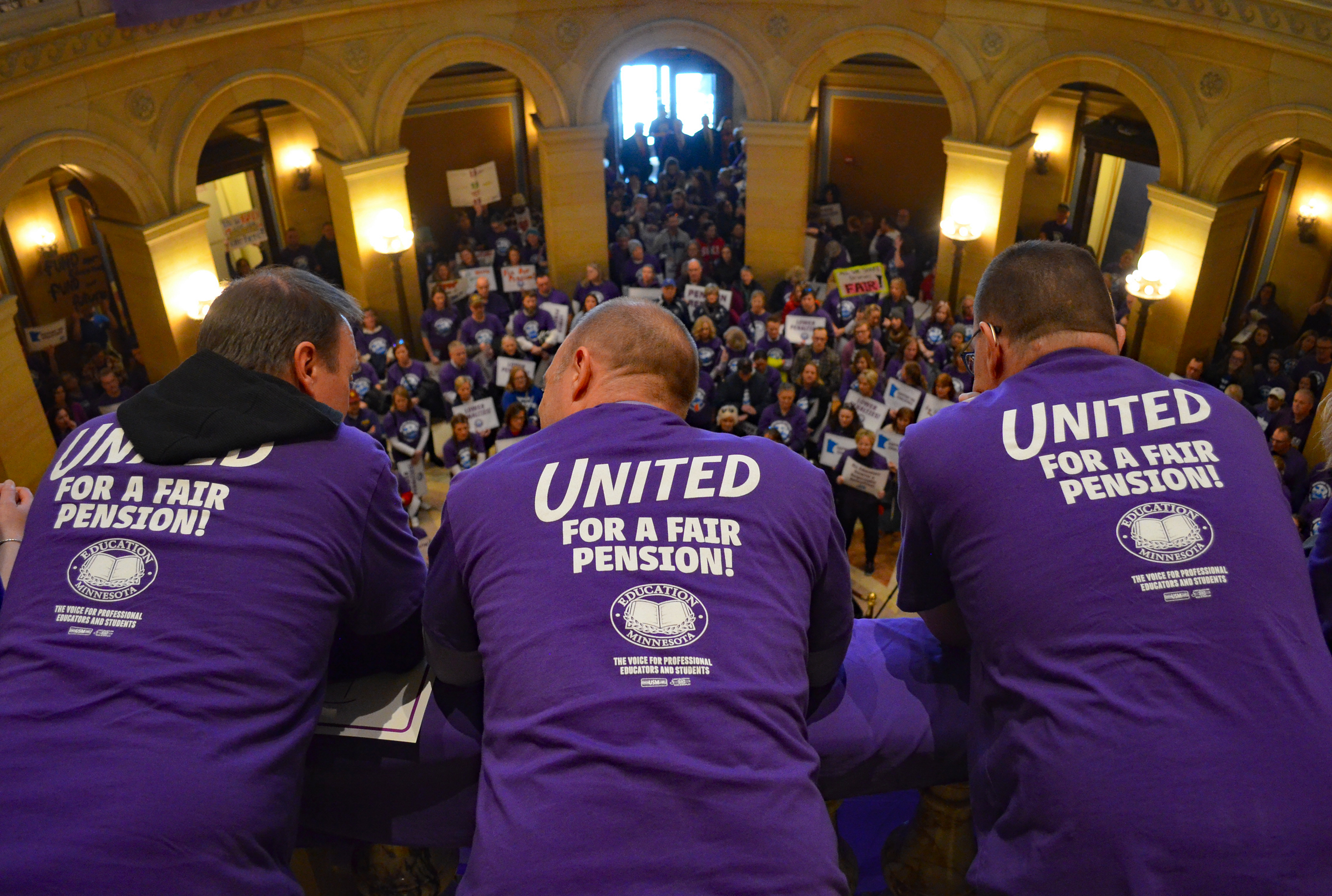
Members of Education Minnesota rallied for pension reform Feb. 29 at the Capitol.
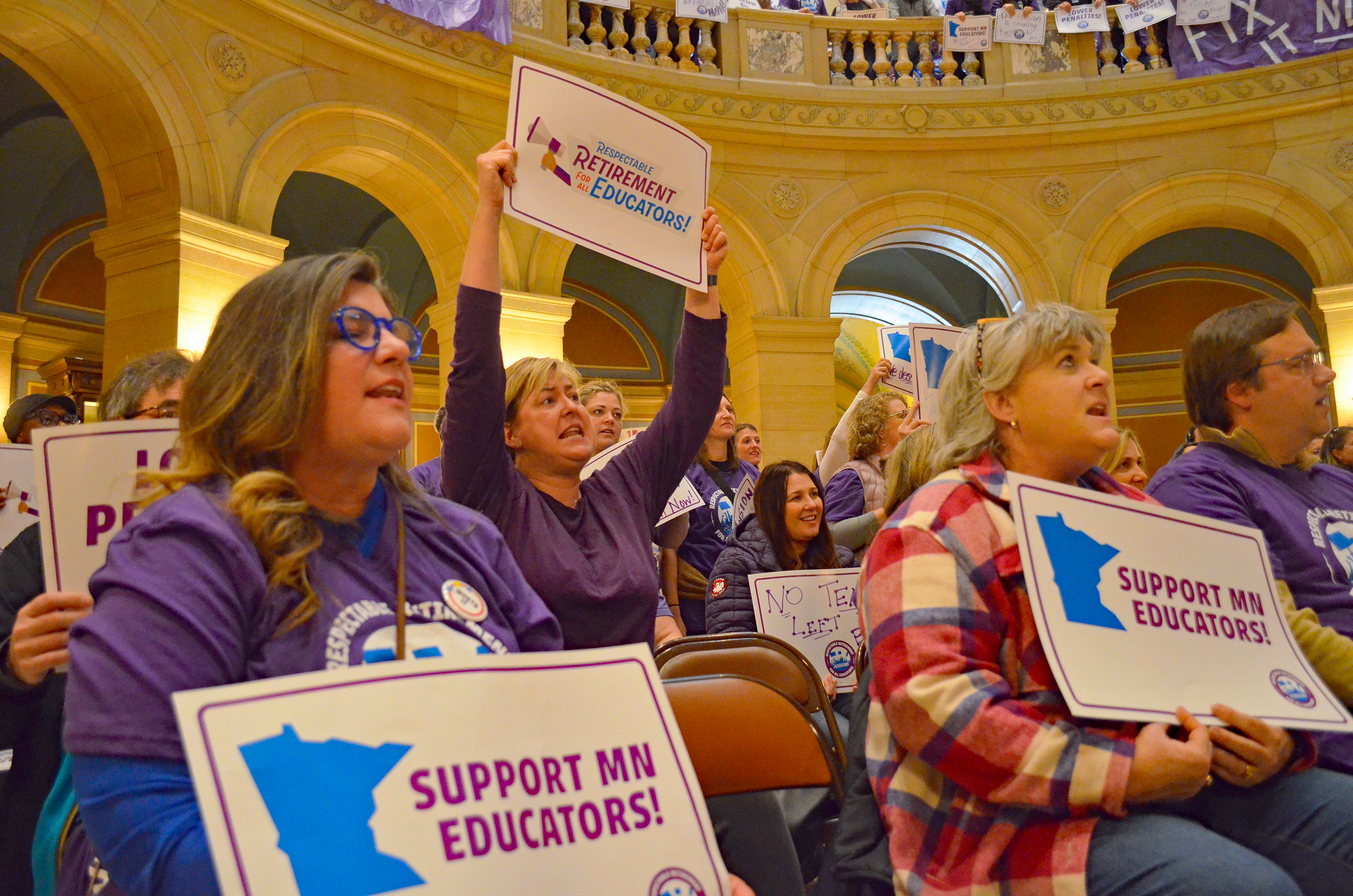
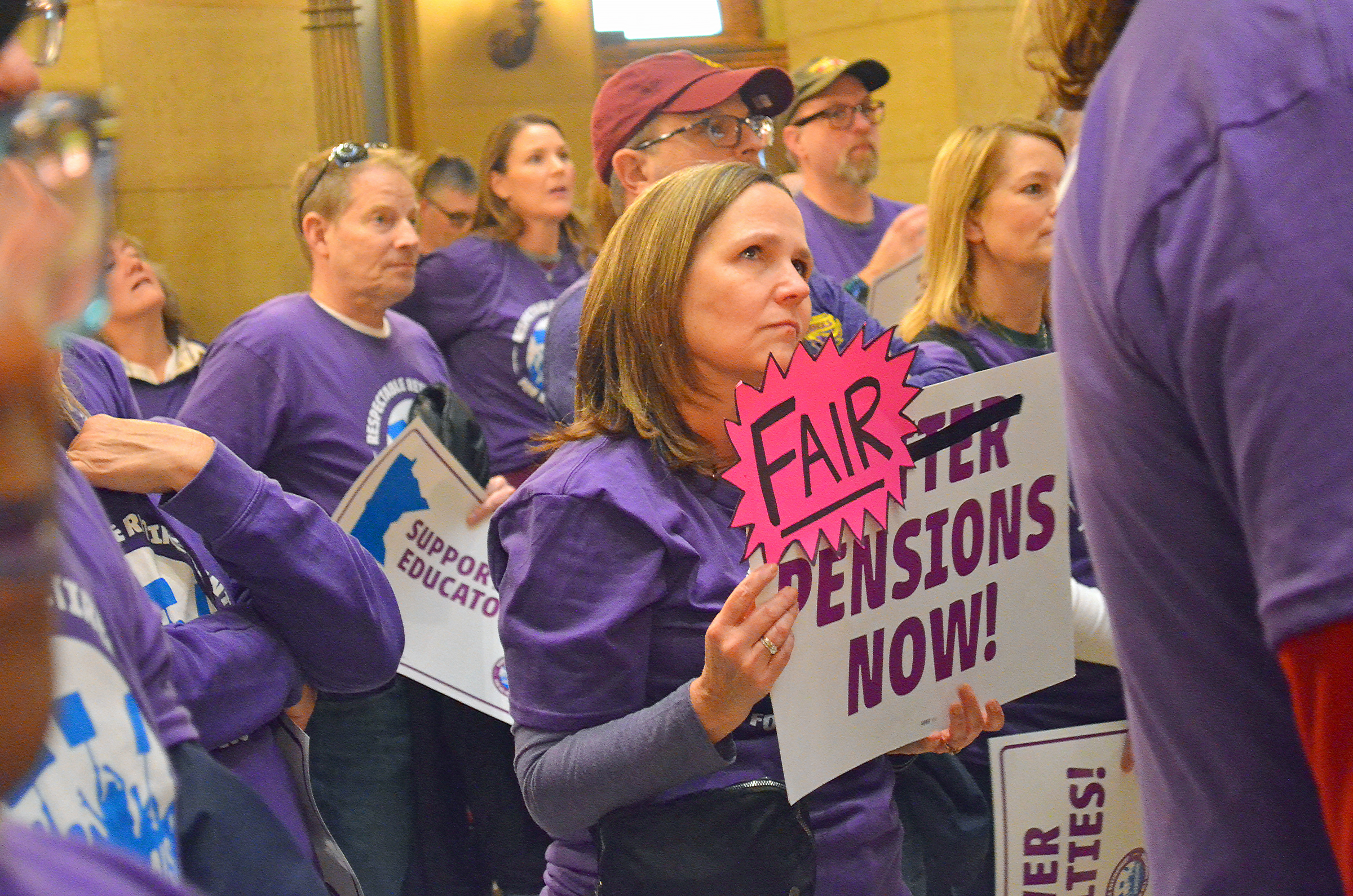
Hundreds of educators from across Minnesota packed the Capitol rotunda yesterday to demand that lawmakers fix inequities in the state-run pension plan covering most public school employees.
Several DFL legislators joined the rally and pledged to advance legislation that would invest some of the state’s projected $3.7 billion surplus into educators’ pension fund and reduce financial penalties some longtime educators face when looking to retire before age 66.
“Penalties are for hockey, not for pensions,” Sen. Heather Gustafson (D-Vadnais Heights) said, shouting out a hand-made sign that one educator brought to the Thursday-afternoon event.
Rep. Kaohly Her (D-St. Paul), chair of the Legislative Committee on Pensions and Retirement, said the newly announced surplus gives the state an opportunity to live up to its responsibility to education workers.
“We have a promise that we made to you that we would take care of you if you sacrificed the best years of your lives to take care of our children,” Her said. “That is why we need to do right by all of you.”
 The statewide educators’ union, Education Minnesota, is making pension reform a legislative priority as disparities that have been baked into the Teachers Retirement Association since 1989 are coming to a head.
That’s when state lawmakers scrapped the “Rule of 90” – a formula that allowed pension participants to retire early with full benefits based on their combined age and years of service – for school employees hired after June 30, 1989, creating a two-tier system.
Now, thousands of “Tier II” teachers with 30-plus years of experience are facing a difficult choice that their colleagues hired before the cutoff never faced. They can work until age 65 and retire with a full pension, or retire early and lose a significant amount of their benefit to penalties.
Educators at the rally said the new system is bad for teachers, students and school districts.
“We have trapped teachers into staying beyond their own expectations of themselves,” Eastview High School social studies teacher Joe Wollersheim said. “Because it is so financially irresponsible to leave before a certain age, teachers are staying when they know they are not as effective as they want to be. And district budgets are squeezed, as they continue paying those at the top of the pay scale.”
Minnesota’s pension tiers not only create inequities within the state’s education workforce, but they also put Minnesota educators behind their colleagues in neighboring states. In Iowa, Michigan, Wisconsin, North Dakota and South Dakota, the combined average age at which an educator can retire without pension reductions is 57.
 Gustafson, herself a “Tier II” participant in the teachers’ pension plan, introduced a bill this session that would reduce penalties for early retirement. She said making the pension benefit more attractive would help schools attract and retain teachers at a time when most districts are short staffed.
“I know just how much we sacrifice financially to do the job,” she said. “We put our hearts, our souls, our tears and very often our own money into this job, and for most of us the one thing we have to rely on is that when we’re done, we’ll have a pension.”
Whether Minnesota educators can continue to rely on that promise – “a promise that we earned, that we paid for with every paycheck,” Education Minnesota President Denise Specht said – is up to lawmakers.
“We are not asking for a favor,” Specht said. “We are asking for fairness.”
– Michael Moore, Union Advocate editor
 Union Advocate