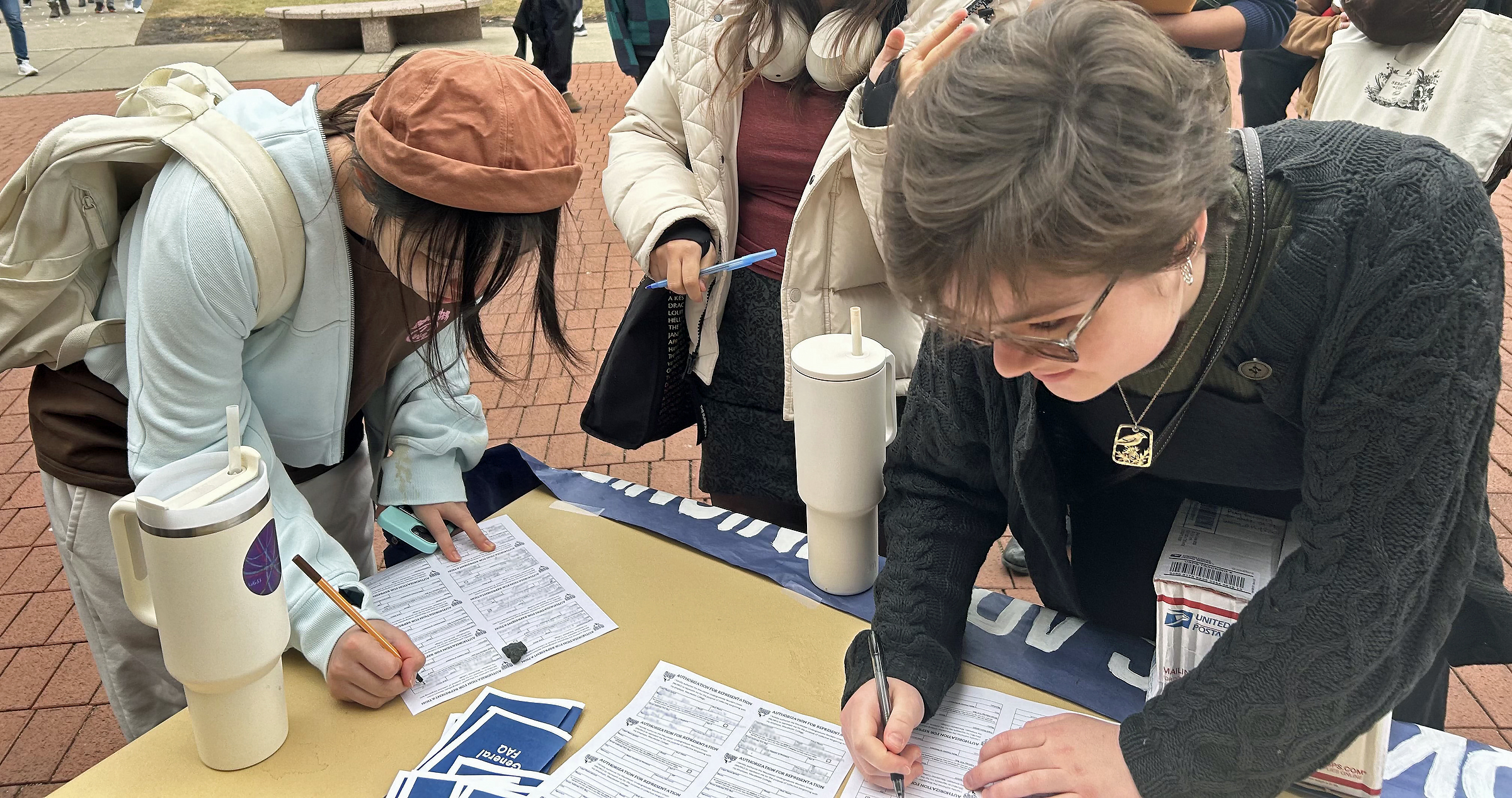
Macalester student workers signed a petition to join MUWU – the Macalester Undergraduate Workers’ Union – after organizers went public with the campaign in February. (photo submitted by MUWU)
After 14 months of internal organizing, student workers at Macalester College went public in February with their campaign to form a union on the St. Paul campus.
“There are pretty big problems with student employment that are not going to be addressed unless we have the legally protected means to do so that you only really get with a union,” sophomore Henna Schecter, a member of the organizing committee, said.
Student workers hope to bargain for better pay and assurances that they will get enough hours to maximize their financial-aid packages. They also said unionizing would create protected, respectful lines of communication with their supervisors – who may double as their teachers – on work-related concerns.
“We’re treated more as students than we are as workers,” Roxy, a sophomore who works in the campus center, said. “We’re expected to do the work that any employee would be expected to do, but we’re not given the same sort of respect that an employee of the school should be given.”
Roughly half of Macalester’s 2,000 students have work-study jobs on campus. Organizers are moving quickly to collect enough union cards to demonstrate majority support before the spring semester ends – and hundreds of potential members of the bargaining unit graduate.
 In the interest of timing, the Macalester Undergraduate Workers’ Union – or “MUWU,” an acronym that, yes, served as inspiration for the union’s cattle-themed logo – sought a neutrality agreement from the school, and asked for voluntary recognition if they collect enough union cards to demonstrate a majority.
While Macalester pledged to maintain a neutral public stance toward the organizing drive, a spokesperson said the school would force an election before recognizing the union.
For organizers, the decision was disappointing.
“Macalester has always been very prominent when it comes to activism, and they’ve always been very good about having people feel comfortable in making their voices heard,” Schecter said. “We would love to see that continue in recognizing us as a union.”
A frenzied start
Despite the setback, Schecter and other supporters described a growing enthusiasm for the union on campus. Hundreds of student workers signed onto the campaign in the days following the public announcement, as organizers posted signs, chalked sidewalks and collected signatures in public spaces.
“I feel like people are being heard, and it always feels good to be heard,” junior Bontu Takele, a sports medicine and research assistant, said. “It’s been exhilarating.”
It’s also been a long time in the works.
Student workers at Macalester began organizing in the fall of 2022. Roxy, Schecter and a few other students were planning actions in solidarity with Macalester dining workers who were forming a union at the time, when someone floated the idea of a union of their own.
The group quietly expanded its outreach to student workers in different departments, seeking to identify common issues that collective bargaining might address.
Several student workers cited disparities in the expectations of different work-study jobs that pay the same wage. Students working in the dining hall or assisting the training staff during an early-morning football practice are paid the same amount – minimum wage – as workers in cushier jobs, like staffing an information desk in the library.
“People are working long shifts in hot conditions and making the same amount as people who are working like three hours a week in an office, doing their homework,” Schecter said.
Organizers also heard from workers that lack of respect could be an issue in some positions.
“It feels like straight-up verbal abuse at times, and we don’t really have an outlet to talk about it except for with each other because of fear of being heard and potentially getting fired,” Takele said. “Having a level of respect between employer and employee is what I would like, not a power imbalance.”

MUWU decided to go public its union drive after organizing meetings began drawing nearly 50 student workers. (photo submitted by MUWU)
Within months of forming an organizing committee, its meetings had grown from six workers to 20. When nearly 50 student workers tried to cram into a meeting space earlier this semester, organizers decided it was time to go public.
“Summer is going to be a huge momentum waster, so we decided it was best to keep the momentum going now,” Schechter said. “It feels like we are very much at the start of something. We don’t know where it’s going to go, and we have no real context for what’s going to happen. But it is really exciting.”
Seizing the moment
Undergraduate student worker unions are a relatively recent phenomenon, as the National Labor Relations Board waffled for years on the question of whether or not student workers were primarily students and, as a result, ineligible for collective bargaining.
In 2016 the board issued a ruling that affirmed student workers’ right to unionize, and it survived a challenge by Duke University last year. Thousands of student workers – mostly graduate, but some undergraduate students, too – have unionized since the 2016 ruling, with a big spike in organizing during the pandemic.
Worker-organizers at Macalester hope to join their ranks soon.
“This is the culmination of a long, long period of work,” Roxy said. “It’s really cool to see the solidarity and see people coming together, and I really think this can spark more organizing among undergrads.”
 Union Advocate