Bargaining moves slowly for Macalester’s newly organized unions

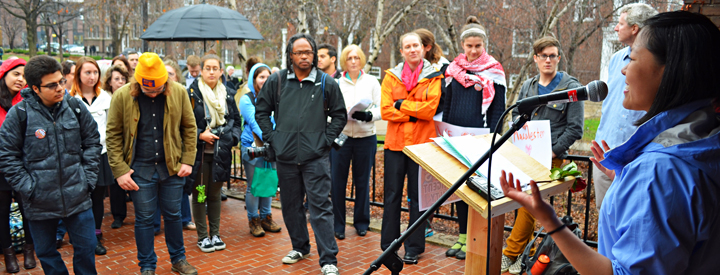
Macalaster student workers held a union rally on campus in May 2025.

First, it was the undergraduates at Macalester who unionized with the United Auto Workers (UAW). Then the non-faculty staff followed suit, unionizing with the Minnesota Association of Professional Employees (MAPE).

So why is Macalester dragging their feet on hammering out the needed contracts?

Undergraduate cafeteria workers get fed up

“It started with a group of cafeteria workers,” student Luca Schira explained. “That was the place with the most issues for student employees. It was unsafe, and students weren’t trained on most things. And then the demand (for unionization) quickly spread to all the student workers.”

After connecting with students from as far as Oregon and as close as the U of M graduate students, the Macalester students decided to unionize with the United Auto Workers (UAW). They formed Macalester Undergraduate Workers Union (MUWU), the first union of undergraduate workers in Minnesota.

“UAW had the reputation for being a progressive, fighting union, and they had a high-profile strike at the time,” student Xavier Honer said. “Also, we looked at Grinnell as a model: A small liberal arts college that also started as cafeteria workers and branched out.”

The hard part

The successful vote to unionize the student workers took place Feb. 25 and 26. After the initial relief and celebration came the hard part: Negotiating a contract.

Said Honer: “It started slowly, and the ICE invasion forced us to cancel one or two of our meetings. The bargaining sessions were scheduled for every other week. Beyond scheduling, there is a lot of resistance. We joke that their favorite phrase is ‘the employer is not interested in hearing this proposal,’ and they would only put into writing that they would follow the current law, basically doing the bare minimum already required of them.”

In the meantime, MAPE at Mac was born, representing non-faculty, non-supervisory staff. They also began negotiating with the college administration over benefit and wage disputes.

How a storied liberal arts college responds

The ball was in Macalester’s court. This is Macalester, the storied liberal arts college, whose mission reads: “Macalester is committed to being a preeminent liberal arts college with an educational program known for its high standards for scholarship and its special emphasis on internationalism, multiculturalism, and service to society.”

Macalester’s response? They hired Felhaber Larson, which has a reputation for advising corporate clients on how to fight unionization. They have provided counsel with companies like Starbucks, for example, and are often viewed as legal defenders of anti-union policies.

Next steps

Now that summer is over, there is a break in the action as school gets rolling into the fall semester. The negotiations are expected to begin again in earnest. What will happen next?

“We need people in the community aware of what’s going on and how slow Macalester is making the bargaining process,” Honer said. “Joining our mailing list to keep up with our events and bargaining updates is the best place to start.

“We always appreciate anybody showing up to our events whether they’re students, alumni, or just community members wanting to support us.”

Show your solidarity

Find links to support student workers and their union at region4.uaw.org/local5105.

– Joel Haskard, Special to The Union Advocate

For Macalester staff, union drive gained urgency after Nov. 5

Macalester staff members celebrate their successful organizing drive. (MAPE photo)

Macalester College staff members voted to unionize this summer in an organizing drive that gained urgency after the 2024 presidential election.

The bargaining unit brings together over 200 non-faculty, non-supervisory employees – both full- and part-time – at the liberal-arts college in St. Paul. They voted to join the Minnesota Association of Professional Employees (MAPE) by a 99-84 margin.

Talk among co-workers about forming a union shifted to serious organizing last November, organizers said, after President Donald Trump’s victory.

Trump’s campaign rhetoric was hostile toward higher education, and since taking office his administration has sought to bully colleges and universities with executive orders, legal threats and funding clawbacks.

For many non-faculty workers at Macalester, their jobs suddenly felt a lot less secure on Nov. 6.

“We sort of figured we had to act now or never,” Jeremy Meckler, a self-described “staffulty” member in the school’s Media and Cultural Studies department, said.

“Faculty typically have some type of contract protection, whether a yearly contract for contingent faculty or tenure,” Meckler added. “But if financial cuts come to an institution of higher education, often the easiest people to pick off are the staff who are at-will employees.”

With support from MAPE, Macalester workers began circulating union cards in December. By May, they had enough support to request voluntary recognition from the school, but administrators declined, prompting workers to petition the National Labor Relations Board for an election.

Workers voted June 10, and the NLRB counted ballots June 23 at the agency’s offices in Minneapolis.

Meckler, a Macalester alum who lives in Minneapolis, was among several union supporters on hand to observe the count. He said their emotions ran the gamut, from “shock and disbelief and excitement” to “relief that we’d really done it.”

“Mostly, I’m just really excited that we won – that a majority of staff, even despite this election happening in the summer when a lot of people weren’t around, showed up to say that they wanted to be in a union and that we’re stronger and safer together,” he added. “It makes me feel good about the place I work.

“As an alum, I think the values of the institution really are in line with the union. It’s a progressive college that teaches the collective value of working together to make the world a better place, and I think that’s what we’re trying to do with our union.”

The new bargaining unit will survey membership and begin planning for first-contract negotiations when the school year begins in the fall.

Macalester’s student workers – over 1,100 strong – voted to unionize earlier this year after a two-year campaign.

Predominantly a public-sector union, MAPE represents over 1,000 staff in the Minnesota State Colleges and Universities system.

This article appeared in The Union Advocate’s August 2025 issue.

– Michael Moore, Union Advocate editor

Mac’s new union weighs labor charge after college changes work rules

Members of MUWU marched on their boss, who was in a meeting inside the campus center, to deliver a petition May 2

Newly unionized student workers at Macalester College in St. Paul marched on their boss May 2 after the school abruptly changed terms of employment covering many in the bargaining unit of 1,100.

The Macalester Undergraduate Workers Union (MUWU) alleges that its members showed up to work at the Leonard Center – an athletics and wellness facility and the campus’ largest student employer – in April and were told their hours had been cut.

The announcement came with no warning, and the administration did not consult with the student workers’ newly recognized union.

“They showed up to their shifts and found out that they were canceled,” MUWU spokesperson Xavier Honer said.

Macalester student workers voted overwhelmingly to unionize in February, but MUWU has yet to negotiate a contract with the college. Federal labor law requires employers to maintain the “status quo” of a newly organized bargaining unit’s terms and conditions of employment as the two sides work toward a first contract.

Macalester violated labor law by canceling shifts at the Leonard Center, MUWU alleges, and by announcing that the college would no longer allow students whose financial-aid packages do not include work-study employment to apply for work-study-eligible jobs, as they have in the past.

“A lot of people that had jobs are going to lose jobs next semester under this new policy,” Honer said. “It’s illegal because it’s a change, but also because it would shrink our bargaining unit.”

Student workers at Macalester allege that their shifts have been shortened and work rules altered since they voted to form a union in February. A spokesperson said the union is prepared to file charges with the National Labor Relations Board.

At the rally May 2, student workers attempted to deliver a petition demanding the college bargain with MUWU over those changes – and demanding the drop efforts to exclude some student workers from the bargaining unit – to Macalester Vice President of Administration and Finance Patricia Langer.

Over 50 student workers marched into the campus center and climbed the stairs to the second floor, where Langer was in a meeting. She initially refused to accept their petition, and student workers began chanting and reading the petition aloud.

Outside the campus center, dozens of alumni and supporters from the labor community gathered to show their solidarity with MUWU.

“I’m not willing to say that (the administration’s change to employment terms) was retaliatory, but I think that regardless of how they meant it, this was a test,” Honer said. “And we came out strong and showed them that we’re not going to sit around while they break the law.”

The fledgling union is asking alumni and community supporters to sign up for updates on how they can show solidarity with MUWU’s contract campaign.

Find a link to sign up at muwu.org.

– Michael Moore, UA editor

Union election in February for Macalester student workers

Macalester College student workers will vote in a union election on campus Feb. 25-26.

The vote will be open to an estimated 1,300 students in a wide range of work-study jobs, from library and cafeteria staff to athletic and research assistants.

The union, Macalester Undergraduate Workers United (MUWU), petitioned the National Labor Relations Board (NLRB) for an election Nov. 25, after collecting signed authorization cards from over half of the potential bargaining unit, MUWU spokesperson Xavier Honer said.

The organizing drive launched publicly last spring.

“When we came back this fall, we started with a meeting out on the lawn for Labor Day, and a lot of new freshmen like me got to see the union organizing for the first time,” Honer said. “So that was a catalyst for a lot of new activity, new energy.”

But school administrators have held the union campaign at arms’ length from the start, refusing student workers’ requests for a neutrality agreement and voluntary recognition, which would bypass the NLRB election process.

More recently, Macalester refused a meeting with MUWU organizers to negotiate an election agreement before a hearing at the NLRB earlier this month. And the school is pushing to exclude student workers paid by stipend from the bargaining unit.

Those workers will be eligible to vote in the union election, but their votes could be challenged in an effort to sway the outcome. The NLRB will decide their eligibility, if necessary, after the election.

Student workers have said they hope forming a union will give them a seat at the table to bargain for better pay and assurances that they will get enough hours to maximize their financial-aid packages.

“I am heavily reliant on financial aid, on work-study,” Honer, an assistant in the Administration and Finance Division, said. “I want to make sure that my colleagues and I can secure our work-study and have good, safe, well-paying jobs that give us experience and education.”

Others have voiced concerns about job-related expectations that go unpaid, like travel time, as well as the need for grievance procedures and other protected lines of communication with supervisors.

“We have a lot of diverse interests, but I think we’re all united as workers here working for one employer, just trying to get through college,” Honer added. “That’s tough enough; we shouldn’t have to worry about fighting for our rights in the workplace as well.”

Student-worker unions have spread to campuses across the U.S. since a 2016 NLRB ruling that affirmed students’ right to unionize. The opinion survived a challenge by Duke University in 2022.

Thousands of student workers – mostly graduate, but some undergraduate students, too – have unionized since 2016, with a big spike in organizing during the pandemic.

Macalester student workers launch public union drive: ‘It’s been exhilarating’

Macalester student workers signed a petition to join MUWU – the Macalester Undergraduate Workers’ Union – after organizers went public with the campaign in February. (photo submitted by MUWU)

After 14 months of internal organizing, student workers at Macalester College went public in February with their campaign to form a union on the St. Paul campus.

“There are pretty big problems with student employment that are not going to be addressed unless we have the legally protected means to do so that you only really get with a union,” sophomore Henna Schecter, a member of the organizing committee, said.

Student workers hope to bargain for better pay and assurances that they will get enough hours to maximize their financial-aid packages. They also said unionizing would create protected, respectful lines of communication with their supervisors – who may double as their teachers – on work-related concerns.

“We’re treated more as students than we are as workers,” Roxy, a sophomore who works in the campus center, said. “We’re expected to do the work that any employee would be expected to do, but we’re not given the same sort of respect that an employee of the school should be given.”

Roughly half of Macalester’s 2,000 students have work-study jobs on campus. Organizers are moving quickly to collect enough union cards to demonstrate majority support before the spring semester ends – and hundreds of potential members of the bargaining unit graduate.

In the interest of timing, the Macalester Undergraduate Workers’ Union – or “MUWU,” an acronym that, yes, served as inspiration for the union’s cattle-themed logo – sought a neutrality agreement from the school, and asked for voluntary recognition if they collect enough union cards to demonstrate a majority.

While Macalester pledged to maintain a neutral public stance toward the organizing drive, a spokesperson said the school would force an election before recognizing the union.

For organizers, the decision was disappointing.

“Macalester has always been very prominent when it comes to activism, and they’ve always been very good about having people feel comfortable in making their voices heard,” Schecter said. “We would love to see that continue in recognizing us as a union.”

A frenzied start

Despite the setback, Schecter and other supporters described a growing enthusiasm for the union on campus. Hundreds of student workers signed onto the campaign in the days following the public announcement, as organizers posted signs, chalked sidewalks and collected signatures in public spaces.

“I feel like people are being heard, and it always feels good to be heard,” junior Bontu Takele, a sports medicine and research assistant, said. “It’s been exhilarating.”

It’s also been a long time in the works.

Student workers at Macalester began organizing in the fall of 2022. Roxy, Schecter and a few other students were planning actions in solidarity with Macalester dining workers who were forming a union at the time, when someone floated the idea of a union of their own.

The group quietly expanded its outreach to student workers in different departments, seeking to identify common issues that collective bargaining might address.

Several student workers cited disparities in the expectations of different work-study jobs that pay the same wage. Students working in the dining hall or assisting the training staff during an early-morning football practice are paid the same amount – minimum wage – as workers in cushier jobs, like staffing an information desk in the library.

“People are working long shifts in hot conditions and making the same amount as people who are working like three hours a week in an office, doing their homework,” Schecter said.

Organizers also heard from workers that lack of respect could be an issue in some positions.

“It feels like straight-up verbal abuse at times, and we don’t really have an outlet to talk about it except for with each other because of fear of being heard and potentially getting fired,” Takele said. “Having a level of respect between employer and employee is what I would like, not a power imbalance.”

MUWU decided to go public its union drive after organizing meetings began drawing nearly 50 student workers. (photo submitted by MUWU)

Within months of forming an organizing committee, its meetings had grown from six workers to 20. When nearly 50 student workers tried to cram into a meeting space earlier this semester, organizers decided it was time to go public.

“Summer is going to be a huge momentum waster, so we decided it was best to keep the momentum going now,” Schechter said. “It feels like we are very much at the start of something. We don’t know where it’s going to go, and we have no real context for what’s going to happen. But it is really exciting.”

Seizing the moment

Undergraduate student worker unions are a relatively recent phenomenon, as the National Labor Relations Board waffled for years on the question of whether or not student workers were primarily students and, as a result, ineligible for collective bargaining.

In 2016 the board issued a ruling that affirmed student workers’ right to unionize, and it survived a challenge by Duke University last year. Thousands of student workers – mostly graduate, but some undergraduate students, too – have unionized since the 2016 ruling, with a big spike in organizing during the pandemic.

Worker-organizers at Macalester hope to join their ranks soon.

“This is the culmination of a long, long period of work,” Roxy said. “It’s really cool to see the solidarity and see people coming together, and I really think this can spark more organizing among undergrads.”

Dave Zirin: The ‘megaphone of sports’ is more global, powerful than ever

As the NFL staged its Opening Night Party in St. Paul Monday, protesters shut down streets downtown, calling on Super Bowl sponsors to support local schools and racial equity.

Donald Trump has made politics part of nearly every reporter’s beat. The president’s policy proposals and inflammatory public comments spark reaction and resistance that spill beyond the Beltway, outside the traditional spaces reserved for political debate.

Nowhere, perhaps, has the spillover been more apparent – or uncomfortable – than in the world of sports.

When Colin Kaepernick chose not to stand during the national anthem at a preseason game in 2016, the “take a knee” movement against police brutality in communities of color caught fire. TV networks squirmed over the impact on their ratings, shock jocks lit up sports radio with hot takes, and sports reporters started asking questions that went beyond X’s and O’s.

Dave Zirin has been asking those questions for a long time. A former student at Macalester College, he is the author of “A People’s History of Sports” and other books on how sports and progressive movements intersect. Zirin is at work on a book with Seattle Seahawks defensive end Michael Bennett, and he writes and podcasts regularly at edgeofsports.com. He offered up his thoughts on what Minnesotans can expect during – and after – Super Bowl week in this interview, which has been edited (albeit lightly) for length (he had lots of good things to say).

UA: Teachers, low-wage workers and progressive groups here are using the Super Bowl spotlight to lift up their own campaigns, and some of their messages are obviously inspired by the way pro athletes have used their platform lately. This isn’t a new phenomenon in sports, but to what degree are we witnessing something historic?

Dave Zirin (photo credit: Jen Maler)

DZ: We’re certainly looking at a massive uptick in what is a historical continuum. Sports has always been this very powerful place. We’re taught that sports is this level playing field, this epitome of America, where anybody who’s good can make it. Yet the reality of sports is it’s a very unlevel playing field. It’s also one of the few places that if you come from a working-class or poor background, you have this immense cultural capital to tell your story – and to speak about what’s happening in the world.

I would argue that events like the Super Bowl become more and more these kind of global political events, almost like an economic Trojan horse in these communities. The spotlight is so bright. We’ve never been at a point where the megaphone of sports is more global and more powerful.

UA: What would you say to local activists looking to divert that spotlight into the streets?

DZ: I would say that they are doing the right kind of work. They are part of a tradition that’s really fired up recently in Olympic host cities, World Cup host countries and Super Bowl host cities, where people use the fact the world is watching this particular space to speak about everyday injustices in that space – and also how those injustices are aggravated by hosting these mega-events. People who are homeless find themselves under attack, sex workers find themselves under attack, union workers who might want to exercise their rights for the next week find themselves under attack. It’s not just about leveraging the spotlight, it’s about mounting a very real defense campaign against what these mega-events bring.

We’re talking about an increased police presence, the privatization of public space. We’re talking about the fact that the city is bending over backward to almost create a Potemkin village for the 1 percent that’s coming in. They seek to create this fake veneer of what the city actually is… And then as soon as those people leave and the media leaves, it all gets torn down. And when it all gets torn down, that’s also when it gets really dangerous for people because there’s this push to try to keep some of what’s been in there, whether you’re talking about stepped up police presence or closed-circuit TV cameras. I’ve been to so many Super Bowl host cities and Olympic or World Cup host cities, and that’s what they always say, that there becomes this mission creep…

UA: Twin Cities corporations spent $52 million to lure the Super Bowl to town, and the NFL won’t pay for much of anything this week as a result. What’s the local cost of this willingness to bend over backwards for the NFL and other pro sports leagues?

DZ: We have to suss through this. The actual cost, tragically, is not something that we’re going to be able to know until weeks, if not months, after the event itself. There should be an economic forensic exam, and the unions should take the lead on that. We can’t expect Democrats to do it for us… When they say they don’t have enough money for schools, for health care – this isn’t a question of having enough money, it’s about priorities.

UA: Are attitudes toward mega-events changing?

DZ: You are seeing changes. Cities are rejecting the Olympics, from Boston to Krakow. Cities have stood up to hosting these games because of the economic costs and political costs. Cities have started demanding concessions from the NFL and from local officials, like offsets so that every dollar that goes to the Super Bowl also goes to our schools, or goes to health care. Until that happens, we’re going to keep having this privatization of public wealth, which is really what the Super Bowl is once all the smoke and glitter clears.

UA: Going back to the player protests, how vital have players’ collective bargaining agreements been to this movement?

DZ: The collective bargaining agreement in the NFL has meant everything to these protests. While I would certainly argue that they have the First Amendment right to protest during the anthem, I really do think a lot of NFL players would have just been fired outright if it wasn’t for the fact that the CBA in the NFL has very specific language about whether players have to stand at attention. To compare and contrast, the NBA, which has much more political foment in it, has different language in their CBA that actually directs players to stand at attention. I think that’s one of the reasons you haven’t seen those kinds of protests in the National Basketball Association. They’re just not protected.

If the NFL had just started firing players left and right, they would have been at dire risk of invalidating the entire collective bargaining agreement. They would have given the union, which is already setting up in the next year for contract negotiations, an unfathomable amount of leverage …

As someone who’s interviewed a lot of these players, something that makes me really angry is that the players who are political also tend to be the players who are most community minded, bighearted and down to earth. There’s something so repellent to me that they’re the ones who are demonized by Trump and by certain members of the NFL ownership community. They’re the ones who really do represent the best – not just among NFL players, but among trade unionists in general.

UA: Trump’s use of the NFL – from tweeting about players who kneel to picking on the league at rallies – is remarkable. Why do you think it strikes such a chord with his supporters?

DZ: Like so much with Trump, while it strikes a chord with his base, it has not expanded his base. The polls I see show as many as three-fourths of people do not agree with how he has dealt with this issue. More people, after Trump got involved, were actually on the side of the players than before because he is so toxic.

But this is rank racism. There’s no other way to say it. These are players who are trying to start a conversation – not about the anthem or patriotism, but about racism and police violence. You think Donald Trump wants to have that conversation? Of course not. So he demonizes and attacks these players for being ‘ungrateful.’ One player said to me that ‘ungrateful’ is like Trump’s n-word, something he reserves for only black athletes. This is a very old script, and it resonates because you tap into envy. As if these ‘ungrateful’ athletes … haven’t worked their entire lives to make their way in the world.

UA: But you see backlash against this script?

DZ: Let’s talk about the No. 1 way we can tell that it didn’t work. When he called players SOB’s and used profanity before a rapturous crowd, where was he? He was in Huntsville, Alabama. What happened in Alabama? Somehow the Republicans lost a Senate race…

UA: Are you the guy no one wants to sit next to at the Super Bowl party?

DZ: No, people like sitting next to me. I always bring out the good food. I clean my house so I give people a nice place to sit. I usually spend the first 30 minutes of the Super Bowl in my own personal protest, live tweeting an episode of the “Facts of Life.” People on Twitter tend to go crazy. I lose a couple hundred followers, but I find it funny. I call it the Tootie Bowl.

UA: Who wins? Who are you rooting for?

DZ: I hate the New England Patriots because they always win and they’re arrogant and they’re obnoxious. But I’m sure you’ve heard people say that when the Patriots win it feels like Trump wins all over again. Slow your roll. They’re not Team Trump. Don’t take it that seriously please.

But I’m rooting for the Eagles, and I’ll pick the Eagles. I’ll never root for the Patriots. Ever.

Erik Brandt: An open letter to Macalester College (and its peers)

Erik Brandt is an English teacher in the St. Paul Public Schools.

I’d like to tell you about my long-time colleague, Amy. Over the last 20 years at Harding High School in St. Paul, I have watched Amy work tirelessly with thousands of our fantastic students – nearly all of whom are low-income, minority, first generation to attend college – to help them navigate the college acceptance and enrollment process, which, as you well know, is not a transparent procedure for any non-English speaking, poor, immigrant family. She has helped raise millions of dollars of scholarship funds to help these students afford higher education. With her connections and persistence, she has forged relationships with schools like yours and has helped get our students to college, where they have thrived. This is the good part of the story.

Undoubtedly, as an attentive neighbor, you have heard about the budget shortfall in the St. Paul Public Schools that has led to reductions all over the district, including at Harding. Guess who got cut at my school? It’s tragic: Amy will not be returning to Harding after 22 years of service. Amy’s equivalents at several other St. Paul high schools have also been cut.

So, why should you care, Macalester? This doesn’t really seem like your problem, but it is – on many levels. You need the brilliant, diverse students who come out of the St. Paul Public Schools. They enrich your campus and enliven the nature of the dialogue that happens in your classrooms. The truth is, however, that these students rarely make it to you without someone like Amy advocating for them within our schools.

Now, I know that the good people of Macalester believe in making the world a better place. That is certainly the image you sell to the public, and, having graduated from Mac myself, I believe there is truth in it. I know that you want to do something to help because it’s in your nature.

Well, guess what? There is something you can do, and it’s very easy – and it’s something that the public probably isn’t even aware of … and probably something you’d like them not to know about.

Regardless, here it is: Pay your property taxes.

Or at least make a PILOT (Payment in Lieu of Taxes), like other colleges or businesses do in dozens of cities around the U.S.

You benefit from all of the resources afforded by property taxes but pay none of them while your school sits on one of the most valuable un-taxed pieces of land in the city. Your staff members live in St. Paul and send their children to our schools, but you provide no financial support for the schools. This is not like you, Macalester. You believe in responsibility and civic duty.

Our students want to attend your college, but without people like Amy, they won’t know how to make it happen. If you and your peers (yeah, I’m talking to you, St. Thomas, Hamline, St. Kate’s) contributed your fair share of property taxes, we wouldn’t be laying off desperately needed staff in our public schools or questioning whether or not we can afford enough firefighters and police officers for our city.

C’mon Mac. Be a good neighbor. It’s the right thing to do.

– Brandt is a National Board Certified English teacher in the St. Paul Public Schools and a member of St. Paul Federation of Teachers Local 28. Twice a finalist for Minnesota’s Teacher of the Year award, Brandt resides in St. Paul.

As strike drags on, nurses question Allina board members’ leadership

Striking nurses assemble outside Piper Jaffray's offices in downtown Minneapolis, seeking a meeting with Allina Health board member Debbra Schoneman.

Striking nurses assemble outside Piper Jaffray’s offices in downtown Minneapolis, seeking a meeting with Allina Health board member Debbra Schoneman.


The 16 members of Allina Health’s board of directors have remained mostly above the fray since a contentious round of negotiations with nearly 5,000 union nurses began in February.

But that changed last week, when Allina nurses at five Twin Cities facilities began an open-ended strike and, at the same time, rolled out a campaign to hold their not-for-profit employer’s governing body accountable.

The Minnesota Nurses Association, which represents striking nurses, is publicly questioning whether Allina’s negotiating team, led by CEO Dr. Penny Wheeler, has provided board members with accurate information, particularly when it comes to the cost of prolonging the work stoppage after the two sides came so close to an agreement in their most recent talks.

“Allina Health will spend $20 million every week the nurses are on strike,” MNA Executive Director Rose Roach said. “How can the stewards of a not-for-profit health care company allow that to happen when we were just $2 million away from a deal at the bargaining table?”

allina-board-numbers_Layout 1

More Wall Street than wellness

It’s a question nurses have tried asking several board members over the last week, seeking them out in commercial high-rises and corporate headquarters – even on one college campus – across the Twin Cities.

It’s a strange and troubling road map for tracking down the people who oversee a non-profit health care provider, and it reveals a governing body whose makeup skews more toward Wall Street than wellness.

John Church chairs Allina’s board; he works a vice president at General Mills. Executives from Buffalo Wild Wings and the for-profit Capella University also hold seats. The financial sector is well represented too, with executives from four investment firms holding seats. There’s a lawyer, a retired partner in global auditing and tax giant KPMG, the founder of a Minneapolis consulting company and the president of Macalester College in St. Paul.

Just four members of the Allina board make their livings in health care. Two are doctors, one works in human resources for a local medical-technology firm and the other is an entrepreneur whose latest start-up helps employers shop for insurance providers.

Elizabeth English, a nurse at Mercy Hospital in Coon Rapids, joined a delegation of about 20 striking nurses who dropped in on board members with offices downtown Minneapolis last Thursday. None of the board members made themselves available, but if they had, English would have asked one simple question: “Why are you on the board of a hospital?”

“The problem is they’re on the board, and they’re just trying to make money,” English said. “They know nothing about caring for patients. It’s very disappointing.”

Support from Mac students, alumni

Nurses and Macalester students assemble outside the offices of college president Brian Rosenberg, who collected $10,000 from the not-for-profit health system to serve on its board of directors in 2014.

Nurses and Macalester students assemble outside the offices of college president Brian Rosenberg, who collected $10,000 from the not-for-profit health system to serve on its board of directors in 2014.

Equally disappointed are some members of the Macalester community with President Brian Rosenberg’s involvement in the nurses’ strike.

Nurses who took part in a delegation to his office last Wednesday were pleasantly surprised to find several students, including sophomores Jackson Dean and Nicolas Koch-Gallup, awaiting their arrival. Dean said he wanted to “show that students support the nurses’ union.”

That Rosenberg’s fingerprints are on the Allina standoff will come as no shock to anyone familiar with his approach to labor relations on campus. Two years ago, with Rosenberg at the helm, the school refused to stay neutral as contingent faculty members attempted to organize a union.

“Last year we organized a protest against Café Mac workers being paid minimum wage,” Koch-Gallup said. “We tried to get Macalester to give them a livable wage, and (Rosenberg) shut that down.”

Rosenberg, meanwhile, was paid $10,000 for his service on Allina’s board in 2014, according to the non-profit’s most recent IRS filings.

[Paying board members is a rare practice in the not-for-profit health care world, according to an article published by Modern Healthcare in June. But Allina paid out $190,959 to 15 board members in 2014 for a job that, on average, requires two hours of work per week.]

Nurses and students plan to continue working together to hold Rosenberg accountable as the strike, now in its second week, continues. Alumni, too, “will want to make their voices heard on this issue,” according to Leewana Thomas, a member of the school’s 2014 graduating class.

“If Brian Rosenberg continues to turn the other cheek on a major crisis happening right under his nose while preaching the merits of global citizenship, I know that the Macalester alumni will make their voices heard,” Thomas said.

Hamline adjunct faculty members vote to join union

In the first union-organizing election among faculty members at a private college in Minnesota, adjunct instructors at Hamline University in St. Paul voted to join Local 284 of the Service Employees International Union.

Eligible faculty members at Hamline cast their ballots by mail earlier this month. A vote tally took place this morning at the Minneapolis office of the National Labor Relations Board, with 72 percent voting in favor of forming the union.

The victory at Hamline is a shot of momentum for the SEIU’s Adjunct Action organizing campaign both nationally and locally. In voting to form a union, Hamline faculty members joined instructors at Northeastern University, Georgetown University and a growing number of institutions across the U.S.

Closer to home, St. Paul is becoming a hotbed of adjunct union activity. In addition to the 83 Hamline instructors who joined SEIU today, about 300 adjunct instructors at St. Thomas University are scheduled to vote by mail in an organizing election next month.

Contingent faculty members at Macalester College petitioned the NLRB for an election in May, but they have since pulled that petition. No election is scheduled, although organizing continues.

Jhon Wlaschin, an adjunct psychology instructor at both Hamline and St. Thomas who has been active in both organizing drives, said the overwhelming victory at Hamline is proof of a strong appetite for collective bargaining among part-time faculty members.

“It’s confirmation that there’s a lot of other people in my situation, that are trying to earn a living teaching and finding it very difficult, finding that being an adjunct is kind of an isolating lifestyle,” Wlaschin said. “We don’t really know each other, we don’t feel like we have any voice, like we don’t have any future.

“Now we can join together, get to know each other, hear each other’s issues, work together to maybe make teaching a viable living and career in higher education. That’s all very exciting and encouraging.”

Economics 101

While Hamline, like most colleges across the country, has steadily increased its reliance on non-tenured teaching staff, adjunct faculty members at the school have not seen a pay raise in 10 years, adjunct English instructor Jennifer Beckham said. The “vast majority” of adjunct instructors, she said, earn $4,000 per course and do not qualify for benefits like health insurance or a retirement plan.

“I’ve asked for a raise,” Beckham, who has taught at Hamline the last nine years, remembered. “I was told that they don’t do raises, that nobody would receive a raise and as long as there was parity with other institutions in the area, there would not be raises.”

Even those instructors who teach courses at multiple institutions report struggling to afford basic necessities like rent and health insurance, Beckham added. Many instructors are paying off loans they took out in order to gain the degrees necessary to teach at a post-secondary institution.

“I have multiple advanced degrees,” Beckham said. “Most adjuncts have a Ph.D. I think most people, by the time they have the qualifications to do the work we do, are at a stage where you need to be having some kind of stability.

“Many adjuncts delay starting families because the work we do does not sustain our families. Many people won’t be able to retire.”

A new model

Of course, it doesn’t have to be that way. Wlaschin knows that from experience.

Before becoming a psychology professor, Wlaschin said, he worked in the film industry in New York. Jobs were temporary, and he bounced from employer to employer as work on one film ended and another began. But because Wlaschin was a member of the Stagehands union, his employers paid into a health and welfare fund maintained by the union.

“It would be great to have a citywide contract, like what we had in the film union,” Wlaschin said. “A union might advocate for a kind of agreement among the different universities to contribute to greater benefits like health care or maybe even a 401k.

“If Hamline or St. Thomas wants to keep adjuncts as part-time workers, it’s still within our rights to try to cobble together a full-time living.”

A citywide contract will require a lot more organizing, Wlaschin and other adjunct instructors acknowledged. But today’s election results were a step in the right direction.

“As adjuncts, we shoulder a huge economic burden in higher education institutions,” Beckham said. “Pushing for our teaching to be valued more, I think, is a small step, but if this is a step back toward more emphasis on teaching and education, then that’s a good thing.”

10460724_10152289884488893_7189299118090911965_n

Macalester won’t stay neutral in faculty union vote

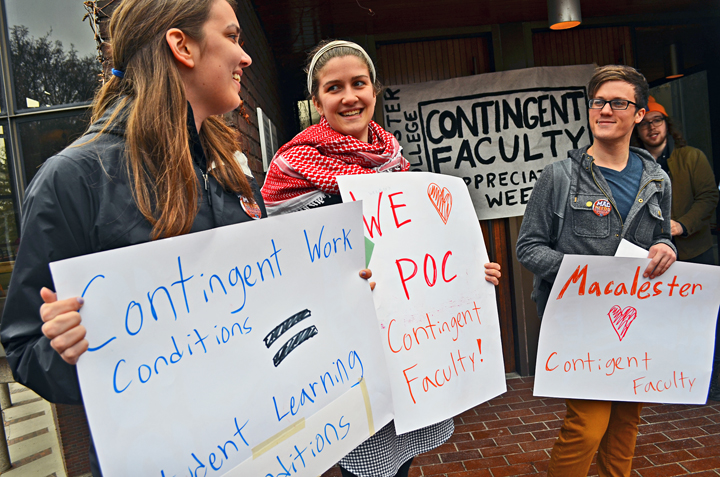
Macalester sophomore Julia Gay leads a rally during Contingent Faculty Appreciation Week on campus.

Macalester sophomore Julia Gay leads a rally during Contingent Faculty Appreciation Week on campus.

Despite public appeals from students, instructors and U.S. Rep. Keith Ellison to take a neutral stance, Macalester College administrators last week announced their opposition to efforts by contingent faculty members to organize a union.

Macalester President Brian Rosenberg and Provost Kathy Murray revealed their opposition in a memo sent May 2 to the school’s tenured and tenure-track faculty members, who are not a part of the organizing drive. Macalester’s student newspaper, The Mac Weekly, obtained a copy of the memo.

Although respectful in tone, the memo takes a clear stance against the union, arguing that organizing “is not the right direction for any of our faculty members, will not strengthen our institution or our governance structure, will not help the faculty who are directly involved, and will not assist our students in any way.”

Rosenberg and Murray also declared their intent to tell contingent faculty members “why the College is opposed to this effort” before they vote on whether to join Local 284 of the Service Employees International Union. The vote is likely to take place in June.

[Sign a petition calling on Macalester not to use financial resources to fight its contingent faculty members’ union drive.]

U.S. Rep. Keith Ellison urges Macalester to remain neutral during contingent faculty's organizing drive.

U.S. Rep. Keith Ellison urges Macalester to remain neutral during contingent faculty’s organizing drive.

In forgoing neutrality, the administrators turned a blind eye to a sizable demonstration on campus last month. The culmination of a student-organized “Contingent Faculty Appreciation Week,” the rally drew students, faculty members and community leaders who showed their support for the organizing drive – and voiced their opposition to interference from the administration.

“It would be unfitting for this school to interfere with a union drive,” Rep. Ellison warned administrators during a speech at the rally. “It would lower this institution that has given so much to the world if you took any position other than neutrality.”

The 5th District Congressman, who taught a course on civil rights and liberties at Macalester 20 years ago, praised contingent faculty members at Macalester and adjunct undergraduate instructors at nearby Hamline University, who also have petitioned the National Labor Relations Board to conduct a union election, for having the courage to “step out and say we are going to organize a union,” acknowledging the decision can be “a little scary.”

Feeling invisible

Contingent faculty members at the rally said they approached forming a union as a proven method of achieving greater job security, more professional development opportunities, higher pay and more reliable benefits. And like any group of workers looking to organize, they want a voice in decisions that affect their working conditions.

“Contingent faculty often just feel invisible,” said Kathryn Pratt, a former contingent faculty member who now works for the school’s Institute for Global Citizenship. “Contingent faculty want to be allies and collaborators in decision-making processes and not feel like they are on the margins of decision-making processes.”

Better working conditions for contingent faculty, visiting assistant professor Brendan Miller added, will increase stability inside the classroom – and increase instructors’ availability to students outside the classroom. Faculty members are paid substantially less per course if they do not teach a full course load, forcing many to pick up courses at campuses across the metro. That makes it especially difficult to work with students outside of class hours, Miller said.

Eric Otremba, a visiting professor of history at Macalester, thanks students for organizing Contingent Faculty Awareness Week.

Eric Otremba, a visiting professor of history at Macalester, thanks students for organizing Contingent Faculty Awareness Week.

Miller, who teaches physics and astronomy at Macalester, pointed to a list on the school’s website of key reasons students should choose to enroll, including a strong commitment to teaching, low student-to-faculty ratios and opportunities for interaction between faculty and students.

“Contingent faculty are essential to Macalester delivering on this core mission,” Miller said. “We share and we embody Macalester’s strong commitment to teaching.”

Student body supportive

Still, contingent faculty members are treated differently than their tenured and tenure-track colleagues – a fact that initially surprised sophomore Kathy Paral, one of the organizers behind Contingent Faculty Appreciation Week.

“In the classroom there is no difference,” Paral said. “Contingent faculty do as much work and are just as passionate as any other faculty member. My education at Macalester would be hard to imagine without them.”

Junior Eli Liebman said the organizing drive “affects every student here.”

“If the contingent faculty have a union, then they have a collective voice, they can make decisions as a group and have a little more power,” Liebman said. “They probably would be compensated more and maybe be more willing to do more work outside their contracts. If you do that now and you’re an adjunct professor, you do that out of the goodness of your heart.”

web.mac-students