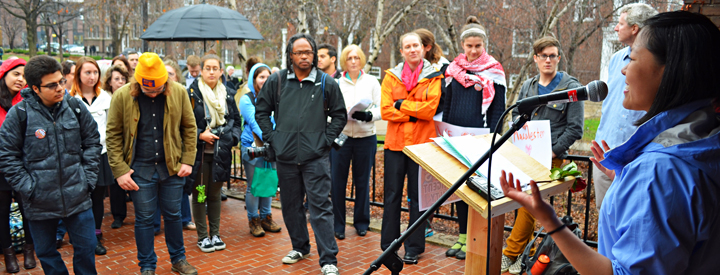
Hamline puts posturing before progress in contract talks, adjuncts say

Imagine paying $40,000 per year to attend a university, asking a faculty member for a letter of recommendation, and finding out the letter will come not from a “.edu” address associated with the school, but from an AOL account the professor maintains to write restaurant reviews and buy vintage concert posters online.

It’s just one example, adjunct faculty members say, of the retrograde positions Hamline University and its high-priced lawyers have staked out in negotiations that, despite 14 meetings since last June, have made no progress toward a new union contract.

“All we are trying to do is make reasonable improvements to the contract that help us be better teachers,” said Richard Wiebe, an adjunct instructor of creative writing and digital arts. “We haven’t even gotten to the point of (discussing) economics yet, and every ask we’ve made has been denied by administration on the other end of the table.

“These are things that don’t cost the university anything, so we’re kind of at a loss.”

The frustration boiled over in a press release issued last week by Minnesota Academics United, the SEIU-backed union that represents faculty members at Hamline, Augsburg and other local campuses.

The release blasted Hamline’s approach to bargaining a new contract, accusing school administrators of trying to weaken adjunct faculty members’ union and marginalize their status on campus.

They also blasted university leaders for bringing attorneys from the law firm Dorsey and Whitney into negotiations. The legal fees “almost certainly” have cost Hamline more “than the total cost of the first year of the union’s proposals,” the release said.

David Weiss, a co-steward of the faculty members’ bargaining unit, said union members had hoped talks would be collaborative and positive.

“We were sorely mistaken,” Weiss said. “Far from working with us in a collaborative spirit, Hamline is choosing to become a ‘gated’ academic community, trying to weaken our contract and union – as well as our relationships with students and fulltime faculty colleagues.”

Hamline relies on adjunct faculty to fill roughly half its teaching positions. Adjunct instructors’ workloads fluctuate at the school’s discretion, with few guarantees beyond the end of a given semester.

The intermittent nature of adjunct employment would become even more pronounced under contract language proposed by the university, union members said. One proposal would eliminate standing arrangements that protect adjunct instructors from having to reapply for teaching jobs each semester. Another would block their access to university email accounts, library services and online records in between teaching assignments.

The changes, faculty members warn, would impede their own scholarship and cut them off from students, who often look to instructors for academic assistance or networking support after a semester ends.

The school also rejected the union’s proposal that adjunct faculty members be allowed to carry over earned sick and safe time from one academic year to the next, Wiebe said. Some instructors have been teaching at Hamline for 17 years without accruing a single day of sick leave.

“It’s something we thought it would be reasonable to ask for,” Wiebe said. “We’re trying to work with an unconventional model, being on the academic calendar, but nevertheless ensure some continuity and security for ourselves and our families.”

Hamline’s previous contract with adjunct faculty members, finalized in Feburary 2016 after a first-of-its-kind organizing drive in Minnesota, expired in September. Anthropology instructor Marcia Regan, who has been teaching at Hamline since 2004, said progress on a new agreement won’t come until administrators put posturing aside.

“We know, as dedicated professionals who teach because we believe in the Hamline students, that our long-term connection to Hamline makes us better teachers and deepens our ties to the Hamline community,” Regan said. “The administration refuses to recognize that value, and this has really undercut our best efforts to reach an agreement.”

MCAD faculty members unionize; Augsburg adjuncts on track to vote soon

mcad_thumbnailFaculty at Minneapolis College of Art and Design have voted overwhelmingly to unionize after an organizing drive sponsored by Local 284 of the Service Employees International Union.

The election results were announced this afternoon, just days after adjunct faculty at Augsburg College filed for a union election of their own.

MCAD’s part- and full-time instructors voted separately to form distinct bargaining units, with 64 percent of faculty members voting “yes.”

Negotiations on first contracts for MCAD faculty could begin before year’s end. Faculty members said they looked forward to using their collective voice to advocate for themselves and their students.

“I am thrilled to see such a resounding vote for forming our union amongst both part-time and full-time faculty,” adjunct media instructor Daniel Dean said. “Now, we can work together towards changes that will improve our working conditions as well as our students’ experience.

“As part-time adjunct faculty, we need to know that we will be able to be there for our students when they need us.”

For Augsburg adjuncts, the timeline of their organizing election has yet to be determined, but faculty requested an election by mail ballot in November.

“I want to form an adjunct faculty union at Augsburg because I love teaching here – so much so that I am teaching this semester at a financial loss, as I did over the summer,” adjunct physics instructor Jessica Ennis said. “I have two small children, and I pay more in child care than I make from teaching. This is not sustainable in the long term for my family and me, for my students, or for the Augsburg administration.”

Over 11,000 faculty members nationwide have formed unions with SEIU in the last three years, including adjunct faculty at Hamline University in St. Paul, who voted to join Local 284 in June 2014.

Augsburg adjuncts aren’t the only local faculty poised to vote in an organizing election. Tenure-track and contingent faculty at the University of Minnesota – Twin Cities campus have filed for an election, but the university’s administration has bogged down the process with legal appeals.

MCAD faculty members voting in union election this month

mcad_thumbnail

photo: Minnesota Private College Council

Like thousands of faculty members on campuses across the country, faculty at the Minneapolis College of Art and Design are seeking a stronger voice to advocate for themselves and their students – and they’re organizing a union in order to get it.

MCAD’s part- and full-time faculty members will vote by mail in separate organizing elections this month, deciding whether to form bargaining units represented by Local 284 of the Service Employees International Union. The National Labor Relations Board will count ballots Oct. 19.

Before petitioning for an NLRB election, a majority of MCAD’s 100-plus faculty members signed cards in support of forming a union. Collective bargaining, union supporters said, would give faculty members a seat at the table in decisions that affect their teaching conditions and their students’ learning conditions.

Full- and part-time faculty members agreed their organizing drive is part of a broader effort to push back against some troubling trends in higher education – a “corporatizing” effect, full-time MCAD Professor Frenchy Lunning said, that makes top scholars less likely to enter the field.

“For me, this is about the future of higher education,” part-time MCAD faculty member Dawn Pankonien, a political economist, said. “It is about ensuring pay rates and job security that will allow not only secondary but also primary household earners to assume positions as educators without needing to arrive at their morning lectures after working night shifts in other industries.”

If they vote to unionize, MCAD faculty would join over 11,000 faculty nationwide who have formed unions with SEIU in the last three years.

That includes adjunct faculty at Hamline University in St. Paul, who voted to join Local 284 in June 2014. Since then, more than half of faculty members on campus have seen their base pay increase by 20 percent – the first pay increase in more than a decade for many instructors.

Tenure-track and contingent faculty at the University of Minnesota – Twin Cities campus are on track to vote in a union election after an organizing drive with Local 284 as well.

Hamline adjunct professor David Weiss said he looks forward to welcoming MCAD and U of M faculty into the local soon.

“Together with faculty at other colleges and universities across the Twin Cities, we can raise standards for our students and stop the race to the bottom in higher education,” Weiss said.

Ruling sets stage for 2,500 Twin Cities faculty to take union vote

cs0bau0ueaaidznThe historic organizing drive among faculty at the University of Minnesota’s Twin Cities campus cleared a major hurdle today, when a state agency ruled contingent and tenure-track faculty could join together in one potential bargaining unit.

The Minnesota Bureau of Mediation Services’ decision clears the way for about 1,000 contingent and 1,500 tenure-track faculty members to vote in an organizing election as soon as this fall. If successful, the vote would create one of the largest single-campus faculty unions in the U.S.

Supporters of the organizing effort, sponsored by MN Academics United and SEIU Local 284, said the ruling confirms faculty members’ shared stake in a strong, unified voice at the university.

“As the university’s administration has increased the number and ratio of non-tenure-line positions, the fates of all faculty are increasingly intertwined,” Irene Duranczyk, an associate professor in the College of Education and Human Development, said. “We believe that the precarious working conditions under which contingent faculty labor are not only bad for them but also bad for students and bad for us, the remaining tenure-line faculty.”

How soon Duranczyk and other U of M faculty get to vote depends on whether the school appeals the BMS ruling.

An appeal seems likely, as university administrators have made every attempt to derail the union-organizing election since faculty filed for representation in January – efforts that have focused mostly on dividing tenure and contingent faculty.

Last week the nonpartisan Minnesota Public Interest Research Group revealed documents obtained from the U of M showing over $500,000 of spending on outside legal counsel between January and June for services related to the organizing drive.

Even more egregious, faculty members, students and state lawmakers said, are annotations indicating the payments came out of funds the university collected from tuition-paying students and the Minnesota Legislature.

“I’m sure no one in the legislature – Democrat or Republican – intended for … taxpayer dollars we appropriated to the University of Minnesota’s general fund to be used for attorney’s fees fighting the University’s own employees in exercising their right to form a union,” Rep. Jim Davnie said.

U of M sophomore Jada Brown pointed out that Minnesotans, on average, have the 5th-highest student debt in the country, urging administrators “to spend money on our education, not on fighting the people who teach us every day.”

Paying high-priced attorneys to run out the clock on an organizing drive is a move straight out of the corporate anti-union playbook and, lecturer Jason Stahl said, yet another reason for faculty to seek a more powerful voice in university governance.

“We are building this union together to strengthen the voice of faculty on our campus for ourselves and our students,” Stahl said. “And we are confident that we will win our vote.”

Macalester won’t stay neutral in faculty union vote

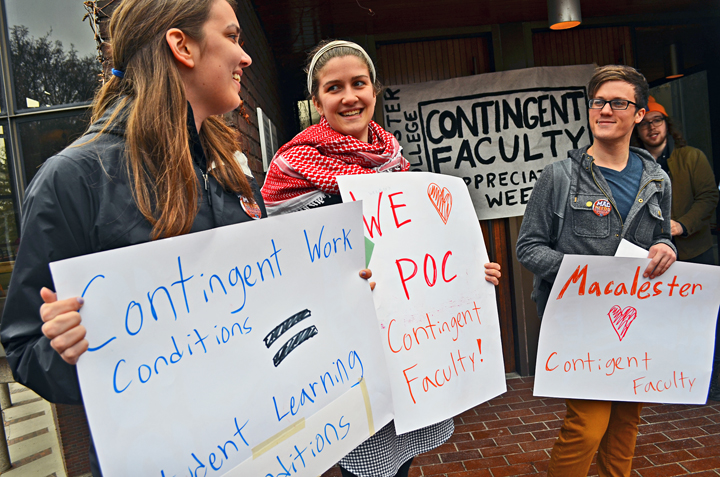
Macalester sophomore Julia Gay leads a rally during Contingent Faculty Appreciation Week on campus.

Macalester sophomore Julia Gay leads a rally during Contingent Faculty Appreciation Week on campus.

Despite public appeals from students, instructors and U.S. Rep. Keith Ellison to take a neutral stance, Macalester College administrators last week announced their opposition to efforts by contingent faculty members to organize a union.

Macalester President Brian Rosenberg and Provost Kathy Murray revealed their opposition in a memo sent May 2 to the school’s tenured and tenure-track faculty members, who are not a part of the organizing drive. Macalester’s student newspaper, The Mac Weekly, obtained a copy of the memo.

Although respectful in tone, the memo takes a clear stance against the union, arguing that organizing “is not the right direction for any of our faculty members, will not strengthen our institution or our governance structure, will not help the faculty who are directly involved, and will not assist our students in any way.”

Rosenberg and Murray also declared their intent to tell contingent faculty members “why the College is opposed to this effort” before they vote on whether to join Local 284 of the Service Employees International Union. The vote is likely to take place in June.

[Sign a petition calling on Macalester not to use financial resources to fight its contingent faculty members’ union drive.]

U.S. Rep. Keith Ellison urges Macalester to remain neutral during contingent faculty's organizing drive.

U.S. Rep. Keith Ellison urges Macalester to remain neutral during contingent faculty’s organizing drive.

In forgoing neutrality, the administrators turned a blind eye to a sizable demonstration on campus last month. The culmination of a student-organized “Contingent Faculty Appreciation Week,” the rally drew students, faculty members and community leaders who showed their support for the organizing drive – and voiced their opposition to interference from the administration.

“It would be unfitting for this school to interfere with a union drive,” Rep. Ellison warned administrators during a speech at the rally. “It would lower this institution that has given so much to the world if you took any position other than neutrality.”

The 5th District Congressman, who taught a course on civil rights and liberties at Macalester 20 years ago, praised contingent faculty members at Macalester and adjunct undergraduate instructors at nearby Hamline University, who also have petitioned the National Labor Relations Board to conduct a union election, for having the courage to “step out and say we are going to organize a union,” acknowledging the decision can be “a little scary.”

Feeling invisible

Contingent faculty members at the rally said they approached forming a union as a proven method of achieving greater job security, more professional development opportunities, higher pay and more reliable benefits. And like any group of workers looking to organize, they want a voice in decisions that affect their working conditions.

“Contingent faculty often just feel invisible,” said Kathryn Pratt, a former contingent faculty member who now works for the school’s Institute for Global Citizenship. “Contingent faculty want to be allies and collaborators in decision-making processes and not feel like they are on the margins of decision-making processes.”

Better working conditions for contingent faculty, visiting assistant professor Brendan Miller added, will increase stability inside the classroom – and increase instructors’ availability to students outside the classroom. Faculty members are paid substantially less per course if they do not teach a full course load, forcing many to pick up courses at campuses across the metro. That makes it especially difficult to work with students outside of class hours, Miller said.

Eric Otremba, a visiting professor of history at Macalester, thanks students for organizing Contingent Faculty Awareness Week.

Eric Otremba, a visiting professor of history at Macalester, thanks students for organizing Contingent Faculty Awareness Week.

Miller, who teaches physics and astronomy at Macalester, pointed to a list on the school’s website of key reasons students should choose to enroll, including a strong commitment to teaching, low student-to-faculty ratios and opportunities for interaction between faculty and students.

“Contingent faculty are essential to Macalester delivering on this core mission,” Miller said. “We share and we embody Macalester’s strong commitment to teaching.”

Student body supportive

Still, contingent faculty members are treated differently than their tenured and tenure-track colleagues – a fact that initially surprised sophomore Kathy Paral, one of the organizers behind Contingent Faculty Appreciation Week.

“In the classroom there is no difference,” Paral said. “Contingent faculty do as much work and are just as passionate as any other faculty member. My education at Macalester would be hard to imagine without them.”

Junior Eli Liebman said the organizing drive “affects every student here.”

“If the contingent faculty have a union, then they have a collective voice, they can make decisions as a group and have a little more power,” Liebman said. “They probably would be compensated more and maybe be more willing to do more work outside their contracts. If you do that now and you’re an adjunct professor, you do that out of the goodness of your heart.”

web.mac-students

Panel explores new approaches to building a better economy

Anne Winkler-Morey holds a picture of Mary Vojtko, the late adjunct professor at Duquesne University whose death last year drew national attention to declining wages, hours and benefits for adjuncts nationwide.

Anne Winkler-Morey holds a picture of Mary Vojtko, the late adjunct professor at Duquesne University whose death last year drew national attention to organizing efforts by adjuncts nationwide.

Cantaré Davunt nodded her head as Anne Winkler-Morey talked about struggling to make ends meet as an adjunct professor. To Davunt, the challenges adjunct faculty face – low wages, unreliable hours, few opportunities for advancement – sounded all too familiar to her experience as an associate at Walmart.

Davunt and Winkler-Morey joined a panel discussion in St. Paul last week that explored new employment trends and offered a glimpse into how seemingly different workers – like college faculty and retail clerks – are waging similar battles to turn their low-wage jobs into middle-class careers.

“I’ve always been a believer that making change, the only way you can do it is by getting your hands dirty,” Davunt said, explaining why she’s become active in OUR Walmart, a growing collection of associates nationwide who are organizing to improve working conditions at the world’s largest retailer.

But it isn’t just retail workers like Davunt who are feeling the squeeze.

Although the economy continues to regain jobs lost during the Great Recession, the bulk of those gains are coming in low-wage industries. According to a report released last month by the National Employment Law Project, there are nearly 2 million fewer jobs in mid- and higher-wage industries nationwide than there were before the recession took hold, while there are 1.85 million more jobs in lower-wage industries.

What’s more, temporary is becoming the new reality for an increasing number of workers forced to settle for part-time or temporary employment. In Minnesota, employment in the economy’s “employment services” sector, which includes subcontractors and temp agencies, is up 42 percent since November 2009. The uptick in temporary hiring, in fact, drew scrutiny from a state legislative committee last year.

Given these employment trends, how can workers expect to make ends meet? That’s the question moderator Michael Kuchta, former editor of The Union Advocate, posed to panelists.

“Not all workers are letting this get shoved down their throats,” said Kuchta, a member of the planning committee for the Friends of the St. Paul Public Library’s “Untold Stories” labor-history series, which sponsored the event April 29 at the St. Paul Labor Centre. “Workers are responding to the changing economy, responding to a middle class that is shrinking.”

Cantaré Davunt, a Walmart associate, borrows adjunct professor Ann Winkler-Morley's visual aids during a panel discussion on low-wage jobs.

Cantaré Davunt, a Walmart associate, borrows adjunct professor Ann Winkler-Morey’s visual aids during a panel discussion on low-wage jobs.

One way is via worker centers, including the Twin Cities-based Centro de Trabajaderos Unidos en Lucha (CTUL), or Center for Workers United in Struggle.

Like most worker centers, CTUL emerged in response to allegations of employer misconduct voiced by members of a distinct community. In CTUL’s case, organizer Ruth Schultz said, the allegations came from Latino workers cleaning big-box retail stores.

Over the last five years, CTUL has broadened its mission from helping individual workers fight wage theft and other employer abuses to the “next level” of building solidarity and working on legislative issues that affect its members, Schultz said.

Currently, CTUL is leading a campaign to hold big-box retailers, particularly Target, responsible for ensuring fair employment practices in their stores. Most workers who clean big-box stores are employed by subcontracting firms, often fly-by-night operations based in other states, making it difficult both to organize workers and to hold employers accountable.

“We’re not a traditional union, where there is one employer,” Schultz explained. “CTUL is really in the leadership of where worker centers are going, in looking at how we raise the wage floor – not only for our members, but for all low-wage workers.”

The recent – and successful – campaign to raise the state’s minimum wage saw CTUL working hand in hand with another group reaching out to non-union workers in Minnesota, Working America.

Although more broad in its approach than CTUL, Working America is another way workers are pushing back against recent employment trends. Backed by the nation’s largest labor federation, the AFL-CIO, Working America sponsors door-to-door canvassing in neighborhoods across the state, signing up members, polling workers about the issues that matter to them and building grassroots campaigns around the results.

Minimum wage was one of those issues, said Brianna Halverson, Working America’s statewide director. Now, with victory secured, the group is building a new campaign to ensure all workers have access to earned sick time.

“We’re constantly hearing stories from our members about the imbalance of work life and home life,” Halverson said. “We heard that even if a workplace had paid time off or some other policy, people felt like it was frowned upon to actually use it. That’s why we’re working on a campaign right now around the issue, and we’re hoping to move it next year at the Capitol.”

Of course, Working America and worker centers like CTUL are not meant to supplant traditional unions, but to fill in the gaps in industries or employment models – subcontracting, temp agencies – where organizing is particularly difficult.

Workers, including adjunct professors like Winkler-Morey, still look to unions as a way to gain a voice on the job and bargain for better wages, benefits and working conditions. Adjuncts at Hamline University and contingent faculty at Macalester College filed for union elections last month.

Winkler-Morey, who teaches primarily at Metro State University, hopes it’s a vote she gets to take someday. Already, she’s seen her “middle-class profession become a low-wage profession,” as the share of adjunct faculty – professors on the “poverty track” instead of the tenure track, she quipped – at colleges and universities has increased from 25 to 75 percent during her career.

“It’s a mystery,” Winkler-Morey said. “Why is tuition going up and up and up, and class sizes are going up and up and up, and the number of low-wage instructors is going up? What’s happened?”

history-tour

The panel discussion on low-wage organizing was part of “Untold Stories,” presented annually by The Friends of the St. Paul Public Library. Click the image for more information on the labor-history series.