Ruling deals blow to faculty union drive at U’s Twin Cities campus

A Minnesota Court of Appeals ruling issued yesterday dealt a setback to faculty members organizing a union at the University of Minnesota’s Twin Cities campus, who are now weighing an appeal to the state’s Supreme Court.

The ruling overturned a decision by the Bureau of Mediation Services, which oversees public employee labor disputes in Minnesota, to allow contingent and tenure-track faculty members to form a united front in bargaining with the U of M, should they vote to form a union.

The faculty union, Minnesota Academics United, released a statement from its steering committee in response to the decision:

“We are disappointed that the Court of Appeals overruled the Bureau of Mediation Services (BMS). We believe that the Commissioner’s decision was the more accurate assessment of faculty labor on our campus, a decision reached based on a thorough and thoughtful process including meetings of the parties, lengthy hearings, and extensive legal arguments. We stand firm in our belief that contingent faculty and tenure-track faculty necessarily share a community of interest.

“The university administration’s position is driven by backwards priorities that value administrative prerogatives over intellectual excellence and student learning. The University’s position is a deliberate misinterpretation of what campus faculty do, explicitly intended to divide us in order to limit our power to protect and improve our working conditions, which are also our students’ learning conditions.

“Further, it relies on a fundamental disavowal of the value of our contingent colleagues’ teaching, research, and service to our campus community. This approach to university education is anachronistic and unacceptable. In spite of this unfavorable outcome in the Court of Appeals, we will continue to advocate for our students and colleagues through a variety of channels including a possible appeal to the Minnesota Supreme Court.”

Faculty members at the U of M filed their petition for a union election in January 2016.

Minnesota Academics United, an affiliate of the Service Employees International Union, has 30 days to appeal the Court of Appeals ruling.

 

Ruling sets stage for 2,500 Twin Cities faculty to take union vote

cs0bau0ueaaidznThe historic organizing drive among faculty at the University of Minnesota’s Twin Cities campus cleared a major hurdle today, when a state agency ruled contingent and tenure-track faculty could join together in one potential bargaining unit.

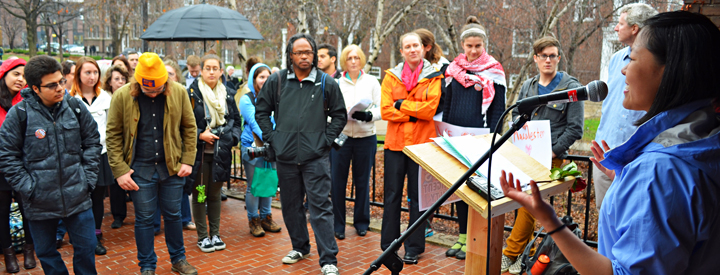
The Minnesota Bureau of Mediation Services’ decision clears the way for about 1,000 contingent and 1,500 tenure-track faculty members to vote in an organizing election as soon as this fall. If successful, the vote would create one of the largest single-campus faculty unions in the U.S.

Supporters of the organizing effort, sponsored by MN Academics United and SEIU Local 284, said the ruling confirms faculty members’ shared stake in a strong, unified voice at the university.

“As the university’s administration has increased the number and ratio of non-tenure-line positions, the fates of all faculty are increasingly intertwined,” Irene Duranczyk, an associate professor in the College of Education and Human Development, said. “We believe that the precarious working conditions under which contingent faculty labor are not only bad for them but also bad for students and bad for us, the remaining tenure-line faculty.”

How soon Duranczyk and other U of M faculty get to vote depends on whether the school appeals the BMS ruling.

An appeal seems likely, as university administrators have made every attempt to derail the union-organizing election since faculty filed for representation in January – efforts that have focused mostly on dividing tenure and contingent faculty.

Last week the nonpartisan Minnesota Public Interest Research Group revealed documents obtained from the U of M showing over $500,000 of spending on outside legal counsel between January and June for services related to the organizing drive.

Even more egregious, faculty members, students and state lawmakers said, are annotations indicating the payments came out of funds the university collected from tuition-paying students and the Minnesota Legislature.

“I’m sure no one in the legislature – Democrat or Republican – intended for … taxpayer dollars we appropriated to the University of Minnesota’s general fund to be used for attorney’s fees fighting the University’s own employees in exercising their right to form a union,” Rep. Jim Davnie said.

U of M sophomore Jada Brown pointed out that Minnesotans, on average, have the 5th-highest student debt in the country, urging administrators “to spend money on our education, not on fighting the people who teach us every day.”

Paying high-priced attorneys to run out the clock on an organizing drive is a move straight out of the corporate anti-union playbook and, lecturer Jason Stahl said, yet another reason for faculty to seek a more powerful voice in university governance.

“We are building this union together to strengthen the voice of faculty on our campus for ourselves and our students,” Stahl said. “And we are confident that we will win our vote.”

Macalester won’t stay neutral in faculty union vote

Macalester sophomore Julia Gay leads a rally during Contingent Faculty Appreciation Week on campus.

Macalester sophomore Julia Gay leads a rally during Contingent Faculty Appreciation Week on campus.

Despite public appeals from students, instructors and U.S. Rep. Keith Ellison to take a neutral stance, Macalester College administrators last week announced their opposition to efforts by contingent faculty members to organize a union.

Macalester President Brian Rosenberg and Provost Kathy Murray revealed their opposition in a memo sent May 2 to the school’s tenured and tenure-track faculty members, who are not a part of the organizing drive. Macalester’s student newspaper, The Mac Weekly, obtained a copy of the memo.

Although respectful in tone, the memo takes a clear stance against the union, arguing that organizing “is not the right direction for any of our faculty members, will not strengthen our institution or our governance structure, will not help the faculty who are directly involved, and will not assist our students in any way.”

Rosenberg and Murray also declared their intent to tell contingent faculty members “why the College is opposed to this effort” before they vote on whether to join Local 284 of the Service Employees International Union. The vote is likely to take place in June.

[Sign a petition calling on Macalester not to use financial resources to fight its contingent faculty members’ union drive.]

U.S. Rep. Keith Ellison urges Macalester to remain neutral during contingent faculty's organizing drive.

U.S. Rep. Keith Ellison urges Macalester to remain neutral during contingent faculty’s organizing drive.

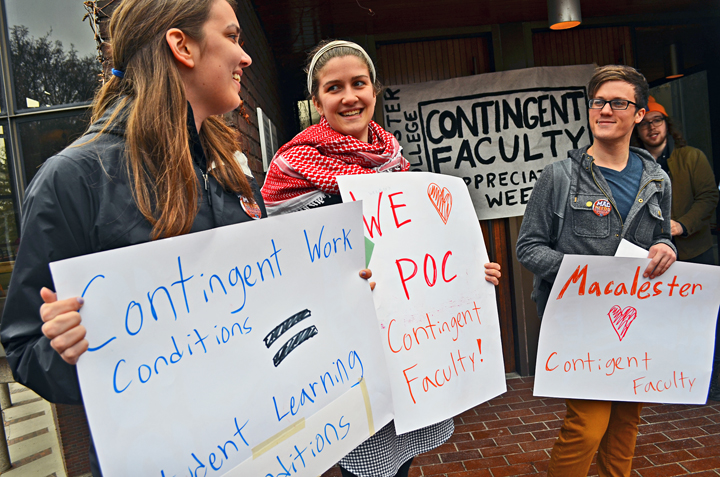
In forgoing neutrality, the administrators turned a blind eye to a sizable demonstration on campus last month. The culmination of a student-organized “Contingent Faculty Appreciation Week,” the rally drew students, faculty members and community leaders who showed their support for the organizing drive – and voiced their opposition to interference from the administration.

“It would be unfitting for this school to interfere with a union drive,” Rep. Ellison warned administrators during a speech at the rally. “It would lower this institution that has given so much to the world if you took any position other than neutrality.”

The 5th District Congressman, who taught a course on civil rights and liberties at Macalester 20 years ago, praised contingent faculty members at Macalester and adjunct undergraduate instructors at nearby Hamline University, who also have petitioned the National Labor Relations Board to conduct a union election, for having the courage to “step out and say we are going to organize a union,” acknowledging the decision can be “a little scary.”

Feeling invisible

Contingent faculty members at the rally said they approached forming a union as a proven method of achieving greater job security, more professional development opportunities, higher pay and more reliable benefits. And like any group of workers looking to organize, they want a voice in decisions that affect their working conditions.

“Contingent faculty often just feel invisible,” said Kathryn Pratt, a former contingent faculty member who now works for the school’s Institute for Global Citizenship. “Contingent faculty want to be allies and collaborators in decision-making processes and not feel like they are on the margins of decision-making processes.”

Better working conditions for contingent faculty, visiting assistant professor Brendan Miller added, will increase stability inside the classroom – and increase instructors’ availability to students outside the classroom. Faculty members are paid substantially less per course if they do not teach a full course load, forcing many to pick up courses at campuses across the metro. That makes it especially difficult to work with students outside of class hours, Miller said.

Eric Otremba, a visiting professor of history at Macalester, thanks students for organizing Contingent Faculty Awareness Week.

Eric Otremba, a visiting professor of history at Macalester, thanks students for organizing Contingent Faculty Awareness Week.

Miller, who teaches physics and astronomy at Macalester, pointed to a list on the school’s website of key reasons students should choose to enroll, including a strong commitment to teaching, low student-to-faculty ratios and opportunities for interaction between faculty and students.

“Contingent faculty are essential to Macalester delivering on this core mission,” Miller said. “We share and we embody Macalester’s strong commitment to teaching.”

Student body supportive

Still, contingent faculty members are treated differently than their tenured and tenure-track colleagues – a fact that initially surprised sophomore Kathy Paral, one of the organizers behind Contingent Faculty Appreciation Week.

“In the classroom there is no difference,” Paral said. “Contingent faculty do as much work and are just as passionate as any other faculty member. My education at Macalester would be hard to imagine without them.”

Junior Eli Liebman said the organizing drive “affects every student here.”

“If the contingent faculty have a union, then they have a collective voice, they can make decisions as a group and have a little more power,” Liebman said. “They probably would be compensated more and maybe be more willing to do more work outside their contracts. If you do that now and you’re an adjunct professor, you do that out of the goodness of your heart.”

web.mac-students