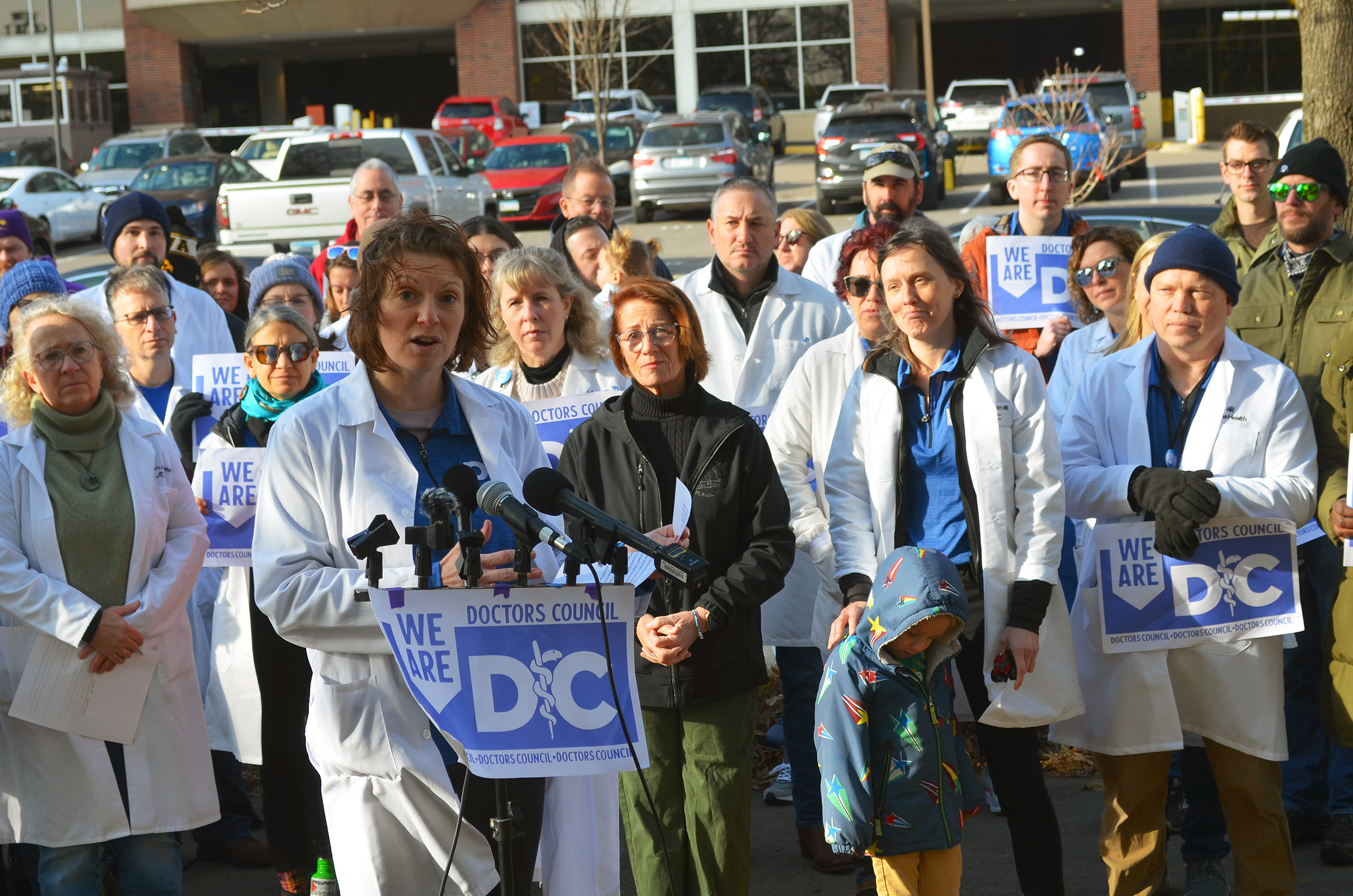
Dr. Cora Walsh, who practices at Allina’s clinic in West St. Paul, spoke during a press conference outside Abbott Northwestern.
Unionized doctors in the Allina Health system are frustrated with the slow pace of contract negotiations and management’s failure to address concerns about ongoing lab-processing delays.
That frustration that boiled over in a press conference outside Abbott Northwestern Hospital in Minneapolis on Nov. 16. Doctors publicly called out members of Allina’s board of directors for failing to respond to their letters – sent to each board member individually – warning about the lab delays and their serious impact on patient care.
Not one board member responded, Dr. Matt Hoffman, a family clinician at Allina’s Vadnais Heights facility, said.
“What we hear from that is that the board of directors does not seem to care or feel accountable to the communities they serve,” Hoffman said. “They certainly don’t seem to care or feel accountable to the health care providers who depend on them.”
The press event marked one year since 600 physicians at Allina clinics across the region voted to form the largest private-sector doctors’ union in the country, joining the Doctors Council, an affiliate of the Service Employees (SEIU) union.
They were the second group of Allina doctors to unionize, following a vote at Mercy-Unity in the north metro that brought together about 150 hospital doctors. The two groups are bargaining first contracts with Allina separately.
Members of both bargaining units, wearing their white lab coats, joined the event in Minneapolis. They described shared concerns about the pace of bargaining and the continued corporatization of their health care facilities.
“There are some days where I feel like Allina’s representatives are showing up and really being thoughtful (in bargaining), and there are some days where it feels like there are deliberate delays,” Dr. Jess Boland, who works in Mercy-Unity’s intensive-care unit, said.
Dr. Kristin Sanders-Gendreau, a pediatrician in Allina’s Maplewood clinic with 30-plus years of experience, said that Allina executives were “squandering a great opportunity to join with us to make the careful corrections needed in health care to realign and bring the healing relationship between clinician and patient back to the forefront.”
“But we need a real seat at the table in order to do so,” she added.

Dr. Kristin Sanders-Gendreau said collective bargaining is an opportunity to restore physicians’ voice within large health care systems like Allina.
The lab delays – which result from Allina’s move to outsource its clinical lab work to Quest Diagnostic, a private company, in September – are a point of contention inside – and outside – bargaining between the clinicians and Allina. Hoffman said his patients have had to wait several days for diagnoses that would previously take hours, delaying necessary care.
“Our CEO, Lisa Shannon, makes $2.7 million,” Hoffman said. “Our health care executives gave themselves 20-30% raises recently. We believe they can bring these services back.”
But doctors said Allina’s indifference to the delays and disruptions that have come with outsourcing lab work is reflective of a broader approach that prioritizes the bottom line over patient care. It’s why doctors are also seeking contract language that would ensure adequate staffing across their facilities – not just for physicians, but for all members of the care team.
“While corporate health care continues to grow, staffing shortages and cost cutting measures mean we give more of ourselves to deliver the care our patients deserve,” Dr. Cora Walsh, who practices at Allina’s clinic in West St. Paul, said. “This is why we are fighting for contract protections that will provide us with time, resources and staff to do this essential work.
“When we do this work long after the clinic day has ended or late into the evening, we struggle to provide the care our patients deserve, and we struggle to care for our own well-being.”
Boland added, “I want another 20 years out of my career, and it’s worrisome to think of doing another 20 years with the trends we’ve seen of increased administrative distance and decreasing administrative interest in the actual provision of patient care.”
Union members said some progress had been made toward a settlement, pointing to language that will create a new mentorship program and a “collaboration council” to give health care professionals a voice in Allina’s decision making. New safety provisions will protect doctors from being forced to provide care to patients who have harassed or threatened them.
But members of the bargaining teams stressed that the finish line remains far from sight.
“They need a contract,” said Senate Majority Leader Erin Murphy (D-St. Paul), a registered nurse who attended the rally. “I’m asking those on the other side of the table to stand in common cause with those who are licensed to provide care, in advocacy for Minnesotans who need care. Find a path forward for a contract … so that providers are able to practice in a way that puts patients first.”
– Michael Moore, Union Advocate editor

