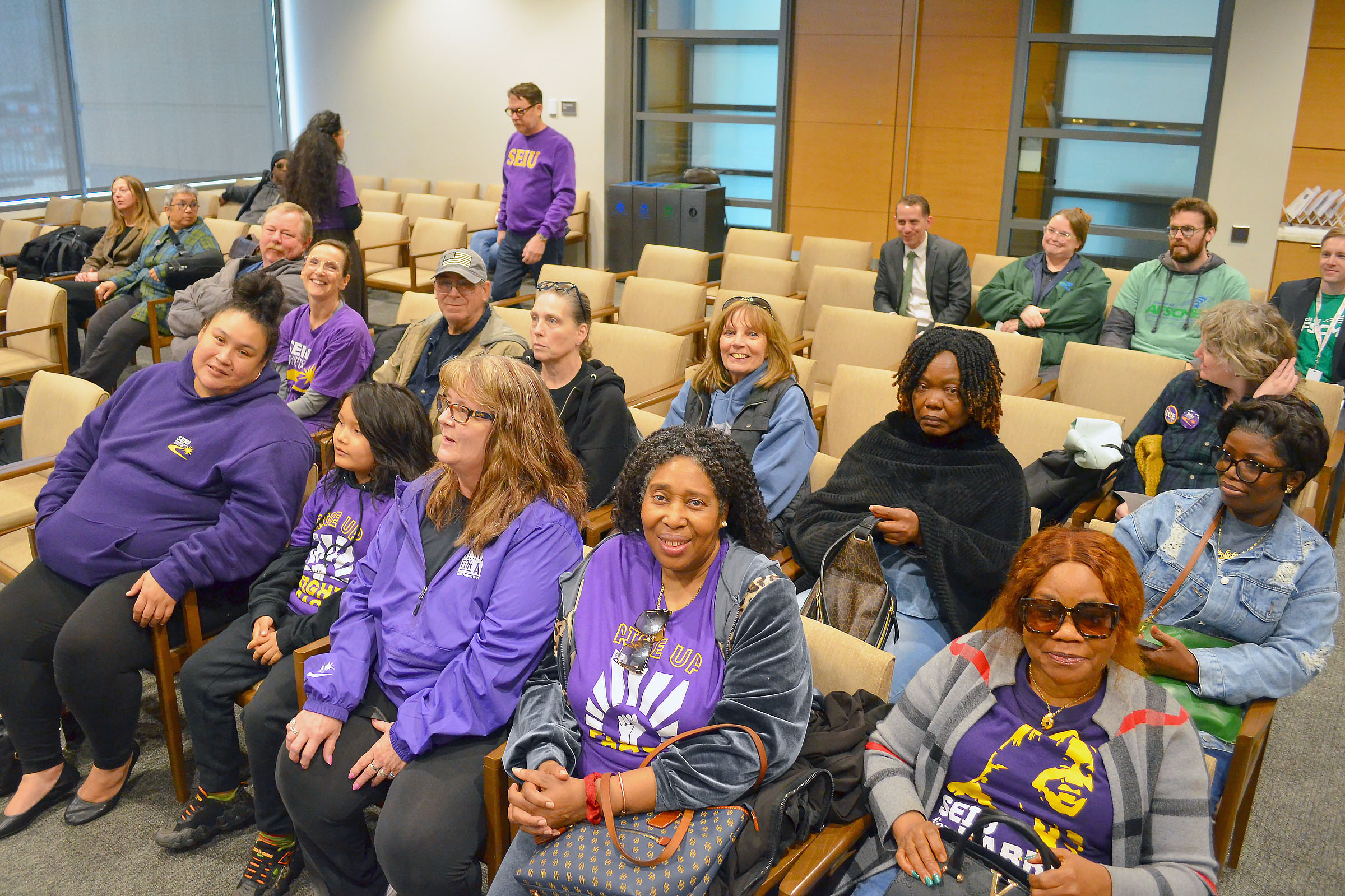
Minnesota nursing home workers attend a Senate Labor Committee hearing on rampant union-busting in the heavily subsidized industry.
Authors of two recently published reports on union busting in Minnesota nursing homes presented their findings to the Senate Labor Committee last week, raising concerns among some lawmakers that public funds are being used to stifle worker voice.
Committee Chair Jen McEwen (D-Duluth) called the new research “kind of a bombshell.” Sen. Sandy Pappas (D-St. Paul) said she was “pretty shocked.”
But the findings came as no surprise to about two dozen nursing home workers in the hearing-room gallery, many of whom had been on the business end of management’s union-avoidance playbook.
Addressing the committee, Cassandra Thomas, a certified nursing assistant at Chapel View Home in Hopkins, described the changes she and her co-workers saw after they petitioned for a union election last year, like town-hall meetings with free food and regular check-ins with an out-of-town consultant.
The message, Thomas said, was clear. “They kept talking about how much the union would cost us,” she said. “But I wondered how much all this cost them, instead of just giving us that raise.”
Chapel View workers won their union election in December, joining SEIU Healthcare Minnesota and Iowa. They are working toward a first contract that delivers that raise – and addresses concerns over staffing, safety and client care that sparked their organizing drive.
But the anti-union campaign left a bitter taste in workers’ mouths – especially after they learned the estimated price tag of Chapel View’s union-avoidance campaign: as much as $400,000, or $2,800 per worker, according to Labor Lab researcher Teke Wiggin, who also addressed the Senate committee.
“It was so frustrating to hear how much they spent to try and stop us,” Thomas told lawmakers. “This all happened while we were working short. They could have spent that money on staff to care for our residents.
“How is this OK?”
Wiggin presented findings from Labor Lab’s new report, “The Price of Repression,” which studied five union-busting campaigns at nursing homes in Minnesota from 2022 to 2025.
The report uses anti-union consultants’ public disclosures, industry billing rates, campaign manuals and independent research to estimate the price tag of those union-busting campaigns, which ran from $140,000 to over $400,000.
Wiggin compared those costs to the amount employers could have spent on wage increases for impacted workers had they recognized the union voluntarily, an amount that ranges from 3.5% to 20% – or $1,400 to $7,300 per worker.
“Our report underscores that when nursing homes really want to find money and resources, they do,” Wiggin told lawmakers.
In a separate report on Minnesota nursing homes, Columbia University researchers surveyed 2,000 certified nursing assistants statewide and uncovered a “pattern of anti-union tactics” in the industry – especially in nursing homes that rely heavily on public funding.
Sociologist Adam Reich, one of six researchers who worked on the Columbia report, walked lawmakers through two case studies of union-busting in Minnesota nursing homes.
The report includes firsthand accounts from workers reacting to their bosses’ anti-union campaign, including misinformation, so-called “captive audience meetings” and, most shockingly, appeals to nursing home residents and their families to encourage caregivers to vote “no.”
At one nonprofit nursing home with a religious affiliation, an administrator leaned on Biblical proverbs to suggest that union organizers were wolves in sheep’s clothing.
“One story that sticks in my mind is a worker whose manager told them that they were going to talk to the pastor of the church they both attended about how this worker was organizing,” Reich said.
Asked by lawmakers what policy recommendations might come out of the two reports, Reich suggested a precise analysis of how nursing homes are using public funds, and whether they are being used to thwart organizing efforts.
“That seems deeply problematic in a state that I know cares deeply about the integrity of public funding,” he said.
– Michael Moore, UA editor

