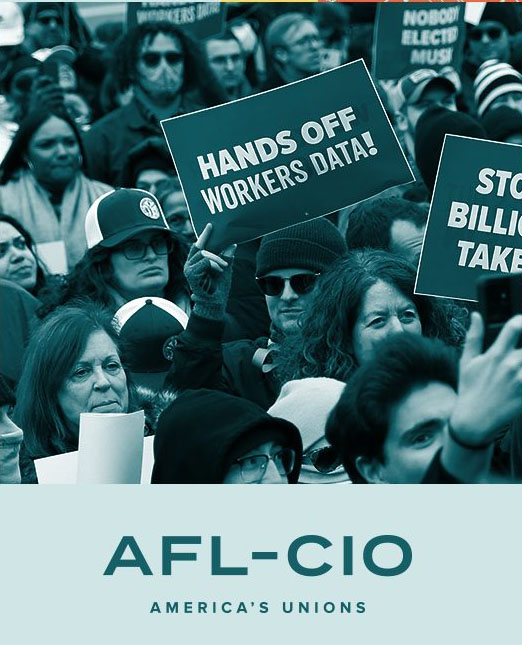
 The AFL-CIO released new polling this month that shows overwhelming support for union protections against job losses and invasions of privacy caused by artificial intelligence (AI).
The nation’s largest labor federation called the report, which draws on surveys, polling and focus groups, the most in-depth study to date of workers’ attitudes toward AI.
It found broad-based support for the AFL-CIO’s Workers First Initiative on AI, a set of guiding principles, released by the federation earlier this year, for the development and implementation of AI that ensures workers share in its benefits.
In polling, more than 9 in 10 respondents supported most of the initiative’s guardrails, including requirements for training, transparency and accountability. And workers said they trusted unions – more than either political party – to protect their jobs and privacy.
“The vast majority of America’s workers agree on how to move forward on AI and who they trust to do it, and it’s not Democrats, Republicans, Big Tech, or their employers – it’s the labor movement,” AFL-CIO President Liz Shuler said. “We’re at the most important fork in the road our economy has faced in the last 100 years, and workers are united in our power.”
While AI’s impact will be felt across the economy, workers in Minnesota are especially at risk, according to a report issued last year by the Minnesota-based North Star Policy Action think tank. It ranked Minnesota 10th nationally and second in the Midwest for vulnerability to AI, with 500 17% of the workforce – at “high risk” of having their job altered by the emerging technology.
Those impacts could be positive for workers, researchers stressed, but only if workers have a voice in the process.
The AFl-CIO polling suggests workers are ready to assert that voice – through unions.
Unions were the only institution with net positive trust (+26) on the issue, scoring higher than both political parties and employers as the institution most likely to protect workers from AI harms.
Worker survey results included in the report found support for every worker protection outlined in the federation’s Workers First Initiative on AI, with 7 of 10 respondents or better agreeing that transparency, human oversight and worker voice are key in AI implementation.
Meanwhile, just 7% of survey respondents who are currently working say their employer has disclosed how or when AI is monitoring their work, and 94% say workers should know if AI is being used to monitor their work.
The findings suggest an opportunity for unions to mobilize workers around AI-related issues during contract, organizing and lobbying campaigns.
Some unions already have seized on the issue of AI, most notably the Writers Guild. In negotiations with entertainment studios in 2023, the union won language that allows them to use AI as a tool for script writing, but protects against the use of fully AI-generated scripts.
Closer to home, nearly 2,000 members of SEIU Healthcare Minnesota and Iowa who work at HealthPartners settled a contract earlier this year that established a new labor-management committee to focus on the impact of AI on both patient care and workers.
That’s the kind of action North Star’s report last year recommended Minnesota unions start taking, whether it’s organizing new workers susceptible to AI’s impacts or bargaining to protect their current members.
There’s a role for lawmakers to play, too, North Star Policy researcher Aaron Rosenthal, author of the AI report, told Minnesota lawmakers during a House Labor Committee hearing earlier this year. Rosenthal encouraged action to protect workers against the “three D’s of AI risk:” digital surveillance, decision-making (in employment matters) and displacement.
“We are, I think, on the precipice of a 21st century industrial revolution, and we are, as a state, woefully unprepared to meet the moment,” he said.
The Legislature adjourned this week without taking action to protect workers from AI, although Gov. Tim Walz did sign into a law a bipartisan measure targeting so-called “nudification” technology.
Notably, the Trump administration has sought to block states from regulating AI on their own. An executive order issued in December instructs the attorney general to seek to overturn state laws that fail to advance the “United States’ global AI dominance.”
– Michael Moore, Union Advocate editor

