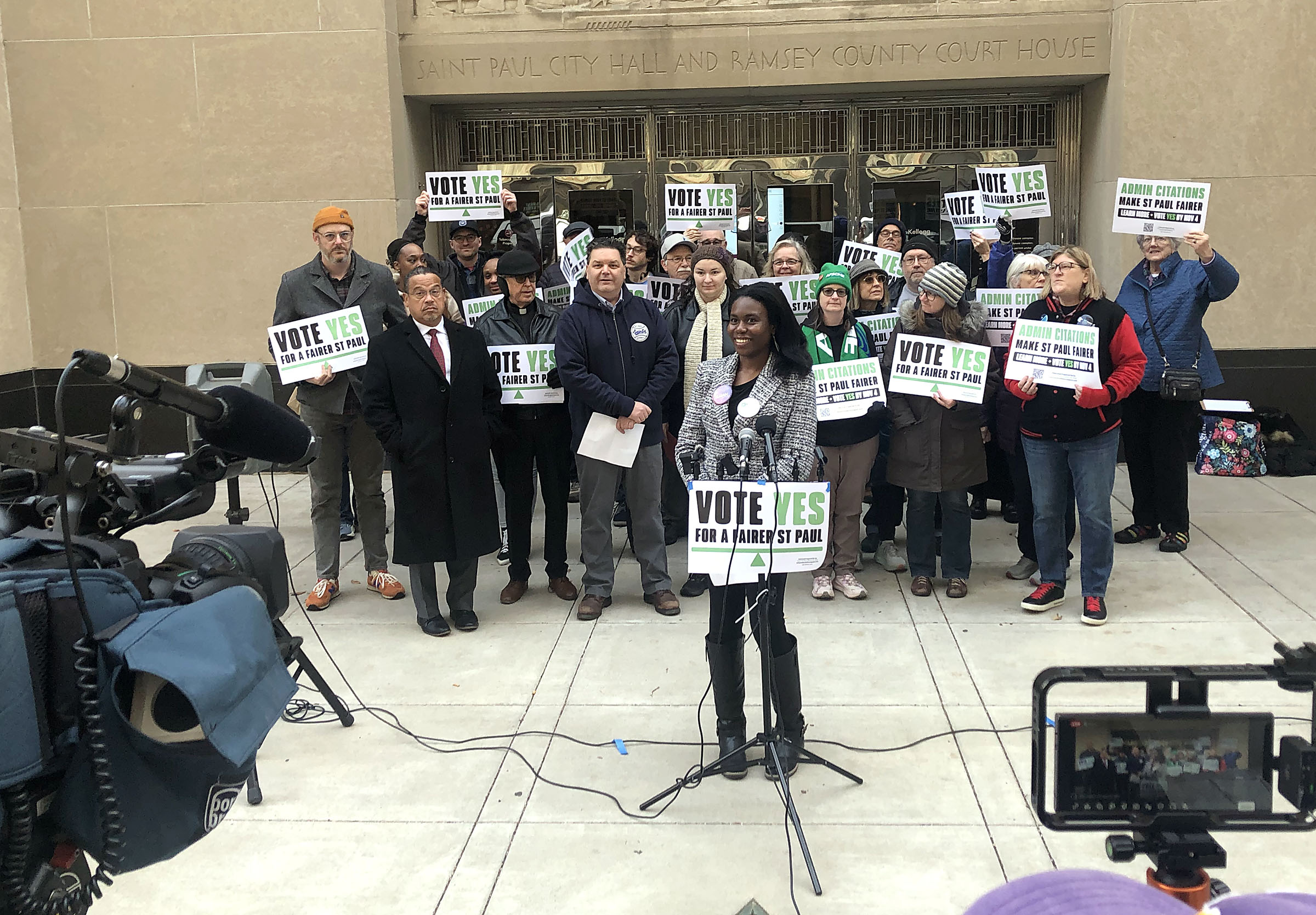
 Attorney General Keith Ellison today joined St. Paul workers, renters, small business owners and community activists making one last appeal for a “yes” vote on administrative citations.
St. Paul currently lacks authority under the city’s charter to enforce labor standards, property codes, renter protections and other ordinances by issuing civil fines. That makes it an outlier among Minnesota’s largest cities.
When local officials have both civil and criminal enforcement options, Ellison said, they are less likely to tap the Attorney General’s Office for assistance, and their low-income residents are less likely to turn to nonprofits for legal aid.
“We’ve had to sue bad landlords all over the state,” Ellison said during a press conference with the Vote Yes for a Fairer St. Paul campaign outside City Hall. “Every time we do, that means time, money and people, and it means that there’s some other problem that is not being addressed.”
Question 1 on the ballot in the City of St. Paul asks voters whether to amend the charter to allow enforcement of certain ordinances through civil fines, rather than criminal charges.
The proposal emerged from the city’s Charter Commission earlier this year and advanced to the City Council, where it passed unanimously. Mayor Melvin Carter supported the change, but opponents collected enough signatures to put the question before voters Nov. 4.
Labor groups, including the St. Paul Regional Labor Federation, have endorsed the “Vote Yes” campaign, arguing the change will allow more efficient and equitable enforcement of labor standards that unions lobbied hard for, including a higher minimum wage and protections against wage theft.
“These ordinances make our city stand out, but, unfortunately, we also stand out for not having a critical tool to enforce them,” Rick Varco, political director of SEIU Healthcare Minnesota and Iowa, said.
Varco pointed to the city’s first major attempt to enforce its ordinance requiring employers to provide earned sick and safe time. The case, filed in 2020, involved about 100 workers at a home health agency who had to wait over four years to get their legally required benefit.
Forcing enforcement into the criminal courts isn’t just impractical, advocates at the press conference said; it also plays into the hands of employers and property owners, with deeper pockets than workers and renters.
“Without administrative citations, the city is left with only two extremes: send a warning letter or pursue a time-consuming, costly criminal case,” Housing Justice Center attorney Jessica Szuminski said. “Predictably, most violations result in no actions at all.”
With a victory for administrative citations Nov. 4, Szuminski added, “tenant protections in St. Paul will finally have teeth, and renters can be assured that their calls for help to the city will mean something.”
– Michael Moore, Union Advocate editor
 Union Advocate