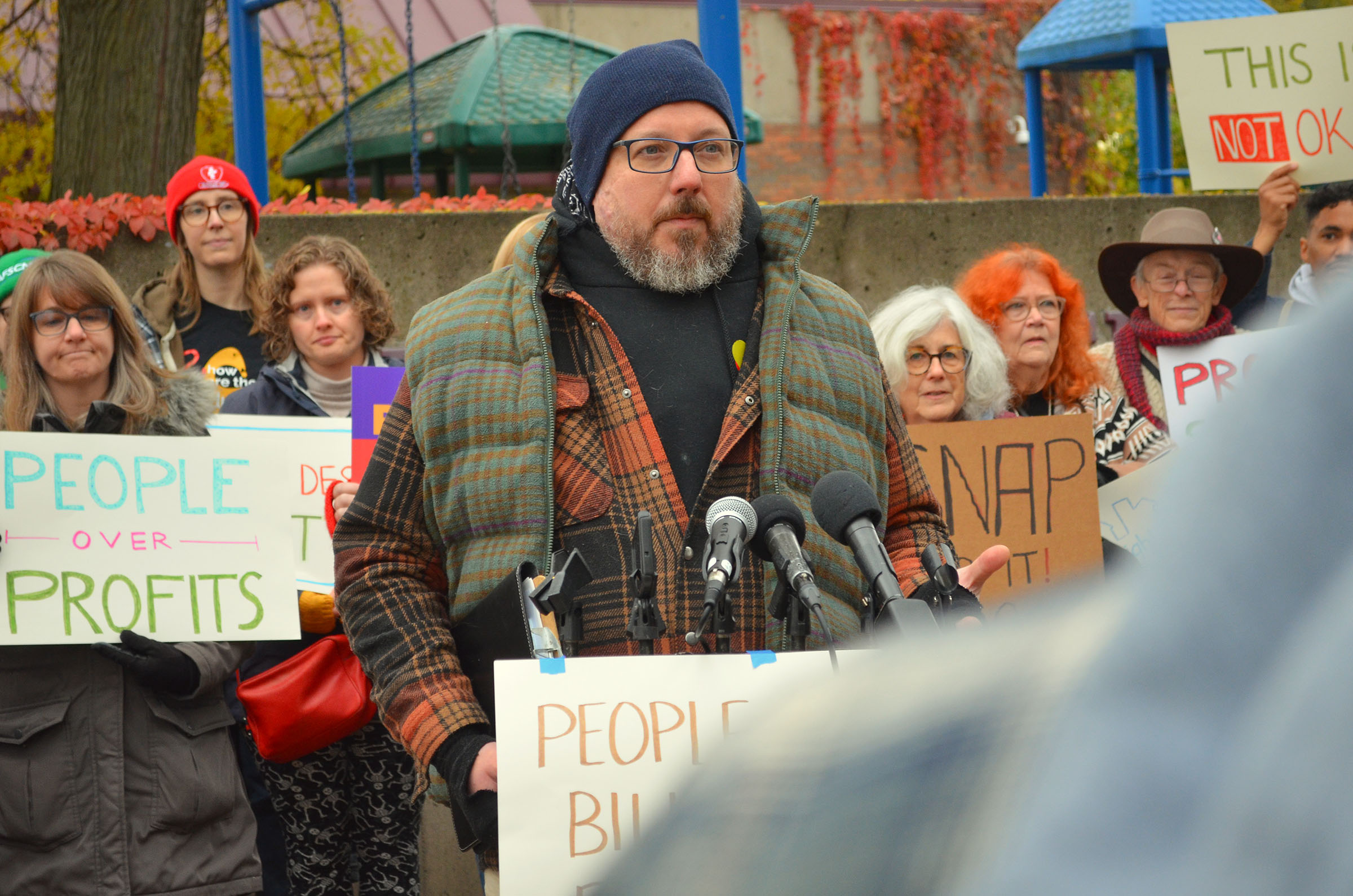
Matteo Halbesleben speaks at a press conference outside a St. Paul food shelf.
Matteo Halbesleben of Minneapolis is among 42 million people nationwide, including 440,000 in Minnesota, who will see food assistance from the federal government, known as SNAP, disappear tomorrow.
Benny Roberts is executive director of the Hallie Q. Brown Food Shelf in St. Paul, where demand already has doubled this week, prompting staff to put out a call for donations – money, food, clothes, toiletries and volunteer help.
Devina Moore teaches at nearby Benjamin E. Mays elementary school, where over half of students qualify for free or reduced school lunch. She and other educators are trying to keep things “as consistent as possible” for children – 150,000 of whom rely on SNAP in Minnesota – while scrambling to connect families with other resources.
As they brace for the impacts on their families and their community, Halbesleben, Roberts, Moore and others are also calling out the driving force behind the SNAP cutoff and ongoing federal government shutdown.
“Greed,” Roberts said during a press conference outside his food shelf in the city’s Rondo neighborhood, arranged by unions, faith groups and progressive organizations.
“This isn’t a charity issue,” St. Paul school board member Erica Valliant added. “This is a policy choice.”
Sitting on $5 billion
The motive behind that choice, union leaders say, is especially callous – an attempt by President Donald Trump and Republicans to use hunger as political leverage. Why else would the administration refuse to release more than $5 billion in SNAP contingency funds?
The AFL-CIO and 26 labor unions today sent a letter demanding Agriculture Secretary Brooke Rollins release the contingency funding. AFL-CIO President Liz Shuler said Trump is “deliberately inflicting pain on workers by cutting jobs, slashing food assistance and ripping away livelihoods.”
“The administration could continue SNAP without a hitch,” she added. “Instead, it’s inflicting cruelty on people and treating this crisis as some sick political game.”
SNAP cuts will only add to the pain inflicted on workers during the shutdown.
The administration has forced 730,000 federal workers to do their jobs without pay, locked 670,000 federal workers out of their jobs, threatened to destroy 130,000 health care jobs and sidelined hundreds of thousands of workers in construction, transportation and energy by canceling infrastructure projects.
Pain spreads
As the shutdown enters a second month, more Minnesotans, like Halbesleben, will feel the pain.
He began accessing SNAP benefits several years ago, after a string of health crises – skin cancer, reconstructive surgery and a car accident – left him unable to work. Halbesleben is now able to work part time, but still cannot stand for more than four hours without needing to lie down for a physical-therapy exercise that resets his rib cage.
“My story is my own, but there are other stories out there – people who have families who are trying to keep their kids fed, elderly (people) who can’t work anymore and whose retirement doesn’t pay enough for them to (buy) food.”
He said SNAP benefits allow him to put money he does earn toward keeping his home. He already lost the home where lived at the beginning of his health troubles.
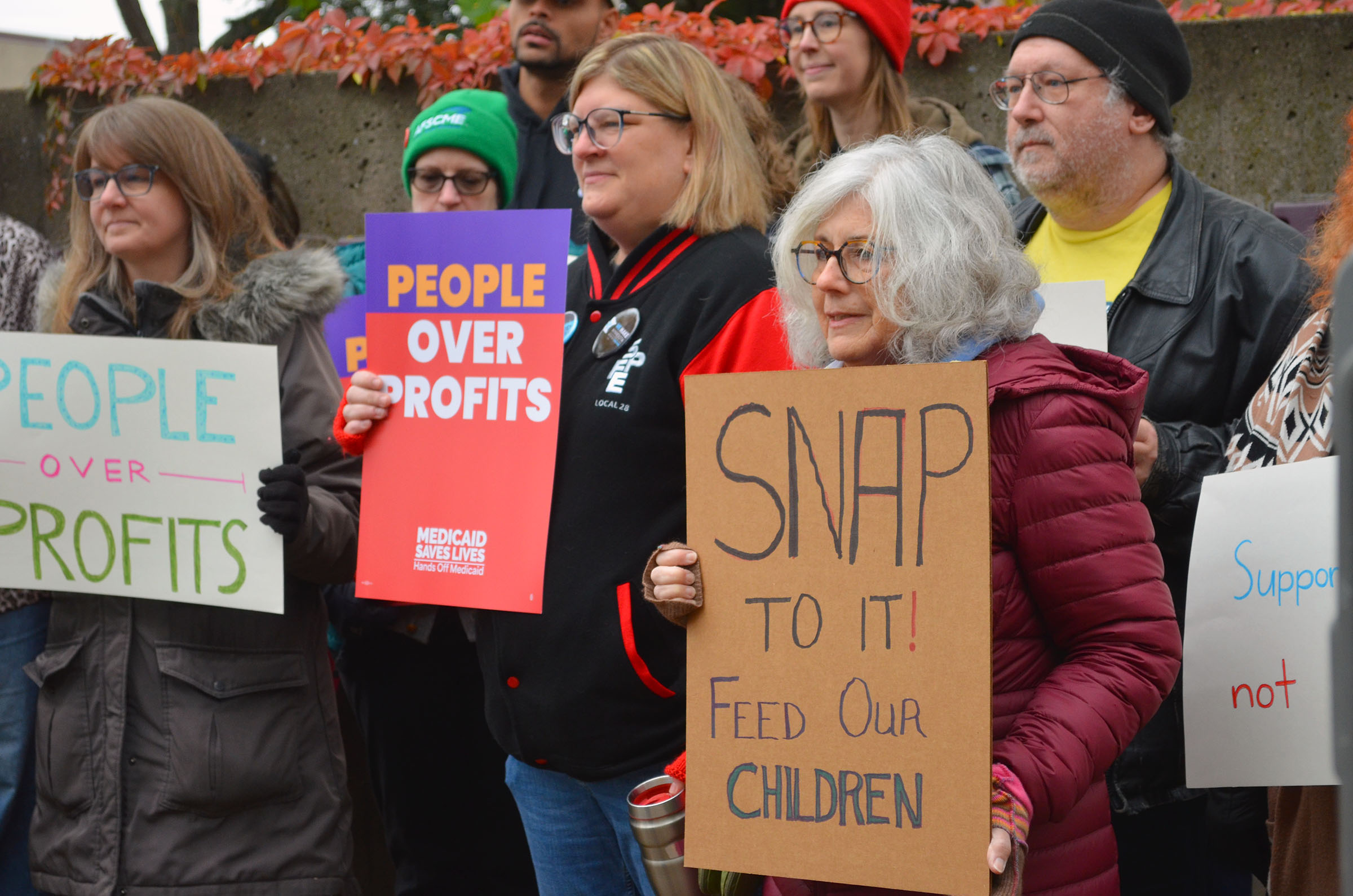 Valliant and Moore said they worry that losing SNAP benefits will create a similar snowball effect for SPPS families, making it even harder to afford housing, transportation, energy and other costs.
“It’s overwhelming to see what our families are already going through, the needs that they already have,” Moore said. “Our youngest citizens are being affected the most, and they can’t do for themselves.”
‘We need community’
Valliant noted that Minnesota students will continue to have access to free breakfast and lunch on school days, and Gov. Tim Walz and some counties have tapped emergency funds to help prepare local food shelves like Hallie Q. Brown for a surge in demand.
But it won’t replace SNAP.
“For every meal a food shelf provides, SNAP provides nine,” Valliant said. “We’d be hard pressed to replace that with donations and good will alone, and we should not have to.”
Roberts agreed, calling the shutdown a continuation of “overt and covert practices that pick on the vulnerable for the profit of the comfortable” – a nod to the political fight behind the government shutdown, which pits tax cuts for the wealthy against funding that keeps clinics open and health insurance affordable.
“We’re going to brace for harm – in community,” Roberts said. “We’re going to support each other – in community. We’re going to do our best, but we need community.”
Looking to access food, donate or volunteer with a local food shelf? Click here for a map of locations across Minnesota.
– Michael Moore, Union Advocate editor
 Union Advocate