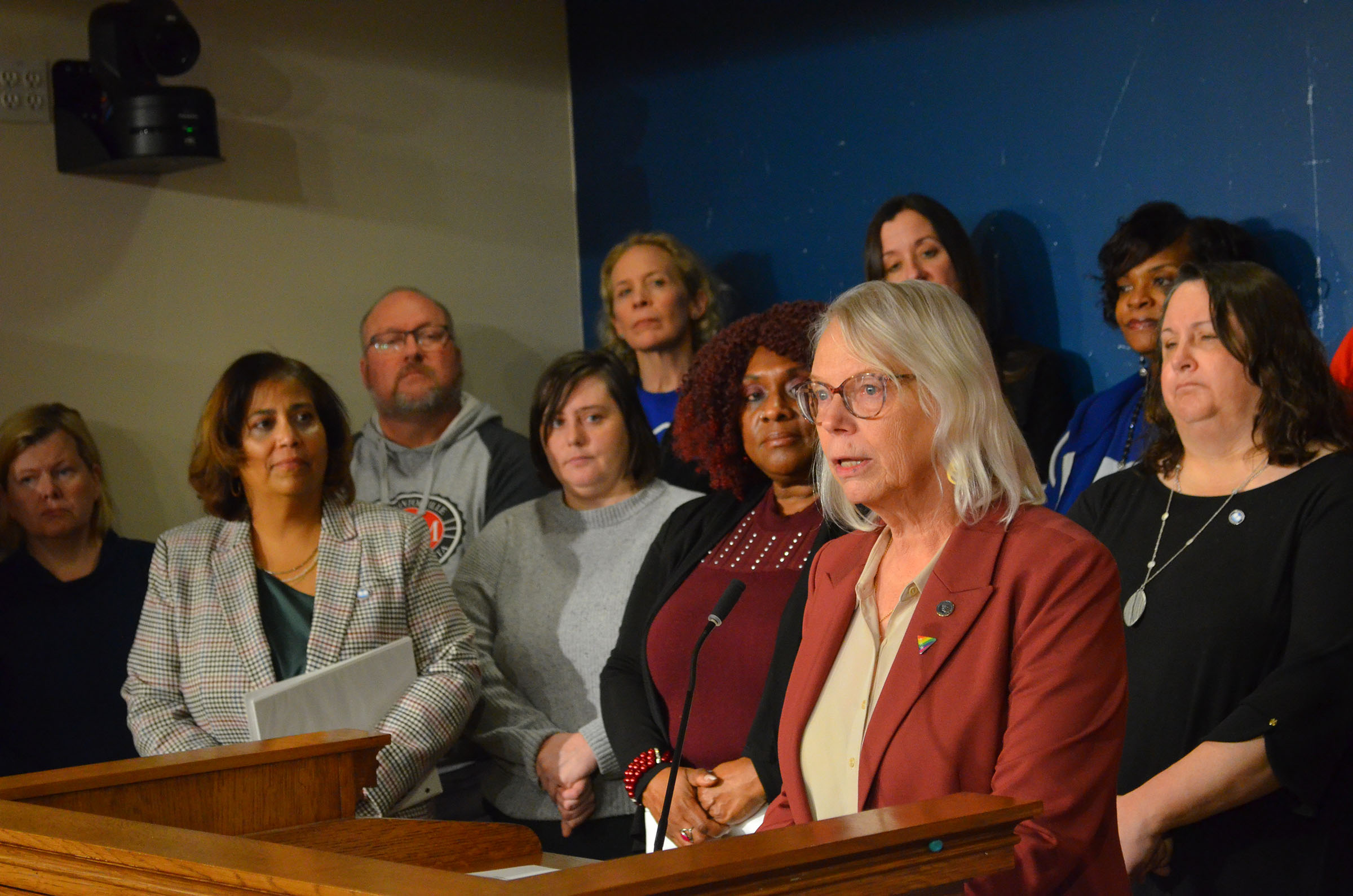
Rep. Liz Reyer of Eagan joins members of Education Minnesota at a Capitol press conference about the Educator Group Insurance Program.
House and Senate authors of a statewide health insurance pool for school employees, one of Education Minnesota’s top priorities this session, outlined their legislation’s path forward last week.
The statewide educators’ union held a day of action at the Capitol March 18 to drum up support for the idea among lawmakers. During a press conference, Rep. Liz Reyer (D-Eagan) and Sen. Mary Kunesh (D-New Brighton) said they hoped to pass bills this session that would survey school districts about the insurance coverage they provide.
The data is necessary, Kunesh said, to calculate costs of the full proposal, known as the Educator Group Insurance Program (EGIP). Kunesh and Reyer said they are aiming for EGIP’s passage in 2027.
“This session, the goal is to vet concepts through committees,” Kunesh said during a press conference with educators at the Capitol on March 18.
Modeled after an existing program that covers State of Minnesota employees and after programs in other states, EGIP is Education Minnesota’s preferred approach to stabilizing school districts’ skyrocketing health insurance costs.
The issue has increasingly become a stumbling block for local unions in contract negotiations, as educators and other school employees are repeatedly forced to choose between absorbing big premium hikes or accepting lower wage increases.
Over 150 union members joined the day of action at the Capitol, and many carried signs bearing the exact amount by which their district’s health insurance costs have increased in recent years – 30% in Mankato, 34% in Lyle, 54% in New Ulm.
By consolidating the purchasing power of every school district into a statewide risk pool, EGIP would cut down on brokerage fees and level the playing field in negotiations with large insurers like UnitedHealthcare and Blue Cross MN, advocates say.
“Minnesota’s school districts are small buyers in a market that rewards large ones,” Education Minnesota President Monica Byron said. “Every year, hundreds of school districts negotiate alone against a multi-billion-dollar insurance industry that knows exactly how much leverage it has. Educators pay for that power imbalance in higher premiums, worse coverage and impossible choices.”
Because the risk pool in most school districts is relatively small, they often see a dramatic spike in coverage costs after an employee experiences a health crisis, Byron added. “Every school district in Minnesota is just one sick employee away from a crisis that it cannot manage.”
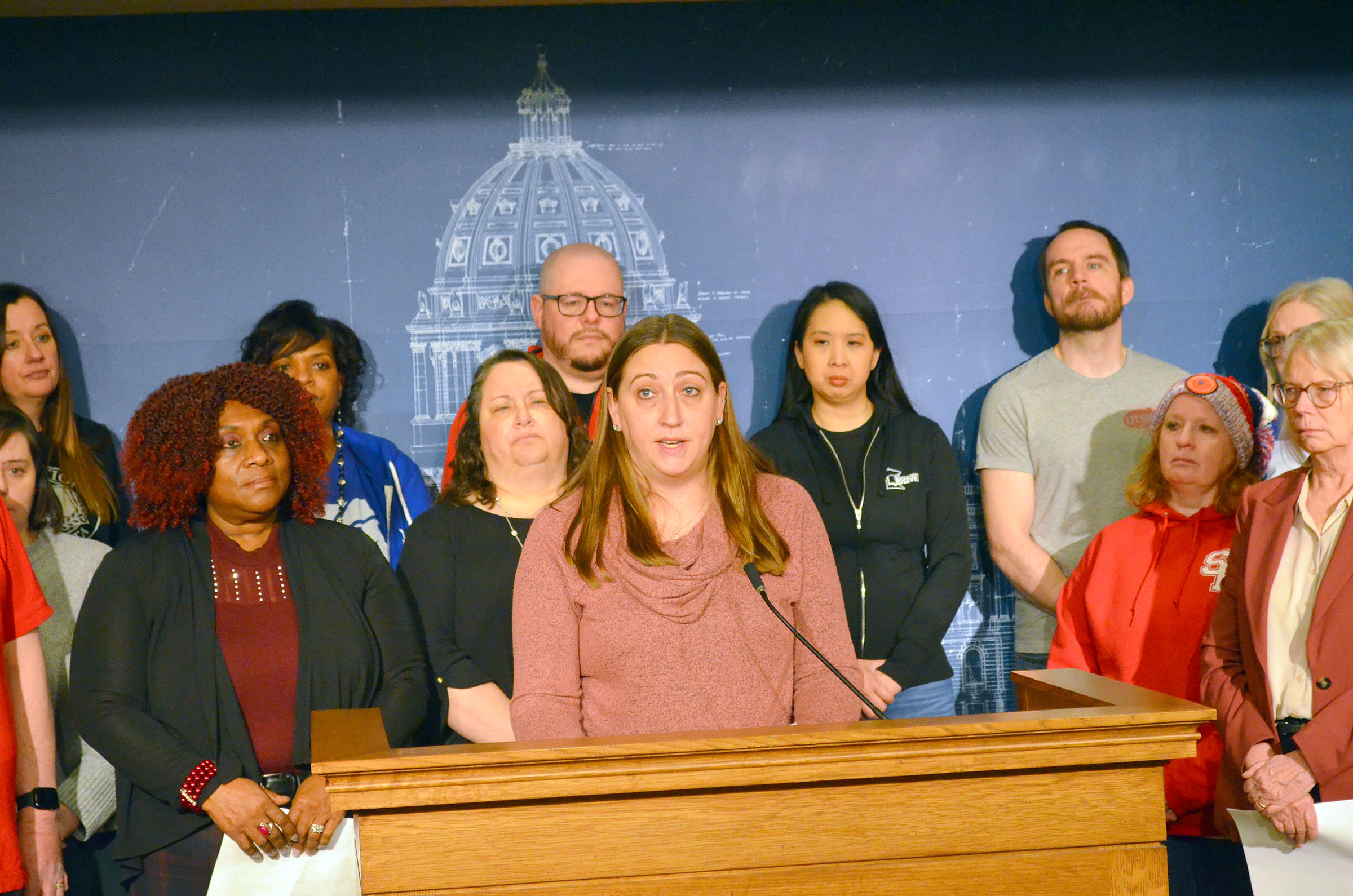
A high-deductible insurance plan left Glencoe-Silver Lake science teacher Amanda Kottke’s family with steep medical bills after her son’s hospitalization.
That’s what happened to Amanda Kottke, a science teacher in the Glencoe-Silver Lake district. Her son spent 10 “long, terrifying days” at Children’s Hospital last year receiving treatment for complications from a ruptured appendix.
Kottke, who has a high-deductible plan through her employer, acknowledged that concerns about out-of-pocket costs factored into her family’s initial decision to hold off on a $250 trip to the urgent care. But the hospital stay left Kottke with a much larger bill – and feelings of “guilt and trauma” that she now can’t afford to address in therapy.
“We were asked to pay our $10,000 deductible up front, and we couldn’t,” Kottke said. “They then suggested $900 a month until the bill was paid off, and we couldn’t do that either.”
Now her district, which already has seen insurance costs increase 165% over the last six years, is seeing bids for insurance plans next year come in 30% to 50% higher, she said.
The rising cost of their health insurance comes with public costs beyond the strain it creates on districts’ budgets. (The proposal would include a “hold harmless” provision to ensure districts’ costs don’t increase with EGIP.)
Education Minnesota reports that high insurance costs are a leading factor in driving licensed educators away from the profession. Lower-paid school employees, meanwhile, often forego the district’s insurance and look to public programs for coverage.
Kunesh and Reyer, EGIP’s authors in the legislature, said most lawmakers agree that public schools’ rising insurance costs are an urgent problem. Reyer had a message for those who are still skeptical EGIP is the solution.
“They have not offered a systemic solution, and that’s what we need,” she said. “Every day without a solution is another educator choosing between a paycheck and a family’s health care. Minnesota can do better than that.”
– Michael Moore, UA editor
 Union Advocate
Leave a comment