Bakery Workers are taking their contract fight to UNFI Cub Foods’ customers

Flyering outside the Har Mar Cub Foods (L to R): BCTGM Local 22 Secretary-Treasurer James Rutten, St. Paul Regional Labor Federation President Kera Peterson, Local 22 President Wally Borgan and retired Local 22 President Bruce Peglow.

If you’d love to shop a Cub that isn’t trying to strip its bakers of their union health and pension benefits, then Bakery Workers Local 22 has a list of stores for you.

The Twin Cities-based has distributed flyers outside dozens of Cub Foods stores owned by United Natural Foods Incorporated (UNFI) in the Twin Cities area over the last two weeks. Local 22 represents 240 bakery workers at 44 UNFI-owned Cub Foods stores.

“We’re not calling for a boycott, but some people we talk to don’t like the news we’re giving them,” Local 22 President Wally Borgan said outside the Har Mar Cub Foods in Roseville yesterday. “So we made a list to make it easy for them to find an alternative shopping site.”

The news bakery workers are giving Cub customers is that UNFI has been demanding, since contract negotiations began last fall, that Local 22 members give up their longstanding, hard-fought health care and pension benefits.

“We’re not asking for treasure chests of gold, we just want a fair contract and fair pay increases,” Borgan said.

The union-sponsored health care plan currently in Local 22’s contract covers 100% of expenses after the deductible, and Borgan said out-of-pocket costs are capped at $1,200 per year for workers who utilize a health savings account. UNFI wants bakers to switch to its corporate plan, which caps costs at $12,000 per year and requires workers to cover 20% of premiums, Borgan said.

The union’s pension fund, meanwhile, is fully funded, and Borgan said other Local 22 employers have offered to increase their contributions to the pension in recent negotiations, looking to retain and attract workers during a labor shortage.

Thirty-five members of Local 22 left UNFI Cub stores between October and December 2021, as UNFI’s attempt to strip members of their accrued vacation time set an ominous tone before bargaining even began.

Borgan said vacation hours have been restored for most workers in bargaining, but the early attack prompted Local 22 to ask its international union — the Bakery, Confectionary, Tobacco Workers and Grain Millers (BCTGM) — to take the lead in bargaining with UNFI.

“We don’t trust this employer,” Borgan said. “We used to be able to, but it was a different environment back then.”

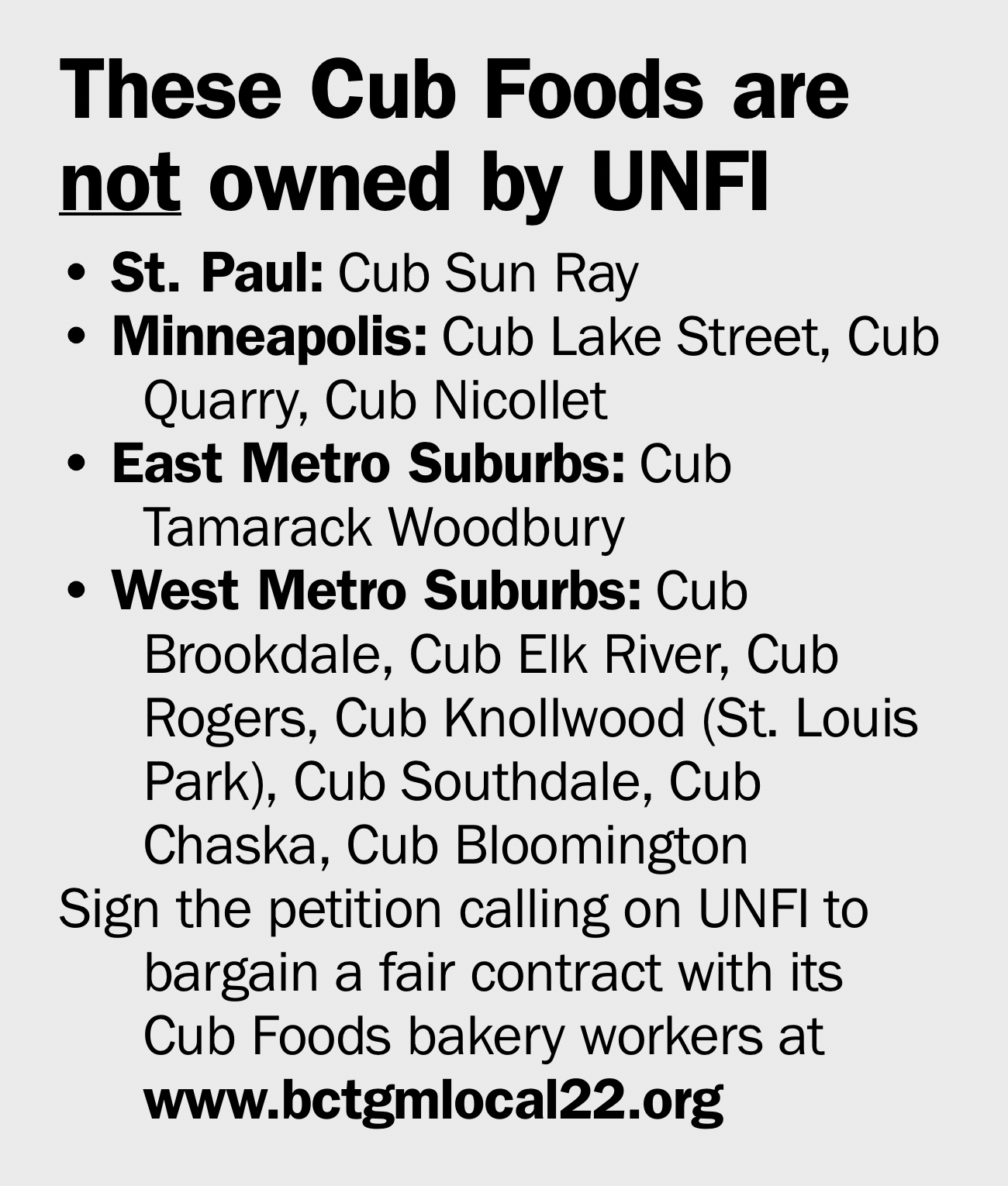
This is the first round of contract negotiations since UNFI acquired Supervalu in 2018. Not all Cub Foods stores are owned by UNFI, which is why Local 22 is circulating a list of stores that are “not trying to negatively impact workers’ livelihoods,” according to the flyer.

The two sides are scheduled to return to the bargaining table in April.

Local 22 is asking supporters to sign a petition calling on UNFI to negotiate a fair contract with its Cub Foods workers.

Conditions that sparked strikes at Nabisco, Frito Lay have ‘spread’ to Minnesota, union warns

Old Dutch workers, members of BCTGM Local 22, gather outside the union’s offices in Minneapolis.

Members of Bakery Confectionary, Tobacco and Grain Millers Local 22 who work at Old Dutch are gearing up for contract talks this fall, in which they intend to push the company to ease increasingly taxing workloads.

That’s the same rallying cry sounded by union members who went on strike at Frito Lay and Nabisco in other parts of the U.S. this year, drawing nationwide attention.

“We recently had over 50 members in our parking lot on a Saturday morning, their only day off of the week,” Local 22 President Wally Borgen said. “These members are angry because they’re working a lot of overtime, and they say the company doesn’t pay enough to recruit and retain workers.”

The dissatisfaction over unsafe workloads and lack of work-life balance among food-processing workers, Borgen said, “has spread to Local 22 in a big way.”

Borgen said negotiations with Old Dutch have been respectful in recent years, giving him hope Local 22 can avoid the drastic measures Nabisco and Frito Lay forced workers to take.

But Local 22 members in other bargaining units might not be so lucky.

Cub Foods’ parent company, UNFI, is threatening to stop paying into a union pension fund covering about 230 bakers at corporate-owned stores in Minnesota, according to Local 22, which began contract negotiations with UNFI last month.

Not all Cub Foods stores in the Twin Cities are owned by UNFI.

“They’re not talking about bargaining about it; their lawyer just informed us on the first day of negotiations that they are withdrawing from our pension fund the 1st of the year,” Borgen said. “Our pension is fully funded at 104%. There’s no reason to pull out of a great benefit for these workers.”

Additionally, three members of Local 22 have filed grievances accusing UNFI of stealing paid vacation hours. It’s a slap in the face, Borgen said, to workers who have kept bakery shelves stocked in grocery stores during the pandemic.

“Thousands of people were pouring in and out of those stores, putting our members at higher risk than your average worker,” he said. “They came to work knowing that they’d probably walk through a COVID cloud at some point.”

In some good news for Local 22, grain millers stood together and won significant pay raises at two General Mills elevators in Minneapolis earlier this month.

Union members voted unanimously to authorize a strike Sept. 9, after management refused to put more money into wages during negotiations that began in June. Within a week of the strike vote, General Mills had upped the offer, and Local 22 members had a new, four-year contract with 3% raises in the first and second years.

Local 22 is also in negotiations with Archer Daniels Midland on a contract covering 15 grain millers at another Minneapolis elevator, where members have voted down an offer with wage increases below 3%.

“There are places that are paying more, and everyone’s hiring,” Borgen said. “They worked every day through this pandemic. They think they deserve some respect.”

Grocery workers ask you to #ShopSmart during pandemic

Members of UFCW Local 1189 are keeping food and critical supplies on the shelves of local grocery stores, but they’re asking for our help keeping themselves – and all of us – healthy.

Going grocery shopping? Retail workers have a few polite requests for your consideration.

Wear a mask if you have one. Go alone if you can. Keep six feet between you and others in the store. And don’t leave trash – especially not gloves or tissues – on the floor.

In other words, United Food and Commercial Workers (UFCW) Local 1189 President Jennifer Christensen said, “shop smart” until the pandemic is over – please and thank you.

“It’s about keeping yourself safe, keeping the workers safe and keeping the community safe,” said Christensen, whose union represents workers at Cub Foods, Jerry’s, Kowalskis, Lunds and Byerlys, Festival, Cooper’s, Oxendales and other union grocers in the east-metro area.

“It’s about all of us doing the right thing to ensure that everybody has safe access to food.”

Bakery Workers (BCTGM) Local 22 represents people working inside many of the same stores. Union President Wally Borgen said most employers have made unions aware of management’s plans for dealing with potential exposure to COVID-19, with many committed to a full facility shutdown for deep cleaning.

To prevent that from happening, employers are taking extreme precautions, Borgen added.

“Most companies are following a very diligent sanitizing plan, many with dedicated employees who simply spend the entire day sanitizing and re-sanitizing any surface that is touched frequently,” he said. “Most of them are also enforcing the 20-second hand washing rule, some literally observing with stop watches and issuing discipline to employees who don’t do a good enough job.”

So far, it’s worked well.

Minnesota has avoided the fate of areas forced to limit the number of customers allowed into the store at one time, or consider delivery-only options. And union members, many of whom are earning bonus “appreciation pay” during the pandemic, want to keep it that way.

“Our members are going to work, and I know they’re happy to be working, proud to be working,” Christensen said. “And they want to stay working, but that means they need to stay healthy.”

The UFCW’s international union launched the #ShopSmart campaign on social media and other channels earlier this month after a poll of some 5,000 members found 85% said customers are not practicing social distancing, 62% said customers are blaming employees for shortages and 43% reported instances of customers shouting at employees

“We really are all in this together,” Christensen said. “It’s a people business, and it’s hard to get away from people in these stores. They weren’t built for social distancing. But you can get six feet apart if you try, and that’s what we’re asking.”

As of last week’s print deadline, no UFCW Local 1189 grocery workers had tested positive for COVID-19, nor had any member of BCTGM Local 22.


With support from more unions, St. Paul labor federation gains strength

Working people gain a stronger, more powerful voice when they join together in unions. That’s the basis of collective bargaining and a core principle of the labor movement.

But solidarity works for unions, too. By joining together in coalitions and federations, unions build important bonds that amplify the voice of all working people and advocate for our common interests.

Faced with a relentless wave of corporate attacks on unions and collective bargaining, unions won’t survive unless they stick together.

Three local unions – Bakery Workers Local 22, Teamsters Local 320, and Office and Professional Employees Local 12 – pledged to do just that last month, affiliating with the east metro’s largest labor organization, the St. Paul Regional Labor Federation, AFL-CIO.

“We’re excited and honored to welcome these three local unions into our labor family,” St. Paul Regional Labor Federation President Bobby Kasper said. “There is strength in numbers, and we need to be as strong as possible heading into election season.”

The St. Paul RLF works year round to support its affiliates’ contract, organizing and issue-based campaigns. The federation also recruits, trains and deploys volunteers for Labor 2018, the campaign to elect union-endorsed candidates, in four east-metro counties: Ramsey, Dakota, Washington and Chisago.

OPEIU Local 12

Local 12 of the Office and Professional Employees International Union represents more than 2,500 people working in health care operations, credit unions, the Minneapolis Institute of Art, local union offices and other workplaces in Minnesota.

The local’s largest bargaining unit is at HealthPartners, and women make up roughly 80 percent of the union’s total membership.

Ryan Mortensen, Local 12’s business manager, said the political atmosphere for organized labor drove his union’s decision to affiliate with the RLF.

“We alone cannot take this on,” he said. “By affiliating with the St. Paul labor federation, we gain more voice, more power to get our message out across the state and, hopefully, the nation.”

BCTGM Local 22

Bakery, Confectionery, Tobacco Workers and Grain Millers International Union Local 22’s history in St. Paul dates back to 1886, when it was just the Bakers and Confectioners Union. The founding charter still hangs in Local 22’s offices in Minneapolis.

Today, Local 22 represents about 1,800 workers in Minnesota, South Dakota and Wisconsin, including people working at Pearson’s Candy and Baldinger Bakery in St. Paul.

Union President Bruce Peglow noted the St. Paul RLF provided assistance to Local 22 even before the union affiliated. The RLF stepped up in support of workers at Franklin Street Bakery, whose attempt to form a union has been met with harsh – and sometimes illegal – pushback from management.

“We appreciated that help, and we wanted to help out others in the labor movement as we are able to,” Peglow said. “We’re all stronger when we’re all together. None of us can afford to be an island unto ourselves.”

Teamsters Local 320

Teamsters Local 320 represents 11,500 public employees in all 87 Minnesota counties. They serve cities, townships, counties, school boards and other municipalities in a wide variety of jobs: maintenance workers, lawyers, food service aides, doctors, police and corrections officers, airport workers and more.

Brian Aldes, secretary-treasurer and principal officer, considers Local 320’s diversity to be among its greatest strengths.

“No matter what the member’s craft is, we all have something in common, and that’s being public employees who serve the taxpayers,” Aldes said. “We all understand how important what all of us do is for the public and for our communities.”

Local 320 members also know the importance of electing people to local, state and national office who value the work public employees do. That was among the reasons, Aldes said, the union’s political board voted to affiliate with the RLF.

“We live and die by who we elect to serve in public office,” Aldes said. “We saw what can happen when we don’t have a positive outcome in our presidential elections when the most recent Supreme Court nominee tipped the scales in the Janus case. Now we have nationwide right to work in the public sector.”

Closer to home, Local 320 saw the power of building relationships with elected officials during a difficult round of negotiations with the St. Paul Public Schools over cafeteria workers’ contract.

“We reached out to the St. Paul labor federation and Bobby Kasper, and I’ll tell you, it was an incredible resource to have,” Aldes said. “Whether it’s connections in community-based organizations, school boards, city councils or county boards, the work the labor federation does – and its ability to reach so many households with our message – we just knew we had to be a part of this.

“We’re stronger together.”