Bakery Workers are taking their contract fight to UNFI Cub Foods’ customers

Flyering outside the Har Mar Cub Foods (L to R): BCTGM Local 22 Secretary-Treasurer James Rutten, St. Paul Regional Labor Federation President Kera Peterson, Local 22 President Wally Borgan and retired Local 22 President Bruce Peglow.

If you’d love to shop a Cub that isn’t trying to strip its bakers of their union health and pension benefits, then Bakery Workers Local 22 has a list of stores for you.

The Twin Cities-based has distributed flyers outside dozens of Cub Foods stores owned by United Natural Foods Incorporated (UNFI) in the Twin Cities area over the last two weeks. Local 22 represents 240 bakery workers at 44 UNFI-owned Cub Foods stores.

“We’re not calling for a boycott, but some people we talk to don’t like the news we’re giving them,” Local 22 President Wally Borgan said outside the Har Mar Cub Foods in Roseville yesterday. “So we made a list to make it easy for them to find an alternative shopping site.”

The news bakery workers are giving Cub customers is that UNFI has been demanding, since contract negotiations began last fall, that Local 22 members give up their longstanding, hard-fought health care and pension benefits.

“We’re not asking for treasure chests of gold, we just want a fair contract and fair pay increases,” Borgan said.

The union-sponsored health care plan currently in Local 22’s contract covers 100% of expenses after the deductible, and Borgan said out-of-pocket costs are capped at $1,200 per year for workers who utilize a health savings account. UNFI wants bakers to switch to its corporate plan, which caps costs at $12,000 per year and requires workers to cover 20% of premiums, Borgan said.

The union’s pension fund, meanwhile, is fully funded, and Borgan said other Local 22 employers have offered to increase their contributions to the pension in recent negotiations, looking to retain and attract workers during a labor shortage.

Thirty-five members of Local 22 left UNFI Cub stores between October and December 2021, as UNFI’s attempt to strip members of their accrued vacation time set an ominous tone before bargaining even began.

Borgan said vacation hours have been restored for most workers in bargaining, but the early attack prompted Local 22 to ask its international union — the Bakery, Confectionary, Tobacco Workers and Grain Millers (BCTGM) — to take the lead in bargaining with UNFI.

“We don’t trust this employer,” Borgan said. “We used to be able to, but it was a different environment back then.”

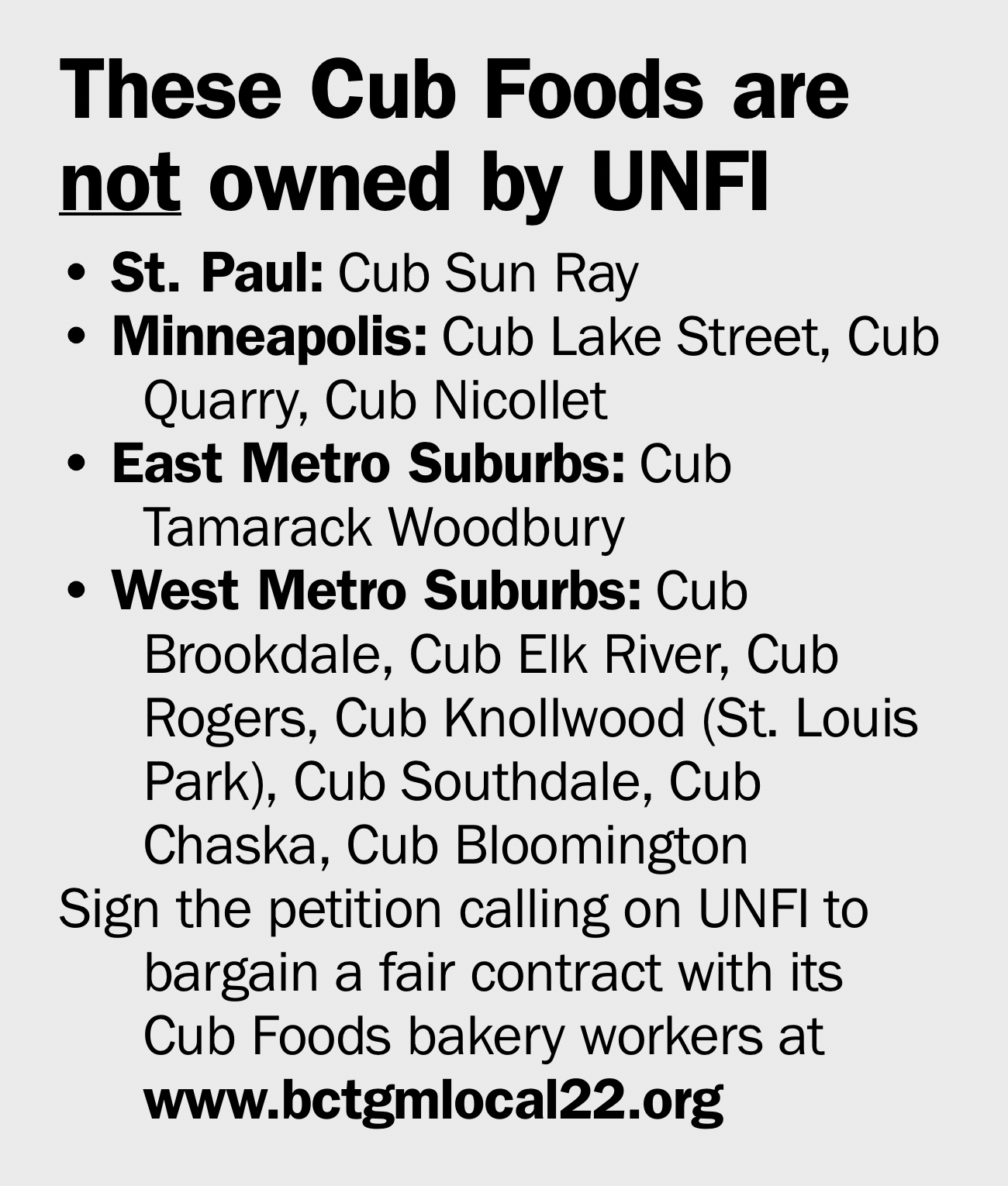
This is the first round of contract negotiations since UNFI acquired Supervalu in 2018. Not all Cub Foods stores are owned by UNFI, which is why Local 22 is circulating a list of stores that are “not trying to negatively impact workers’ livelihoods,” according to the flyer.

The two sides are scheduled to return to the bargaining table in April.

Local 22 is asking supporters to sign a petition calling on UNFI to negotiate a fair contract with its Cub Foods workers.

With support from more unions, St. Paul labor federation gains strength

Working people gain a stronger, more powerful voice when they join together in unions. That’s the basis of collective bargaining and a core principle of the labor movement.

But solidarity works for unions, too. By joining together in coalitions and federations, unions build important bonds that amplify the voice of all working people and advocate for our common interests.

Faced with a relentless wave of corporate attacks on unions and collective bargaining, unions won’t survive unless they stick together.

Three local unions – Bakery Workers Local 22, Teamsters Local 320, and Office and Professional Employees Local 12 – pledged to do just that last month, affiliating with the east metro’s largest labor organization, the St. Paul Regional Labor Federation, AFL-CIO.

“We’re excited and honored to welcome these three local unions into our labor family,” St. Paul Regional Labor Federation President Bobby Kasper said. “There is strength in numbers, and we need to be as strong as possible heading into election season.”

The St. Paul RLF works year round to support its affiliates’ contract, organizing and issue-based campaigns. The federation also recruits, trains and deploys volunteers for Labor 2018, the campaign to elect union-endorsed candidates, in four east-metro counties: Ramsey, Dakota, Washington and Chisago.

OPEIU Local 12

Local 12 of the Office and Professional Employees International Union represents more than 2,500 people working in health care operations, credit unions, the Minneapolis Institute of Art, local union offices and other workplaces in Minnesota.

The local’s largest bargaining unit is at HealthPartners, and women make up roughly 80 percent of the union’s total membership.

Ryan Mortensen, Local 12’s business manager, said the political atmosphere for organized labor drove his union’s decision to affiliate with the RLF.

“We alone cannot take this on,” he said. “By affiliating with the St. Paul labor federation, we gain more voice, more power to get our message out across the state and, hopefully, the nation.”

BCTGM Local 22

Bakery, Confectionery, Tobacco Workers and Grain Millers International Union Local 22’s history in St. Paul dates back to 1886, when it was just the Bakers and Confectioners Union. The founding charter still hangs in Local 22’s offices in Minneapolis.

Today, Local 22 represents about 1,800 workers in Minnesota, South Dakota and Wisconsin, including people working at Pearson’s Candy and Baldinger Bakery in St. Paul.

Union President Bruce Peglow noted the St. Paul RLF provided assistance to Local 22 even before the union affiliated. The RLF stepped up in support of workers at Franklin Street Bakery, whose attempt to form a union has been met with harsh – and sometimes illegal – pushback from management.

“We appreciated that help, and we wanted to help out others in the labor movement as we are able to,” Peglow said. “We’re all stronger when we’re all together. None of us can afford to be an island unto ourselves.”

Teamsters Local 320

Teamsters Local 320 represents 11,500 public employees in all 87 Minnesota counties. They serve cities, townships, counties, school boards and other municipalities in a wide variety of jobs: maintenance workers, lawyers, food service aides, doctors, police and corrections officers, airport workers and more.

Brian Aldes, secretary-treasurer and principal officer, considers Local 320’s diversity to be among its greatest strengths.

“No matter what the member’s craft is, we all have something in common, and that’s being public employees who serve the taxpayers,” Aldes said. “We all understand how important what all of us do is for the public and for our communities.”

Local 320 members also know the importance of electing people to local, state and national office who value the work public employees do. That was among the reasons, Aldes said, the union’s political board voted to affiliate with the RLF.

“We live and die by who we elect to serve in public office,” Aldes said. “We saw what can happen when we don’t have a positive outcome in our presidential elections when the most recent Supreme Court nominee tipped the scales in the Janus case. Now we have nationwide right to work in the public sector.”

Closer to home, Local 320 saw the power of building relationships with elected officials during a difficult round of negotiations with the St. Paul Public Schools over cafeteria workers’ contract.

“We reached out to the St. Paul labor federation and Bobby Kasper, and I’ll tell you, it was an incredible resource to have,” Aldes said. “Whether it’s connections in community-based organizations, school boards, city councils or county boards, the work the labor federation does – and its ability to reach so many households with our message – we just knew we had to be a part of this.

“We’re stronger together.”

At organizing boot camp, workers look to build power from the inside out

Todd Dahlstrom (blue shirt), the Minnesota AFL-CIO’s organizing director, leads a session during the AFL-CIO Organizing Institute last week in St. Paul. The Minnesota Nurses Association hosted the three-day training.

It takes a strong union to bargain a strong contract. Or, as CWA Local 7304 member Jim Wiebe put it: “A hammer doesn’t swing by itself.”

A union steward and welder at the New Flyer bus facility in St. Cloud, Wiebe was one of 55 activists from across the Midwest who traveled to St. Paul last week for the AFL-CIO Organizing Institute, a three-day boot camp in building stronger unions.

It convened less than two weeks after the Supreme Court sided with corporate interests in Janus v. AFSCME, a decision making it harder for public-sector workers to join together and bargain strong contracts.

Janus may be a setback for labor, but activists at the training sounded ready to push back, building power from the inside out.

“Too many of our members, they think that the stewards or the reps are the union,” said Andrea Branson, a HealthPartners billing representative and steward for Office and Professional Employees Local 12. “No, they are the union, but a lot of people don’t recognize that.”

Janus makes “right-to-work” (RTW) the law of the land in public-sector workplaces, allowing workers to reap the benefits of a union contract without sharing in the costs. Under RTW, unions must convince as many workers as possible to resist the temptation of “free-riding” and, instead, sign up for membership.

At the Organizing Institute, activists picked up tips for engaging fellow workers in conversations about supporting their union. Chris Tucker, president of Machinists Local 1010 in right-to-work Iowa, called it one of the most important conversations some people will ever have.

“When you talk to someone who doesn’t have a union, it can be a life changing experience for them,” Tucker said. “They can figure out there’s a better life by bonding together with their fellow workers.”

Even in states like Minnesota without a RTW law on the books (yet), private-sector unions have seen one-on-one conversations build the foundation of successful contract campaigns.

Wiebe’s St. Cloud-based local includes some 600 members of the Communications Workers of America. (“It’s a big unit to mobilize,” he deadpanned.) But as talks with New Flyer reached a tipping point last year, the local staged a rally that drew a third of its members. It was the largest event in Local 7304’s history, Wiebe said – and the result of scores of conversations on the shop floor, in the break room and outside the plant gate.

“New Flyer came to the table after that action, and it looked like they’d lost their best friend,” Wiebe said. What’s more, the company improved its offer on the table to include double-time pay for workers logging overtime on weekends.

Chris Tucker (L), president of Machinists Local 1010 in right-to-work Iowa, said unions can remain strong in RTW states.

Bonnie Jolly, a union steward at the Pearson’s Candy plant in St. Paul, hopes for a similar outcome this fall when Bakers Local 22 enters contract negotiations with the company. She’s already making sure as many members as possible on her shift are tuned into the process.

“We’re going for wages and better benefits,” Jolly said. “Whenever I go on break, I try to talk one-on-one with somebody I work with. I tell them if you don’t get involved now, you have no right to complain after the contract is done.”

In RTW states, though, the work of engaging co-workers doesn’t start when negotiations show up on the calendar. It’s part of a constant campaign to keep the union afloat.

Duluth resident Keith Musolf, a member and organizer for Ironworkers Local 512, represents people in Wisconsin and North Dakota, both RTW states where Ironworkers can opt out of paying dues while working on union job sites.

“You don’t have to drive very far to see a large change,” he said. “We’re so secure in our island of Minnesota, and they’re on their own race to the bottom. Traveling there is just an attitude check for me.”

Indeed, many labor experts now believe RTW will be the law of the land in the near future, whether by legislative action or court decision. (Janus-style cases targeting private-sector workplaces are already in the works.)

But the outcome isn’t necessarily gloomy, Branson said. She befriended several workers from RTW states at the Organizing Institute.

“I’m listening and hearing that a lot of unions in these states got stronger,” Branson said. “They say members have a better sense of what’s at stake. They are the union, they know what it’s about and they haven’t let (RTW) discourage them. I think that is so cool.”

In the end, Wiebe said, every conversation in an organizing drive comes down to the same question, and it’s one public-sector workers in Minnesota and across the country are presently answering for themselves.

“Would you rather try going in and bargaining by yourself, or go in and bargain as a bunch?” Wiebe said. “We’ve got to get people to understand that there’s power in numbers.”

Here’s how labor activists plan to celebrate Super Bowl week

Today marks the kickoff of Super Bowl events in the Twin Cities, and organizers plan a 10-day run of concerts, parties, conventions and other events leading up to the big game Feb. 4 at U.S. Bank Stadium.

What you won’t find listed on the Super Bowl Host Committee’s online calendar are several opportunities to support working people organizing for dignity, respect on the job and quality public services.

“Minnesota’s Super Bowl shouldn’t just be about entertaining the rich and the powerful,” said bakery worker Travis Reinhart, whose union-busting employer will host a star-studded celebrity fundraiser in St. Paul next Saturday.

Already, the St. Paul Federation of Teachers is promoting a social media campaign targeting two of the Super Bowl committee’s biggest corporate sponsors: Ecolab and U.S. Bank. Teachers are in a difficult round of contract negotiations with the St. Paul school district, which is facing a multi-million dollar budget shortfall.

“Money has been stolen from our schools over the last 20 years … and that money has been going into tax breaks for corporations,” SPFT President Nick Faber said.

Kirinda Anderson, a parent active in union-led efforts to address the district’s racial disparities, called on Ecolab and U.S. bank to “step up and be better partners with the schools and the students … and to support public education in the same way they’ve supported this game.”

Here’s a rundown of events you won’t find on the Super Bowl committee’s website:

• The Pre-Game: Our lives over their game. Monday, Jan. 29, 6 to 8:30 p.m. Hamm Plaza, St. Paul.

Unions and worker groups are teaming up with racial-justice, climate-defense and immigrant-rights organizations to plan a march and rally outside the NFL’s Super Bowl Opening Night party in St. Paul.

Activists like Antonia Sanchez, a member of the Twin Cities low-wage worker center CTUL, are calling on the corporations sponsoring Super Bowl week to do more in their community than hold a round-the-clock party for ultra-rich.

“The millionaires are just going to get richer, and we’re not going to get anything out of it,” Sanchez said at a press conference announcing the groups’ Super Bowl plans. “These corporations are grinding us all down.

“We want to demand that these corporations … support raising the minimum wage in St. Paul to $15 an hour. We want them to support ending wage theft in Minneapolis and St. Paul.”

• Super Bowl Protest: Tackle Corporate Greed! Friday, Feb. 2, 4:30 p.m. Home Depot, 1520 New Brighton Blvd, Minneapolis.

Home Depot co-founder Arthur Blank owns the NFL’s Atlanta Falcons, making Super Bowl week the perfect time for janitors who clean Home Depot stores in the Twin Cities to renew their demand that the retailer adopt a responsible contractor policy.

CTUL, which is organizing janitors who clean Home Depot, has negotiated policies with Best Buy, Target and other retailers, paving the way for 500 retail cleaning workers to form a union last year.

Most people working in retail cleaning are immigrants, and CTUL is teaming up with immigrant-rights group Navigate MN to demand Home Depot use its lobbying clout to support so-called Dreamers’ protected status, pass a clean immigration reform bill and end immigration raids dividing families across the country.

• Super Bowl Breakfast: Support $15 and Workers’ Rights! Saturday, Feb. 3, 7 a.m. Hilton Minneapolis, 1001 Marquette Ave.

As the Super Bowl Committee and its corporate sponsors hold a breakfast inside the hotel to honor the NFL’s “positive legacy” of community service, worker groups will gather outside for a “people’s breakfast to honor the worker leaders and community members in Minneapolis and St. Paul who fight for living wages rights on the job for themselves, their families and their communities.”

The event will call attention to the need to fund enforcement of Minneapolis’ new minimum-wage ordinance, and lift up the campaign for a $15 minimum wage – without a tip penalty – in St. Paul.

• A Taste of Justice. Saturday, Feb. 3, 5 p.m. St. Paul Labor Center, 353 W. 7th St.

Workers at Franklin Street Bakery have been trying to organize a union for over two years, looking to improve wages and working conditions in the Minneapolis facility. Their campaign has drawn a stifling – and sometimes illegal – response from management, which recently sent a labor lawyer to intimidate one worker in his own home, according to a report from Bakery Workers Local 22.

Bakery owner Wayne Kostroski holds a hunger-relief event – “Taste of the NFL” – with celebrity chefs, NFL players and wealthy executives each year during Super Bowl week. Last year, bakery workers countered with a fundraiser of their own, and this year they plan to do it again, only blocks away.

“While helping food shelves is a good thing, Wayne pays many workers as little as $11 an hour, forcing us to use food shelves,” Reinhart said. “I know I’ve been there. The Taste of the NFL’s slogan is ‘kick hunger.’ We have a simple answer for Wayne: Kicking hunger starts at home.”

As Super Bowl approaches, NFL players take sides in local labor standoffs

As Minnesota prepares to bask in the Super Bowl spotlight, pro football players are using their platform to lift up Minnesota workers fighting for justice and a voice on the job.

Through their union, the NFL Players Association, the athletes are standing in solidarity with bakery workers fighting for a union in Minneapolis and Teamsters weighing a strike at University of Minnesota campuses statewide.

DeMaurice Smith, executive director of the NFLPA, sent letters this week putting bosses at the university and Franklin Street Bakery on notice that the players stand squarely – and publicly – on the side of working people in Minnesota.

“The NFLPA is a labor union,” Smith wrote to U of M President Eric Kaler on Monday. “In that regard, we do what is necessary to protect the rights of our members and support the efforts of other unionized workers across America.”

At the university, that means supporting members of Teamsters Local 320, who voted in November to authorize a strike after the U balked at their request for contract language strengthening protections against workplace harassment.

The roughly 1,500 custodians, food-service workers and groundskeepers will vote soon on the university’s final contract offer. Union leaders say a vote to reject the offer would trigger a strike, creating a potential conflict for the NFLPA, which plans to hold an event at the U’s alumni center during Super Bowl week.

“We would not have signed the contracts for this event had we known of the pending local labor issues,” Smith wrote to Kaler. “My hope is that the University will resolve all remaining issues with Teamsters Local 320 soon.”

Smith sent a letter Thursday to the CEO of the Super Bowl Host Committee outlining concerns with the glitzy “Taste of the NFL” event, organized annually by Franklin Street Bakery co-owner Wayne Kostroski as a fundraiser for food pantries nationwide. Kostroski, who received a copy of the letter, “doesn’t practice what he preaches” when it comes to his own employees, Smith warned.

“Many Franklin Street Bakery workers are reportedly paid as little as $11 per hour, well below what it takes to sustain a family, raising the real possibility that some of Mr. Kostroski’s own employees are often forced to visit the same food pantries for whom he raises money,” Smith added.

Smith also noted Franklin Street Bakery’s track record of breaking labor law to prevent its workers from organizing for a voice on the job. After the National Labor Relations Board investigated dozens of charges filed by bakery employees, Kostroski and his co-owner last year agreed to a settlement providing $20,000 in back pay to three workers unjustly fired or disciplined for union activity.

But the settlement hasn’t put a stop to bakery workers’ organizing efforts. While Kostroski hobnobs with celebrity chefs and corporate sponsors Feb. 3, his workers will hold a separate event – the “Taste of Justice” – at a union hall just blocks away.

Last year’s “Taste of Justice” raised $1,200 for the food shelf closest to Franklin Street Bakery. The event is free and open to all community supporters. Click here to RSVP on Facebook.

“We stand in full solidarity with our brothers and sisters of the Franklin Street Bakery,” Smith wrote.

Workers to give Franklin Street Bakery owners a ‘taste of justice’

Rosa Baires, pictured speaking at a press conference outside FSB in December, used to work at the bakery, but after taking time off to be with her dying ex-husband, the company told her she no longer had a job – an example, she said, of why workers there need a union.

Rosa Baires, pictured at a rally outside FSB in December, used to work at the bakery, but after taking time off to be with her dying ex-husband, the company told her she no longer had a job – an example, she said, of why workers there need a union.

Fighting hunger is a worthy cause, but workers at a local bakery say their bosses should start by paying them a living wage.

Workers at Franklin Street Bakery in Minneapolis are planning “A Taste of Justice” next Saturday, Feb. 4, the same night their bosses, Wayne Kostrowski and Mark Haugen, will throw their glitzy fundraiser, the “Taste of the NFL,” in Houston. The event raises money for hunger relief each year in advance of the Super Bowl.

The bakery owners have vigorously – and illegally, according to NLRB charges – opposed workers’ efforts to improve their wages and working conditions by organizing for a voice on the job with Local 22 of the Bakery, Confectionery, Tobacco Workers and Grain Millers International Union.

Workers have filed 50 unfair-labor-practice charges with the National Labor Relations Board related to the organizing drive, and many report earning so little that they have to use food shelves themselves.

Union and community supporters are invited to attend the “Taste of Justice” Feb. 4, from 5 to 8 p.m. at Waite House, 2323 11th Ave. S., Minneapolis. Food will be provided at the event, but people who attend are also welcome to bring a dish to share.

In Minnesota, apprenticeship model expanding to other industries

Apprenticeship has long been the backbone of the Building Trades unions. Their on-the-job training programs put workers on a path to family-sustaining careers while ensuring union contractors have access to the highly skilled labor pool they need to remain competitive.

It’s a win-win model.

Now, with a push from the federal government, unions and employers in other industries are looking to emulate it.

Minnesota is one of three states where the AFL-CIO’s Working for America Institute, armed with a grant from the U.S. Department of Labor, is promoting a registered apprenticeship program for industrial manufacturing workers. It’s an 18-month, 3,000-hour training course that employers can access at no cost to boost their workers’ skills.

Several Minnesota manufacturers are warming up to the idea of partnering with a union on an apprenticeship course, program coordinator Jerome Balsimo said.

“Employers have said to us, ‘This is a recruiting tool,’” Balsimo said. “‘There are four or five other manufacturers right next to us, but I’m the manufacturer that has the apprenticeship program, wage increase and industry-recognized certifications when you finish. Come work for us.’”

Among those employers is Baldinger Bakery in St. Paul. After being approached by its workers’ union, BCTGM Local 22, Baldinger agreed to install the Industrial Manufacturing Technician apprenticeship program, which will launch later this year.

The company, which manufactures buns for McDonald’s and other restaurants, recently relocated to a “rebuilt, high-tech facility” on Phalen Boulevard, Local 22 President Ron Mohrland said. Management viewed the apprenticeship program as an opportunity to ensure workers’ skills keep pace.

Much of the training curriculum is standardized, with MnSCU faculty facilitating. But Baldinger is able to customize many aspects to meet the plant’s needs.

“There’s a basic education that these guys are getting, but the plant is helping write the program to what needs to be taught specifically at our facility,” Mohrland said.

About one-third of the 60-plus union members working in the facility are expected to participate, from new hires to more experienced factory workers. Apprentices will get paid for the time they spend in classroom or on-the-job training, and when they complete the program, they will add seven industry-recognized credentials and certifications to their resumes – not to mention the $1.50 per hour raise.

“They’re going to go from walking in the door as a helper to the very top scale, something called a bakery processor,” Mohrland said. “That’s somebody who can pretty much walk in there can do anything – from minor maintenance to running the machines all around the facility.”

Industrial unions like the BCTGM aren’t the only ones eying apprenticeship opportunities as an added value to union membership. Todd Dahlstrom, the Minnesota AFL-CIO’s organizing and growth director, said another federal grant is in the works to boost health care workers’ skills and wages via apprenticeship.

“The union does grievances, the union does arbitration, the union negotiates contracts – all fundamental things that are very, very important. But they’re not always tangible to a new employee,” Dahlstrom said.

“If workers understand that they get their training and certificate for that training through a program their union has helped develop and offer, you get workers on the front end and give them a stronger union identity.”

– Interested in the Industrial Manufacturing Technician apprenticeship? Contact program coordinator Jerome Balsimo at 651-335-2896 or Jbalsimo@mnaflcio.org.

Letters to the Editor: Thanks from sugar workers

CrystalSugICON_1_0(This letter was received by Bobby Kasper, president of the St. Paul Regional Labor Federation. In addition to donating funds to the locked-out workers’ cause, the RLF organized two holiday drives, collecting more than $50,000 worth of toys, household supplies and cash donations for sugar workers and their families.)

Dear President Bobby Kasper,

We would like to personally thank you for your personal support and for the contributions by unions and individuals to the hardship and action funds that your regional federation organized. We will always be grateful for the hard work you have done, along with our members and their families.

  •  John Riskey, President BCTGM Local 167G
  •  Roger Delage, President BCTGM Local 267G
  •  Gayln Olson, President BCTGM Local 372G

*****

New approach to labor education

The other night I met a few people who found out I was a St. Paul Steamfitter/Pipefitter and proud to be so. A group of people verbally attacked me and told me, “The union I work for does nothing for me and steals money from me in the form of union dues!”

So I sat back and told the group of attackers, in a very polite tone of voice, “I respect your vision and opinion, but I don’t work for a union. I work for a contractor who pays me, and I am represented by the union that I chose to pay minimal dues to.”

I used to get upset and argue with friends and relatives about people’s ignorance on skilled labor and how we earn a wage. I have now learned and like to educate others, that anyone who earns a wage is done so out of an arrangement between two parties. Party No. 1 is the party that pays; party No. 2 is the party that gets paid.

I belong to Party No. 2 and choose, along with my skilled brothers and sisters, to earn wages working for union contractors. These wages are based off a contract that was collectively bargained between our membership and the Minnesota Mechanical Contractors Association, which represents the contractors we work for.

– Pauly Strusz, Pipefitters Local 455

Operation Christmas Solidarity to support Crystal Sugar workers

Last year’s Operation Christmas Solidarity raised more than $25,000 in toys and household items for locked-out families.

The St. Paul Regional Labor Federation and American Income Life will sponsor a second Operation Christmas Solidarity this year, with proceeds of the gift, toy and household-goods drive benefiting families of workers who have been locked out of their jobs by American Crystal Sugar.

Over 1,300 members of the Bakery, Confectionery, Tobacco Workers and Grain Millers union in Minnesota, North Dakota and Iowa have been affected by the lockout, which began more than 16 months ago. As the need in these families has grown, their resources have depleted, but last year’s holiday drive raised more than $25,000 for locked-out families.

Unwrapped items and monetary donations will be accepted through Dec. 17 at the following location, by mail or in person: St. Paul Regional Labor Federation, Attention: Laura Testor, 411 Main Street, Suite 202, St. Paul, MN 55102.

Make checks payable to: St. Paul Labor Studies & Resource Center (LSRC). Please note in memo line: Operation Christmas Solidarity. All donations are tax deductible.

Holiday baking? Be sure not to use Crystal Sugar!

This holiday season, your Christmas cookies will taste better knowing union-busting Crystal Sugar isn’t among the ingredients.

The Moorhead-based company has locked 1,300 union workers out of their jobs for 16 months, prompting the AFL-CIO to call a nationwide boycott.

The easiest way to avoid buying Crystal Sugar is to buy cane sugar, like the C&H brand, instead. For more on the boycott, go to www.boycottacs.com.

Locked-out workers, members of the Bakery, Confectionery, Tobacco Workers and Grain Millers union, were scheduled to vote on the company’s contract offer for a fourth time  on Dec. 1.