Worker advocates welcome St. Paul’s new wage theft law

Supporters of a measure to crack down on wage theft were pictured during a rally at the Minnesota Capitol in 2019.

St. Paul will have a new wage theft ordinance on the books Jan. 1.

The measure, pushed by Mayor Melvin Carter and co-authored by all seven members of the City Council, drew praise from labor leaders and worker advocates as a step toward more robust, efficient protections for people working in the capital city.

Construction and service-industry unions, in particular, pushed city officials to add wage theft to the scope of its labor enforcement work.

At a public hearing on the ordinance in October, Carpenters Local 322 member Saben De Smet called wage theft a “competing business model” for too many developers and non-union contractors in his industry.

“Here in Minnesota, a construction contractor using a wage-theft model can underbid other contractors – whether union or non-union – by up to 20%,” De Smet told council members. “This is because they avoid paying worker compensation, unemployment insurance and other costs associated with being above board.

“This is both a leveling of the playing field and a human-rights issue for us.”

Wage theft has come under increased public scrutiny in recent years, after a 2014 report by the Economic Policy Institute estimated that it costs U.S. workers more than $50 billion annually. In Ramsey and Hennepin counties alone, construction workers lose $3 million to wage theft each year, according to a 2022 report authorized by the county attorneys offices.

“If someone was to shoplift or steal a car, you’d expect them to get arrested or get in trouble,” Ironworkers Local 512 member Nick Petrucelle, a co-chair of Minnesota’s Labor Council for Latin American Advancement, told council members. “But employers, they can rip off their employees, they can steal their wages, and it’s really hard to do anything about it.”

St. Paul’s new ordinance largely aligns with state legislation passed in Minnesota five years ago. Hailed at the time as the nation’s toughest wage theft law, it gave state regulators and the Attorney General new powers to investigate wage theft and created stiffer penalties, both civil and criminal.

While St. Paul’s ordinance does not create new requirements for employers, it does complement the city’s unique minimum wage and earned-sick-and-safe-time laws, advocates on the city’s Labor Standards Advisory Committee (LSAC) said.

“City staff should be able to resolve all of these issues together in one package,” LSAC member Rick Varco, political director for SEIU Healthcare Minnesota and Iowa, told council members.

Varco noted that city investigators pursuing a minimum-wage complaint are well positioned to identify other forms of wage theft, too. But without an ordinance on the books, the city must turn the matter over to state regulators.

“This is better for workers who don’t have to navigate one more bureaucratic maze,” he said. “It is better for employers, especially those who fail through ignorance or capacity issues, to have one stop that can get them back on the right track.”

The city’s Department of Human Rights and Equal Economic Opportunity (HREEO) will begin handling wage theft complaints when the new ordinance takes effect Jan. 1.

Wage theft occurs any time employers fail to pay wages employees are legally entitled to, including paying below minimum wage, not paying overtime, requiring work without pay, denying legal breaks, misclassification, withholding tips, failing to pay fringe benefits and making illegal payroll deductions.

“Wage theft is one of the largest types of theft in our country and is a pervasive and systemic problem throughout Minnesota,” St. Paul Regional Labor Federation President Kera Peterson said. “It affects workers in all sectors of our economy. This ordinance helps to make workers in Saint Paul more secure and helps level the playing field for employers who are following our state laws and local ordinances.”

– Michael Moore, Union Advocate editor

Mitra Jalali Nelson: Labor endorsed in St. Paul’s Ward 4

Mitra Jalali Nelson thanks delegates to the St. Paul Regional Labor Federation for their support.

Renters outnumber homeowners in St. Paul, but there are no renters on the city council. That’s something Mitra Jalali Nelson is out to change.

Nelson, the labor-endorsed candidate in a special election Aug. 14 to fill St. Paul’s Ward 4 seat, has drawn on her experience as a renter to craft a “blueprint” of policy proposals aimed at making housing in St. Paul more affordable, like zoning rules that allow development of more rental stock and programs that support aspiring homeowners.

Nelson is thinking big. And as a former union organizer and current aide to U.S. Rep. Keith Ellison, she has firsthand experience turning big ideas into reality.

The self-described “organizer at heart” knows it takes teamwork to make meaningful change.

“I look forward to working hand-in-hand with workers, unions and partners citywide to address income inequality head-on, and achieve citywide progress that brings all of us with it,” Nelson said.

‘The rent won’t wait’

Nelson has positioned herself as a champion of affordable housing from the start of her bid for City Hall. She won labor’s backing, meanwhile, by connecting the dots between her top issue and the things St. Paul unions fight for every day – good jobs, quality public services and strong public schools.

Affordable housing, Nelson said, is “key to ending income inequality” and, in St. Paul, a “crisis” that demands urgent attention.

Recent data from the Census Bureau backs up her claim. It shows 51 percent of renters are in “cost-burdened” situations, meaning they spend more than 30 percent of their income on rent. Too often, Nelson said, the amount is closer to half.

“When people spend most of their income on housing, they’re forced to buy fewer groceries, skip a doctor’s appointment, forego school supplies and spend less in St. Paul businesses,” she said. “Foregoing action on this issue is holding our city back.”

A leading contributor to St. Paul’s affordable housing crisis? Rents are going up faster than working people’s wages. Over the last 25 years, median rents have increased by 9 percent, when adjusted for inflation, while median household incomes have fallen by 3 percent.

Backers of a $15 minimum wage ordinance in St. Paul have printed shirts with their rallying cry: “15 Now because the rent won’t wait.” Nelson said she supports $15 “without any exemptions.”

“I support passing one fair wage for our city and will work with community partners toward a $15 minimum wage citywide without any exemptions,” she said. “As the costs of living rise, our wages have been stagnant, and we need to take significant action locally to address this.”

But the city can also do more to make rental housing more affordable, she said.

“We need to act on our affordable housing crisis, using tools at the city level like inclusionary zoning and upzoning to help create more affordable units throughout the Ward and our city,” Nelson said. “We also need help from the county and state, and I will advocate for and seek additional resources to support the construction of more affordable housing, including public housing.

“As a renter, I am running to organize a coalition of renters and homeowners alike to achieve progress on this issue.”

Unions impressed

Barb Herrington-Hall, who retired this summer after 33 years as an educator, participated in the St. Paul Federation of Teachers’ screening process in Ward 4. She came away impressed with Nelson’s vision, energy and grasp of the issues facing St. Paul.

Nelson’s passion for affordable housing struck a chord with Herrington-Hall, whose job involved making house calls to families in the district to screen children for special education services.

“I’ve been in apartments that the number of people living there, the quality of the housing, it would break your heart,” Herrington-Hall, a Ward 4 resident, said. “And it’s parents who have to work multiple jobs just to pay the rent.

“As educators, we know these parents aren’t able to come to meetings at conference time or help their child with homework. So I see the difference it would make if parents only had to work one full-time job.”

Herrington-Hall also knows Nelson does more than talk about supporting union members.

“The first time I met her she was participating in a rally in front of the school board building to support our bargaining team,” Herrington-Hall said. “Mitra was there in the crowd before she was ever endorsed, standing out in the cold with the rest of us.”

On the web

• Learn more about Nelson’s campaign at www.mitranelson.com.

• View a list of labor-endorsed candidates on the St. Paul Regional Labor Federation’s website.

Parental leave policy a ‘giant leap forward’ for City of St. Paul employees

st-paulApril VanMassenhove gave birth to her second child, Miles, last Tuesday. A clerical worker in the City of St. Paul’s Public Works department, VanMassenhove will exhaust her paid-sick days, then her vacation time and, finally, land on short-term disability in order to maintain an income while she cares for her newborn son.

Fortunately for parents-to-be working for the city, Mayor Chris Coleman and the St. Paul City Council have moved to guarantee paid parental leave for city employees.

The new policy, set to kick in Jan. 1, 2015, will provide four weeks paid salary to employees like VanMassenhove, who are birthing mothers. Non-birthing employees, like fathers or couples adopting children, will have access to two weeks paid salary as they become parents.

“This policy is good for families, and it’s good for bringing in the best and brightest to the City of St. Paul,” Coleman said. “As the manager of a 2,850-person workforce that’s seeing an increase in retirements, I believe this policy will make us an attractive employer to a new generation of public employees.”

City officials estimate the policy will cost $200,000 annually out of the city’s general fund, but it’s worth the price, said Eliot Seide, director of AFSCME Council 5, the state’s largest union of public employees.

“Our capital city is leading the way on paid leave for parents,” Seide said.  “It’s a giant leap forward for working families. And it’s a great benefit to attract the next wave of city employees as baby boomers retire.”

The Family Medical Leave Act guarantees workers up to 12 weeks of job-protected leave after bringing a child into their families – but without pay. That forces new mothers to make difficult choices about caring for their newborn and drawing an income, said Peggy Flanagan, director of the Children’s Defense Fund of Minnesota.

“All workers should be able to take time off to bond with a new child without having to sacrifice a paycheck,” Flanagan said. “Minnesota is a state that values children and families. We applaud the City of St. Paul for reflecting this value in its workplace policies and encourage other cities and employers to follow its lead.”

VanMassenhove, a member of AFSCME, plans to spend at least three months bonding with and caring for Miles. “I need that time to spend with a newborn, especially at first when we’re not sleeping,” she said. “Bringing a child to day care at 6 weeks – I don’t like that. It’s too young.”

But drawing down her paid-sick time – already low as a result of pre-delivery doctor’s appointments – and vacation, VanMassenhove said, will leave her in a perilous position after she returns to work.

“When Miles starts day care, if he gets sick it’s hard for me to take time off and care for him because I don’t have any time left,” she said. “I have to start from zero.”

VanMassenhove is hopeful the new policy will apply retroactively.

“To have one of those three months paid for would just be wonderful,” she said.

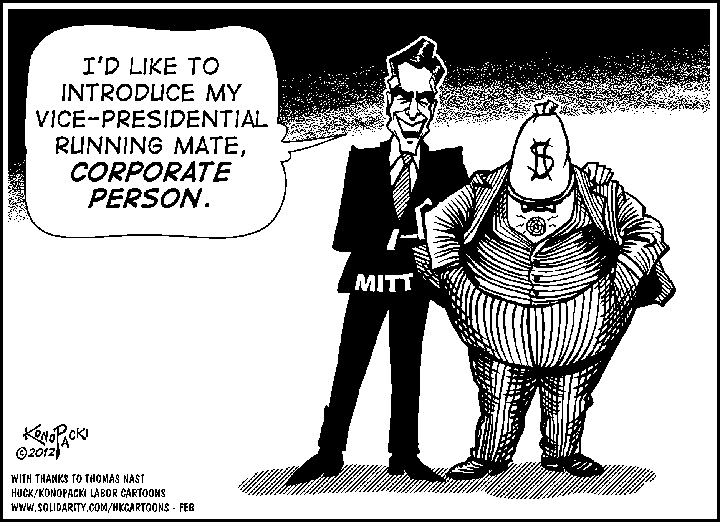
St. Paul City Council to consider resolution against corporate personhood

The St. Paul City Council will consider a labor-backed resolution opposing corporate personhood at its meeting Wednesday, June 13.

Council Member Dave Thune, who authored the resolution, said he expects it to pass. Organizers with the Move to Amend coalition in St. Paul are planning a rally and press conference at 3:40 – 10 minutes after the Council is scheduled to vote on the resolution – in the City Hall lobby.

Pushing cities like St. Paul to pass resolutions is the present organizing strategy employed by Move to Amend, a nationwide organization working to pass a constitutional amendment declaring that inalienable rights belong to human beings only.

Thune modeled his resolution after a similar measure passed by the Duluth City Council in December. Duluth was the first Minnesota city to pass such a resolution, sparking similar resolution drives in cities across the state.

If passed, Thune said, St. Paul’s resolution will “show a groundswell of people care about this and are concerned about it. It’s both a message to decision makers in Washington, but also – and probably most importantly – meant to keep the discussion and the outrage alive at the grassroots level.”

Outrage surrounding corporate personhood exploded with the U.S. Supreme Court’s 2010 Citizens United decision, which struck down campaign-finance laws restricting the ability of corporations – and unions – to spend money to influence elections, candidate selection and policy decisions.

“When that ruling came down it just shook people’s belief and trust in the government,” Thune said. “It turned the reigns over to unelected decision makers making decisions based on how much money was available. It’s just wrong.”

Although Citizens United expanded their ability to spend money to influence elections, unions have criticized the decision loudly from the day it was handed down, and several union groups have backed the Move to Amend campaign.

The St. Paul Regional Labor Federation, AFL-CIO, passed a resolution against corporate personhood in September 2011. The organization is urging members to turn out for the City Council vote on Wednesday.

Thune also urged citizens to attend the vote and the rally afterward.

“It’s pretty well established that cities are the bottom line of government,” Thune said. “We’re showing that at the level of government closest to the people, we are fed up with this thing. We the people are making a statement.”

For more information on the Move to Amend campaign’s work in St. Paul, e-mail minnesota.move.to.amend@gmail.com.