Lex-Ham Community Theater presents ‘Days to Come’

The Lex-Ham Community Theater will present Lillian Hellman’s drama “Days to Come” in six performances this month at the Wellstone Center on St. Paul’s West Side.

The play, directed by John Townsend, is set in 1930s Ohio, and it tells the story of a strike – and the discord it creates within a family-owned business, as family members try to break the strike to preserve their business and their family.

Hellman combines political themes with tales of personal struggle in “Days to Come,” as the play explores union busting, social class and questionable business practices – issues still timely today.

Performances will begin at 7:30 p.m. Oct. 19, 20, 25, 26 and 27; and 2 p.m. Oct. 21. A discussion about the state of organized labor in the Twin Cities during the 1930s will follow the Oct. 25 show.

Tickets are $18 for adults and $12 for children, students and seniors 65 and older. See www.DaysToCome.org for more information.

Statewide labor convention opens with political call to action

Election-year politics dominated Day 1 of the Minnesota AFL-CIO’s 51st Constitutional Convention in Rochester yesterday, as speakers, including U.S. Sen. Amy Klobuchar, urged delegates to take action in support of labor-endorsed candidates up and down the Nov. 6 ballot.

Klobuchar, whose campaign for a second term has the state labor federation’s endorsement, said unions will succeed in the 2012 elections by sticking to their vision for the U.S. economy – one that creates shared prosperity, preserves opportunities for all and rewards those who work hard and play by the rules.

“As hard as this (economy) is, it could be so much worse,” Klobuchar said. “We have to keep focused on the economic agenda, and that’s what I’ve done.”

Klobuchar and other speakers drew a sharp distinction between President Obama’s economic plan and the vision offered by Republican nominee Mitt Romney. One candidate puts middle class families first, she said; the other serves the interests of the richest 1 percent.

“In order to bring the debt down – which it actually doesn’t do – they’re proposing $250,000 in additional tax cuts for people making over $1 million,” Klobuchar said. “That’s totally the opposite of what we need to do.”

Liz Shuler, secretary-treasurer of the national AFL-CIO, called Romney the “outsourcer in chief.”

“At Bain Capital he destroyed jobs and bankrupted companies like they were toys in his personal toy chest,” Shuler said, adding that Romney “even outsources his own bank accounts to Bermuda and Switzerland and other tax havens so he doesn’t have to pay his fair share to support this country.”

Delegates to the convention also heard about political efforts closer to home, including the Minnesota AFL-CIO’s plan to rebuild labor majorities in both houses of the Minnesota Legislature. Republicans in the House and the Senate, Minnesota AFL-CIO President Shar Knutson said, have done much over the last two years to divide workers, weaken unions and make it harder to vote – but they haven’t done much to create jobs.

“They tried to throw everything they could at us,” Knutson said. “They tried to weaken collective bargaining, gut prevailing wage, reduce safety standards and attack the professionals that educate our children… There were hundreds of attacks.”

Ultimately, DFL Gov. Mark Dayton helped stave off most attacks on workers. But as Nov. 6 draws closer, Knutson said, union members must remember how narrow Dayton’s election was.

“If 2.4 percent of union members had voted for Emmer instead of Dayton, Tom Emmer would be governor, and our state would look just like Wisconsin,” she said, referring to the all-out attack on collective bargaining that took place after Republicans swept control of that state’s government in 2010.

“If we do what we need to do – knock the doors, make the calls, get those fliers out at the worksite, talk to our friends and neighbors – we will elect a pro-worker majority to the Minnesota Legislature that will put us, middle class families, to work,” Knutson added. “If we fail, Right to Work will come back with a vengeance.”

After the conclusion of business Sunday, the convention floor became the site of a brief Labor 2012 campaign phone bank, as delegates called fellow union members on behalf of endorsed candidates from Southeast Minnesota.

The Minnesota AFL-CIO’s convention continues today. Delegates participated in workshops this morning, and were scheduled to hear from more speakers, including Dayton, this afternoon.

Today’s schedule also includes presentations on union organizing, the campaigns to defeat both constitutional amendments on the Nov. 6 ballot and the lockout of 1,300 American Crystal Sugar workers in Minnesota, North Dakota and Iowa.

Union leaders applaud Supreme Court decision upholding Affordable Care Act

Minnesota AFL-CIO President Shar Knutson spoke at a rally for supporters of the Affordable Care Act in 2009.

The U.S. Supreme Court’s decision to uphold the Affordable Care Act, announced today, keeps the country moving toward a health care system that ensures affordable, high-quality coverage for all Americans, Minnesota’s union leaders said.

The court’s narrow, 5-4 decision to keep intact the landmark 2010 law, known as “Obamacare,” drew cheers from workers, retirees, students and other groups whose access to health care and prescription drugs has increased as a result of the Affordable Care Act.

Shar Knutson, president of the 300,000-member Minnesota AFL-CIO, called it a “great day for working Americans” and said the decision “clears the way for millions of people to have the access to the affordable, high quality health care that had previously been denied.”

Knutson added: “Minnesota’s union members worked hard to make this law a reality, and we are pleased the court affirmed its constitutionality. Now that this issue has been settled, we are hopeful our elected leaders will come together to craft policies that get middle class Americans back to work.”

Knutson and other supporters of the Affordable Care Act pointed to several benefits of the law that Minnesotans will continue to enjoy as a result of the court ruling.

• Seniors with Medicare coverage are saving money on prescription drugs as a result of the new health care law. Minnesota’s seniors already have saved millions since the law passed, according to statistics from the Centers for Medicare and Medicaid Services.

• Insurance companies may not deny coverage to people with pre-existing medical conditions, a provision that has made coverage accessible for hundreds of Minnesotans.

• Thousands of young adults, up to age 26, are able to stay on their parents’ insurance plans as they transition into the workforce. U.S. Department of Health and Human Services statistics show that 35,000 Minnesotans have taken advantage of this provision of the Affordable Care Act.

“Seniors will continue to be spared from having to choose between paying for prescription drugs and putting food on the table,” Knutson said. “Parents can rest easier knowing their children are covered. Bankruptcies due to health care costs will soon become a thing of the past.”

SEIU Healthcare Minnesota President Julie Schnell, whose union represents thousands of workers in hospitals and care centers statewide, said the decision rejects the cynical, partisan idea that “we are all on our own” when it comes to our health.

“SEIU Healthcare Minnesota’s nurses, doctors, and caregivers know firsthand there’s no room for such extreme politics in the overall governance of our health care system,” Schnell said. “Justices made a decision that now is not the time to slow down the benefits of the law that is making health care more affordable.”

Health care advocates warned, however, that the ruling will not stop opponents of the Affordable Care Act from seeking to dismantle it in Congress. The House of Representatives, in fact, is scheduled to vote on repealing the law next month.

“Today is a tremendous victory for seniors, their children, and their grandchildren,” said Edward Coyle, director of the 4 million-member Alliance for Retired Americans. “But we cannot rest on our laurels. In the 2012 elections we cannot let politicians roll back the progress we have made.”

Others warned that more work remains in order to achieve a health care system that works for all Americans. Linda Hamilton, president of the Minnesota Nurses Association, called the Affordable Care Act “an important first step,” but noted that an estimated 250,000 Minnesotans remain uninsured.

“As nurses, we don’t want to see a single patient suffering because he or she doesn’t have adequate and affordable health care coverage,” Hamilton said. “We need Medicare for all, and it’s our mission as nurses to keep this country moving toward that goal.”

Many unions will join a public celebration of the Supreme Court decision upholding the Affordable Care Act tomorrow in Minneapolis. The celebration is set to begin at 11 a.m. in Government Plaza. Click here for details.

Workers will protest archdiocese for dissolving Catholic Spirit union

Workers will rally outside the Cathedral of St. Paul on June 24, protesting the archbishop’s decision to strip 13 workers of their union rights.

The Twin Cities labor community will rally behind workers at The Catholic Spirit newspaper Sunday, protesting Archbishop John Nienstedt’s decision to strip 13 workers at the archdiocesan publication of their union rights.

The protest will begin at 9:30 a.m. Sunday, June 24, at the Cathedral of St. Paul. It is being organized by the St. Paul Regional Labor Federation and the Minnesota Newspaper Guild, which has represented workers at The Catholic Spirit since 1965.

Click here to view complete details of the protest.

Click here to read The Union Advocate’s full report on The Catholic Spirit dispute.

In an overhaul intended “to create a more integrated communications function,” the Archdiocesan Office of Communications will absorb The Catholic Spirit and some of its 13 workers at the end of this month – but not their union contract.

In negotiations, Guild members asked representatives of the Archdiocese of St. Paul and Minneapolis, which publishes The Catholic Spirit, to continue recognition of their bargaining unit voluntarily. The archdiocese denied that request.

Workers say that decision ignores church teachings that address the value of labor unions and collective bargaining in a socially just workplace.

The Guild is asking supporters to contact Archbishop Nienstedt and ask him to respect The Catholic Spirit workers’ request to keep their union. To reach the archbishop, call (651) 291-4511, or fill out the e-mail form on the archbishop’s website.

Archdiocese strips Catholic Spirit workers of their union contract

The Catholic Spirit is the award-winning official publication of the Archdiocese of St. Paul and Minneapolis.

The Archdiocese of St. Paul and Minneapolis is moving forward with plans to dissolve the bargaining unit of workers at its official newspaper, The Catholic Spirit, when their current collective bargaining agreement expires at the end of this month.

In an overhaul intended “to create a more integrated communications function,” the Archdiocesan Office of Communications will absorb The Catholic Spirit and some of its 13 workers, but not their union contract.

In meetings with lawyers for the archdiocese last month, Catholic Spirit workers, represented by the Minnesota Newspaper Guild, requested the archdiocese voluntarily continue to recognize their bargaining unit within the expanded communications office. The archdiocese denied that request, prompting Guild members to send a letter to Archbishop John Nienstedt seeking clarification.

“The only reason we were given for the unit disappearing so far is that the Guild unit does not fit within the central corporation’s needs,” said Chris Pierskalla, chair of the Guild’s Catholic Spirit bargaining unit. “That hasn’t been expounded upon.”

The Guild is asking supporters to contact Archbishop Nienstedt and ask him to respect The Catholic Spirit workers’ request to keep their union. To reach the archbishop, call (651) 291-4511, or fill out the e-mail form on the archbishop’s website.

The Guild has represented workers at The Catholic Spirit since 1965. Prior to the communications overhaul, the bi-weekly newspaper, with a circulation of 82,000, operated “not independently, but with autonomy” from the archdiocese, Pierskalla said. The archbishop served as publisher, but the newspaper “operates basically at the direction of the associate publisher and his staff.”

The arrangement has fostered award-winning results. The Catholic Spirit and its staff members have collected several awards from the Catholic Press Association, including first place in the General Excellence category in 2009.

It remains unclear how the newspaper will fit into the archdiocese’s new communications strategy – and how the transition will affect The Catholic Spirit’s 13 workers. Guild members, Pierskalla said, are feeling uncertain about their wages, benefits and job security.

“We’ve had two meetings, and we still don’t know what the transition plan is,” he said. “Jobs aren’t necessarily going to move over the way they are now. We know they are not moving the newspaper as it is over there; they are changing. But as of yet we don’t know what the changes are.”

In a statement released today, the archdiocese confirmed plans to continue publishing on a bi-monthly schedule, but acknowledged that some Guild members will lose their jobs at the end of the month due to “overlap in functions.” For workers absorbed into the office of communications, their Guild contract will be replaced by a non-negotiable employment agreement called “Justice in Employment.”

According to the archdiocese’s release: “This employment agreement, which has been in place in the Archdiocese since 1999, provides a number of features that provide extensive protections for employees. In addition, the Archdiocese provides an Office of Conciliation to assist employees in protecting their rights afforded under the ‘Justice in Employment’ agreement.”

Pierskalla and other workers say they would prefer to keep their collective-bargaining rights.

“I would like to stay within the unit,” Pierskalla said. “I would like to have collective bargaining. If this were to be lost, what I would miss most are those opportunities to be treated like a peer at the table. Not to assume immediately that I won’t be treated that way by management going forward, but it’s an unknown right now.”

As a religious entity, the archdiocese appears to be on firm legal footing in dissolving the Catholic Spirit bargaining unit. But workers say the archdiocese, in refusing their request for voluntary recognition, ignores Catholic doctrine supporting their right to union representation.

In their letter to Nienstedt, workers cited the writings of Pope John Paul II. The letter states: “Laborem Exercens, under The Importance of Unions, No. 20, states: ‘All these rights, together with the need for the workers themselves to secure them, give rise to yet another right: the right of association, that is to form associations for the purpose of defending the vital interest of those employed in the various professions.’”

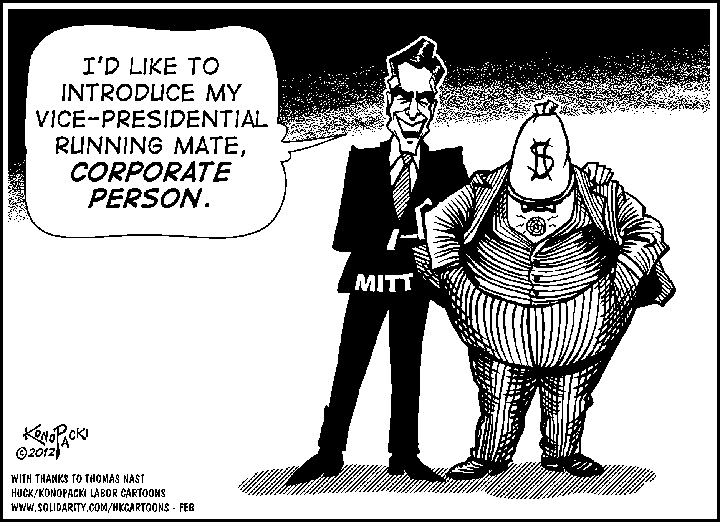
St. Paul City Council to consider resolution against corporate personhood

The St. Paul City Council will consider a labor-backed resolution opposing corporate personhood at its meeting Wednesday, June 13.

Council Member Dave Thune, who authored the resolution, said he expects it to pass. Organizers with the Move to Amend coalition in St. Paul are planning a rally and press conference at 3:40 – 10 minutes after the Council is scheduled to vote on the resolution – in the City Hall lobby.

Pushing cities like St. Paul to pass resolutions is the present organizing strategy employed by Move to Amend, a nationwide organization working to pass a constitutional amendment declaring that inalienable rights belong to human beings only.

Thune modeled his resolution after a similar measure passed by the Duluth City Council in December. Duluth was the first Minnesota city to pass such a resolution, sparking similar resolution drives in cities across the state.

If passed, Thune said, St. Paul’s resolution will “show a groundswell of people care about this and are concerned about it. It’s both a message to decision makers in Washington, but also – and probably most importantly – meant to keep the discussion and the outrage alive at the grassroots level.”

Outrage surrounding corporate personhood exploded with the U.S. Supreme Court’s 2010 Citizens United decision, which struck down campaign-finance laws restricting the ability of corporations – and unions – to spend money to influence elections, candidate selection and policy decisions.

“When that ruling came down it just shook people’s belief and trust in the government,” Thune said. “It turned the reigns over to unelected decision makers making decisions based on how much money was available. It’s just wrong.”

Although Citizens United expanded their ability to spend money to influence elections, unions have criticized the decision loudly from the day it was handed down, and several union groups have backed the Move to Amend campaign.

The St. Paul Regional Labor Federation, AFL-CIO, passed a resolution against corporate personhood in September 2011. The organization is urging members to turn out for the City Council vote on Wednesday.

Thune also urged citizens to attend the vote and the rally afterward.

“It’s pretty well established that cities are the bottom line of government,” Thune said. “We’re showing that at the level of government closest to the people, we are fed up with this thing. We the people are making a statement.”

For more information on the Move to Amend campaign’s work in St. Paul, e-mail minnesota.move.to.amend@gmail.com.

Dakota County legislators dodge community meeting on school funding

Working America member Mike Adair addresses a community meeting on school funding in Burnsville.

A group of Dakota County residents convened a community meeting in Burnsville May 12, hoping to give people an opportunity to ask their legislators questions about things like school funding and property taxes.

Unfortunately, not one of the area’s legislators acted on the invitation to attend, leaving the roomful of concerned parents, school district employees and other community members with more questions than answers.

“Why are our schools suffering? Why are property taxes on the middle class skyrocketing while our schools are giving kids less and less each year?” asked Mike Adair, an Eagan resident and father of four students in the Eagan school district.

“It’s not the district’s fault that they are squeezed dry every year. This mess comes directly from the state, and our representatives need to be held accountable for making choices that hurt our kids and their schools.”

The meeting underscores the task at hand for Minnesota’s union members and their community allies in this election year. The 2011-12 legislative sessions produced unprecedented attacks on workers from newly elected Republican majorities in the House and Senate, including a so-called “Right to Work” constitutional amendment.

Electing pro-worker majorities to the Legislature this November will require unions, through their Labor 2012 campaign, to make gains in places like Burnsville and Eagan, communities that have suffered from the state’s failure to fund local schools and public services adequately.

Residents like Adair, a member of the AFL-CIO community group Working America, are ready to work for candidates committed to raising revenue fairly to balance the budget in 2013.

“This is not the Minnesota I envisioned my kids growing up in,” said Adair. “Simply putting band-aids on the wounds every school year is not going to help. We need to think long-term.”

Metro-area unions will kick off in the Labor 2012 campaign with a rally May 17 in Minneapolis, where union leaders and volunteers plan to “celebrate our victories – and talk about what’s next, so these attacks don’t come back in 2013.”

Immigrant workers march on Wells Fargo, accuse bank of betraying their communities

People line the sidewalk outside Wells Fargo downtown Minneapolis, waiting to close their accounts with the bank.

Hundreds marched through the streets of downtown Minneapolis on May 11, protesting the recklessness and hypocrisy of Wells Fargo’s dealings with Minnesota’s immigrant community.

The march capped a weeklong string of “Occupy”-style protests across the Twin Cities. Organized by the Service Employees union (SEIU) in partnership with several progressive, faith-based and labor groups, the “99 Percent Week of Action” took aim at corporate tax dodgers and irresponsible Wall Street CEO’s with public demonstrations, civil disobedience and street theater.

Aztec dancers open the protest outside Wells Fargo in Minneapolis.

The May 11 event began on the sidewalk outside Wells Fargo’s Marquette Avenue branch, where colorfully dressed Aztec dancers twirled and danced to a lone drummer’s thunderous beat, entertaining dozens of people lined around the block, waiting to close their Wells Fargo accounts.

Javier Morillo-Alicea, president of SEIU Local 26, waved a withdrawal slip in the air as he addressed the crowd of protesters. The union, he said, had removed $72,000 in funds from Wells Fargo and had presented the bank with a petition signed by more than 1,000 people ready to do the same.

“We’ve been trying to get these big banks to listen to us, but they refuse to be good partners in our community,” Morillo-Alicea said. The union leader cited a long list of complaints about Wells Fargo, including the bank’s record of foreclosing on homes owned by immigrants and targeting immigrant communities with offers of “reckless subprime mortgages.”

Rank-and-file union members, meanwhile, said they felt betrayed by Wells Fargo, an institution that markets heavily to immigrant communities but, at the same time, bankrolls several organizations, businesses and politicians working contrary to most immigrant workers’ interests.

“Wells Fargo is the place where thousands of workers have deposited not just our money, but our trust,” said Gerardo Cajamarca, a member of Local 26. “Wells Fargo betrays that trust by financing anti-immigrant politicians. These are politicians that enact laws that hurt us, the 99 percent.

“In the last two years about 2,000 members of SEIU local 26 have lost their jobs because of our broken immigration system. We are here to protest the policies and politics of Wells Fargo and what they are doing to our communities.”

Fany Fonseca, a Local 26 steward, said more and more workers are beginning to connect the dots.

“As an immigrant and a customer of Wells Fargo, I was surprised to learn they are investing in private prison systems like Corrections Corporation of America,” Fonseca said, singling out a Wells Fargo-backed company that lobbied for – and profited from – Arizona’s extreme anti-immigrant law.

“We say enough of profiting off of immigrants,” Fonseca added. “The Latino community has had it. We will no longer work with banks that do not support our communities. Enough is enough!”

Many of the workers waiting to close their accounts at Wells Fargo were Somali immigrants, upset that the bank was refusing to conduct wire transfers necessary to send money to relatives in their native country.

Imam Hassan Mohamud said many families in Somalia depend on support from relatives living abroad. By blocking wire transfers from Somali immigrants to their families, he added, Wells Fargo “puts millions at risk” of starvation and death.

“We cannot let any institution, whether it is Wells Fargo or a government institution, let those people die,” Mohamud said. “My brothers and sisters, war and terror have nothing to do with this situation.”

Union reaches tentative agreement with The Saint Paul Hotel

The Saint Paul Hotel became the target of several union demonstrations as negotiations with UNITE HERE Local 17 stalled last winter.

After six months of unusually bitter contract negotiations, union workers at The Saint Paul Hotel will vote May 17 on a tentative agreement with the company on a new three-year contract.

Leaders of UNITE HERE Local 17, the union that represents about 170 workers at the downtown hotel, are recommending members vote to accept the tentative agreement. Local 17 President Nancy Goldman would not comment on details, but said the agreement includes “everything we asked for and more.”

The union’s previous contract with The Saint Paul Hotel expired Dec. 1, 2011.

Local 17 has represented the hotel’s workers since 1984, but when contract talks began last November, management surprised union negotiators by insisting on steep concessions from the hotel’s workers.

According to Goldman, the company sought to dramatically decrease its contribution to workers’ health insurance and pension benefits. Management also proposed rolling back new employees’ wages by as much as $8 per hour.

While The Saint Paul Hotel insisted on concessions, it never pleaded poverty in negotiations, Goldman said.

“We have never had this sort of dispute go on (at The Saint Paul Hotel), and there was absolutely no need for it,” she said. “Management never claimed to have an economic problem. I asked them outright, ‘Is it because you can’t afford it?’ and they said no.”

With negotiations deadlocked, Local 17 ratcheted up public pressure on the high-profile hotel, mobilizing a network of supporters throughout the community that included labor federations, progressive groups and faith-based organizations.

Twice over the winter, the union turned out dozens of people for informational picketing outside the hotel. Supporters also called and e-mailed management to voice their disgust.

Goldman said the public response forced hotel negotiators to “come off their position” of demanding concessions.

“So many people called and e-mailed the hotel,” she said. “I know several organizations pulled their business out of there, and a lot of people stayed out of the hotel. Several large pieces of business for the hotel booked their functions elsewhere.”

Local 17’s successful contract campaign, Goldman added, speaks to the value local unions gain from being a part of the larger labor community. The St. Paul Regional Labor Federation, she said, played a key role in building public pressure on the hotel to negotiate fairly with its workers.

“President Bobby Kasper and the Regional Labor Federation were extremely helpful in this,” she said. “Bobby made phone calls, he spoke directly to the manager and the general manager over there, and the RLF assisted with rallies and getting people there.”

With time running out at the Capitol, unions plan rally for jobs

Before adjourning the 2012 legislative session, Minnesota lawmakers could act on a pair of bills that, if passed, would create nearly 50,000 family-sustaining jobs. But on Tuesday it appeared Republican majorities in the House and Senate were more preoccupied with saving their own.

By law, the session must adjourn by May 21. That means the clock is ticking on an infrastructure-jobs bill and a $1 billion financing package for construction of a new Vikings stadium. Together, the measures could create more than 40,000 jobs in the sluggish construction industry.

Unions are lobbying hard for both measures. The state’s largest labor federation, the Minnesota AFL-CIO, announced plans to stage a rally on the Capitol steps Thursday at 11 a.m.

“Workers in the construction trades were hit hardest when the great recession began and the sector still has yet to recover,” Minnesota AFL-CIO President Shar Knutson said. “Stadium construction and a large infrastructure bill will put tens of thousands of Minnesota construction workers back on the job in every corner of the state.

“If the Legislature adjourns and leaves nearly 40,000 family sustaining jobs on the table; it will be a great disservice to Minnesotans who want and need to work. Middle class Minnesotans are waiting for real results on job creation from this Legislature.”

Gov. Mark Dayton, waiting for the Legislature to resume its work tomorrow, held a press conference at the Capitol today, responding with visible disappointment to Republican leaders for calling a last-minute stadium audible yesterday. They attempted to alter the existing stadium package after “thousands of hours of negotiations and seven committee hearings,” according to the governor.

The Republican proposal for a “roof-ready” stadium on the current Metrodome site is a non-starter for the Vikings’ local partner, the City of Minneapolis. Dayton said Republicans know their proposal will not pass, but are seeking to give themselves political cover with voters hungry for the jobs a new stadium would create.

Dayton characterized it as “one of the most cynical attempts at political gamesmanship” he has ever seen.

“It’s extremely, extremely disappointing and profoundly disturbing that all these months of working together, working it out together … have come to this kind of disaster,” Dayton added. “I hold the Republican leadership in the House and the Senate responsible for it.”

Unions are encouraging members to tell their legislators that Minnesota needs middle class jobs, not tax cuts for corporations.