Twin Cities workers join nationwide Walmart strike

Supporters set up a picket line outside the Walmart in Brooklyn Center, where two associates, members of OUR Walmart, are on strike this week.

Supporters set up a picket line outside the Walmart in Brooklyn Center, where two associates, members of OUR Walmart, are on strike this week.

BROOKLYN CENTER – Walmart associates from Apple Valley and Brooklyn Center walked off the job today, joining another nationwide wave of strikes and demonstrations targeting the world’s largest retailer for its low pay and retaliation against workers looking to organize.

Similar strikes took place today in 20 other U.S. cities, as members of the workers’ group OUR Walmart built up momentum for demonstrations Friday outside Walmart’s annual shareholder meeting in Fayetteville, Ark.

Twin Cities supporters, including U.S. Rep. Keith Ellison, demonstrated outside the Walmart here today. They rallied around Cantaré Davunt, an Apple Valley associate and one of three local OUR Walmart members who joined the strike.

“I walked into work today and told them I will not be coming in, even though I was on the schedule” Davunt said.

U.S. Rep Keith Ellison hugs Cantare Davunt, who walked out of her job at Walmart in Apple Valley to join the OUR Walmart strike.

U.S. Rep Keith Ellison hugs Cantare Davunt, who walked out of her job at Walmart in Apple Valley to join the OUR Walmart strike.

Two workers at the Brooklyn Center store walked off the job earlier this week. They traveled to Arkansas yesterday and will take part in protests outside Walmart’s shareholder meeting, OUR Walmart organizer Diana Tastad said.

Strikers nationwide are demanding Walmart pay $25,000 a year for full-time work, reinstate workers who have been fired for taking part in OUR Walmart activities and end its campaign of retaliation against workers standing up for a voice on the job.

“I’m on strike today to end retaliation,” Davunt said. “I’m tired of seeing (OUR Walmart) members and other associates bullied in the workplace because they want to speak out. We want Walmart to end the retaliation so we can finally live better.”

The midday demonstration in support of striking workers drew about 30 people, including clergy, other low-wage workers, small business owners and supporters from the labor community. In addition to ending retaliation, demonstrators called on Walmart to raise wages and provide more stable scheduling, so that working parents are better able to balance work and family commitments.

“We’re not anti-Walmart, we’re anti-poverty wages,” Ellison said.

A DFLer from Minnesota’s 5th Congressional District, Ellison and his staff have become a fixture of local Walmart walkouts, providing assurance to workers that they have the right to strike – and warning Walmart that it is illegal to retaliate against workers who participate.

“Our country has been made great because of courageous people like you,” Ellison told Davunt. “I want you to know you’ve got the love, affection and appreciation of people all over this state and this country.

“If anybody messes with you, we want to know about it right away. We’re going to do something about that because it’s retaliation.”

The NLRB last year charged Walmart with illegally threatening, disciplining and firing workers for participating in OUR Walmart protests and strikes – charges the retailer is currently fighting in court.

Among the incidents included in the NLRB’s case against Walmart is the disciplining of an associate in Sauk Centre, Minn., who joined an OUR Walmart strike one year ago. Mike Ahles, who took part in protests surrounding the company’s 2013 shareholder meeting, received a “coaching” – Walmart’s term for disciplinary action – from his manager for missing work. After three coachings, a worker can be fired.

Davunt said she’s seen too many “coachings” come on the heels of workers speaking out.

“If you do something to speak out, they’ll find a reason to coach you,” Davunt said. “It’s scary when you can’t afford to run the risk of losing your job and your income.

“I’m not afraid because I believe no matter what Walmart chooses to do, I’m doing the right thing. There are too many people who are scared to speak up, so I’m doing this for them too.”

The Walmart Wall of Inequality.
The Walmart Wall of Inequality.

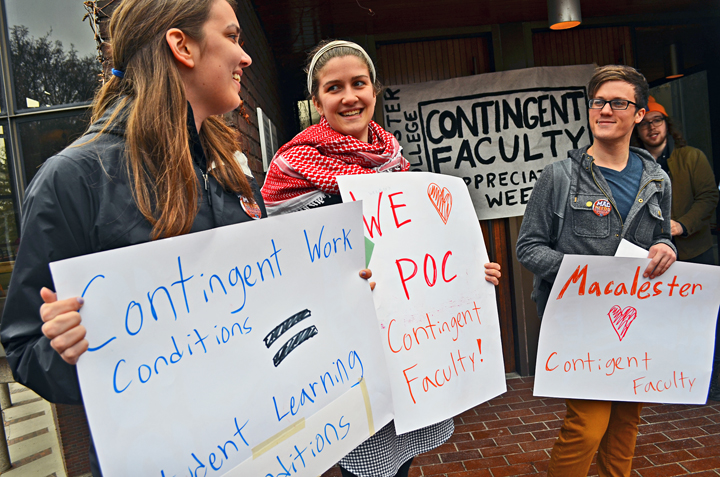
Macalester won’t stay neutral in faculty union vote

Macalester sophomore Julia Gay leads a rally during Contingent Faculty Appreciation Week on campus.

Macalester sophomore Julia Gay leads a rally during Contingent Faculty Appreciation Week on campus.

Despite public appeals from students, instructors and U.S. Rep. Keith Ellison to take a neutral stance, Macalester College administrators last week announced their opposition to efforts by contingent faculty members to organize a union.

Macalester President Brian Rosenberg and Provost Kathy Murray revealed their opposition in a memo sent May 2 to the school’s tenured and tenure-track faculty members, who are not a part of the organizing drive. Macalester’s student newspaper, The Mac Weekly, obtained a copy of the memo.

Although respectful in tone, the memo takes a clear stance against the union, arguing that organizing “is not the right direction for any of our faculty members, will not strengthen our institution or our governance structure, will not help the faculty who are directly involved, and will not assist our students in any way.”

Rosenberg and Murray also declared their intent to tell contingent faculty members “why the College is opposed to this effort” before they vote on whether to join Local 284 of the Service Employees International Union. The vote is likely to take place in June.

[Sign a petition calling on Macalester not to use financial resources to fight its contingent faculty members’ union drive.]

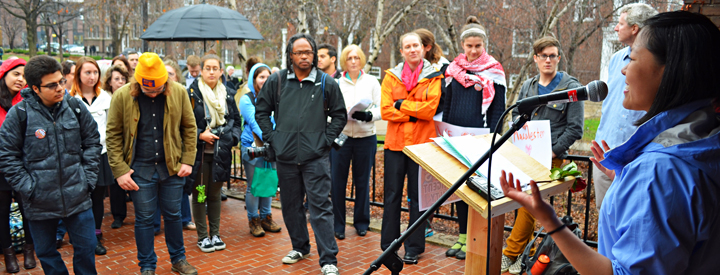
U.S. Rep. Keith Ellison urges Macalester to remain neutral during contingent faculty's organizing drive.

U.S. Rep. Keith Ellison urges Macalester to remain neutral during contingent faculty’s organizing drive.

In forgoing neutrality, the administrators turned a blind eye to a sizable demonstration on campus last month. The culmination of a student-organized “Contingent Faculty Appreciation Week,” the rally drew students, faculty members and community leaders who showed their support for the organizing drive – and voiced their opposition to interference from the administration.

“It would be unfitting for this school to interfere with a union drive,” Rep. Ellison warned administrators during a speech at the rally. “It would lower this institution that has given so much to the world if you took any position other than neutrality.”

The 5th District Congressman, who taught a course on civil rights and liberties at Macalester 20 years ago, praised contingent faculty members at Macalester and adjunct undergraduate instructors at nearby Hamline University, who also have petitioned the National Labor Relations Board to conduct a union election, for having the courage to “step out and say we are going to organize a union,” acknowledging the decision can be “a little scary.”

Feeling invisible

Contingent faculty members at the rally said they approached forming a union as a proven method of achieving greater job security, more professional development opportunities, higher pay and more reliable benefits. And like any group of workers looking to organize, they want a voice in decisions that affect their working conditions.

“Contingent faculty often just feel invisible,” said Kathryn Pratt, a former contingent faculty member who now works for the school’s Institute for Global Citizenship. “Contingent faculty want to be allies and collaborators in decision-making processes and not feel like they are on the margins of decision-making processes.”

Better working conditions for contingent faculty, visiting assistant professor Brendan Miller added, will increase stability inside the classroom – and increase instructors’ availability to students outside the classroom. Faculty members are paid substantially less per course if they do not teach a full course load, forcing many to pick up courses at campuses across the metro. That makes it especially difficult to work with students outside of class hours, Miller said.

Eric Otremba, a visiting professor of history at Macalester, thanks students for organizing Contingent Faculty Awareness Week.

Eric Otremba, a visiting professor of history at Macalester, thanks students for organizing Contingent Faculty Awareness Week.

Miller, who teaches physics and astronomy at Macalester, pointed to a list on the school’s website of key reasons students should choose to enroll, including a strong commitment to teaching, low student-to-faculty ratios and opportunities for interaction between faculty and students.

“Contingent faculty are essential to Macalester delivering on this core mission,” Miller said. “We share and we embody Macalester’s strong commitment to teaching.”

Student body supportive

Still, contingent faculty members are treated differently than their tenured and tenure-track colleagues – a fact that initially surprised sophomore Kathy Paral, one of the organizers behind Contingent Faculty Appreciation Week.

“In the classroom there is no difference,” Paral said. “Contingent faculty do as much work and are just as passionate as any other faculty member. My education at Macalester would be hard to imagine without them.”

Junior Eli Liebman said the organizing drive “affects every student here.”

“If the contingent faculty have a union, then they have a collective voice, they can make decisions as a group and have a little more power,” Liebman said. “They probably would be compensated more and maybe be more willing to do more work outside their contracts. If you do that now and you’re an adjunct professor, you do that out of the goodness of your heart.”

web.mac-students

Postal workers to Staples: ‘The U.S. mail is not for sale!’

web.staples-staplesU.S. Postal Service employees from the Twin Cities rallied with supporters April 24 outside a Staples store in Roseville, part of a nationwide day of action opposing plans to put USPS service counters inside Staples locations across the country.

Already, 82 Staples stores in Georgia, California, Pennsylvania and Massachusetts house USPS service counters, and postal administrators hope to expand to other locations – and, potentially, other retail chains – if the pilot program is successful.

But union members at the rally decried the pilot program as a privatization scheme that threatens middle-class jobs and undermines the security of the mail.

Supporters of the Stop Staples campaign march outside the Roseville location during a nationwide day of action.

Supporters of the Stop Staples campaign march outside the Roseville location during a nationwide day of action.

All four unions representing USPS workers – the American Postal Workers Union, the National Association of Letter Carriers, the National Postal Mail Handlers and the Rural Letter Carriers – are united in opposition to the program.

“For a while we splintered, but we’re standing together on this,” said Dan Garhofer, president of St. Paul-based Branch 28 of the Letter Carriers.

“If you pick on one of us, you get all of us,” added Mike Zagaros, president of Branch 9 in Minneapolis. “That’s what unions are all about.”

Increased access – at a cost

The Staples plan won support from Postmaster General Patrick Donahoe as a way to increase public access to postal services, but postal union members raised several objections at the rally.

Allowing Staples employees to do postal work, they said, undermines the security of the mail. Uniformed postal workers swear an oath to protect the safety and security of the mail. They must pass a background check before being hired, and, once on the job, they go through trainings that equip them to uphold their oath.

Additionally, workers say the pilot program threatens USPS jobs, which offer middle-class wages and benefits, in favor of low-wage, high-turnover jobs like the ones at Staples.

“This is an attack on the postal unions,” Zagaros said. “This is an attack on the middle class. This is an attack on good-paying jobs.”

AFSCME Council 5's Eliot Seide pledges support for postal workers.

AFSCME Council 5’s Eliot Seide pledges support for postal workers.

Community support

The rally drew about 100 people, including U.S. Rep. Keith Ellison, a DFLer from Minnesota’s 5th Congressional District, and Mike Obermueller, the DFL-endorsed candidate in the state’s 2nd District.

Ellison called the Postal Service “the great American melting pot” when it comes to providing middle-class employment, and he noted its commitment to hiring military veterans upon their re-entry into the workforce.

The strong turnout, Ellison added, was proof postal workers are not alone in the fight to stop Staples. “May America always stand with the post office,” Ellison said. “You are not alone. We are with you. Do not put our mail up for sale.”

Representatives of other unions, including the St. Paul Regional Labor Federation, also pledged support for the Stop Staples campaign.

“We want the profits from the Postal Service to go back into the Postal Service, not some CEO’s pocket,” Minnesota Nurses Association President Linda Hamilton said.

Added Eliot Seide, director of Council 5 of the American Federation of State, County and Municipal Employees: “Staples can sell paperclips, but they can’t sell the mail. We won’t stop until Staples gives up its claim, and the mail is handled by professional postal employees.”

St. Paul Regional Labor Federation President Bobby Kasper speaks at the Stop Staples rally in Roseville.

St. Paul Regional Labor Federation President Bobby Kasper speaks at the Stop Staples rally in Roseville.

Ellison to give keynote at Nellie Stone Johnson scholarship fundraiser

Nellie Stone Johnson had a distinguished record of public service in support of the advancement of minority concerns, the rights of workers and equal opportunities for all people.

Nellie Stone Johnson had a distinguished record of public service in support of the advancement of minority concerns, the rights of workers and equal opportunities for all people.

U.S. Rep. Keith Ellison will give the keynote address at the 2014 Nellie Stone Johnson Scholarship Dinner and Silent Auction at the Prom Center in Oakdale March 27.

The Nellie Stone Johnson Scholarship Fund, named after a lifelong crusader for social justice, labor rights and higher education in Minnesota, awards scholarships to students of color from union families who attend or plan to attend a school in the Minnesota State Colleges and Universities system.

In 2013, the fund awarded scholarships ranging from $500 to $2,000 to 21 students.

The March 27 fundraiser will begin with a social hour at 5:30 p.m. and dinner at 6:30 p.m. The Prom Center is located at 484 Inwood Ave., Oakdale. Tickets are $65 or $490 for a table of eight.

To purchase tickets, mail a check payable to “Nellie Stone Scholarship” to Nellie Stone Johnson Scholarship Program, P.O. Box 40309, St. Paul, MN 55104. Be sure to indicate how many tickets or tables are being purchased.

The scholarship fund also is accepting donations to its silent auction from individuals and unions. Donations are tax deductible.

To make a donation, deliver or send items to Rodney Rowe, Education Minnesota, 41 Sherburne Ave., St. Paul, MN 55103; or to Chas Martin, AFSCME Council 5, 300 Hardman Ave. S, South St. Paul, MN 55075.

For more information go to www.nelliestone.org/nsj-scholarship-dinner, or contact Mitch Franklin at 612-331-6668 or mfranklin@fmcs.gov.

Strike supporters say fast food’s poverty wages bad for workers, communities

Demonstrators in Minneapolis show their support for striking fast-food workers across the U.S.

Demonstrators in Minneapolis show their support for striking fast-food workers across the U.S.

As fast-food workers in an estimated 100 U.S. cities walked off the job today to protest the industry’s poverty-level wages, union members and faith leaders in Minnesota showed their solidarity – and their support for raising the state’s minimum wage – outside a block of fast-food restaurants in Northeast Minneapolis.

The demonstration took place over the lunch hour outside McDonald’s, Burger King and Taco Bell restaurants on Stinson Boulevard. Solidarity demonstrations also took place today in St. Paul and Cambridge, 45 miles north of the Twin Cities.

Isaiah Campbell (L) and Anytrea Baker talk about the effects of poverty wages on workers, families and communities.

Isaiah Campbell (L) and Anytrea Baker talk about the effects of poverty wages on workers, families and communities.

Isaiah Campbell, a member of Local 284 of the Service Employees International Union, joined the Minneapolis demonstration, he said, because as a former fast-food worker, he knows “what it’s like to have to work 80 hours per week just to pay my bills.”

“McDonald’s makes billions in profits each year,” Campbell said. “Their employees have a significant hand in making that happen. Instead of helping them sign up for government subsidies, they should pay them a decent wage.”

The median wage among front-line workers in the fast-food industry is $8.69, according to a study released in October by researchers from two universities. The median number of hours worked per week is 30, and only 13 percent of front-line workers receive health benefits through their employers.

The report, “Fast Food, Poverty Wages,” also debunked common stereotypes of fast-food workers. Most, in fact, are adults for whom “fast-food wages are an essential component of family income.”

Wages that keep workers in poverty “not only hurt the employee, they hurt the community as a whole,” Rev. Grant Stevensen of Spirit of the Truth Church in St. Paul said. He noted that more than half of front-line workers in the industry rely on public assistance to support themselves or members of their families, costing taxpayers $7 billion per year.

“When you ask someone to work for you, you’re asking for a sacred thing. You are asking for their life,” Stevensen said. “When you ask someone for their life, they should be able to live.”

Fast-food strikers’ demands include starting wages of $15 per hour and the freedom to organize for a voice on the job without the threat of retaliation from their employers.

Campbell remembered approaching management at one of his fast-food jobs in an effort to improve working conditions, and the reaction he drew “was kind of harsh.”

“They raised my responsibilities for a couple days, but I didn’t see a wage raise,” he said.

The fast-food strikes come a week after activists in Minnesota staged a week of action calling out poverty-wage employers like Walmart and Target – and calling for an increase in the state’s minimum wage. Activists outside McDonald’s today cited the fast-food strikes as more evidence momentum is on their side.

“I am here to support any and everybody who works for minimum wage,” said Anytrea Baker, a member of SEIU Local 284. “We need to raise it.”

Striking fast-food workers also received a showing of support from 53 members of Congress, including Minnesota DFL Reps. Betty McCollum and Keith Ellison. They signed onto a letter urging McDonald’s CEO Don Thompson to heed the call to end poverty wages in his restaurants.

“Paying fair wages and putting more spending money in the hands of consumers will strengthen our economy and put our nation on the path to greater prosperity for all,” the letter says, urging Thompson to work with striking workers to “find solutions to this moral and economic issue.”

[Click here to tell your legislator you support raising Minnesota’s minimum wage to $9.50 by 2015.]

Minnesotans to support fast-food workers’ strike for better wages

Rev. Grant Stevensen and SEIU Local 284 Executive Director Carol Nieters speak to activists outside a Wendy's in Minneapolis.

Rev. Grant Stevensen and SEIU Local 284 Executive Director Carol Nieters joined a demonstration outside Wendy’s in Minneapolis in October.

Building on a string of public actions last week calling out poverty-wage employers across the state, Minnesota activists will stand in solidarity tomorrow with fast-food workers planning one-day strikes in more than 100 cities nationwide.

Organizers today laid out plans for solidarity demonstrations tomorrow outside two McDonald’s restaurants around the metro area:

• In Northeast Minneapolis, activists will demonstrate at noon outside the McDonald’s at 1440 Stinston Blvd. [Click here to view the Facebook event page.]

• In Cambridge, 45 miles north of the Twin Cities, activists will demonstrate from 11:30 a.m. to noon outside the McDonald’s at 11 Garfield St. South. [Click here to download the event flier.]

Fast-food workers across the country are joining together to fight for better wages, and their campaign has picked up steam over the last year. Workers staged short-term strikes in a handful of cities in August, demanding $15 per hour and the freedom to form a union without retaliation from their employers.

Protests tomorrow are expected in 100 cities, and solidarity demonstrations are expected in 100 more, including Cambridge and Minneapolis.

Labor and faith groups backing the local demonstrations are part of a coalition pushing Minnesota lawmakers to pass a bill this winter that would raise the state’s minimum wage to $9.50 by 2015. That effort gained momentum last week, thanks to a series of actions around the metro highlighting the impact poverty wages have on working families and their communities.

Just as fast-food workers intend to do tomorrow, workers at Walmart in Brooklyn Center and workers who clean area Target stores staged short-term strikes to protest low wages. On Black Friday, about 1,000 people marched on Target and Walmart and called for a minimum-wage hike.

Poverty wages at fast-food restaurants come at a particularly high cost to taxpayers, according to the findings of a study by researchers at the University of California, Berkeley and the University of Illinois at Urbana-Champaign, released in October.

The study found 52 percent of front-line workers in the fast-food industry rely on public assistance – like food stamps and Medicaid – to support themselves or their families, costing taxpayers nearly $7 billion per year.

Rep. Keith Ellison released a statement via Minnesotans for a Fair Economy in support of the striking workers nationally, and he applauded the Minnesota community for standing up in support of them.

“In the richest country in the world, no one working full-time should be living in poverty,” Ellison said. “The movement against poverty wages gets stronger each time a working American bravely stands up. I stand with the workers walking off the job today because too many people working at fast-food restaurants are barely able to put food on their own tables.”

At MSP Airport, workers use heavy travel day to rally for better wages

Airport workers and their supporters march outside Terminal 1 at Minneapolis-St. Paul International Airport during a week of action targeting low-wage employers.

Airport workers and their supporters march outside Terminal 1 at Minneapolis-St. Paul International Airport during a week of action targeting low-wage employers.

On one of Minneapolis-St. Paul International Airport’s busiest days of the year, the low-wage workers who make holiday travel happen put the public on notice they will no longer settle for poverty-level wages.

Abenezer Madde earns $8.10 per hour after working four years as a cabin cleaner at MSP.

Abenezer Madde earns $8.10 per hour after working four years as a cabin cleaner at MSP.

Airport workers and their supporters – about 100 people total – rallied outside the arrivals area of Terminal 1, showing support for both an ongoing effort to form a union and legislative attempts to raise the state’s minimum wage. The demonstration was part of a week of action targeting low-wage employers.

[Click here to tell your state senator your support raising the state’s minimum wage to $9.50 by 2015.]

Workers who clean planes, transport seniors and assist passengers with disabilities at MSP earn, on average, $7.73 per hour with very limited benefits.

Wages have bottomed out in recent years, as airlines have outsourced passenger services to low-wage subcontractors. That “race to the bottom” may be good for profits, but it’s bad for workers and their families, according to Javier Morillo, president of Service Employees International Union Local 26, which is working to organize about 600 workers at MSP.

“The cost of flying has gone up so much. Many people would be surprised to learn that money does not end up in the pockets of workers,” Morillo said. “In fact, many of the people who work here at MSP live in poverty.”

Samson Yeshitla is among them. After working 19 months as a baggage handler, he still earns minimum wage, $7.25 per hour. Yeshitla took a second job to help support his wife and two children, but it’s taken a toll on his life at home.

“I don’t have enough time to see my children,” Yeshitla said. “When I get home at night, my children are asleep. I leave for work before they get up in the morning.”

Abenezer Madde, a cabin cleaner, began working at MSP for minimum wage four years ago. Now, he said, he’s reached the top hourly wage scale of $8.10.

“We are not here today to ask for some kind of special treatment,” Madde said. “We are here to ask for basic human rights,” including “wages that can feed a family” and benefits that include vacation and paid sick time.

Madde and other employees of non-union subcontractors at MSP need not go far to find examples of workers being paid higher wages to do similar jobs. Union janitors at the airport, members of Local 26, earn close to $14 per hour with health care benefits.

“If you clean the airport, you have health care,” Morillo said. “If you clean inside the airplane, you have nothing.”

U.S. Rep. Keith Ellison, who joined the rally, said that if subcontractors and airlines are going to pocket fees paid by airport travelers, lawmakers should raise the minimum wage to ensure the families of workers like Yeshitla and Madde don’t live in poverty.

Voters in Washington recently approved a $15 minimum wage for hospitality and transportation workers in and around the Seattle-Tacoma International Airport, a victory that could spark momentum for workers at MSP.

“The airport doesn’t work without their hard work,” Ellison said. “These folks are hard working. They deserve better, and we’re going to make sure they get better.”

web.MSP-minwage.outside

Walmart workers go on strike in Brooklyn Center, kick off week of action for better wages

Labor, faith and community supporters picket outside Walmart in Brooklyn Center as three associates inside inform their manager they are going on strike.

Labor, faith and community supporters picket outside Walmart in Brooklyn Center as three associates inside inform their manager they are going on strike.

The nationwide wave of Walmart strikes hit Minnesota this morning, when three women who work at the Brooklyn Center store informed management they were going on an unfair-labor-practices strike.

U.S. Rep. Keith Ellison and Rev. Doug Mork of nearby Cross of Glory Lutheran Church accompanied the workers into the store, and dozens of supporters from faith, labor and community groups greeted them on their way out, ready to erect a picket line.

Andrea Williams, April Williams and Lillian Griffin said they decided to take a stand after attempts to organize for better wages, meaningful benefits and a voice on the job drew retaliation from store managers.

“If you try to speak out to management, they retaliate,” Andrea Williams said. “They cut your hours.”

U.S. Rep. Keith Ellison walked out of Walmart alongside three striking Brooklyn Center employees: (L to R) April Williams, Lillian Griffith and Andrea Williams.

U.S. Rep. Keith Ellison walked out of Walmart alongside three striking Brooklyn Center employees: (L to R) April Williams, Lillian Griffith and Andrea Williams.

The three workers are a part of the non-union organizing group OUR Walmart, which is giving voice to Walmart associates and has supported similar short-term, ULP strikes across the country over the last year.

The strike kicks off a week of action in the Twin Cities targeting low-wage employers like Walmart. The week will culminate with Black Friday events, including a march to the Midway Walmart in St. Paul.

Workers in Miami also went on strike this morning, and Walmart stores in Sacramento, Tampa, Dallas, Chicago, Seattle, Los Angeles and Ohio have seen strikes this month as well.

The strikes build momentum heading into Black Friday, the biggest shopping day of the year, when OUR Walmart claims workers and activists will protest outside 1,500 stores nationwide. [Click here to RSVP for the St. Paul event on Facebook.]

The strikers’ demands – a living wage, full-time scheduling for workers who want it and an end to retaliation – hardly seem like too much to ask from a company that turned a $15.7 billion profit last year.

Yet Griffin and Andrea Williams earn just $8.40 per hour, while April Williams, a single mother, earns $9.50. The three women use Walmart’s benefits sparingly – Griffin said she can afford only the company’s vision plan – and rely on public assistance programs like food stamps and Medicaid to meet their needs.

A recent report by Minnesotans for a Fair Economy estimated the cost to taxpayers of providing public assistance to Walmart workers statewide at $40.6 million per year.

How much of a raise do workers want? “With the money Walmart makes, I think at least $13 per hour,” Andrea Williams said.

Ellison agreed, but the DFLer, who represents Minnesota’s 5th Congressional District, said Walmart was not the only employer paying poverty wages. That’s why Congress should act to raise the minimum wage for all workers, he said.

“This is not just about this Walmart or this company; this is a low-wage problem that is hurting the whole country,” he said.

Low-wage employers are the target of a series of events planned this week by OUR Walmart and its allies, including the Minnesota AFL-CIO, the Service Employees International Union, Minnesotans for a Fair Economy and TakeAction Minnesota. A protest Wednesday will call attention to poverty wages paid by customer-service contractors at Minneapolis-St. Paul International Airport, and janitors who clean Target stores in the Twin Cities plan to stage a one-day strike Friday morning downtown Minneapolis.

When the week of action concludes with hundreds of people marching to the Midway Walmart, the three striking workers from Brooklyn Center will be leading the way. With support from Ellison and so many community members, the strikers were hopeful they would not face retaliation from management upon their return to work.

“There might be retaliation for this, but we’re out here,” Griffin said. “So there’s no going back now.”

“You’re exercising your rights,” Ellison told the strikers. “You deserve a voice on the job. You deserve respect on the job. And you are not alone.”

The Brooklyn Center strike is the first of several actions planned this week targeting low-wage employers like Walmart.

The Brooklyn Center strike is the first of several actions planned this week targeting low-wage employers like Walmart.

Josh Wise: Trade Promotion Authority puts U.S. on fast track to more job losses

mug-wise

Josh Wise is director of the Minnesota Fair Trade Coalition.

When are Keith Ellison and Michele Bachmann on the same side of an issue? When it comes to standing up for separation of powers and Congress’ ability to oversee trade policy that has a massive effect on us as constituents.

In separate letters released Nov. 13, Rep. Bachmann and all five Democratic house members from Minnesota expressed their opposition to a legislative maneuver known recently as Trade Promotion Authority, but more commonly referred to as “fast track.” Fast track means that instead of going through the normal legislative process, new trade agreements would not be amendable, debate would be limited and the U.S. House would be forced to vote on them within 60 days of submission – and the White House gets to write all of the implementing legislation. Although a fast-track bill would also include Congress’ priorities for trade agreements, the administration would not have to abide by them.

Fast track essentially turns the government into a dictatorship when it comes to trade policy. And it’s no surprise the administration wants to ram this through Congress without debate, as drafts of the Trans-Pacific Partnership – the massive free-trade agreement currently being negotiated in secret – leaked into the public view are not pretty.

[Click here to sign a petition demanding the administration release the draft TPP text to the public!]

After NAFTA, good union jobs went to Mexico, where the average factory wage is now about $2.50 an hour. Now even those Mexican jobs are going to get shipped to Vietnam, where the average factory wage is $2.50 a day! The U.S. is expected to lose over half a million jobs in the textile sector alone. And it’s not just jobs. TPP gives more protections and deregulations to big corporations, everything from banking laws to limiting our access to medicine and allowing corporations to monitor our internet use, a huge violation of privacy. And say goodbye to knowing where your food comes from. Under TPP it would be illegal to know whether your shrimp comes from Louisiana or the South China Sea.

Minnesota has always been on the losing end of these deals. The Economic Policy Institute estimates the state has lost nearly 14,000 jobs due to NAFTA and over 72,000 jobs to China since it was granted permanent normal trade relations in 2000.

The good news is no fast-track bill has been introduced yet despite the Obama administration’s requests. We had expected to see a bill introduced over the summer, but the building opposition and Congressional gridlock pushed back the corporate trade agenda. If we can keep fast track in the public light and make it a campaign issue, we’ll be in a strong position, as I can guarantee no politician is going to campaign on giving up their constitutional responsibility in order to outsource jobs! So we need to thank our representatives and pressure our Senators until Minnesota becomes the strongest bastion for fair trade in the country. The Minnesota Fair Trade Coalition is leading the way on this, when we’re united and work together, we win!

– Josh Wise is executvie director of the Minnesota Fair Trade Coalition, with more than 40 member organizations statewide.

Unions honor March on Washington with a renewed call for justice

U.S. Rep. Keith Ellison urges young people at the March on Washington anniversary event to take up the struggle for social justice.

U.S. Rep. Keith Ellison urges young people at the March on Washington anniversary event to take up the struggle for social justice.

Fifty years after the March on Washington, the march toward justice continues.

That was the tone struck by union members, elected officials and civil rights advocates who gathered on the Capitol grounds in St. Paul today to honor the 50th anniversary of the watershed event in the civil rights movement.

Nearly 200 people participated in a march from Boyd Park to the Capitol’s South Mall, site of a program that featured speeches, prayers, music and a reading of the “I Have a Dream” speech delivered by Rev. Martin Luther King Jr. 50 years ago.

Cherrish Maxon, 12 years old, reads MLK's "I Have a Dream" speech.

Cherrish Maxon, 12 years old, reads MLK’s “I Have a Dream” speech.

“The fight must continue,” U.S. Rep. Keith Ellison said, drawing a connection between the struggle to end discrimination and inequality 50 years ago and several issues facing the nation today, like voting rights, marriage equality and immigration reform.

Minnesotans led the way last year, according to Ellison, when they rejected constitutional amendments that would have limited access to the ballot box and denied same-sex couples the freedom to marry.

“We said a threat to justice anywhere is a threat to justice everywhere,” the 5th District DFLer said. “This is the kind of thing that will happen if you stand up for what’s right and you don’t back down.”

Abraham Kone, a janitor and member of Service Employees International Union Local 26, was among the speakers who called members of Congress to “honor the civil rights movement by passing common-sense immigration reform” with a pathway to citizenship for the nation’s 11 million undocumented workers.

“Congress must act because without reform, millions of immigrants will be relegated to a permanent underclass,” Kone said.

Sponsored by the SEIU Minnesota State Council’s African-American caucus (AFRAM), the event underscored the labor movement’s commitment to civil rights. “If we do not have an economy that works for all, we do not have justice,” said Carol Nieters, director of SEIU Local 284.

"There were union members in that march," Minnesota AFL-CIO President Shar Knutson says.

“There were union members in that march,” Minnesota AFL-CIO President Shar Knutson says.

“There were union members in that march too,” Minnesota AFL-CIO President Shar Knutson added. “They marched for racial justice, social justice and economic justice.”

The AFL-CIO, the nation’s largest labor federation, has considered strengthening its commitment to civil rights by inviting organizations like the NAACP and the Hispanic civil-rights group La Raza under the federation’s umbrella.

“We’ve got to keep on marching – and marching together,” Knutson said. “If we do, we can make more strides so that every man, woman and child is achieving and prospering.”

“Rosa Parks sat so Martin Luther King could walk. Martin walked so Barack Obama could run. Obama ran so that we all could fly,” said Bobby Kasper, president of the St. Paul Regional Labor Federation. “I ask you now, are you going to fly? Are you going to fight? Are you going to achieve the dream?”