HealthPartners member? Former Trades leader seeks your vote in board election

Harry Melander

Longtime union leader Harry Melander is hoping to give working people a voice on the HealthPartners board of directors.

Melander, who retired as president of the Minnesota Building and Construction Trades Council last year, is one of four candidates running for three open seats on the 16-member board, which oversees the largest consumer-governed health care organization in the U.S.

Over 1 million participants in HealthPartners’ coverage plans are eligible to vote in the election, including tens of thousands of union members. But it has been over two decades, Melander said, since organized labor has had a voice on the board.

“With so many participants from our Building Trades unions, our public employee unions and beyond, I think labor needs to have a voice at the table,” Melander said.

HealthPartners planned to mail ballots and voting instructions to eligible voters by the end of October. Participants can cast their ballots by mail or online through Nov. 28.

Melander and other finalists for the board seats went through a five-step vetting process, including interviews with CEO Andrea Walsh and current board members.

Melander, a longtime member of the Carpenters union, served as executive secretary of the St. Paul Building Trades Council for a decade. During that time, he led efforts to expand the Building Trades’ outreach to communities underrepresented in their unions, including women, people of color and veterans.

“The mission of HealthPartners and its focus on health care for all, no matter your economic status or zip code, goes deep within my beliefs,” Melander said. “During my career at the Building Trades, improving diversity, equity and inclusion was part of its mission, and those efforts continue today. Diversity of thought, work and opportunities within an organization is the recipe for success.”

Melander remains heavily involved in the community during his retirement.

He is vice president of the Twin City Housing Development Corporation and a board member of the Minnesota Housing Partnership and the Union Bank and Trust. For over 20 years, he has chaired the Washington County Board of Adjustment and Appeals.

Previously, he served as chair of the Metropolitan Council and as vice chair of the Federal Reserve Bank of Minneapolis.

Melander said his approach to civic leadership is collaborative and open-minded. “You listen, and you learn,” he said. “And you hope that by working with other leaders, you can make some recommendations that deliver practical results.”

Learn more about the board election at healthpartners.com.

MSP workers unite to push for affordable health benefits

U.S. Rep. Ilhan Omar joins union members as they release a report highlighting the need for affordable health insurance at MSP Airport.

Workers who led the successful push for a $15 minimum wage at Minneapolis-St. Paul International Airport have launched a new campaign for affordable health insurance benefits.

At a press conference inside Terminal 1 today, janitors, gate agents, catering workers and others at the airport explained that, as their hourly wages increase beyond $15 per hour, many in their ranks fear losing eligibility for the government insurance programs on which they rely.

Insurance benefits currently offered by their employers, airport workers said, are unaffordable for most, with high premiums and deductibles.

“It would be too hard because $15 is not enough for me to afford to pay for the insurance,” MSP worker Khadiga Zail said. Managing her diabetes and high blood pressure without coverage, she added, would be impossible. “If I don’t have health insurance, it’s not going to be good for me. I could lose everything.”

Workers want the Metropolitan Airports Commission to amend the ordinance it passed increasing MSP’s minimum wage, adding an “hourly health and wellness benefit” to the minimum compensation airport contractors must offer their employees.

At least one person on the 15-member MAC already supports the idea. Leili Fatehi, who represents Minneapolis residents on the commission, stood alongside airport workers at the press conference.

“Fifteen is not enough for me to afford to pay for the insurance,” MSP worker Khadiga Zail said.

“We here at the MAC can and will do everything that is within our power to address the gaps and disparities that exist in the wages and benefits of our workforce, the majority of whom are people of color or immigrants” Fatehi said. “That is why I am committed to continuing to work with the groups that are here today to find solutions meeting the needs of our workforce, including affordable health care.”

Governing bodies at other U.S. airports have adopted similar requirements, with hourly benefit contributions ranging from $2.39 in Oakland to $9.50 in San Francisco.

Three unions that represent workers at MSP Airport – Teamsters Local 120, Service Employees (SEIU) Local 26 and UNITE HERE Local 17 – released a report today recommending MSP employers “eventually” be required to provide hourly fringe benefits at the same level as federal contractors under the Service Contract Act. The local rate is $4.80 per hour now, and it increases annually with inflation.

The report includes results of a survey of 290 MSP service workers from 17 different employers. Among workers who had coverage at the time of the survey, just 15.2% said they receive benefits from their employer, and 83.3% reported accessing insurance through government programs.

“There should be no reason, when there are record profits for the airlines, that our workers are worried about how they are going to pay for their doctors, or having to come into work sick because they can’t afford to go to the doctor,” said Local 17 President Christa Sarrack said, whose union represents about 1,500 food-service workers at MSP.

The report also highlights the positive impact an affordable-insurance requirement at MSP could have on the Twin Cities’ racial disparities, among the worst of any metro area in the U.S. MSP workers are disproportionately black and foreign-born, with a large population of East African immigrants.

U.S. Rep. Ilhan Omar, meanwhile, said the report reinforces her push in Congress to pass the Good Jobs for Good Airports Act, which would require hub airports to ensure workers at their facilities are covered by prevailing wage and provided fringe benefits. The bill has 49 co-sponsors in the House and 12 in the Senate.

“For the last two years we’ve been saying essential workers should be celebrated as heroes,” Omar said. “They have kept our economy going, they’ve kept businesses going and they’ve kept this airport going. It’s imperative that we don’t just say thank you, but we thank them with benefits, with wages and with labor standards.”

Minimum wage at the airport will increase from $15 to $15.19 per hour Jan. 1, 2023.

Bakery Workers are taking their contract fight to UNFI Cub Foods’ customers

Flyering outside the Har Mar Cub Foods (L to R): BCTGM Local 22 Secretary-Treasurer James Rutten, St. Paul Regional Labor Federation President Kera Peterson, Local 22 President Wally Borgan and retired Local 22 President Bruce Peglow.

If you’d love to shop a Cub that isn’t trying to strip its bakers of their union health and pension benefits, then Bakery Workers Local 22 has a list of stores for you.

The Twin Cities-based has distributed flyers outside dozens of Cub Foods stores owned by United Natural Foods Incorporated (UNFI) in the Twin Cities area over the last two weeks. Local 22 represents 240 bakery workers at 44 UNFI-owned Cub Foods stores.

“We’re not calling for a boycott, but some people we talk to don’t like the news we’re giving them,” Local 22 President Wally Borgan said outside the Har Mar Cub Foods in Roseville yesterday. “So we made a list to make it easy for them to find an alternative shopping site.”

The news bakery workers are giving Cub customers is that UNFI has been demanding, since contract negotiations began last fall, that Local 22 members give up their longstanding, hard-fought health care and pension benefits.

“We’re not asking for treasure chests of gold, we just want a fair contract and fair pay increases,” Borgan said.

The union-sponsored health care plan currently in Local 22’s contract covers 100% of expenses after the deductible, and Borgan said out-of-pocket costs are capped at $1,200 per year for workers who utilize a health savings account. UNFI wants bakers to switch to its corporate plan, which caps costs at $12,000 per year and requires workers to cover 20% of premiums, Borgan said.

The union’s pension fund, meanwhile, is fully funded, and Borgan said other Local 22 employers have offered to increase their contributions to the pension in recent negotiations, looking to retain and attract workers during a labor shortage.

Thirty-five members of Local 22 left UNFI Cub stores between October and December 2021, as UNFI’s attempt to strip members of their accrued vacation time set an ominous tone before bargaining even began.

Borgan said vacation hours have been restored for most workers in bargaining, but the early attack prompted Local 22 to ask its international union — the Bakery, Confectionary, Tobacco Workers and Grain Millers (BCTGM) — to take the lead in bargaining with UNFI.

“We don’t trust this employer,” Borgan said. “We used to be able to, but it was a different environment back then.”

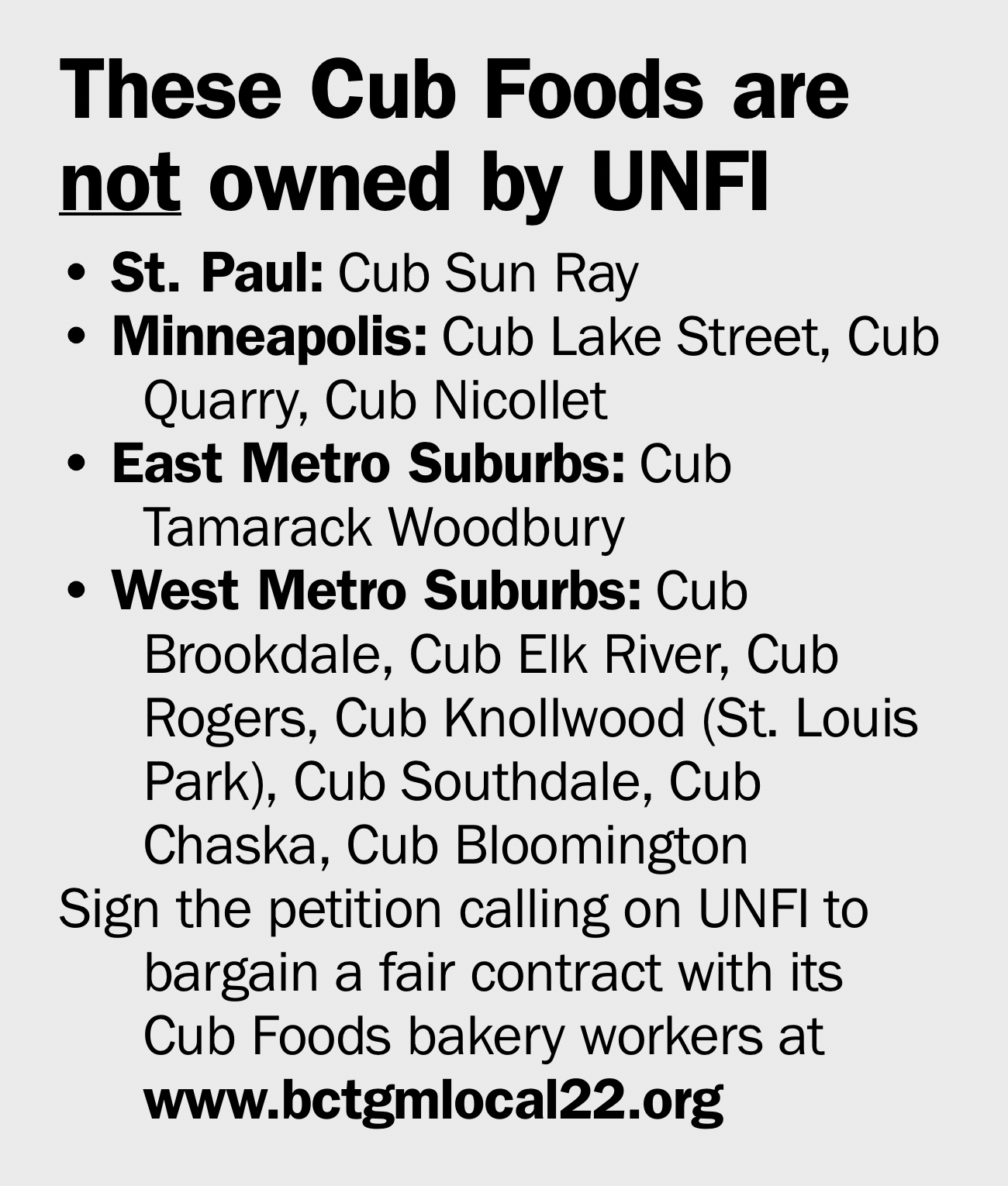
This is the first round of contract negotiations since UNFI acquired Supervalu in 2018. Not all Cub Foods stores are owned by UNFI, which is why Local 22 is circulating a list of stores that are “not trying to negatively impact workers’ livelihoods,” according to the flyer.

The two sides are scheduled to return to the bargaining table in April.

Local 22 is asking supporters to sign a petition calling on UNFI to negotiate a fair contract with its Cub Foods workers.

Mounds View paras stick together with strike vote

(SEIU photo)

More Twin Cities workers are making preparations for a possible strike.

The union representing nearly 400 para-educators in the Mounds View Public Schools today announced its members voted overwhelmingly to authorize a 24-hour strike if contract negotiations continue to stall.

Para-educators are the first district employees to take a strike vote in 40 years, according to their union, Local 284 of the Service Employees International Union.

“It’s sad we had to go this route,” said Local 284 member Melissa Grewe, who works with special-ed students at Reach Academy. “But we’re united, we’re standing together and we’re hopeful we can get this done.”

Bargaining with the district began nine months ago, but for union members, progress has been slow on key issues like affordable health insurance.

Para-educators pay a greater share of health-insurance premiums than other bargaining units in the district. Equity, para-educator Cathy Springhorn said, is long overdue.

“Paras are the people who always put others before themselves,” Springhorn said. “But now we’re standing up in a way we never have before. We deserve to get the same health insurance as everyone else, and we need the tools to make sure every student reaches their highest potential.”

Para-educators also are fighting the school district’s attempt to eliminate a provision allowing them to spread their pay over 12 months.

Other union demands reflect the changing nature of para-educators’ work.

Before bargaining began last June, Local 284 circulated surveys asking members to list their top concerns. Many said they lacked the time needed to keep up with new responsibilities, like third-party billing, communicating with families and filling out reports. Others felt they could better serve students with more time to plan and collaborate with teachers.

Contract proposals developed out of those concerns, Grewe said, have gone nowhere in negotiations so far.

“We have no time built into our day to get these tasks done, so a lot of people are either doing them after school on their own time or during their break time, their lunch time,” she said. “It’s frustrating, and members don’t feel respected or valued by the district.

“I think that shows by the number of people who came out to vote.”

About 90% of union members participated in the strike-authorization vote, held at school facilities earlier this week, and 80.7% voted “yes,” according to the union. Grewe said she hopes district leaders got the message.

“Come to the table and actually bargaining with us,” she said. “We do this because we love kids. And with a fair contract, we can make the kids’ experience even better than what it is.”

Para-educators have not set a strike date. They are required to provide the district with 10-days notice before going on strike.

The two sides are scheduled to resume mediated talks March 31.

Some 4,000 janitors across the metro and 3,600 St. Paul educators are in last-ditch negotiations this week. If they are unable to reach an agreement, janitors plan to begin an open-ended strike over unfair labor practices March 9. Educators would begin their strike a day later.

Outbreak adds urgency to janitors’ push for sick pay

Ahmed Kahsay, a janitor at MSP Airport, speaks at a press conference called by his union, SEIU Local 26, to discuss the coronavirus, as Local 26 President Iris Altamirano (R) listens.

The coronavirus outbreak has Edith Patiño worried not just about her family’s health, but her ability to pay the bills, too.

After eight years working as a janitor for Minneapolis-based Harvard Maintenance, Patiño gets just four days of earned sick and safe time per year. When she runs out, Patiño said, she often goes to work sick rather than lose hours toward her paycheck.

What would it mean to miss work for two weeks while recovering from COVID-19?

“I am the head of my household,” Patiño said. “It would be detrimental. I would have to ask for government assistance, which I don’t want to do and have never had to do. But if I can’t work, I have no other option.”

Public response to the epidemic has put a grim spotlight on limited access to paid sick time in the U.S., particularly for low-wage workers like Patiño.

According to federal labor-market statistics, 73% of all private-sector workers had access to paid sick leave last year, but less than half of workers in the lowest 25% of earners. Access to paid sick time also was lower among workers in service occupations, who are most likely to interact with the public, making containment of the outbreak more challenging.

As news broke today that two passengers arriving at Minneapolis-St. Paul International Airport had been asked to self-quarantine, the union representing 4,000 Twin Cities janitors, including about 200 who clean the airport, carried a new sense of urgency into contract negotiations with local cleaning contractors.

Among janitors’ top demands is an increase in their earned sick and safe days, to a minimum of six per year.

Iris Altamirano, president of Service Employees International Union Local 26, said union members “will be on the front lines” of preventing the virus from spreading in Minnesota. “Our workers are being given new tasks to do right now, like wiping down chairs, doorknobs and other surfaces,” Altamirano said.

About 4,000 janitors across the Twin Cities, members of SEIU Local 26, went on a 24-hour strike over unfair labor practices last week.

Should they fall ill from the virus, janitors want their union contract to provide basic protections for themselves and their communities, like paid sick time and affordable health insurance. Altamirano said the union hopes to use its leverage at the bargaining table “to tackle something bigger than just us.”

“We know right now we’re under threat, and we are part of the solution to containing that virus,” Patiño added.

If negotiators fail to make meaningful progress on those demands and others in contract talks scheduled through Friday, the union’s 4,000 members, who staged a 24-hour strike last week, plan to begin an open-ended strike over unfair labor practices Monday.

“We are coming into these negotiations very hopeful we can land a settlement but preparing to do whatever we have to do to get a fair contract,” Altamirano said.

Local 26 members in negotiations are employed by over a dozen different subcontractors to clean corporate office buildings across the Twin Cities. They voted unanimously Feb. 8 to authorize a ULP strike over the companies’ practices of stalling and refusing to give information, and to settle a fair contract.

1,800 HealthPartners caregivers set strike date

Jean Pharr, a registered nurse and member of SEIU’s bargaining team at HealthPartners, speaks at a press conference to announce the strike-authorization vote.

Workers who provide care at clinics across the Twin Cities put HealthPartners on notice today that they are ready to strike to keep quality, affordable health benefits in their union contract.

SEIU Healthcare Minnesota, which represents about 1,800 workers in the bargaining unit, delivered the legally required 10-day notice to HealthPartners after a whopping 95% of voting members supported a strike in balloting yesterday.

That means picket lines could go up outside the health provider’s 30 metro-area clinics Feb. 19 if the two sides are unable to reach agreement before then.

A strike would put registered nurses, dental hygienists, licensed practical nurses, midwives, lab techs, physicians assistants – “nearly all caregivers other than doctors,” the union says – on the picket line.

A separate union representing administrative employees at HealthPartners intends to file notice that its 1,200 members will honor SEIU’s picket line, raising the potential number of employees involved in the work stoppage to 3,000.

Kelsie Anderson, an OPEIU Local 12 member, says she plans to honor SEIU’s picket line.

At a press conference outside HealthPartners’ neuroscience facility in St. Paul, SEIU members said the decision to strike over their health care and wages was difficult but necessary to retain and attract the skilled caregivers their patients deserve.

“We’re here for our patients,” said Clara Boykin, a lab tech with over 30 years of experience working at HealthPartners. “We’re here for each other.”

Kate Lynch, a licensed practical nurse and member of the bargaining team, said she fought back tears after last-ditch talks broke down early Saturday morning, just hours after their previous contract expired. But workers, she said, can’t afford to let HealthPartners make them sick.

“Why wouldn’t you care for your employees? Why wouldn’t you want them to be healthy and go to the doctors they want to see?” Lynch said. “It is really disheartening.”

HealthPartners has not wavered from its demand for steep concessions that would force SEIU members to absorb a greater share of their health care costs. The demand comes despite published reports that HealthPartners brought in a record $7 billion in revenue last year and raised CEO Andrea Walsh’s pay to $2 million.

“If Andrea Walsh can give herself a $600,000 pay increase, I don’t think we’re in that much trouble,” Lynch said.

But SEIU members worry they will be in trouble if HealthPartners gets its way and someone on their second-rate insurance plan gets sick. Jean Pharr, a registered nurse, said her husband spent a month in the hospital after contracting pancreatitis 15 years ago.

“I didn’t have to worry about our medical bills because of the health insurance we had then – and the health insurance we have now,” Pharr said. With the substandard insurance HealthPartners is offering, she added, “we would have probably gone bankrupt.”

After the press conference ended, workers raised their fists in the air and huddled together for one last cheer of solidarity.

Among them was Kelsie Anderson, an administrative secretary for HealthPartners and vice president of Office and Professional Employees Local 12. She said SEIU’s fight is her union’s fight – both now and when Local 12 begins contract negotiations later this year.

“One of the core benefits of working at HealthPartners is our health care,” Anderson said. “If this is happening to SEIU, we’re expecting them to do the same thing to us. If they’re slapping SEIU members in the face, they’re going to slap us in the face.

“We need to stand united, and we will not be crossing that picket line.”

Nationwide campaign to fight cancer launches at Twin Cities union grocers

Union retail workers are teaming up with area grocers and The Leukemia & Lymphoma Society this month to fight cancer, forging a bond they hope will catch on nationwide.

The Labor Against Cancer campaign will encourage customers at several union grocery stores to donate $1 or more at checkout, with proceeds supporting cancer research and copay support. The campaign runs from St. Patrick’s Day through March 31.

The United Food and Commercial Workers, which represents retail workers nationwide, has a 36-year relationship with the LLS, and union members have raised over $86 million for the organization over that time.

But the new campaign, piloted by UFCW locals 1189 and 653, brings union employers and their customers into the fold, with hopes of expanding the fundraising drive’s public profile – and improving its results.

“What we realized is that we had a huge opportunity to engage not only our union friends but their employers, their retailers to be a part of a movement to end blood cancer,” Kay Skonieczny, a vice president at LLS, said. “UFCW is powering our movement, and we’re inviting unions of all types to join us.”

UFCW Local 1189 President Jennifer Christensen and member Dean Nelson of South St. Paul join a Labor Against Cancer kickoff event.

Jennifer Christensen, president of St. Paul-based UFCW Local 1189, credited participating employers for “taking the big leap to work with us” on the campaign.

Blood cancer survivors from both local unions attended a campaign kickoff event at the LLS chapter’s Minneapolis offices Thursday. Dean Nelson, a meat cutter in the Midway Cub Foods, said his recovery from chronic myeloid leukemia diagnosis was “a walk in the park” thanks to lifesaving medication discovered as a result of LLS-funded research.

And the medication was affordable, Nelson added, because of his union-negotiated health insurance. He pays $15 per paycheck toward premiums and a $600 copay on medication that costs $176,000 per year.

“Collective bargaining is why I am where I am today,” Nelson said. “If I worked for Target, if I worked for Wal-Mart, they would have dumped me into public assistance.”

Raising awareness of union retailers, Christensen said, is an added bonus of the Labor Against Cancer campaign. “I think it’s important that we set our union employers apart from some of the competition, in the way that they support the folks that work there,” she said.

Participating retailers in the East Metro include Cub Foods, Jerry’s, Lunds and Byerlys, and Oxendales. [Click for participating sites in the East Metro and West Metro.]

“You’re going to hear a lot about Labor Against Cancer in the future,” Skonieczny said. “You can all know that it started right here in Minnesota.”

Nurses buy – and forgive – $2.6 million in medical debt for Minnesotans

MNA President Mary Turner (L) and Executive Director Rose Roach rip up medical debt for 1,800 Minnesotans.

Twin Cities community members overwhelmingly supported Allina nurses during their historic strike last year. Today, members of the Minnesota Nurses Association offered a thank-you gift for that support, purchasing and forgiving the past-due accounts of 1,800 families facing a combined $2.6 million in medical debt.

MNA, a union of more than 20,000 registered nurses, located and acquired the accounts with help from RIP Medical Debt, a New York-based non-profit. Like a collection agency, the organization buys medical debt at a fraction of its value.

Rather than aggressively pursuing the debt it purchased, though, MNA immediately forgave it.

“Nurses are happy to allow these families to be free of their debt,” MNA President Mary Turner said. “They’ve had this medical debt hanging over their heads for two years or more.  It’s cost them their credit, pushed them toward bankruptcy and hurt them in so many ways.”

MNA paid $28,000 for the $2.6 million balance.

Names and other details regarding the forgiven accounts will remain private, but one Minnesotan struggling to pay down medical debt, Debra Puchala, agreed to tell her story during a press conference at MNA’s headquarters in St. Paul this morning.

Debra Puchala speaks about her battle to get out of medical debt. (MNA photos by Chris Reinke)

After undergoing hip replacement surgery in September 2015 and shoulder surgery the following year, Puchala owes various medical providers more than $5,000.

“The bills kept coming,” she said. “When you have surgery, you know, you get more than one bill, and … everybody wants their money right away. I was told that I was going too slow.”

One of her six bills wound up in collection, and as a result, Puchala said, “I can’t make a regular medical appointment. I have to go to either urgent care or, if it gets bad, emergency.”

In January 2017, faced with the prospect of tacking on another $5,000 to her debt load before reaching the insurance plan’s deductible, Puchala dropped out of her physical therapy regimen, and she continues to put off knee replacement surgery, she said, “because I can’t take on the debt.”

MNA has long derided the U.S. health care system for forcing patients like Puchala into consumer decisions that pit their wellness against their other needs, like food and rent.

Medical debt is the No. 1 cause of bankruptcy in the U.S. Past due accounts to health care providers are cited in 62 percent of bankruptcy cases, and bad debt to medical providers is expected to top $200 billion by 2019.

“Medical bills are now the No. 1 reason people are contacted by debt collectors,” Minnesota Attorney General Lori Swanson said at the MNA press conference. “Even people with health insurance face unpaid medical bills due to the very high deductibles in many insurance policies.

“The Minnesota Nurses Association is generous to have relieved people from the weight of this debt.”

The union was inspired to acquire Minnesotans’ medical debt after several members watched a report on HBO’s “Last Week Tonight with John Oliver” about RIP Medical Debt.

“We’d had many discussions about how to repay the community for what they gave nurses during the strike,” Turner said. “The John Oliver show inspired us, and we decided to see if we could do the same thing. MNA is grateful to RIP Medical Debt for helping us make this happen.”

About 5,000 MNA members who work at Abbott Northwestern, Mercy, United and Unity hospitals and Phillips Eye Institute spent nearly a month and a half on the picket line last year in a campaign to keep their high-quality health insurance, improve workplace safety and protect patients from staffing shortages.

Poised to strike this weekend, AT&T wireless workers seek support on picket line

Melinda Casey of Minneapolis is among 2,000 AT&T wireless workers in Minnesota poised to strike this weekend. “I have a family to support. I have two children. I need a job that’s secure,” she said.

Some 21,000 AT&T wireless workers in 36 states – including about 2,000 in Minnesota – plan to strike this weekend, a show of frustration over the company’s failure to negotiate a new contract that protects good, family-supporting jobs.

The strike is set to begin at 2 p.m. tomorrow unless AT&T and the Communications Workers of America, which represents wireless workers, reach a tentative agreement before then. AT&T wireless workers have never been on strike before, and it could drastically limit AT&T’s ability to handle traffic at 27 company-owned retail stores in Minnesota and hundreds more across the U.S.

Members of Twin Cities-based CWA Locals 7200 and 7250 are seeking support on picket lines across the state, including the following metro locations:

  • Apple Valley: 7634 – 150th St. W
  • Coon Rapids: 12481 Poppy St. NW
  • Maple Grove: 8105 Wedgewood Ln.
  • Roseville: 2724 Lincoln Dr.
  • Woodbury: 10100 City Walk Dr.
  • Eden Prairie retail store, 590 Prairie Center Dr.
  • Minnetonka: 1800 Plymouth Rd.

Workers say AT&T has offered only meager pay raises in negotiations – not nearly enough to cover the increased share of health insurance premiums the company is demanding workers pay. Commission rates, job security and sick pay are also sticking points in talks, which “are stalled right now,” CWA Minnesota State Council President Mona Meyer said.

Local 7200 member Melinda Casey, who works in AT&T Mobility’s Bloomington call center, said she’s fighting to support her two children, one of whom is epileptic. Casey earns the contract’s top wage scale of $18.57 per hour, and out-of-pocket medical costs, including a $2,500-per-patient deductible, already absorb a big portion of her earnings, she said.

Brian Gnerer

“If they raise premiums then that essentially washes out any type of pay raise we would get,” she said. “It makes it easy to walk out on Friday, knowing it’s the only way to bring a better contract.”

Brian Gnerer, who works in the Bloomington call center too, echoed Casey’s sentiment.

“I’m for the strike,” Gnerer said. “Thinking short term, I need to make sure I get my bills paid, but I also want to have a decent life after I’m done working. That means getting paid more, getting better health care so I can maybe put more money away for my future. And I’m willing to do what I need to do to get there.”

“Overall, I feel like there is a lot of unity” in our bargaining unit, Casey added.

Learn more about the contract negotiations at www.unityatmobility.com.

Nurses, allies back MinnesotaCare expansion as fix for state’s individual market woes

Rally participants signed Valentine’s Day cards to Gov. Dayton urging him to stand against legislation that would bail out insurance companies.

Rally participants signed Valentine’s Day cards to Gov. Dayton urging him to stand against legislation that would bail out insurance companies.

Union nurses rallied at the Capitol today with family farmers, small business owners, clergy and other allies in their push to expand health care coverage to all Minnesotans – and hold insurance companies accountable.

Members of the Minnesota Nurses Association spent the day talking to state representatives about making health care more accessible and affordable, including a proposal by Gov. Mark Dayton to expand MinnesotaCare and make it an option for all Minnesotans buying individual insurance.

Rose Roach, MNA’s executive director, called expansion of the popular, successful insurance program for low-income Minnesotans an “obvious solution that’s been in front of us all along.” It’s preferable, she added, to Republican and industry calls for the state to subsidize a “reinsurance” fund to protect insurers from losses.

Insurance companies “want to socialize debts and privatize profits, and they dare to ask us for more,” Roach said.

Small business owners, farmers and retirees at the rally took to the podium to vent their frustrations with the individual health insurance market, which saw premiums soar and provider networks shrink dramatically this year.

Dayton and state lawmakers agreed last month to provide emergency assistance to consumers, but that’s a one-time fix, Franklin dairy farmer James Kanne said. Kanne would have paid individual premiums of $1,040 per month this year without subsidies. But farm incomes fluctuate, and he said he’s worried next year those subsidies might not be available.

web-mna-capitol2The “ultimate” fix,” Kanne said and other speakers acknowledged, would be a single-payer health system, such as the proposal long advanced by Roseville Sen. John Marty. But with Republicans controlling the Legislature, Marty’s plan is not likely to get a hearing.

“That first rung on the ladder (to single payer) is MinnesotaCare as a public option,” Kanne said.

MNA’s rally drew support from members three progressive organizations partnering with the union on the health care campaign: the Land Stewardship Project, TakeAction Minnesota and faith-based ISAIAH.

“Nurses don’t care about your insurance card or your credit card,” Roach told supporters. “They only care about your get-well card.”

After the rally participants delivered a Valentine’s Day message to Dayton “thanking him for his leadership and urging him to stand against proposed legislation that provides more money to bail out insurance companies.”