MCAD faculty members voting in union election this month

mcad_thumbnail

photo: Minnesota Private College Council

Like thousands of faculty members on campuses across the country, faculty at the Minneapolis College of Art and Design are seeking a stronger voice to advocate for themselves and their students – and they’re organizing a union in order to get it.

MCAD’s part- and full-time faculty members will vote by mail in separate organizing elections this month, deciding whether to form bargaining units represented by Local 284 of the Service Employees International Union. The National Labor Relations Board will count ballots Oct. 19.

Before petitioning for an NLRB election, a majority of MCAD’s 100-plus faculty members signed cards in support of forming a union. Collective bargaining, union supporters said, would give faculty members a seat at the table in decisions that affect their teaching conditions and their students’ learning conditions.

Full- and part-time faculty members agreed their organizing drive is part of a broader effort to push back against some troubling trends in higher education – a “corporatizing” effect, full-time MCAD Professor Frenchy Lunning said, that makes top scholars less likely to enter the field.

“For me, this is about the future of higher education,” part-time MCAD faculty member Dawn Pankonien, a political economist, said. “It is about ensuring pay rates and job security that will allow not only secondary but also primary household earners to assume positions as educators without needing to arrive at their morning lectures after working night shifts in other industries.”

If they vote to unionize, MCAD faculty would join over 11,000 faculty nationwide who have formed unions with SEIU in the last three years.

That includes adjunct faculty at Hamline University in St. Paul, who voted to join Local 284 in June 2014. Since then, more than half of faculty members on campus have seen their base pay increase by 20 percent – the first pay increase in more than a decade for many instructors.

Tenure-track and contingent faculty at the University of Minnesota – Twin Cities campus are on track to vote in a union election after an organizing drive with Local 284 as well.

Hamline adjunct professor David Weiss said he looks forward to welcoming MCAD and U of M faculty into the local soon.

“Together with faculty at other colleges and universities across the Twin Cities, we can raise standards for our students and stop the race to the bottom in higher education,” Weiss said.

Ruling sets stage for 2,500 Twin Cities faculty to take union vote

cs0bau0ueaaidznThe historic organizing drive among faculty at the University of Minnesota’s Twin Cities campus cleared a major hurdle today, when a state agency ruled contingent and tenure-track faculty could join together in one potential bargaining unit.

The Minnesota Bureau of Mediation Services’ decision clears the way for about 1,000 contingent and 1,500 tenure-track faculty members to vote in an organizing election as soon as this fall. If successful, the vote would create one of the largest single-campus faculty unions in the U.S.

Supporters of the organizing effort, sponsored by MN Academics United and SEIU Local 284, said the ruling confirms faculty members’ shared stake in a strong, unified voice at the university.

“As the university’s administration has increased the number and ratio of non-tenure-line positions, the fates of all faculty are increasingly intertwined,” Irene Duranczyk, an associate professor in the College of Education and Human Development, said. “We believe that the precarious working conditions under which contingent faculty labor are not only bad for them but also bad for students and bad for us, the remaining tenure-line faculty.”

How soon Duranczyk and other U of M faculty get to vote depends on whether the school appeals the BMS ruling.

An appeal seems likely, as university administrators have made every attempt to derail the union-organizing election since faculty filed for representation in January – efforts that have focused mostly on dividing tenure and contingent faculty.

Last week the nonpartisan Minnesota Public Interest Research Group revealed documents obtained from the U of M showing over $500,000 of spending on outside legal counsel between January and June for services related to the organizing drive.

Even more egregious, faculty members, students and state lawmakers said, are annotations indicating the payments came out of funds the university collected from tuition-paying students and the Minnesota Legislature.

“I’m sure no one in the legislature – Democrat or Republican – intended for … taxpayer dollars we appropriated to the University of Minnesota’s general fund to be used for attorney’s fees fighting the University’s own employees in exercising their right to form a union,” Rep. Jim Davnie said.

U of M sophomore Jada Brown pointed out that Minnesotans, on average, have the 5th-highest student debt in the country, urging administrators “to spend money on our education, not on fighting the people who teach us every day.”

Paying high-priced attorneys to run out the clock on an organizing drive is a move straight out of the corporate anti-union playbook and, lecturer Jason Stahl said, yet another reason for faculty to seek a more powerful voice in university governance.

“We are building this union together to strengthen the voice of faculty on our campus for ourselves and our students,” Stahl said. “And we are confident that we will win our vote.”

Faculty blast U’s attempt to delay union vote with legal appeal

10390206_1380042375657915_7758383538287175658_nThe University of Minnesota is asking the state Court of Appeals to slow down a historic union-organizing effort among faculty at the Twin Cities campus. Union supporters today branded the university’s decision as divisive and wasteful.

“We are forming a union so we can gain a stronger voice in university governance, and this is a perfect example of why,” Associate Professor Irene Duranczyk said in a media release issued by MN Academics United, the SEIU-backed union supporting faculty members’ organizing drive.

The university’s appeal seeks to divide tenure-track and contract faculty members, who successfully petitioned the state Bureau of Mediation Service to be united in one bargaining unit earlier this year. That set the stage for approximately 2,500 faculty members to vote in a union election.

Professor Jerry Cohen said faculty rejected the idea of separating tenure-track and contract faculty because they saw a common need for a greater voice at the U. “While we have different roles at the university, we are all responsible for teaching our students and making the U a great place to learn,” Cohen said.

As part of its appeal, the university will request a stay of pre-election hearings to determine who is eligible to vote in the union election. If granted, it could delay a vote by up to a year.

Resorting to time-consuming, costly delay tactics is a move straight out of the corporate anti-union playbook, and faculty members, students and lawmakers were not shy in expressing their disappointment.

“We are dismayed by the University’s decision to spend months of administrative time and untold sums of taxpayer and tuition dollars on costly outside counsel to fight us, their own faculty, rather than just letting us choose for ourselves whether or not we want a union,” said Meredith Gill, a senior lecturer in cultural studies and comparative literature.

Alex Peeper, an undergraduate studying history and political science, blasted university administrators for “spending their time and our tuition dollars fighting our faculty instead of fighting for us.”

Sen. Patricia Torres-Ray, a DFLer from Minneapolis, warned: “The university can’t afford to waste its limited resources fighting against their own faculty.”

Wedge keeps shareholders in the dark as workers near union vote

ufcw1189merge2smallWorkers at the Wedge Co-Op in Minneapolis are poised to vote in an organizing election next month. Co-Op Partners Warehouse workers reached a tentative agreement with the Wedge earlier this month.

But that might come as news to the co-op’s shareholders, who were left in the dark regarding the strides workers are taking toward a greater voice on the job during the co-op’s annual meeting Oct. 22, union representatives said.

“It’s a little disappointing,” UFCW Local 1189’s Abraham Wangnoo said. “A lot of the workers feel the shareholders hold a lot of power, but they’re being kept in the dark when it comes to the things going on with the workforce.”

Now workers are left wondering whether the Wedge might balk at the terms of a neutrality agreement reached during warehouse workers’ organizing drive with the United Food and Commercial Workers four-plus years ago. The agreement covers all of the Wedge’s buildings, and it prevents pro-union workers from picketing or calling for boycotts as long as the Wedge does not interfere in the organizing campaign.

But the agreement hasn’t kept the Wedge from attempting to influence the organizing process, Wangnoo said. After workers approached management in June to discuss the neutrality agreement, management “immediately gave anybody who was making under $11 a raise,” he said. “All these new people who were hired at $10 got a raise just like that.”

Certainly, it was good for workers, but it was also a textbook maneuver used by employers looking to snuff out the spark of collective action. Wangnoo called it the first in a string of “tactics to convince people not to form a union” and “particularly disappointing coming from this employer, given what they’re supposedly about.”

Wedge employees have organized around a variety of issues, including a perceived rise in “corporate culture” at the co-op, a lack of equal opportunity and favoritism among management. They are hopeful, Wagnoo added, that gaining a collective voice will be a step toward creating a “sustainable system of jobs and food” that is consistent with the co-op’s values-driven mission.

The National Labor Relations Board will conduct the organizing election Nov. 16.

Workers at the Wedge’s Co-Op Partners Warehouse, meanwhile, overwhelmingly ratified a new three-year agreement Wednesday. The contract guarantees annual wage increases for all employees and improves language regarding sick leave, the union reported.

It is warehouse workers’ second contract since voting to join UFCW Local 1189 in 2012.

Unity Hospital workers go union after voting under new NLRB rules

Screen Shot 2015-07-13 at 6.41.48 PM

(photo courtesy SEIU Healthcare MN)

About 350 workers at Unity Hospital in Fridley voted yesterday to join SEIU Healthcare Minnesota, the union announced today. The new bargaining unit includes nursing assistants, dietary aides, environmental services aides, patient care technicians and other positions.

Over 59 percent of workers voted in favor of forming a union. It was the first major election in the region conducted under new rules established by the National Labor Relations Board in April, according to SEIU.

Part of an effort to modernize and streamline union organizing elections, the NLRB’s new rules allow workers’ petitions for elections to be filed online, consolidate the post-election appeals process and require equal access to voter contact lists for management and the union.

Management has long exploited the NLRB appeals process to drag out organizing elections, hoping to kill pro-union momentum, and business groups are challenging the NLRB rule changes in court.

Barb Shoemaker, a patient care tech from Anoka, said the process was fair for both Unity Hospital and its workers, who wanted to take an up-or-down vote on whether to form their union and move on with the results.

“With the changes in the union election rules, we were able to have a vote on whether we wanted to join SEIU without overwhelming interference,” Shoemaker said. “Even with the new rules, they tried to scare people out of voting yes and even attempted to stop people from engaging in protected union activity, but I am glad that under new NLRB guidelines we didn’t have to wait weeks longer to have our vote. By voting yes to form our union, our voice will finally be heard.”

The new unit will now begin bargaining their first contract with Unity, an Allina-owned hospital. Tania Logacz, a nursing assistant from Coon Rapids, said better patient care is at the top of Unity workers’ list of priorities.

“Care giving is getting tougher, but management only considers the total number of patients when setting staffing ratios, not the acuity of care needed,” Logacz said. “This has led to many more employee injuries and staff are being burnt out.

“By voting to form a union, we showed that we the employees do count and we’re going to look out for patients’ safety and our own safety.”

The election victory was a decade in the making for several pro-union workers, including Kathy Sodman, a health unit coordinator from Ramsey.

“As a long-time employee, I always have hoped that Unity was as dedicated to my future as much as I am dedicated to Unity’s,” she said. “But the reality is that management views us as easily expendable even through all my years of hard work for the hospital.

“I’ve been part of previous attempts over the past 10 years to organize a union at Unity and today we finally succeeded, and we will be heard!”

SEIU Healthcare Minnesota unites more than 42,000 health care and long-term care workers in hospitals, clinics, nursing homes and home care throughout the state of Minnesota.

Good Luck: WI health care workers form union on same day Walker signs Right to Work

Health care workers celebrate their organizing win at United Pioneer Home in Luck, Wis.

Health care workers celebrate their organizing win at United Pioneer Home in Luck, Wis.

More bad news for working families came out of Wisconsin yesterday, when Gov. Scott Walker approved so-called “Right to Work” legislation. But there was good news, too.

Nursing home workers in the small town of Luck, Wis., about 70 miles northeast of the Twin Cities, voted to form a union in election results certified by the National Labor Relations Board yesterday.

As a result, 57 certified nursing assistants, dietary workers, housekeepers and laundry workers at United Pioneer Home now are represented by Local 1189 of the United Food and Commercial Workers, a union headquartered in St. Paul and Duluth.

The organizing drive began in January, after a handful of United Pioneer Home workers approached the union with concerns about insufficient staffing levels and workplace safety. Abraham Wangnoo, director of organizing for Local 1189, said workers reported being afraid to approach management with their concerns and were frustrated with the lack of respect supervisors showed them on the job. One worker who spoke up to management, he said, was dismissed as “just a maid.”

“People wanted a voice,” Wangnoo said. “When they had concerns, they wanted to be heard. This was a way they thought they could use one voice to speak about issues that affect their jobs and the (nursing home) residents’ lives.”

The organizing drive progressed quickly, and workers voted 25-14 in favor of union representation.

Now, United Pioneer Home becomes an early test of whether newly organized unions can survive in post-RTW Wisconsin. The new law allows workers to benefit from a collective bargaining agreement without paying for the cost of representation, making it illegal to collect fair-share fees from workers in an organized workplace who choose not to join the union.

When Local 1189 members and United Pioneer Home agree on a first contract, it will cover all 57 workers eligible to vote in the NLRB election, including those who voted against unionizing. All 57 will enjoy the benefits of the new contract, from grievance procedures and job security to safety protections and compensation increases.

But the cost of negotiating and servicing the new contract will fall entirely on the workers who choose to join the union and pay dues to Local 1189.

By gutting the resources unions rely on to represent workers, RTW generally undermines the appeal – and bargaining power – of organized labor in states that pass the law. But Wangnoo said Local 1189, which represents more than 650 workers in western Wisconsin, isn’t about to pull up stakes.

“We’re going to continue to do the best we can to be the best we can, so people really do see the value in what workers have done in organizing a union,” Wangnoo said. “We want them all to know that it pays to belong.”

That task becomes more difficult over time, as workers active in an organizing effort retire or take other jobs.

Wangnoo said Local 1189’s bargaining units in Wisconsin have elected union stewards who are dedicated to the kind of service and outreach work necessary to bring new members into the fold. Already, some workers who voted against the union at United Pioneer Home have expressed an interest in being involved in negotiations, he said.

“Our representation is what we’re going to count on for keeping the good, strong union density in these places that we need to maintain strong contracts,” he said. “I believe our record will speak for itself, and people will see the value in membership.”

Home care workers win election, take momentum into contract talks

Pro-union home health care workers celebrate the results of their organizing election at the Minnesota AFL-CIO Labor Pavilion on the State Fairgrounds.

Pro-union home health care workers and their clients celebrate the results of their organizing election at the Minnesota AFL-CIO Labor Pavilion on the State Fairgrounds.

Home health care workers in Minnesota have spoken, and they voted decisively to form a union, the state’s Bureau of Mediation Services announced yesterday.

Now the fight to improve the lives of home care workers and the people they serve shifts from the organizing field to the negotiation table – and back to the State Capitol.

“We’ve been waiting for this day for a long time,” St. Paul home care worker Sumer Spika said during a press conference at the State Fairgrounds to announce the election results. “We know this is an industry that needs fixing, and that is why we have come together for this fight.”

In the process, Spika and other home care workers are making history. The BMS mailed ballots Aug. 1 to about 27,000 workers who are paid by the state to provide care to elderly and disabled Minnesotans – the largest union organizing election in state history.

Sixty percent of the 5,872 workers who returned ballots voted “yes” to joining the Healthcare Minnesota local of the Service Employees International Union, which will represent the newly created bargaining unit in contract negotiations with the state.

Yankuba Fadera, a home care worker from Maplewood, also works as an emergency room technician in a union-organized hospital.

Yankuba Fadera, a home care worker from Maplewood, also works as an emergency room technician in a union-organized hospital.

Workers plan to push for a contract that includes wage increases, benefits and training opportunities to better serve their clients.

Yankuba Fadera, a home care worker from Maplewood, knows firsthand the gains health care workers – and patients – make through collective bargaining. In addition to providing home care, Fadera works as an emergency room technician in a union-organized hospital.

“We have fought for and won real gains, both for workers and the patients we serve,” he said, pointing to pay and benefit increases, as well as contract language guaranteeing safe staffing levels and access to proper equipment.

Lack of benefits like health insurance, sick leave and paid time off makes home care a transitional field for many workers.

“I was shocked to discover home care isn’t considered a ‘real job’ despite how important it is to tens of thousands of Minnesotans,” Fadera said. “This work is real, and this work is very important.”

Home care recipients and advocates for people with disabilities cheered the election results as well. Nikki Villavicencio of Maplewood said better wages and working conditions for her caregivers would increase the stability of her care.

“The high turnover in this field, from the low pay and lack of benefits, causes turmoil for families,” Villavicencio said. “When we undervalue the workers, we undervalue families like mine.”

Whatever gains workers and clients achieve on paper in a bargaining with the state are subject to one last – and potentially major – hurdle: approval from the Legislature.

Home care workers and child-care providers paid with state subsidies lobbied successfully for a new law granting them union rights in 2013, but they faced stiff opposition from Republicans. Returning a pro-worker majority to the Minnesota House in 2015, then, is likely a priority for the new bargaining unit – and the 30,000 SEIU Healthcare Minnesota members statewide.

web.SEIUHCvote-scene

Home care workers ‘invisible no more’ after filing for historic union election

Nikki Villavicencio (L) and home care worker Sumer Spika lead a celebration outside the Bureau of Mediation Services after workers filed for a historic statewide election.

Nikki Villavicencio (L) and home care worker Sumer Spika lead a celebration outside the Bureau of Mediation Services after workers filed for a historic statewide election.

When home care workers in Minnesota launched their campaign to form a statewide union less than two years ago, they set out to raise wages, improve working conditions and bring legitimacy and respect to a career path seen as critical to meeting the needs of an aging population.

They may not have set out to make history, but home care workers did just that today, formally petitioning the state to conduct what would be the largest union election in Minnesota history.

SEIU Healthcare Minnesota, the union seeking to represent an estimated 26,000 workers in state-funded home care programs, presented the Minnesota Bureau of Mediation Services this morning with more than 9,000 cards signed by home care workers requesting representation, exceeding the 30 percent threshold needed to trigger an election.

Afterward, workers gathered outside the BMS’s St. Paul offices, where union supporters like Jaycee Berens celebrated the grassroots organizing behind today’s historic filing – and looked forward to voting “yes” in the near future.

“I knocked on hundreds of doors each day,” Berens said of her involvement in the organizing effort. “I found behind those doors were caring, hard-working, dedicated people who love what they do.

“We are eager as home care workers to take care of clients that live in their homes, but we also need to be able to better provide for ourselves and our families.”

Many workers at the celebration stood alongside the clients who rely on their care. Nikki Villavicencio of Maplewood said she expects the quality and reliability of her care to improve when workers are at the table, participating in decisions that affect the home health care field.

Villavicencio said she’s long wondered, “Why is this field so undervalued? Why are the workers who support my family so invisible?”

“When workers receive better wages, benefits and training, it makes the whole community stronger,” she added.

Pat Winick said she wouldn’t have been able to remain in her South Minneapolis home after suffering multiple brain injuries if it weren’t for the care she receives from state-subsidized home health workers.

Pat Winick said she wouldn’t have been able to remain in her South Minneapolis home after suffering multiple brain injuries if it weren’t for the care she receives from state-subsidized home health workers.

Political, legal hurdles

Today’s filing marked another milestone on home care workers’ uniquely challenging path to collective bargaining – a path that became even more complicated with the Supreme Court’s Harris v. Quinn ruling last month.

When their organizing drive began two years ago, state law prohibited workers who provide self-directed care – workers hired directly by their clients but paid with state funds – from forming a union, treating them more like independent contractors.

Backed by SEIU Healthcare Minnesota, workers lobbied to change the law last year, and in May 2013 Gov. Mark Dayton signed a bill passed by DFL majorities in the Legislature extending collective bargaining rights to both home care workers and child care providers.

Home care workers’ campaign to gain the signatures needed to file for an election kicked into high gear over the winter. Workers, organizers and supporters from the labor community fanned out across the state to collect more than 9,000 signed cards.

But the SEIU waited to file those cards until after the Supreme Court handed down its ruling on Harris v. Quinn, a case that tested the authority of another state, Illinois, to extend collective bargaining rights to workers in state-subsidized home care programs.

The court’s decision was bad news for unions. It exempted home care workers in Illinois from having to pay so-called “fair-share fees,” but kept in place requirements that unions represent all workers in a collective-bargaining unit – even those who choose not to pay dues.

Not giving up

Outside the BMS, however, home care workers like Sumer Spika pledged to move forward with the organizing election, even if their union would not be able to collect fair-share revenue. “This ruling will not stop the home care workers in Minnesota who are joining together,” the St. Paul resident said.

After scrutinizing the authorization cards, the BMS will conduct an election by mail, likely later this summer. If more than half of workers who participate in the election vote “yes,” SEIU Healthcare Minnesota will be authorized as the workers’ exclusive representative.

Nicole Taras, a recipient of in-home care who has muscular dystrophy, traveled to the BMS with her partner and part-time care provider, Tyler Frank.

Nicole Taras, a recipient of in-home care who has muscular dystrophy, traveled to the BMS with her partner and part-time care provider, Tyler Frank.

That’s the celebration Nicole Taras, a recipient of in-home care who has muscular dystrophy, said she looks forward to most. Taras, who traveled to the BMS with her partner, Tyler Frank, said low wages and high turnover rates make it difficult to find caregivers she can rely on.

“Right now this is a throw-away job,” Taras said. “Because turnover is so high, I hardly ever get a fully trained person before they leave for a Walmart job or something better, and then Tyler has to do it.”

With a union, Frank said, comes better pay, more training opportunities and, hopefully, greater stability for home care clients like Taras, which would free him to pursue his own career aspirations.

“I’ll no longer have to choose between my goals and hers,” Frank said.

Macalester won’t stay neutral in faculty union vote

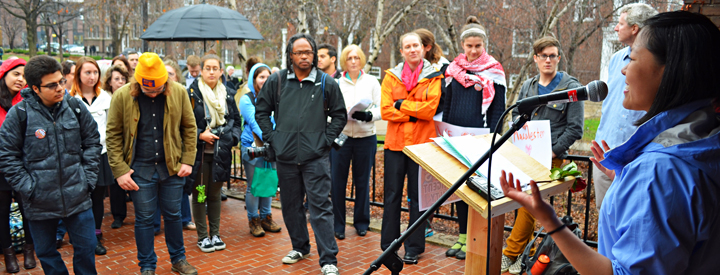
Macalester sophomore Julia Gay leads a rally during Contingent Faculty Appreciation Week on campus.

Macalester sophomore Julia Gay leads a rally during Contingent Faculty Appreciation Week on campus.

Despite public appeals from students, instructors and U.S. Rep. Keith Ellison to take a neutral stance, Macalester College administrators last week announced their opposition to efforts by contingent faculty members to organize a union.

Macalester President Brian Rosenberg and Provost Kathy Murray revealed their opposition in a memo sent May 2 to the school’s tenured and tenure-track faculty members, who are not a part of the organizing drive. Macalester’s student newspaper, The Mac Weekly, obtained a copy of the memo.

Although respectful in tone, the memo takes a clear stance against the union, arguing that organizing “is not the right direction for any of our faculty members, will not strengthen our institution or our governance structure, will not help the faculty who are directly involved, and will not assist our students in any way.”

Rosenberg and Murray also declared their intent to tell contingent faculty members “why the College is opposed to this effort” before they vote on whether to join Local 284 of the Service Employees International Union. The vote is likely to take place in June.

[Sign a petition calling on Macalester not to use financial resources to fight its contingent faculty members’ union drive.]

U.S. Rep. Keith Ellison urges Macalester to remain neutral during contingent faculty's organizing drive.

U.S. Rep. Keith Ellison urges Macalester to remain neutral during contingent faculty’s organizing drive.

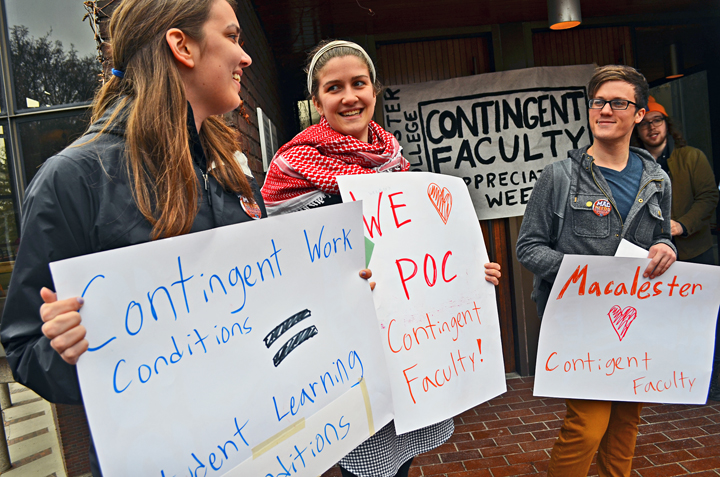
In forgoing neutrality, the administrators turned a blind eye to a sizable demonstration on campus last month. The culmination of a student-organized “Contingent Faculty Appreciation Week,” the rally drew students, faculty members and community leaders who showed their support for the organizing drive – and voiced their opposition to interference from the administration.

“It would be unfitting for this school to interfere with a union drive,” Rep. Ellison warned administrators during a speech at the rally. “It would lower this institution that has given so much to the world if you took any position other than neutrality.”

The 5th District Congressman, who taught a course on civil rights and liberties at Macalester 20 years ago, praised contingent faculty members at Macalester and adjunct undergraduate instructors at nearby Hamline University, who also have petitioned the National Labor Relations Board to conduct a union election, for having the courage to “step out and say we are going to organize a union,” acknowledging the decision can be “a little scary.”

Feeling invisible

Contingent faculty members at the rally said they approached forming a union as a proven method of achieving greater job security, more professional development opportunities, higher pay and more reliable benefits. And like any group of workers looking to organize, they want a voice in decisions that affect their working conditions.

“Contingent faculty often just feel invisible,” said Kathryn Pratt, a former contingent faculty member who now works for the school’s Institute for Global Citizenship. “Contingent faculty want to be allies and collaborators in decision-making processes and not feel like they are on the margins of decision-making processes.”

Better working conditions for contingent faculty, visiting assistant professor Brendan Miller added, will increase stability inside the classroom – and increase instructors’ availability to students outside the classroom. Faculty members are paid substantially less per course if they do not teach a full course load, forcing many to pick up courses at campuses across the metro. That makes it especially difficult to work with students outside of class hours, Miller said.

Eric Otremba, a visiting professor of history at Macalester, thanks students for organizing Contingent Faculty Awareness Week.

Eric Otremba, a visiting professor of history at Macalester, thanks students for organizing Contingent Faculty Awareness Week.

Miller, who teaches physics and astronomy at Macalester, pointed to a list on the school’s website of key reasons students should choose to enroll, including a strong commitment to teaching, low student-to-faculty ratios and opportunities for interaction between faculty and students.

“Contingent faculty are essential to Macalester delivering on this core mission,” Miller said. “We share and we embody Macalester’s strong commitment to teaching.”

Student body supportive

Still, contingent faculty members are treated differently than their tenured and tenure-track colleagues – a fact that initially surprised sophomore Kathy Paral, one of the organizers behind Contingent Faculty Appreciation Week.

“In the classroom there is no difference,” Paral said. “Contingent faculty do as much work and are just as passionate as any other faculty member. My education at Macalester would be hard to imagine without them.”

Junior Eli Liebman said the organizing drive “affects every student here.”

“If the contingent faculty have a union, then they have a collective voice, they can make decisions as a group and have a little more power,” Liebman said. “They probably would be compensated more and maybe be more willing to do more work outside their contracts. If you do that now and you’re an adjunct professor, you do that out of the goodness of your heart.”

web.mac-students