Great River staff union reaches first contract with St. Paul charter

Two years after voting to form a union with Education Minnesota, the teachers, support staff and other frontline workers of Great River School in St. Paul entered the 2023-24 school year with a first union contract in place.

Representatives of the Great River School Union and the charter school district drafted the agreement in bargaining over the course of about 18 months.

GRSU spokesperson Abby Mesnik, a high school math teacher, said the contract delivers on many objectives Great River employees had in mind when they sought a union election in May 2021, including pay transparency and greater stability in their benefits and work rules.

“People wanted some things in writing,” Mesnik said, noting that Great River was on the cusp of a leadership change during the union drive. “It wasn’t that they were necessarily unhappy with the current practices, but they wanted it preserved, and they wanted some consistency in what working in the school looked like. And I think the contract does that.”

Mesnik credited school administrators for taking a collaborative approach to negotiations. The district even brought in its own pro-union consultant to better understand the process and its staff members’ perspectives.

“We brought a draft of the contract that was very pro-union, and we just negotiated from that draft,” Mesnik said. “They never brought us their own version that we would try to reach a middle on; we would just make edits to ours.”

The contract covers about 120 employees at the Montessori charter school, which serves students in grades 1 through 12. GRSU is a “wall-to-wall” union, meaning teachers are in the same bargaining unit as support staff and even student workers, potentially.

That created a bargaining dynamic that’s unique in public education.

“We could not be separated in bargaining for funds,” Mesnik said. “We’re not just trying to move teachers up or just trying to move support staff up. We all rise together.”

The new contract puts every position covered by the unit into one of three pay scales, ensuring greater transparency and equity, Mesnik added.

“Now we can clearly track down what step and what lane people are on, what salary scale goes with which position,” she said. “Previously, there were not clear raises for folks. Some people were getting 5%, some were getting 2%, some knew to go talk to their boss and ask for a certain amount. Now there’s clarity.”

Other highlights of the contract include new incentives for advanced training in some positions, language around paid-time-off rollover, and a new independent retirement savings benefit, with an employer match after one year.

The contract also spells out for the first time what constitutes a working day and how many working days there are in Great River’s school year.

GRSU is one of five charter school unions in Minnesota. Teachers at the Twin Cities German Immersion School in St. Paul formed the state’s first charter school union in 2014.

Charter schools are publicly funded but exempt from some state laws in order to increase flexibility, autonomy and innovation. Minnesota is considered the birthplace of charter schools, having passed a first-in-the-nation law establishing their framework in 1991. Now, 180 charter schools serve about 76,000 pre-kindergarten through 12th-grade students statewide.

Mesnik said she and other GRSU activists often get asked by fellow union educators what it’s like to bargain a contract from scratch.

“I tell them it takes a lot of effort from a lot of people,” she said. “But it’s really exciting to join the labor movement and take power back as workers. We have a lot of power collectively, and it’s really cool to be on the other side with a contract and be able to say that these things are enforceable.”

– Michael Moore, Union Advocate editor

Minnesota unions praise historic legislative session

Gov. Tim Walz spoke to supporters before signing 12 budget bills into law.

In a historically productive legislative session that ended on time Monday, labor-endorsed lawmakers delivered on nearly all their campaign promises, from investments in public infrastructure and schools to expansion of family-supporting benefits, union rights and workplace protections.

Union activists and leaders were among hundreds who celebrated the session’s accomplishments today on the Capitol grounds, as Gov. Tim Walz held a signing ceremony for 12 budget bills that will fund state government for the next two years.

Walz likened the newly approved budget to the “Minnesota Miracle” of 1971, when the state drew nationwide acclaim for investing in public education.

“If this is ‘Minnesota Miracle 2.0,’ the difference between then and now is … we’re leaving no one behind,” Walz said.

Labor leaders praised Walz and DFL legislators for rising to the occasion created by a projected budget surplus that swelled to $17.5 billion – thanks, in part, to one-time federal stimulus dollars that Republicans blocked the state from allocating one year ago.

After winning all three levers of power – with support from union volunteers – during the 2022 election, DFLers invested the surplus in infrastructure projects and jobs, schools, nursing homes and targeted tax relief for working families, including an expanded child tax credit that will return up to $1,750 per child to lower-income families.

Lt. Gov. Peggy Flanagan, former director of the Minnesota Children’s Defense Fund, said the budget is “deeply rooted in equity and decades in the making.” She credited organizers and activists who have devoted years to fighting for policies that will soon become law, like earned sick and safe time and paid family leave.

“We have played the long game,” Flanagan said. “And we won.”

Children and families will also benefit from $2.26 billion in new funding for Minnesota’s public schools over the next biennium. The 10.5% increase will help school districts cover rising costs – and recruit and retain educators and other employees. And the budget allocates $600 million to hire and retain child care teachers.

Walz and DFL lawmakers focused on issues that matter to workers and families, Minnesota AFL-CIO President Bernie Burnham said, noting that their work stands in contrast to Republican-controlled chambers in other states that have sought to ban abortion, weaken child-labor laws and meddle in school curriculum.

“While other states are putting 14- and 15-year-olds to work on assembly lines, Minnesota is making sure parents have the time and resources to care for and sustain their families; while other states ban books in our schools and libraries, Minnesota is making sure no student goes hungry at school; and while other states make it harder to vote, Minnesota is expanding our Democracy to make sure every eligible voter has the freedom to make their voice heard,” Burnham said.

Walz is also expected to sign a $2.3 billion infrastructure deal that contains a mix of borrowing – a so-called “bonding” bill – and cash investments. It would be the first bonding bill the state has passed since 2020.

Sen. Sandy Pappas, the lead author, said the measure “will create thousands of well-paying union jobs and ensure businesses have the infrastructure they need to build in Minnesota for years to come.”

On the Capitol grounds today, Walz gave a shout to people in hard hats throughout the crowd. “All of these good union jobs have built the middle class and built Minnesota,” he said. “It is going to continue that way.”

In addition to historic investments approved this session, Minnesota lawmakers took up several policy changes long sought by union members, including an extension of unemployment benefits to hourly school employees, a ban on private prisons and a new Nursing Home Workforce Standards Board with the authority to set standards like pay and benefits.

Lawmakers expanded and strengthened union rights, enshrining public-sector workers’ ability to bargain on non-economic issues like safe staffing and class sizes, giving workers in the newly legalized recreational cannabis industry a path to collective bargaining and banning “captive audience meetings,” in which workers are forced to listen to their bosses’ religious, political or anti-union views.

Funds allocated this session will also bolster the state’s film industry tax credit, raise pay for home care and nursing home workers and strengthen public pensions.

A measure to address hospital staffing shortfalls, however, fell short of the Minnesota Nurses Association’s expectations. The bill established new safety protections and recruitment bonuses for health care workers, but it left out language that would have would have required hospitals to create labor-management committees to determine appropriate staffing in their wards.

Support for a safe staffing law dwindled after Mayo Clinic threatened to withhold investments in its Rochester campus if it passed.

“I hope Minnesotans know how hard nurses fought for your care and safety,” MNA President Mary Turner said. “And I hope corporate executives and our public officials know that our fight is not over to put patients before profits in our health care system.”

‘Bill of Rights’ would fund $25 minimum wage, health benefits for hourly school staff

Sara Rapp, a school cook on strike in Hastings, testified at the Capitol in support of the ESP Bill of Rights.

As striking food service workers in Hastings put a spotlight on hardships faced by some of the lowest-paid school employees, state lawmakers this week debated bold, new legislation to lift standards for all hourly school workers.

The “Education Support Professionals’ Bill of Rights,” introduced by DFLers in both the House and Senate, would establish a minimum wage of $25 for paraprofessionals, bus drivers, clerical workers and other hourly employees.

It would also require schools to offer affordable, year-round health coverage and to sustain hourly workers’ pay during e-learning days, among other provisions.

To cover schools’ increased costs, the measure would provide new state funding – beyond increases to the per-pupil formula – determined by a district’s ESP staffing needs.

Rep. Brad Tabke of Shakopee, lead author in the House, touted the bill as a matter of fairness for the trusted adults who work in their communities’ school systems.

“All throughout the summer (while) talking to folks, I ran into dozens and dozens of paras, janitors, bus drivers, lunch workers that are really struggling,” he told members of the House Education Finance Committee on Tuesday. “As a state we should be valuing that work.”

Senate author Alice Mann (D-Edina) said school districts need new, dedicated funding to make their hourly positions competitive with other employers.

“You can walk down the street to McDonald’s and get paid more to work there than in our schools taking care of our children, feeding our children, transporting our children and helping to educate them,” Mann said during a Senate committee hearing Tuesday.

Labor market data shows the job vacancy rate at school districts across the nation has been rising for a decade. In Minnesota, where overall workforce participation is higher than the national average, employment in school districts has dropped by 6.4% since October 2019, according to data compiled by the Economic Policy Institute’s Economic Analysis and Research Network (EARN).

“There’s a lot of reasons why this could be, but the most simple and obvious one is compensation,” EARN policy coordinator Dave Kamper said. “Workers are leaving ESP jobs for higher-paying gigs elsewhere.”

Rep. Brad Tabke holds a press conference with school employees after committee hearings on the ESP Bill of Rights.

Hourly school workers who want to continue serving students have found it increasingly difficult to make ends meet, as several ESPs – including one food service worker on strike for higher wages – testified at the Capitol.

Sara Rapp, a cook at Hastings High School, earns just $15.05 per hour in her fourth year with the district. A $10-per-hour raise, she said, “would mean we could take care of ourselves and our families with the same care and compassion we take care of our students.”

Staffing shortfalls in her district have gotten so bad, Rapp told lawmakers, that three employees recently were tasked with doing the work of eight.

“And we know it’s not just us,” said Rapp, a member of Service Employees Local 284. “Our strike shows the crisis facing school workers because of the low wages and disrespect we are facing. We need to fix this before the staffing crisis gets worse, so we can do what we do best – caring for our students.”

Carloline Long, a special-ed teacher in the Minneapolis Public Schools and member of Education Minnesota, said most hourly school employees work multiple jobs to cover rising costs. Health care costs, in particular, have risen faster than ESPs’ wages, she said.

“I believe everyone who works with children should have access to affordable health care,” Long said. “Due to the low wages, some ESPs will work all their hours in one pay period and not have anything to show for it because every dime they made went to pay for health insurance offered by their employer.”

In addition to a $25 minimum wage and affordable health care, the ESP Bill of Rights would require schools to dedicate two days of paid training to all school staff members who work with students, and to build time into special education teachers’ schedule for managing their students’ individualized education program (IEP).

Annie Gibson, a paraprofessional in the South Washington County Schools, said steps to recruit, retain and treat ESPs like the professionals they are will ultimately benefit students.

“Our children with IEPs are so much more successful when they have consistency in staffing,” Gibson said. “I take pride in building my relationships with each child, and I love being a part of a child’s growth, education, and social and emotional wellbeing.

“We need to make this a profession people seek out and stay in for a long time. This legislation would be a great start.”

Women workers leading push for statewide paid family leave

Supporters rallied before the Senate’s first committee hearing on paid family leave this session.

Research shows women suffer most from the widespread lack of paid family leave benefits, so it’s no surprise that women workers – and lawmakers – are leading the push to pass a family leave law at the Minnesota Capitol this year.

The measure, which is among organized labor’s top priorities this legislative session, would create a statewide insurance pool to cover the cost of replacement wages for workers who take time off for the birth or adoption of a child, or to care for an ailing family member.

Only 13% of Minnesota workers currently have access to paid family leave through their employers.

“All workers experience illness or a family member’s illness at some point in their lives,” Rep. Ruth Richardson (D-Mendota Heights), the lead House author, said during a committee hearing earlier this month. “Access to paid leave should not be dictated by your gender, the color of your skin, your zip code or whether you work for a large or small employer, nor should it be denied on your job title.”

Richardson and the Senate’s lead author, Alice Mann (D-Edina), modeled their proposal on the state’s unemployment insurance system, with workers and employers paying into a similar fund for family leave “insurance.” Their bill would tap into the state’s projected $17.6 billion budget surplus to expedite workers’ access to benefits.

Minnesotans would be eligible for up to 12 weeks of leave, with benefits averaging two-thirds of their typical wages.

Multiple House and Senate committees already have approved the legislation, with more still to come before floor votes. At each stop along the way, women workers have provided compelling, personal testimony about the legislation’s potential to improve working families’ lives.

Margaret Citta, a high school counselor and member of the West St. Paul Federation of Teachers, appeared before the House State and Local Government Committee 37 weeks pregnant, telling lawmakers she is “living the experience of being a Minnesotan without paid family and medical leave protections.”

School districts in Minnesota do not offer paid family leave, and their lobbyists are working hard to keep it that way. They warn that paying into the fund will strain school budgets, but Citta and other educators counter that paid family leave has been proven to increase staff retention – a major issue facing public schools.

“At its core, the argument that the greater good is for a teacher to be in the classroom suffering instead of taking the time they need to heal and care for their family members is inhumane,” Citta added.

The same goes for all workers, Fairview Southdale nurse Tess Schlicksup told members of the House Labor Committee.

Schlicksup works with critical cardiac patients, and said she regularly sees how lack of access to paid time off prevents Minnesotans from caring for family members in their homes. That, in turn, contributes to backlogs in local hospitals, she said.

“Elderly patients are unable to get adequate support at home and are forced to get transitional care at facilities,” Schlicksup said. “The placement times can take days to weeks, at best, lengthening their hospital stays and really tying up beds for people who have acute needs.”

Dr. Alice Mann is lead author of paid family leave in the Senate.

Schlicksup said she also sees the emotional and psychological strain families face when workers are forced to choose between their jobs and caring for their loved ones.

“Their loved one’s hospitalization requires them to take unpaid time off, so they are stressed about catching up on bills, the impact on their employment and their financial stability,” she said. “It’s vital to ensure that people in our workforce can maintain their own health and wellness while also being able to balance the needs of their loved ones without worrying about losing their employment or having time off.”

When they can no longer maintain that balance, many Minnesota workers without paid family leave benefits – especially women, who lag men in workforce participation by 8% in the state – choose to leave their jobs, according to a report released last month by the National Partnership for Women and Families.

Anne Thayer, a reference associate at the Minnesota Historical Society and member of AFSCME Council 5, told lawmakers she is among those workers being pulled in opposite directions by their jobs and their responsibilities as caregivers.

Thayer has been her 95-year-old mother’s primary caregiver for the last four years, an arrangement that worked well when Thayer could work from home during the pandemic. But recently, her employer required workers to return to the office.

“My ability to continue caring for her has hit the wall,” Thayer said. “I manage for now, but it’s possible there will come a time when the best thing for my mother will be that I take a long break from working and be by her side.

“Without a program like paid family leave, there simply isn’t a way for me to accomplish that and remain employed.”

Nurses’ picket lines swell with community, labor support

“The people of Minnesota stand with you,” Gov. Tim Walz tells striking United and Children’s hospital nurses.

The Minnesota Nurses Association’s trademark red radiated from picket lines outside Twin Cities hospitals during the union’s three-day strike Sept. 12-14, but nurses were far from alone.

Elected officials, union leaders and supporters from the community bolstered nurses’ ranks, honking horns, joining picket lines and dropping off coffee and treats for the health care heroes standing up to millionaire hospital CEOs to demand safer staffing and better patient care.

“The people of Minnesota stand with you,” Minnesota Gov. Tim Walz told union nurses outside United Hospital on Day 2 of the strike. Walz thanked them for their compassion and service to the state during the pandemic, and he applauded them for using their collective bargaining rights to advocate for their patients and their profession.

“Your message has never been lost,” Walz said. “You walk here to protect patients and Minnesotans. You walk here today to make sure health care is delivered in the safest, most efficient manner. And you walk here today to make sure young people see this profession for what it is – caring, valuable and important to Minnesota.”

State Sen. Erin Murphy of St. Paul, herself a registered nurse, praised MNA members for following their “professional obligation to raise their voices” when they see something wrong, and she called on hospital executives to listen to those voices at the bargaining table.

“We need to heed (nurses’) warning that the understaffing that continues inside our hospitals is undermining their ability to do their jobs with care,” Murphy said.

Executive officers of Education Minnesota stand in solidarity with striking nurses in St. Paul.

Members of local unions brought their colors – and solidarity – to the strike line too.

SEIU members who work alongside nurses as technicians and support staff held rallies at Abbott Northwestern and M-Health Fairview hospitals in Minneapolis. The Teamsters Local 120 semi blared its horn while cruising past several picket lines. And dozens of St. Paul educators, whose union made history with a “strike for the schools St. Paul students deserve” in 2020, joined nurses at United and Children’s.

Denise Specht, president of the statewide educators’ union, said solidarity with nurses comes easily for Education Minnesota members, who take similar issues into their contract negotiations, like workplace safety and adequate staffing to meet students’ needs.

“These nurses are talking about many of the same things we’re hearing in our schools,” Specht said. “They are seeing people walking away from the profession. They are feeling stretched thin. They don’t have professional respect in the workplace. We see that all over in teaching, too.”

Executive officers of the state’s largest labor federation, the Minnesota AFL-CIO, said its affiliate unions, representing over 300,000 working people, stand in “full solidarity” with MNA nurses – during the strike and as long as it takes to get the contracts they deserve.

“Millionaire hospital executives … need to listen to nurses when they tell them patients need hospitals that are fully staffed with nurses who aren’t overworked,” Minnesota AFL-CIO President Bernie Burnham and Secretary-Treasurer Brad Lehto said in a statement. “They should follow the nurses’ lead and put patients before profits.”

Staffing crisis prompts school employees to ask for support, patience

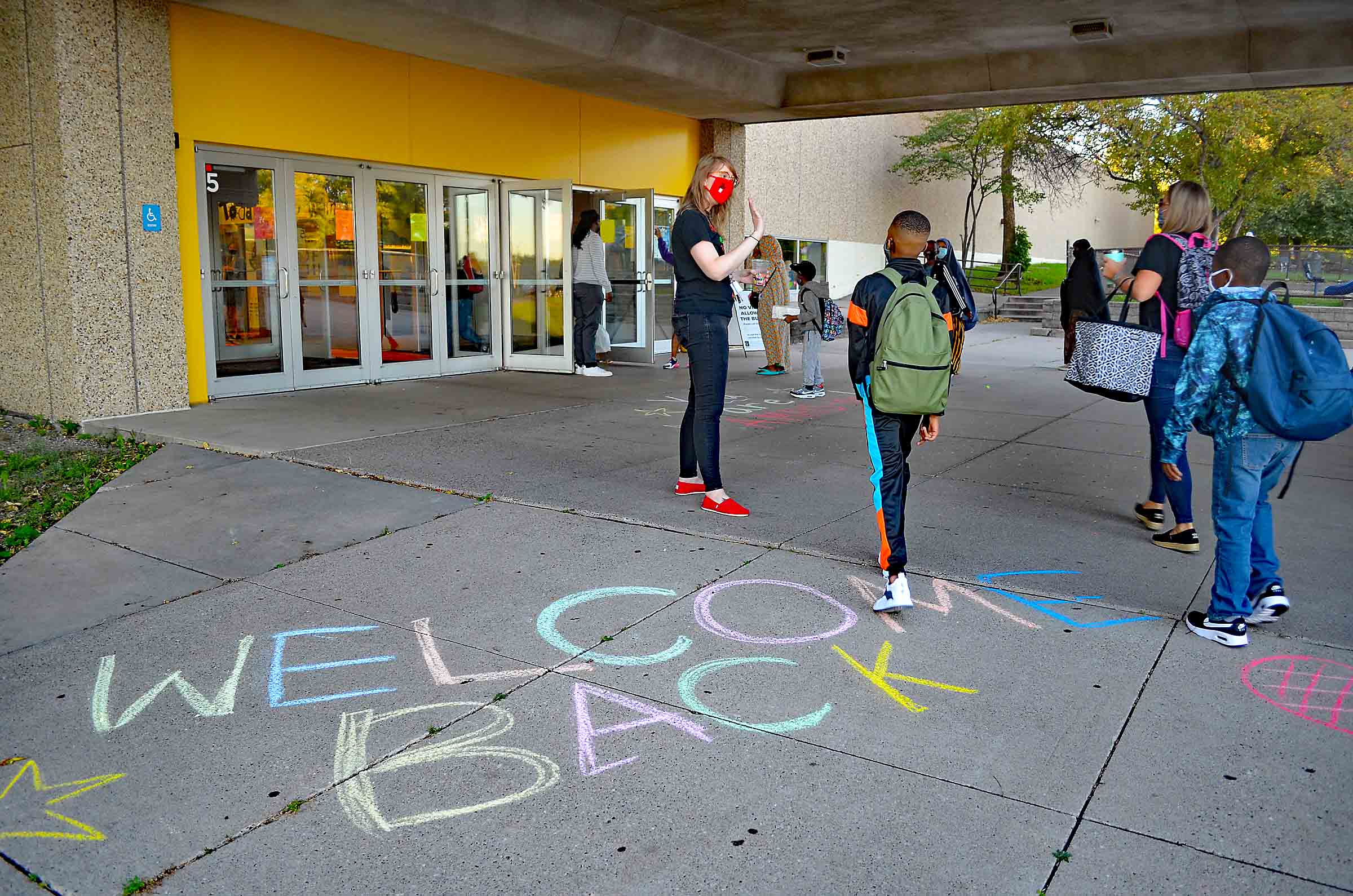
On the first day of school Benjamin E. Mays elementary school in St. Paul last year, teachers greeted returning students at with sidewalk chalk and confetti.

As public schools across Minnesota scramble to fill open positions before classes resume, union members coming back to work this fall asked families for patience, and called on school leaders to offer more incentives – financial and professional – to ease the staffing shortage.

“The working conditions in our schools have suffocated many teachers’ passion for teaching,” said Dr. Mara Borges-Gatewood, who teaches English-language learners in the White Bear Lake district. “There are just so many things being asked from us, and we can’t do them anymore.”

U.S. schools are looking to fill 300,000 positions nationwide, according to an estimate from the nation’s largest teachers’ union, the National Education Association (NEA).

It’s likely to be a rocky start to the school year for many, and Education Minnesota President Denise Specht asked for patience from parents and students.

“Take a breath and remember that the educators and staff who chose to come back this fall did so because they really care about the students and want them to succeed,” she said.

Staffing challenges hit school districts hard after the COVID-19 outbreak, but Borges-Gatewood and other school employees, speaking during a press conference today, said the issues driving workers to leave began well before the pandemic. They include unsustainable workloads, uncompetitive pay and, for hourly workers, lack of access to unemployment-insurance benefits.

Brooke Malek, a licensed school nurse in the Morris Area School District, said nurses are stretched thin across multiple school buildings, with many “leaving for better paying jobs.” Jeanne Fox, an education support professional from Osseo, said her district nickeled and dimed support staff in contract negotiations, despite piling on responsibilities – like covering for absent classroom teachers – over the last two years.

“This extra workload burnt out a lot of school support staff,” Fox said. “They’re expected to step up to the plate, but their extra effort didn’t result in more pay.”

The State of Minnesota’s projected $9.4 billion budget surplus offered lawmakers an opportunity to give school districts more funds to recruit and retain workers. But Republicans who control the Senate never took up a spending package, backed by Gov. Tim Walz and the DFL-controlled House, that would have delivered $1 billion to schools.

Lawmakers also failed to pass legislation that would extend unemployment benefits to hourly school employees in Minnesota, one of just a handful of states that bar school bus drivers, custodians, nutritional workers and others from access.

Without help from the Capitol, union members said, school districts should look for ways to collaborate with their employees to address to the staffing crisis.

Cat Briggs, a bus driver in the Rosemount-Apple Valley-Eagan district, said her union, SEIU Local 284, bargained for higher wages and a retention bonus. It also helped identify opportunities to merge part-time jobs – like crossing guard and bus monitor – into more attractive, full-time positions with benefits.

“We’re calling on every district in the state to make these jobs a career,” Briggs said. “Get all the jobs, including the starting wages, above poverty level.”

Education Minnesota’s think tank, the Educator Policy Innovation Center, released a report earlier this month analyzing firsthand accounts from educators about the challenges of working through the pandemic – and what changes are needed to keep more from leaving the profession.

Authors recommended giving educators more time to build relationships and collaborate within the school community, a greater say in school policies and more authentic opportunities for professional development.

“We can lighten loads; we can take stress off of people’s plate,” said Specht, president of the statewide educators’ union. “We can reach out to licensed staff who have chosen to walk away from teaching and ask them why, ask them what they need to come back.”

Unions decry Supreme Court ruling, urge action to protect abortion access

Minnesota’s highest-ranking union officer added to the chorus of labor voices decrying the U.S. Supreme Court ruling in Dobbs v. Jackson Women’s Health Organization, eliminating the federal right to abortion.

“Reproductive rights are workers’ rights,” Minnesota AFL-CIO President Bernie Burnham said in a public statement, calling the decision to overturn Roe v. Wade after nearly 50 years as the law of the land “a direct attack on working women and people who can get pregnant.”

Research shows people denied abortion care face increased health, wellness and financial risks as a result. Burnham noted that, in the post-Roe landscape, those risks will disproportionally impact “low-income women, black, brown, non-binary and trans workers seeking care.”

“Fortunately for working women and people who can get pregnant in Minnesota, our state Supreme Court has ruled our state constitution protects reproductive freedom and bodily autonomy,” Burnham added. “Minnesota’s unions are committed to protecting these freedoms and closing disparities through policies such as universal paid family and medical leave, affordable childcare, and creating more family-sustaining jobs.”

Leaders of several national unions, including the Service Employees (SEIU), Communications Workers of America, Office and Professional Employees (OPEIU) and American Federation of Teachers, issued similar statements in the hours following the June 24 ruling.

National AFL-CIO President Liz Shuler called the decision “a devastating blow to working women and families.”

“We strongly believe everyone should have control over their own bodies, including decisions over their personal reproductive health care,” Shuler added.

Some unions already have begun strategizing ways to use the collective bargaining process to ensure access to abortion care.

The Newsguild-CWA, which represents about 26,000 journalists and other workers in the U.S. and Canada, began holding meetings in May, after a draft of the Dobbs decision was leaked to Politico, moving quickly to “develop bargaining approaches that provide coverage for abortion care in collective bargaining agreements and to equip our membership with the tools to organize their coworkers to take action on this core labor issue.”

“Working people need access to safe, affordable abortion care just as we need quality health care generally, parental leave, childcare, and all other policies that help us support our families,” NewsGuild President Jon Schleuss said. “This is an issue that spans class, race and gender. And we should fight for it as such.”

That fight will play out in the political arena, too, as several union leaders noted.

Education Minnesota, the statewide union of nearly 90,000 educators, issued a statement from its executive board calling on unions “to harness their collective power and fight for affordable health care for all, equal pay for equal work and paid family and medical leave so workers can care for themselves or loved ones without fear of losing a paycheck.”

“That’s why this fall’s election is so important,” the statement added. “Every Minnesotan needs to be a voter to elect candidates who will defend workers’ rights – including their right to health care and bodily autonomy. We can make it happen, but only if Minnesotans do it together.”

Burnham sworn in as first person of color to lead MN AFL-CIO

Bill McCarthy administers the oath of office to Bernie Burnham.

In a ceremony broadcast live on the federation’s social media platforms, outgoing Minnesota AFL-CIO President Bill McCarthy swore his successor, Bernie Burhnam, into the state’s highest-ranking union office today.

“Every Minnesotan deserves the best opportunity in life, no matter where they live, what they look like, who they love, where and how they worship and even how they vote,” Burnham said in remarks after taking the oath of office. “I promise to do my very best work with you and for you in achieving the goals of our Minnesota AFL-CIO strategic plan, ensuring well-paying jobs which will strengthen our communities and, finally, raising the voices of all working people and their families.”

McCarthy, a longtime member of UNITE HERE Local 17, has retired after more than six years as president of the state federation of labor unions, representing more than 300,000 working people.

The federation’s General Board voted unanimously in December to elect Burnham, a former Duluth elementary teacher and member of Education Minnesota. She is the federation’s 10th president and, as a Pacific-Islander, the first person of color elected to the office.

Burnham pledged to carry forward the Minnesota AFL-CIO’s racial-equity and diversity work, both internally and in the community at large. She has co-chaired the federation’s Committee on Racial and Economic Justice for the last two years.

“I am committed to broadening our understanding of one another’s members, our unions and other organizations,” Burnham added. “We must stay united against the forces that try to divide us.”

Burnham also pointed to recent workforce data showing Minnesota’s union membership is growing, and she called on unions across the state to work together, in partnership with the federation, to keep that momentum going.

“Let’s work to keep growing,” she said. “One-to-one conversations, mentorship, increasing and supporting apprenticeship programs in our schools – these are some of the ways we will make this happen.”

Burnham taught for 14 years in the Duluth Public Schools and was elected president of the Duluth Federation of Teachers. Members of Education Minnesota elected her the statewide vice president in 2019.

Burnham is a dues-paying member of the Asian Pacific American Labor Alliance, which released a statement celebrating her swearing-in. Jigme Ugen, the APALA’s state president and executive vice president of SEIU Healthcare Minnesota, called it a “historic and exciting moment” for the local labor movement.

“Besides being the first person of color and AAPI to be elected president of the MN AFL-CIO, Bernie brings decades of union membership with diverse experiences around racial and social justice at the local and national level,” Ugen said. “She is an inspiring choice to lead our labor movement into the future.”

Bill McCarthy (L), Bernie Burnham and Brad Lehto

Burnham will serve alongside Secretary-Treasurer Brad Lehto, who has held office since 2018. Both officers’ terms run until the next Minnesota AFL-CIO convention, planned in September.

McCarthy, meanwhile, enters retirement after 36 years in the labor movement, a career that began as a bartender at Cleo’s Lounge on the 50th floor of the IDS Tower in downtown Minneapolis.

He rose through the ranks and served 15 years as president of Local 17, the Twin Cities hospitality union, before a successful run for president of the Minneapolis Central Labor Council in 2002. McCarthy won election as state AFL-CIO president in 2015.

The outgoing president thanked his staff, the federation’s board members and its affiliate unions for their support, and said the federation is “positioned well” for the transition.

“I want to congratulate President Burnham on her history making achievement and wish her all the best in leading Minnesota’s Labor Movement,” McCarthy said. “The Minnesota AFL-CIO is in good hands with an exceptional leader in the fight to build a more just and equitable state.”

Burnham to succeed McCarthy as Minnesota AFL-CIO president

Bill McCarthy and Bernie Burnham

The Minnesota AFL-CIO General Board today elected Bernie Burnham as the statewide labor federation’s next president. The former Duluth teacher, who currently serves as Education Minnesota’s vice president, will succeed Bill McCarthy, who plans to retire Feb. 1 after more than six years in the state’s top union office.

The Minnesota AFL-CIO represents over 300,000 union members across the state. The federation supports more than 1,000 affiliate unions in their efforts to build worker power through contract and organizing campaigns, as well as the political process.

As a Pacific-Islander, Burnham is the first person of color elected to an executive office at the Minnesota AFL-CIO, and the second woman elected president. The vote was unanimous.

Burnham became active in the Duluth Federation of Teachers after taking an elementary teaching job 22 years ago and quickly. She served as a steward and member of the union’s racial equity teams, and on the district’s labor-management committee.

“I was a woman of color who took an unconventional route into the teaching profession,” Burnham said. “I didn’t know if I would be accepted, but my new union family embraced me.”

DFT members elected Burnham vice president in 2010 and president in 2013. She successfully ran for vice president of Education Minnesota in 2018.

In campaigning for state AFL-CIO president, Burnham pointed to her experience working in coalition with other unions to boost political activism and to elevate racial justice as an area of focus in the labor movement.

“It’s an honor and privilege to be elected to this office,” she said. “I am committed to continuing the labor movement’s fight for a state where everyone earns a fair return on their work, where every child can pursue their dreams and where every family that’s struggling today will get what they need, things like accessible healthcare, modern roads and bridges, safe housing and world-class schools.”

Burnham is co-chair of the Minnesota AFL-CIO Racial and Economic Justice Committee, which has taken a prominent role in the work of the federation during McCarthy’s time in office.

In an interview last week, McCarthy called the May 2020 murder of George Floyd by Minneapolis police officer Derek Chauvin a turning point. “We just couldn’t stand by and not do anything,” McCarthy said.

Within a month, McCarthy had issued statements calling on the president of the Minneapolis police union to resign and affirming the Minnesota AFL-CIO’s commitment to “dismantling systems of oppression” inside and outside the labor movement.

“These are tough, hard issues, and we’ve just got to keep at it,” McCarthy said. “And I know we’ve failed along the way. We’ve made mistakes. But we cannot be a labor movement that’s effective in any way if we’re not working on social and racial justice issues.”

McCarthy’s accomplishments also include overseeing political programs that thwarted a wave of attacks on union rights at the state level. While anti-union lawmakers were passing right to work and repealing prevailing wage in Wisconsin and other Midwest states, pro-union lawmakers in Minnesota were passing the nation’s strongest wage theft protection law.

Minnesota unions were in better position to advocate for emergency protections after the COVID-19 pandemic hit, too. Under McCarthy’s leadership, the Minnesota AFL-CIO pushed Walz to issue an executive order protecting workers who speak up about unsafe conditions, and fought at the Capitol for expanded unemployment and workers comp.

“Thank God for Gov. Walz,” McCarthy said. “Here’s a man who, I think, really understood what the workers were going through, especially our frontline workers. We asked him to do certain things, to create executive orders to support workers – and he agreed.”

McCarthy also pointed to the expanded work of the federation’s nonprofit, the Minnesota Training Partnership, as a focal point of his presidency. The organization has leveraged grant funding to support Minnesota unions and their apprenticeship programs, helping prepare tradespeople, window washers, manufacturing workers and others for family-sustaining jobs.

“The more we’re supporting our affiliates, the bigger they’re going to be able to grow their unions,” McCarthy said.

A longtime member of UNITE HERE Local 17, the hospitality workers’ union, McCarthy first ran for union office 36 years ago, when he was tending bar at Cleo’s Lounge on the 50th floor of the IDS Tower in Minneapolis.

From there, McCarthy’s rise through the labor ranks began. After taking a job as business agent, McCarthy successfully ran for president of Local 17, a title he held for 15 years before being elected president of the Minneapolis Central Labor Council (now known as the Minneapolis Regional Labor Federation) in 2002. He was seated as state president in 2015.

“I feel like I’ve left the organization in a good place,” he said. “We have a strong team, one of the best teams I’ve worked with. Whoever moves into the leadership role is going to have an opportunity to make it better.”

General Board members voted to name McCarthy president-emeritus for his career of service to Minnesota’s labor movement.

Essential workers tell lawmakers: Minnesotans support emergency leave

Bill Schwandt, an paraprofessional educator in the Bloomington schools, speaks at a press conference in support of emergency paid leave for essential workers.

Thousands of essential workers in Minnesota have lost hours or exhausted their paid time off after being exposed to the coronavirus over the past 15 months, while a measure that would make them whole remains caught up in Capitol gridlock.

That needs to change, according to more than 5,000 nurses, janitors, educators, child care workers and other Minnesotans who signed onto a petition in support of the Essential Workers Emergency Leave Act.

Union members delivered the petitions to Gov. Tim Walz and legislative leaders today after holding a press conference on the Capitol steps.

“We deserve more than nice words, pats on the back and hearty handshakes,” said Bill Schwandt, a paraprofessional in the Bloomington schools and member of Education Minnesota. “We deserve to be remembered, respected and, yes, compensated for the work that we did.”

Lawmakers are scrambling to negotiate the particulars of a $52 billion, two-year budget by the end of the month. The budget taps into federal relief funds that, as several workers pointed out, should prioritize support for essential workers, according to guidance from the Department of Treasury.

Emergency leave for time lost would help workers like Eva Lopez, a local janitor, regain their footing. Lopez is vice president of Service Employees (SEIU) Local 26, which represents janitors and security guards in the Twin Cities, and she said over 1,000 members of her union have missed work to quarantine or wait for test results.

“Most don’t make enough to have big savings accounts, and we can never work from home,” Lopez said via a translator. “This year has been so hard.”

Minnesota Nurses Association President Mary Turner, an intensive care nurse at North Memorial hospital in Robbinsdale, said members of her union have “dipped into their savings, their retirement, their 401(k)” plans to pay their bills while riding out quarantine.

The financial strain many health care workers are facing, Turner added, has only added to the stress of providing care through a crisis that has resulted in over 7,500 deaths statewide.

“We aren’t asking for a handout,” Turner said. “What we are asking for is justice.”

Turner and Troy Bowman, a Minneapolis custodian who had to quarantine twice in the last year, delivered copies of the petition to Walz, who has pledged support for the measure, and Sen. Erin Murphy (DFL-St. Paul), a lead author of the bill.

The DFL-controlled House included funding for emergency leave in its jobs bill last month, but Republicans in control of the Senate did not. Murphy, a registered nurse, promised to bring the petition to Senate Majority Leader Paul Gazelka’s attention, and thanked essential workers for their service to Minnesota during the pandemic.

“You went to work, you took care of us, you kept us alive, you kept us healthy and you kept our economy going,” she said.